Search This Blog

Showing posts with label Angela Merkel. Show all posts

Friday, 18 May 2018

Trump Gives Merkel An Ultimatum: Drop Russian Gas Pipeline Or Trade War Begins

Zero Hedge

It became clear just how important it is to the US for Russia's Nord Stream 2 gas pipeline project to fail two months ago when, as we described in "US Threatens Sanctions For European Firms Participating In Russian Gas Pipeline Project", the U.S. State Department warned European corporations that they will likely face penalties and sanctions if they participate in the construction of Russia's Nord Stream 2 on the grounds that "the project undermines energy security in Europe", when in reality Russia has for decades been a quasi-monopolist on European energy supplies and thus has unprecedented leverage over European politics, at least behind the scenes.

As many people know, we oppose the Nord Stream 2 project, the US government does,” State Department spokeswoman, Heather Nauert said during a late March press briefing adding that "the Nord Stream 2 project would undermine Europe's overall energy security and stability. It would provide Russia [with] another tool to pressure European countries, especially countries such as Ukraine." And speaking of Ukraine, recall that in 2014, shortly after the US State Department facilitated the presidential coup in Ukraine, Joe Biden's son Hunter joined the board of directors of Burisma, Ukraine's largest oil and gas company. Surely that was merely a coincidence.

Nauert also said that Washington may introduce punitive measures against participants in the pipeline project - which could be implemented using a provision in the Countering America's Adversaries Through Sanctions Act (CAATSA).

Fast forward to today, when the dreadfully named CAATSA act just made a repeat appearance; around the time Europe made it clear it would openly defy Trump's Iran sanctions, the WSJ reported that Trump told Merkel that if she wants to avoid a trans-Atlantic trade war, the price would be to pull the break on Nord Stream 2, according to German, U.S. and European sources.

Read more

Sunday, 24 September 2017

German elites prepare Russian hacking claim in case elections don't go their way - ex-MI5 officer

RT

The German national character is risk-averse: stability, prosperity and security tend to be the things Germans would vote for. And if Merkel is perceived to deliver them, she will remain in power, says former MI5 intelligence officer Annie Machon. 
 
While Germans are casting their votes for members of parliament, who will occupy at least 598 seats in the Bundestag for the next four years, Chancellor Angela Merkel and her ruling Christian Democrat/Christian Social Union alliance are favored to win the German parliamentary elections.

RT spoke to former UK intelligence officer Machon to discuss this issue.   

RT: There was much scare-mongering about possible Russian meddling in the German election, of which not a trace has been detected. Why was this made a big issue?

Annie Machon: I am not at all surprised that Russia is being accused yet again of trying to hack or interfere in an election in a Western country. It seems to be a sort of fashion of this year and last year. I think it is interesting, though, every time the elites of whichever country feels that there might be some sort of populist revolt or vote against what the elites think they should be voting for, they almost pro-actively say, ‘There must be Russia interfering in these elections’ because they might get the result they don’t want. But it is crazy because we have seen time and again, there is no evidence of Russian hacking. There were assertions about Brexit, there were assertions in France. Emmanuel Macron during the election said, ‘We’ve been hacked.’ And then the French intelligence agencies went off to investigate and said, ‘There is no evidence of hacking.’ Similarly, we’ve seen Merkel in the run-up to the federal election saying, ‘They are going to hack German elections, too.’ So, she sent off the BND and BFV to investigate and they came back saying, ‘There is absolutely no evidence of Russian hacking.’ Merkel wanted a different result and told them to go and find different information. This is how crazy it is getting. As soon as any powers in any Western country think, ‘Actually, we might not get a result we want, let’s blame the Russians.’ And they are doing that preemptively now as well. It is ridiculous.

Read more

Saturday, 30 July 2016

Brexit increasing tensions in Franco-German relations


Finian Cunningham
Strategic Culture Foundation


Berlin and Paris have long been seen as the main political drivers for the European Union project. When Britain voted last month to quit the 28-member bloc, it was German Chancellor Angela Merkel and French President Francois Hollande to whom the leadership role beckoned for rallying a 'united Europe' and defending the core concept of the EU.

However, this circling of wagons by the EU's top two nations is prone to debilitating competing nationalist interests. And those diverging interests will tend to undermine the much-heralded unity of purpose between Berlin and Paris. What we can expect, in the aftermath of the Brexit, is increasing tensions between Germany and France that could, in turn, lead to further fracturing of the EU.

Already a notable divergence of positions has emerged. When Britain's new Conservative Prime Minister Theresa May embarked on her first foreign visit last week she was scheduled to meet Chancellor Merkel in Berlin, followed the next day by a reception with President Hollande at the Élysée Palace, Paris. May had to wait until the evening on the second day to be received by Hollande who had earlier that same day gone on an official visit to the Republic of Ireland. His strange absence looked like Hollande was sending the British leader a sly snub.

More substantively was the contrasting German and French positions on the Brexit process. The British premier had announced that there would be no formal commencement of Britain's departure from the EU until early next year. Britain, said May, needed to formulate suitable economic terms with the EU before it would sign Article 50 of the 2007 Lisbon Treaty, thus triggering the exit process.

On this delayed departure from the EU by Britain, the German chancellor appeared to be in comfortable agreement with her British counterpart. Merkel said she understood the importance for Britain to obtain economic matters in order.

By contrast, Hollande reportedly adopted a much more vexed attitude, demanding 'the sooner the better' Britain leaves the EU. While the French president appeared to soften his hardline stance on meeting May, he nevertheless continued to express his government's frustration with Britain. Speaking alongside the British leader, Hollande said that Britain cannot continue to avail of the single market while imposing restrictions on freedom of movement.
This differing position between Berlin and Paris towards the Brexit was apparent immediately following the British referendum result. The French have been pushing a policy for more abrupt termination in Britain's membership of the EU compared with the Germans.

Read more
 

Thursday, 30 June 2016

MERKEL’S WORST NIGHTMARE: Germany calls for Referendum as ‘people want to be free of EU

Express UK 


Far right figures in Alternative for Germany have promised to call their own vote if they clutch power in country’s general election in autumn next year. 

A party spokesman branded Brussels a “bureaucracy monster”, before adding: “Next year the AfD will enter the German parliament and Dexit will be top on our agenda”.

They called the vote a Dexit as it stands for a Deutschland exit from the EU.

Eurosceptism has swept across the continent after the people of Britain backed Brexit in the historic EU referendum on June 23.

Party leader Frauke Petry, who caused controversy earlier this year when she called on German police to open fire on illegal immigrations, reacted with delight at Britain’s decision to sever ties with Brussels.

She said: “This is the chance for a new Europe, one which maintains partnerships and respected national sovereignties.

“The Great Britain decision to leave the EU is a signal to the Brussels Politburo and its bureaucratic attachments. If the EU does not finally leave its wrong path, and the quasi-socialist experiment of deeper political integration, more European Nations will reclaim their sovereignty the way British are.”

Read more

Monday, 26 October 2015

"If We Don't Find A Solution Today, It's The End Of The European Union" - Refugee Crisis Hits Tipping Point

Zero Hedge

After escalating for months, Europe's refugee crisis hit its most serious tipping point yet, when when earlier today European Union leaders held a mini-summit on Sunday debating whether to send hundreds of guards to its borders with the western Balkans, as well as deploying more ships off Greece, as the bloc seeks to balance Germany's welcome for refugees with tougher security measures.

So far, over 680,000 migrants and refugees have crossed to Europe by sea so far this year, fleeing war and poverty in the Middle East, Africa and Asia, according to the International Organization for Migration. Their goal has been Germany, which has promised sanctuary, however as a result of a populist backlash and concerns over the economy, Merkel's popularity has taken a major hit, sliding to the lowest level in four years.

Taking place just two weeks after a full EU summit, the meeting was sought by German Chancellor Angela Merkel. According to Reuters, "many see it as an attempt by Juncker and Merkel to raise pressure on central and southeast European states to coordinate among themselves in managing the migration flow in a more humane way and end a series of unilateral actions."

[...]

AIG's explanation: "To use global issues as excuses to extend its power"
  • environmental issues: increase control over member countries; advance idea of global governance
  • terrorism: use excuse for greater control over police and judicial issues; increase extent of surveillance
  • global financial crisis: kill two birds (free market; Anglo-Saxon economies) with one stone (Europe-wide regulator; attempts at global financial governance)
  • EMU: create a crisis to force introduction of “European economic government”
And there it is: in four simple bullet points laid out in a 7 year old presentation, a prediction which has come true time and again: from the endless Greek bailouts, to the austerity paradox, to European youth unemployment stubbornly flat at 50% for years in many "southern" European nations, to Europe's QE creating the deflationary impulse it is said to be fighting against, and now - to the "refugee crisis", it is all playing out as if according to some unseen script.

Read more

Thursday, 13 August 2015

What crisis? Germany made 100 BILLION euros from Greek suffering


© Associated Press
Sputnik
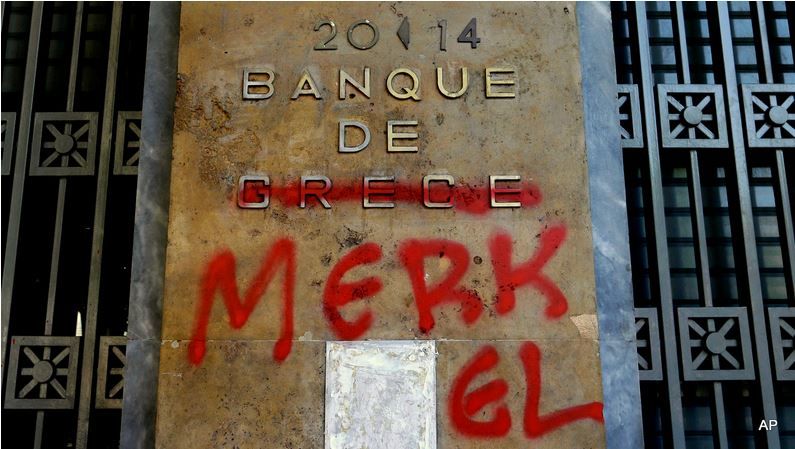
Red spray paint covers a French-language Bank of Greece sign to read ‘Bank of Merkel’ in reference to German Chancellor Angela Merkel in Athens, Monday, July 6, 2015.
The German government, which has taken a hard line on Greece, has saved some 100 billion euros ($109 billion) in the country's financial crisis thanks to lower borrowing costs, a study has found.

Germany saved through lower interest payments on funds the government borrowed amid investor "flights to safety," the German-based non-profit Halle Institute for Economic Research (IWH) said in its paper published Monday. 


"These savings exceed the costs of the crisis - even if Greece were to default on its entire debt," the study said. "Germany has clearly benefited from the Greek crisis."

In the face of turmoil, investors seeking a safe haven for their money within the euro zone turned to export champion Germany, which "disproportionately benefited" from that during the debt crisis, the IWH said.

"Every time financial markets faced negative news on Greece in recent years, interest rates on German government bonds fell, and every time there was good news, they rose."

Germany, the euro zone's effective paymaster, has demanded fiscal discipline and tough economic reforms in Greece in return for consenting to new aid from international creditors, Agence France-Presse reported.

Finance Minister Wolfgang Schaeuble has opposed a Greek debt write-down while pointing to his own government's balanced budget.

The balanced budget, however, was facilitated largely by Germany's interest savings amid the Greek debt crisis, according to the study. The estimated 100 billion euros Germany saved since 2010 accounted for more than 3% of GDP, according to the IHW.

"Even if Greece doesn't pay back a single cent, the German public purse has benefited financially from the crisis," said the paper.

At the same time, the bonds of other countries - including the United States, France and the Netherlands - also benefited, but "to a much smaller extent."

Greece and its creditors are working on the draft of a new bailout of up to 86 billion euros ($94 billion) in exchange for further reforms, AFP reported. They are aiming for a deal before Greece must repay 3.4 billion euros to the European Central Bank on August 20. 

Sunday, 23 March 2014

Sanction me baby one more time

Asia Times Online
Pepe Escobar

If we come to a minefield, our infantry attacks exactly as if it was not there - Marshal Georgy Zhukov

Let's start with the serious stuff. As Russia's Federation Council ratifies a treaty with Crimea, concluding the formal annexation, Ukraine signs the political chapters of an association agreement with the European Union (EU). The signing of the full EU agreement will only happen later in 2014.

These are the facts on the ground. Now let's turn to comedy hour - also known as the sanctions war.

The oh-so democratic EU has punished the democratic Crimea


referendum by sanctioning 33 Russians and Crimeans with asset freezes and travel bans, according to that Magritte-style walking fiction, European Council President Van Rompuy. The EU also canceled the EU-Russia summit in Sochi on June 3. And the vast, Kafkaesque bureaucracy of the European Commission (EC) has taken time out from subsidizing European cows to prepare for "possible economic sanctions", according to German Chancellor Angela Merkel.

The EU is irretrievably split on what to do. Whatever it does, Moscow's capacity to make the EU badly hurt is stronger. There may be another meek set of sanctions next week, as Merkel advertised. But that's it.


Read more

Related Posts Plugin for WordPress, Blogger...