Search This Blog

Showing posts with label JP Morgan. Show all posts

Tuesday, 19 March 2019

JPMorgan Managing Director Dies Suddenly; Has Links to Other JPM Deaths

Pam Martens
Wall St. On Parade

When you are the largest bank in the United States and you’ve been compared to the Gambino crime family in a book by two trial lawyers; when you’ve pleaded guilty to three criminal felony counts brought by the United States Justice Department in the past five years; when you’ve paid over $30 billion in fines over charges of crimes against the public and investors since 2008; and when you’ve had an unprecedented string of employees leaping to their death from buildings, dropping dead at home or on the street, and two alleged murder-suicides by employees — all in just the past five years – one might think that law enforcement might show some interest – especially since this employer – JPMorgan Chase – holds tens of billions of dollars of Bank-Owned Life Insurance (BOLI) on its workers. (This death benefit, by the way, pays tax-free to the corporation, not the employee’s family.)

But when it comes to JPMorgan Chase and law enforcement, there does not seem to be a morsel of curiosity over the continuing sudden deaths of its computer technology workers – no matter how high up the corporate ladder they rank or how many floors they are alleged to fall to their death.

Take the case of Douglas (Doug) Arthur Carucci, age 53, who died on Saturday, March 9 under what Sarah Butcher at eFinancial Careers calls “tragic” and unexpected circumstances. Carucci is believed to have been a resident of Manhattan with his wife, Cindy.

We called the New York City Police Department and were told they had no information in their database about the death of a Douglas Carucci in March 2019. We next emailed the New York City Medical Examiner’s office – which is mandated under law to investigate all deaths from accidents or sudden deaths. Aja Worthy-Davis, the Executive Director for Public Affairs of the Medical Examiner’s Office responded as follows:

“There is no OCME record of this individual (under the name shared). Please keep in mind that the OCME does not investigate (or keep records of) all deaths within the City of New York. The OCME is specifically responsible for investigating only NYC-based deaths occurring from criminal violence, by accident, by suicide, or in any unusual or suspicious manner.”

Read more

Sunday, 17 June 2018

"The Global Bond Curve Just Inverted": Why JPM Thinks A Market Crash May Be Imminent

Comment: Yeah, well, we've heard similar things before...And yet, it all lumbers on...

-----------------------

Zero Hedge

At the beginning of April, JPMorgan's Nikolaos Panigirtzoglou pointed out something unexpected: in a time when everyone was stressing out over the upcoming inversion in the Treasury yield curve, the JPM analyst showed that the forward curve for the 1-month US OIS rate, a proxy for the Fed policy rate, had already inverted after the two-year forward point. In other words, while cash instruments had yet to officially invert, the market had already priced this move in.

One way of visualizing this inversion was by charting the front end between the 2-year and 3-year forward points of the 1-month OIS. Here, as JPM showed two months ago, a curve inversion had arisen for the first time during the first week of January, but it only lasted for two days at the time and the curve re-steepened significantly in the beginning of April.

Read more

Thursday, 10 May 2018

Nomi Prins: Collusion! How central bankers rigged the world

Adam Taggert
Peak Prosperity

Nomi Prins, Wall Street veteran turned financial industry reformist returns to the podcast this week to explain the findings within her new book Collusion: How Central Bankers Rigged The World. 

Nomi has put together a timeline of exactly when and how the central banks have plundered the wealth of the masses since 2008, either directly or indirectly through the loss of purchasing power of the currencies they control:
The relationship between the Central Banks, the major ones — the Fed, Europe Central Bank, Bank of Japan — all the larger Central Banks in the world and their private banks was effectively, and is effectively, kept secret. The relationships they have with each other, a lot of it is secret; so you have to really dig in to it to find out what’s really going on.
What I did was dig into the documents that I could find and create a timeline. That’s why each chapter in each region starts in 2008. It works with Mexico, Brazil, Japan, China and Europe and juxtaposes that with what the Fed was doing at that time to see how that collusive behavior wound up happening. The secret-ness is in the relationships of the banks, where that money that was fabricated by these institutions actually went, and when — or if — it’s coming back.
The ‘cheat and deceiving’ part of that definition is also apparent: people have been cheated out of their futures from the standpoint of the central banks’ strategies. So when the Feds creates cheap money, companies and banks and countries borrow more from the future because it is so cheap and easy. This deceives many people into thinking that the economy is somehow therefore being helped by this strategy, which is in acutality an emergency strategy. It’s an emergency that’s gone on now for ten years.
Yes there have been some tweaks here and there — interest rates have gone up a little bit in the United States — but all in all, rates are still pretty much 0% on average globally and quantitative easing still exists. The books of the major Central Banks are as big as they were at their heights through this last ten-year period…and they’re still growing. Just look at Europe and Japan.
Look at the stock market. The stock market is really high right now in a lot of different places. Why is it so high? Because a lot of this money went into debt which was borrowed to buy corporate stock, to buy the stock of banks, or to buy the banks themselves. That’s a major form of manipulation and deception as well.
Why is JP Morgan’s stock going up? Is it just because JP Morgan is such a great bank and so helping? Well, no. It’s because it received a lot of help from the Federal Reserve. It funneled that help into its own shares, and it has continued to pay settlements and be fined on egregious activity against its own clients, which are many because it’s the largest bank in the United States among the largest banks in the world.
There are multiple points of cheating and deception that have been enabled or that occur because of Central Banks policies. Some of those policies are secret; but a lot of them are public. You just have to piece the documents and the timelines together.
Read more

Wednesday, 22 June 2016

Banks opting to scan fingers and faces for account access

Michael Corkery
AP


The banking password may be about to expire — forever.

Some of the nation's largest banks, acknowledging that traditional passwords are either too cumbersome or no longer secure, are increasingly using fingerprints, facial scans and other types of biometrics to safeguard accounts.

Millions of customers at Bank of America, JPMorgan Chase and Wells Fargo routinely use fingerprints to log into their bank accounts through their mobile phones. This feature, which some of the largest banks have introduced in the last few months, is enabling a huge swath of the American banking public to verify their identity with biometrics. And millions of additional customers are expected to opt in as more phones incorporate fingerprint scans.

Other uses of biometrics are also coming online. Wells Fargo lets some customers scan their eyes with their mobile phones to log into corporate accounts and wire millions of dollars. Citigroup can help verify 800,000 of its credit card customers by their voices. USAA, which serves members of the military and their families, identifies some of its customers through their face contours.

Some of the moves reflect concern that so many hundreds of millions of email addresses, phone numbers, Social Security numbers and other personal identifiers have fallen into the hands of criminals, rendering those identifiers increasingly ineffective at protecting accounts.

"We believe the password is dying," said Tom Shaw, vice president for enterprise financial crimes management at USAA, which is based in San Antonio. "We realized we have to get away from personal identification information because of the growing number of data breaches."

Long regarded as the stuff of science fiction, biometrics have been tested by big banks for decades, but have only recently become sufficiently accurate and cost effective to use in a big way. It has taken a great deal of trial and error: With many of the early prototypes, a facial scan could be foiled by bad lighting, and voice recognition could be scuttled by background noise or laryngitis.

Before smartphones became ubiquitous, there was an even bigger obstacle: To capture a finger image or scan an eyeball, a bank would have to pay to distribute the necessary technology to tens of millions of customers. A few tried, but their efforts were costly and short-lived.

Today, the equation has changed. Many models of the iPhone have touch pads that can scan fingerprints. The cameras and microphones on many mobile devices are so powerful that they can record the minute details needed to create a biometric ID. 


Read more
 

Sunday, 2 August 2015

Israel behind JP Morgan cyber attack, 83 million customers data stolen

Hang the bankers

U.S. and Israeli authorities arrested four people in Israel and Florida on Tuesday in connection with several fraud schemes tied to last summer’s massive data breach at JPMorgan Chase & Co, according to news reports.

The hacking of JPMorgan’s computers compromised information in 83 million household and small business accounts, making it one of the largest such breaches in history.

Federal prosecutors in New York confirmed the four arrests but did not mention the breach, and charging documents unsealed on Tuesday did not refer to the hack. Bloomberg was the first news outlet to report the connection.

The New York Times reported that federal authorities had identified some of the JPMorgan hackers because the attack was relatively unsophisticated but authorities were unable to collect enough evidence to charge anyone with the breach itself.

Read more

Wednesday, 18 February 2015

Something Huge Is Happening! Over 40 Bankers Dead Since 2014: Latest Banker Death Connected To JP Morgan VP

Susan Duclos
All News PipeLine

Since the beginning of 2014, over 40 bankers have died, and while the reports of the circumstances of their deaths, suicides, accidents, natural causes, etc... do not imply any wrongdoing, the sheer number over a 14 month span, seems to contradict the official story line.

The list just got longer with this report showing that investment banker, 32 year-old Kate Matrosova, was found dead in the New Hampshire mountains on Monday. Matrosova was dropped off on Sunday night by her husband, whom the Daily Mail names as Charlie Farhoodi. According to a LinkedIn profile for the name Charlie Farhoodi, he is listed as a Vice President of JP Morgan. (Screen shot shown below)

JPMorganVP.jpg


The connection is solid as on Matrosova's Facebook page, there is a photo album titled "Charlie and my girls," which provides pictures of Mr. Farhoodi, one of which is shown below.

JPMORGANVPFBPHOTO.jpg

The prior 36 banker deaths from 2014, found at ZeroHedge, shown below:
 
1) David Bird, 55, long-time reporter for the Wall Street Journal working at the Dow Jones news room
2) Tim Dickenson, a U.K.-based communications director at Swiss Re AG  
3) William Broeksmit, 58, former senior manager for Deutsche Bank
4) Ryan Henry Crane, age 37, JP Morgan
5) Li Junjie, 33, Hong Kong JP Morgan
6) Gabriel Magee, 39, age JP Morgan employee
7) Mike Dueker, 50, who had worked for Russell Investments
8) Richard Talley, 57, was the founder and CEO of American Title (real estate titles)  
9) James Stuart Jr. 70, Former National Bank of Commerce CEO was found dead in Scottsdale, Ariz  
10) Jason Alan Salais, 34 year old IT Specialist at JPMorgan since 2008  
11) Autumn Radtke, 28, CEO of First Meta, a Singapore-based virtual currency trading platform  
12) Eddie Reilly, 47, investment banker, Vertical Group, New York  
13) Kenneth Ballando, 28, investment banker, Levy Capital, New york  
14) Joseph A. Giampapa, 55, corporate bankruptcy lawyer, JP Morgan Chase  
15) Jan Peter Schmittmann, 57, voormalig topbestuurder ANB/AMRO, Laren, Nederland  
16) Juergen Frick, 48, CEO Bank Frick & Co AG, Liechtenstein  
17) Benoît Philippens, 37, directeur BNP Parisbas Fortis Bank, Ans, België.  
18) Lydia…, 52, bankier Bred-Banque-Populaire, Parijs  
19) Andrew Jarzyk, 27, bankier, PNC Bank, New York  
20) Carlos Six, 61, Hoofd Belastingdienst en lid CREDAF, België  
21) Jan Winkelhuijzen, 75, Commissaris en Fiscalist (voormalig Deloitte), Nederland. 22) Richard Rockefeller, 66, achterkleinzoon elitebankier John D. Rockefeller, Amerika  
23) Mahafarid Amir Khosravi (Amir Mansour Aria), 45, bankeigenaar, zakenman en derivatenhandelaar, Iran  
24) Lewis Katz, 76, zakenman, advocaat en insider in de bancaire wereld, Amerika  
25) Julian Knott, Directeur Global Operations Center JP Morgan, 45, Amerika  
26) Richard Gravino, IT Specialist JP Morgan, 49, Amerika  
27) Thomas James Schenkman, Managing Director Global Infrastructure JP Morgan, 42, Amerika  
28) Nicholas Valtz, 39, Managing Director Goldman Sachs, New York, Amerika  
29) Therese Brouwer, 50, Managing Director ING, Nederland  
30) Tod Robert Edward, 51, Vice President M & T Bank, Amerika  
31) Thierry Leyne, 48, investeringsbankier en eigenaar Anatevka S.A., Israël 
32) Calogero Gambino, 41, Managing Director Deutsche Bank, Amerika 
33) Shawn D. Miller, 42, Managing Director Citigroup, New York, Amerika 
34) Melissa Millian, 54, Senior Vice President Mass Mutual, Amerika  
35) Thieu Leenen, 64, Relatiemanager ABN/AMRO, Eindhoven, Nederland  
36) Geert Tack, 52, Private Banker ING, Haaltert, België

Since the beginning of 2015, the bank deaths have continued, with  1) Michael Flanagan, 45, head of Foreign Exchange, National Australia Bank, London, England 2) Omar Meza, 33, Vice President, AIG, Los Angeles, America 3) Chris van Eeghen, 42, Head of Syndicate and Corporate Finance Markets, ABN / AMRO, Amsterdam, The Netherlands.

Those were as of January 24, 2015.

On February 6, 2015, yet another two bankers were killed, reported here at ANP. Those two were  
1) Aditya Tomar  
2)  Eric Vandercar.

By February 9, 2015, another banker and his wife were dead, supposedly Michael A. Tabacchi, 27, listed as a JPMorgan Chase & Co. employee strangled and stabbed his wife to death before turning the knife on himself.

According to some, that list is even longer than those named above.

Even for those that believe that a stream of coincidences such as well over 40 bankers all dying in such rapid succession, when you add to that knowledge that back in February 2014, when there were less than a handful of deaths, Steve Quayle brought to our attention that there was a hitlist and it included over 3 dozen names, a larger, more disturbing picture emerges.

Something huge is happening here and as the first video below asks, could this all have to do with an upcoming economic collapse and the chaos that would assuredly follow?
 

Monday, 9 February 2015

Another JPMorgan Banker Dies After Murder-Suicide: Chokes Wife, Stabs Himself To Death

Zero Hedge
 
By now, there have been so many banker-related suicides that it has become a moot point of i) tracking them all or ii) trying to find a pattern. And yet, one name continues to stand out: 

JPMorgan.

The bank which has been most prominent among the list of "suicided" bankers notched one more casualty over the weekend when "a JPMorgan Chase & Co. employee strangled and stabbed his wife to death before turning the knife on himself, according to police who are treating the couple’s death in Bergen County, New Jersey as a murder-suicide." 

But most eerie and disturbing is how comparable the Tabacchi double-death is to a comparable case from July of last year when as we reported not only did a JPM executive director shoot his wife multiple times before using the same weapon on himself (like now), but the tragedy also took place in New Jersey.

Read more 
 

Monday, 8 December 2014

Another banker found dead under questionable circumstances

Zerohedge

52-year-old Belgian Geert Tack - a private banker for ING who managed portfolios for wealthy individuals - was described as 'impeccable', 'sporty', 'cared-for', and 'successful' and so as Vermist reports, after disappearing a month ago, the appearance of his body off the coast of Ostend is surrpunded by riddles... Tack disappeared on November 5th...

Impeccable. Sporty. Cared for. Successful. Just some qualifications that are attributed to the 52-year-old from the Belgian Geert Tack Haaltert.

Geert Tack worked as a private banker for ING and managed portfolios of wealthy clients. The Belgian was much respected in the financial world and was known as an up and top professional. His sudden disappearance had the effect of a bombshell. "If Tack himself was having trouble he has managed to keep it well hidden", colleagues say.

Nobody then could have guessed that the man would not return on Wednesday, November 5th to his wife in their villa Vondelen.
And would be found dead this weekend off the coast of Ostend... On December 3, the body was found on the coast of Ostend and removed from the water. The prosecutor confirmed today that it is Geert Tack, but it is still awaiting further results of the autopsy for the exact cause of death. The results of toxicological testing are not yet known.The examiner states that the body showed no outward signs of violence.

Geert Tack rental car found abandoned
As Vermist comments, he was well-liked and successful but the situation of his disappearance remain odd to say the least...
What makes the case very mysterious are the rather peculiar circumstances under which he disappeared. A few weeks earlier Tack drove his car to the garage and then took a replacement car. Oddly enough, he used it much later, shortly before he disappeared. Meanwhile, the car, a Renault Espace, has been found in Knokke, but Tack's whereabouts are still unknown to this day. Also - why did he find it sometimes so difficult to get to sleep in the weeks before his disappearance? Why did he leave his laptop and cell phone at home that Wednesday morning ?Although a desperate act can not be excluded, there are also people considering the missing part of a preconceived plan. From his position Tack had the opportunity - whether or not forced by third parties - to run off with money from his clients. It is a hypothesis that is being seriously investigated by the federal police, but which colleagues refuse to consider. "He would never do something like that" said one of them with certainty. "Geert is a blameless man.
This is the 36th Dead Banker of the year (via Beforeitsnews):

1) David Bird, 55, long-time reporter for the Wall Street Journal working at the Dow Jones news room
2) Tim Dickenson, a U.K.-based communications director at Swiss Re AG
3) William Broeksmit, 58, former senior manager for Deutsche Bank
4) Ryan Henry Crane, age 37, JP Morgan
5) Li Junjie, 33, Hong Kong JP Morgan
6) Gabriel Magee, 39, age JP Morgan employee
7) Mike Dueker, 50, who had worked for Russell Investments
8) Richard Talley, 57, was the founder and CEO of American Title (real estate titles)
9) James Stuart Jr. 70, Former National Bank of Commerce CEO was found dead in Scottsdale, Ariz
10) Jason Alan Salais, 34 year old IT Specialist at JPMorgan since 2008
11) Autumn Radtke, 28, CEO of First Meta, a Singapore-based virtual currency trading platform
12) Eddie Reilly, 47, investment banker, Vertical Group, New York
13) Kenneth Ballando, 28, investment banker, Levy Capital, New york
14) Joseph A. Giampapa, 55, corporate bankruptcy lawyer, JP Morgan Chase
15) Jan Peter Schmittmann, 57, voormalig topbestuurder ANB/AMRO, Laren, Nederland
16) Juergen Frick, 48, CEO Bank Frick & Co AG, Liechtenstein
17) Benoît Philippens, 37, directeur BNP Parisbas Fortis Bank, Ans, België.
18) Lydia..., 52, bankier Bred-Banque-Populaire, Parijs
19) Andrew Jarzyk, 27, bankier, PNC Bank, New York
20) Carlos Six, 61, Hoofd Belastingdienst en lid CREDAF, België
21) Jan Winkelhuijzen, 75, Commissaris en Fiscalist (voormalig Deloitte), Nederland.
22) Richard Rockefeller, 66, achterkleinzoon elitebankier John D. Rockefeller, Amerika
23) Mahafarid Amir Khosravi (Amir Mansour Aria), 45, bankeigenaar, zakenman en derivatenhandelaar, Iran
24) Lewis Katz, 76, zakenman, advocaat en insider in de bancaire wereld, Amerika
25) Julian Knott, Directeur Global Operations Center JP Morgan, 45, Amerika
26) Richard Gravino, IT Specialist JP Morgan, 49, Amerika
27) Thomas James Schenkman, Managing Director Global Infrastructure JP Morgan, 42, Amerika
28) Nicholas Valtz, 39, Managing Director Goldman Sachs, New York, Amerika
29) Therese Brouwer, 50, Managing Director ING, Nederland
30) Tod Robert Edward, 51, Vice President M & T Bank, Amerika
31) Thierry Leyne, 48, investeringsbankier en eigenaar Anatevka S.A., Israël
32) Calogero Gambino, 41, Managing Director Deutsche Bank, Amerika
33) Shawn D. Miller, 42, Managing Director Citigroup, New York, Amerika
34) Melissa Millian, 54, Senior Vice President Mass Mutual, Amerika
35) Thieu Leenen, 64, Relatiemanager ABN/AMRO, Eindhoven, Nederland
36) Geert Tack, 52, Private Banker ING, Haaltert, België 


 ______________________________

See also: Exposing what lies beneath the bodies of dead bankers and what lies ahead for us


Tuesday, 2 December 2014

New G20 Rules: Cyprus-style Bail-ins to Take Deposits AND Pensions

Ellen Brown

On the weekend of November 16th, the G20 leaders whisked into Brisbane, posed for their photo ops, approved some proposals, made a show of roundly disapproving of Russian President Vladimir Putin, and whisked out again. It was all so fast, they may not have known what they were endorsing when they rubber-stamped the Financial Stability Board’s “Adequacy of Loss-Absorbing Capacity of Global Systemically Important Banks in Resolution,” which completely changes the rules of banking.

Russell Napier, writing in ZeroHedge, called it “the day money died.” In any case, it may have been the day deposits died as money. Unlike coins and paper bills, which cannot be written down or given a “haircut,” says Napier, deposits are now “just part of commercial banks’ capital structure.” That means they can be “bailed in” or confiscated to save the megabanks from derivative bets gone wrong.

Rather than reining in the massive and risky derivatives casino, the new rules prioritize the payment of banks’ derivatives obligations to each other, ahead of everyone else. That includes not only depositors, public and private, but the pension funds that are the target market for the latest bail-in play, called “bail-inable” bonds.

“Bail in” has been sold as avoiding future government bailouts and eliminating too big to fail (TBTF). But it actually institutionalizes TBTF, since the big banks are kept in business by expropriating the funds of their creditors.

It is a neat solution for bankers and politicians, who don’t want to have to deal with another messy banking crisis and are happy to see it disposed of by statute. But a bail-in could have worse consequences than a bailout for the public. If your taxes go up, you will probably still be able to pay the bills. If your bank account or pension gets wiped out, you could wind up in the street or sharing food with your pets.

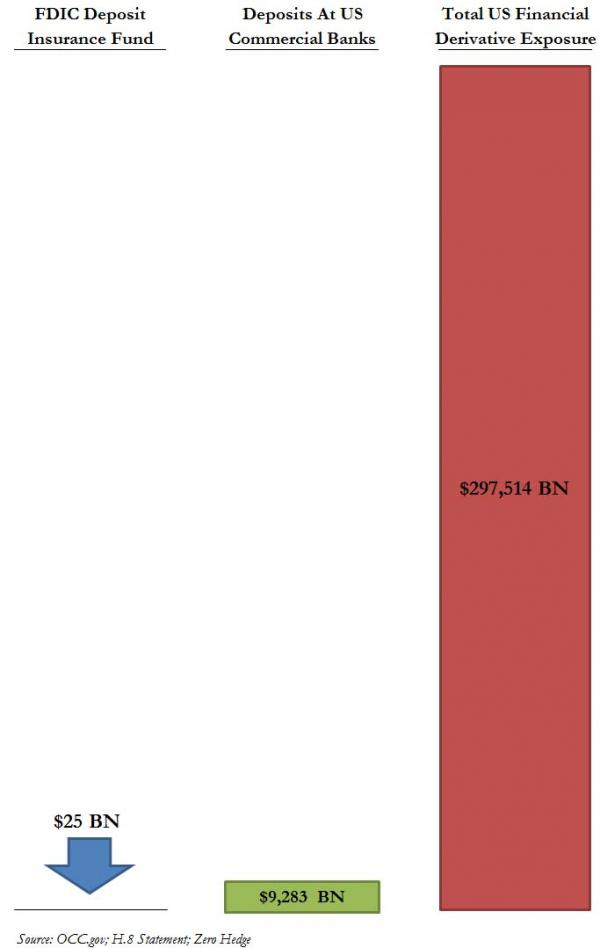
In theory, US deposits under $250,000 are protected by federal deposit insurance; but deposit insurance funds in both the US and Europe are woefully underfunded, particularly when derivative claims are factored in. The problem is graphically illustrated in this chart from a March 2013 ZeroHedge post:

Deposits vs Reserves vs Derivs_0 #2

More on that after a look at the new bail-in provisions and the powershift they represent.

Bail-in in Plain English

The Financial Stability Board (FSB) that now regulates banking globally began as a group of G7 finance ministers and central bank governors organized in a merely advisory capacity after the Asian crisis of the late 1990s. Although not official, its mandates effectively acquired the force of law after the 2008 crisis, when the G20 leaders were brought together to endorse its rules. This ritual now happens annually, with the G20 leaders rubberstamping rules aimed at maintaining the stability of the private banking system, usually at public expense.

According to an International Monetary Fund paper titled “From Bail-out to Bail-in: Mandatory Debt Restructuring of Systemic Financial Institutions”:
[B]ail-in . . . is a statutory power of a resolution authority (as opposed to contractual arrangements, such as contingent capital requirements) to restructure the liabilities of a distressed financial institution by writing down its unsecured debt and/or converting it to equity. The statutory bail-in power is intended to achieve a prompt recapitalization and restructuring of the distressed institution.
The language is a bit obscure, but here are some points to note:
  • What was formerly called a “bankruptcy” is now a “resolution proceeding.” The bank’s insolvency is “resolved” by the neat trick of turning its liabilities into capital. Insolvent TBTF banks are to be “promptly recapitalized” with their “unsecured debt” so that they can go on with business as usual.
  • “Unsecured debt” includes deposits, the largest class of unsecured debt of any bank. The insolvent bank is to be made solvent by turning our money into their equity – bank stock that could become worthless on the market or be tied up for years in resolution proceedings.
  • The power is statutory. Cyprus-style confiscations are to become the law.
  • Rather than having their assets sold off and closing their doors, as happens to lesser bankrupt businesses in a capitalist economy, “zombie” banks are to be kept alive and open for business at all costs – and the costs are again to be to borne by us.
The Latest Twist: Putting Pensions at Risk with “Bail-Inable” Bonds

First they came for our tax dollars. When governments declared “no more bailouts,” they came for our deposits. When there was a public outcry against that, the FSB came up with a “buffer” of securities to be sacrificed before deposits in a bankruptcy. In the latest rendition of its bail-in scheme, TBTF banks are required to keep a buffer equal to 16-20% of their risk-weighted assets in the form of equity or bonds convertible to equity in the event of insolvency.

Called “contingent capital bonds”, “bail-inable bonds” or “bail-in bonds,” these securities say in the fine print that the bondholders agree contractually (rather than being forced statutorily) that if certain conditions occur (notably the bank’s insolvency), the lender’s money will be turned into bank capital.
However, even 20% of risk-weighted assets may not be enough to prop up a megabank in a major derivatives collapse. And we the people are still the target market for these bonds, this time through our pension funds.

In a policy brief from the Peterson Institute for International Economics titled “Why Bail-In Securities Are Fool’s Gold”, Avinash Persaud warns, “A key danger is that taxpayers would be saved by pushing pensioners under the bus.”

It wouldn’t be the first time. As Matt Taibbi noted in a September 2013  article titled “Looting the Pension Funds,” “public pension funds were some of the most frequently targeted suckers upon whom Wall Street dumped its fraud-riddled mortgage-backed securities in the pre-crash years.”
Wall Street-based pension fund managers, although losing enormous sums in the last crisis, will not necessarily act more prudently going into the next one. All the pension funds are struggling with commitments made when returns were good, and getting those high returns now generally means taking on risk.

Other than the pension funds and insurance companies that are long-term bondholders, it is not clear what market there will be for bail-in bonds. Currently, most holders of contingent capital bonds are investors focused on short-term gains, who are liable to bolt at the first sign of a crisis. Investors who held similar bonds in 2008 took heavy losses. In a Reuters sampling of potential investors, many said they would not take that risk again. And banks and “shadow” banks are specifically excluded as buyers of bail-in bonds, due to the “fear of contagion”: if they hold each other’s bonds, they could all go down together.

Whether the pension funds go down is apparently not of concern.

Propping Up the Derivatives Casino: Don’t Count on the FDIC

Kept inviolate and untouched in all this are the banks’ liabilities on their derivative bets, which represent by far the largest exposure of TBTF banks. According to the New York Times:
American banks have nearly $280 trillion of derivatives on their books, and they earn some of their biggest profits from trading in them.
These biggest of profits could turn into their biggest losses when the derivatives bubble collapses.
Both the Bankruptcy Reform Act of 2005 and the Dodd Frank Act provide special protections for derivative counterparties, giving them the legal right to demand collateral to cover losses in the event of insolvency. They get first dibs, even before the secured deposits of state and local governments; and that first bite could consume the whole apple, as illustrated in the above chart.
The chart also illustrates the inadequacy of the FDIC insurance fund to protect depositors. In a May 2013 article in USA Today titled “Can FDIC Handle the Failure of a Megabank?”, Darrell Delamaide wrote:
[T]he biggest failure the FDIC has handled was Washington Mutual in 2008. And while that was plenty big with $307 billion in assets, it was a small fry compared with the $2.5 trillion in assets today at JPMorgan Chase, the $2.2 trillion at Bank of America or the $1.9 trillion at Citigroup.
. . . There was no possibility that the FDIC could take on the rescue of a Citigroup or Bank of America when the full-fledged financial crisis broke in the fall of that year and threatened the solvency of even the biggest banks.
That was, in fact, the reason the US Treasury and the Federal Reserve had to step in to bail out the banks: the FDIC wasn’t up to the task. The 2010 Dodd-Frank Act was supposed to ensure that this never happened again. But as Delamaide writes, there are “numerous skeptics that the FDIC or any regulator can actually manage this, especially in the heat of a crisis when many banks are threatened at once.”

All this fancy footwork is to prevent a run on the TBTF banks, in order to keep their derivatives casino going with our money. Warren Buffett called derivatives “weapons of financial mass destruction,” and many commentators warn that they are a time bomb waiting to explode. When that happens, our deposits, our pensions, and our public investment funds will all be subject to confiscation in a “bail in.” Perhaps it is time to pull our money out of Wall Street and set up our own banks – banks that will serve the people because they are owned by the people.
__________________

Ellen Brown is an attorney, founder of the Public Banking Institute, and author of twelve books including the best-selling Web of Debt. Her latest book, The Public Bank Solution, explores successful public banking models historically and globally. Her 200+ blog articles are at EllenBrown.com.

Thursday, 13 November 2014

Big Banks Busted Massively Manipulating Foreign Exchange, Precious Metals … And Every Other Market

Washington's Blog

Currency Markets Are RiggedCurrency markets are massively rigged. And see this and this.

Reuters notes today:
Regulators fined six major banks including Citigroup (C.N) and UBS (UBSN.VX) a total of $4.3 billion for failing to stop traders from trying to manipulate the foreign exchange market, following a year-long global investigation.
HSBC (HSBA.L), Royal Bank of Scotland (RBS.L), JP Morgan (JPM.N) and Bank of America (BAC.N) also face penalties resulting from the inquiry that has put the largely unregulated $5 trillion-a-day market on a tighter leash, accelerated the push to automate trading and ensnared the Bank of England.
In the latest scandal to hit the financial services industry, dealers shared confidential information about client orders and coordinated trades to make money from a foreign exchange benchmark used by asset managers and corporate treasurers to value their holdings. Dozens of traders have been fired or suspended.
***
Britain’s Financial Conduct Authority (FCA) fined five lenders $1.77 billion, the biggest penalty in the history of the City of London, and the U.S. Commodity Futures Trading Commission (CFTC) ordered them to pay a further $1.48 billion.
***
The U.S. Office of the Comptroller of the Currency, which regulates banks, also fined the U.S. lenders $950 million and was the only authority to penalise Bank of America.


Gold and Silver Are Manipulated

Today, Switzerland’s financial regulator (FINMA) found “serious misconduct” and a “clear attempt to manipulate precious metals benchmarks” by UBS employees in precious metals trading, particularly with silver.
Reuters reports:
Swiss regulator FINMA said on Wednesday that it found a “clear attempt” to manipulate precious metals benchmarks during its investigation into precious metals and foreign exchange trading at UBS …
Gold and silver prices have been “fixed” in daily conference calls by the powers-that-be.
Bloomberg reported last December:
It is the participating banks themselves that administer the gold and silver benchmarks.
So are prices being manipulated? Let’s take a look at the evidence. In his book “The Gold Cartel,” commodity analyst Dimitri Speck combines minute-by-minute data from most of 1993 through 2012 to show how gold prices move on an average day (see attached charts). He finds that the spot price of gold tends to drop sharply around the Londonevening fixing (10 a.m. New York time). A similar, if less pronounced, drop in price occurs around the London morning fixing. The same daily declines can be seen in silver prices from 1998 through 2012.
For both commodities there were, on average, no comparable price changes at any other time of the day. These patterns are consistent with manipulation in both markets.


Derivatives Are Manipulated

Runaway derivatives – especially credit default swaps (CDS) – were one of the main causes of the 2008 financial crisis. Congress never fixed the problem, and actually made it worse.

The big banks have long manipulated derivatives … a $1,200 Trillion Dollar market.
Indeed, many trillions of dollars of derivatives are being manipulated in the exact same same way that interest rates are fixed (see below) … through gamed self-reporting.
Reuters noted in September:
A Manhattan federal judge said on Thursday that investors may pursue a lawsuit accusing 12 major banks of violating antitrust law by fixing prices and restraining competition in the roughly $21 trillion market for credit default swaps.
***
“The complaint provides a chronology of behavior that would probably not result from chance, coincidence, independent responses to common stimuli, or mere interdependence,” [Judge] Cote said.
The defendants include Bank of America Corp, Barclays Plc, BNP Paribas SA, Citigroup Inc , Credit Suisse Group AG, Deutsche Bank AG , Goldman Sachs Group Inc, HSBC Holdings Plc , JPMorgan Chase & Co, Morgan Stanley, Royal Bank of Scotland Group Plc and UBS AG.
Other defendants are the International Swaps and Derivatives Association and Markit Ltd, which provides credit derivative pricing services.
***
U.S. and European regulators have probed potential anticompetitive activity in CDS. In July 2013, the European Commission accused many of the defendants of colluding to block new CDS exchanges from entering the market.
***
“The financial crisis hardly explains the alleged secret meetings and coordinated actions,” the judge wrote. “Nor does it explain why ISDA and Markit simultaneously reversed course.”
In other words, the big banks are continuing to fix prices for CDS in secret meetings … and have torpedoed the more open and transparent CDS exchanges that Congress mandated.


Interest Rates Are Manipulated

Bloomberg reported in January:
Royal Bank of Scotland Group Plc was ordered to pay $50 million by a federal judge in Connecticut over claims that it rigged the London interbank offered rate.
RBS Securities Japan Ltd. in April pleaded guilty to wire frauda s part of a settlement of more than $600 million with U.S and U.K. regulators over Libor manipulation, according to court filings. U.S. District Judge Michael P. Shea in New Haventoday sentenced the Tokyo-based unit of RBS, Britain’s biggest publicly owned lender, to pay the agreed-upon fine, according to a Justice Department Justice Department.
Global investigations into banks’ attempts to manipulate the benchmarks for profit have led to fines and settlements for lenders including RBS, Barclays Plc, UBS AG and Rabobank Groep.
RBS was among six companies fined a record 1.7 billion euros ($2.3 billion) by the European Union last month for rigging interest rates linked to Libor. The combined fines for manipulating yen Libor and Euribor, the benchmark money-market rate for the euro, are the largest-ever EU cartel penalties.
Global fines for rate-rigging have reached $6 billion since June 2012 as authorities around the world probe whether traders worked together to fix Libor, meant to reflect the interest rate at which banks lend to each other, to benefit their own trading positions.
To put the Libor interest rate scandal in perspective:
  • Even though RBS and a handful of other banks have been fined for interest rate manipulation, Libor is still being manipulated. No wonder … the fines are pocket change – the cost of doing business – for the big banks


Energy Prices Manipulated

The U.S. Federal Energy Regulatory Commission says that JP Morgan has massively manipulated energy markets in California and the Midwest, obtaining tens of millions of dollars in overpayments from grid operators between September 2010 and June 2011.

Pulitzer prize-winning reporter David Cay Johnston noted in May that Wall Street is trying to launch Enron 2.0.


Oil Prices Are Manipulated

Oil prices are manipulated as well.


Commodities Are Manipulated

The big banks and government agencies have been conspiring to manipulate commodities prices for decades.
The big banks are taking over important aspects of the physical economy, including uranium mining, petroleum products, aluminum, ownership and operation of airports, toll roads, ports, and electricity.
And they are using these physical assets to massively manipulate commodities prices … scalping consumers of many billions of dollars each year. More from Matt TaibbiFDL and Elizabeth Warren.


Everything Can Be Manipulated through High-Frequency Trading

Traders with high-tech computers can manipulate stocksbonds, options, currencies and commodities. And see this.


Manipulating Numerous Markets In Myriad Ways

The big banks and other giants manipulate numerous markets in myriad ways, for example:
  • Engaging in mafia-style big-rigging fraud against local governments. See thisthis and this
  • Shaving money off of virtually every pension transaction they handled over the course of decades, stealing collectively billions of dollars from pensions worldwide. Details hereherehereherehere,herehereherehereherehere and here
  • Pledging the same mortgage multiple times to different buyers. See thisthisthisthis and this. This would be like selling your car, and collecting money from 10 different buyers for the same car
  • Pushing investments which they knew were terrible, and then betting against the same investments to make money for themselves. See thisthisthisthis and this
  • Engaging in unlawful “Wash Trades” to manipulate asset prices. See thisthis and this
  • Bribing and bullying ratings agencies to inflate ratings on their risky investments


The Big Picture

The experts say that big banks will keep manipulating markets unless and until their executives are thrown in jail for fraud.
Why? Because the system is rigged to allow the big banks to commit continuous and massive fraud, and then to pay small fines as the “cost of doing business”. As Nobel prize winning economist Joseph Stiglitznoted years ago:
“The system is set so that even if you’re caught, the penalty is just a small number relative to what you walk home with.
The fine is just a cost of doing business. It’s like a parking fine. Sometimes you make a decision to park knowing that you might get a fine because going around the corner to the parking lot takes you too much time.”
Indeed, Reuters points out today:
Switzerland’s regulator FINMA ordered UBS, the country’s biggest bank, to pay 134 million francs ($139 million) after it found serious misconduct in both foreign exchange and precious metals trading. It also capped bonuses for dealers in both units at twice their basic salary for two years.
Capping bonuses at twice base salary?  That’s not a punishment … it’s an incentive.
Experts say that we have to prosecute fraud or else the economy won’t ever really stabilize.
But the government is doing the exact opposite. Indeed, the Justice Department has announced it will go easy on big banks, and always settles prosecutions for pennies on the dollar (a form of stealth bailout. It is also arguably one of the main causes of the double dip in housing. And there is no change in the air.)
Indeed, the government doesn’t even force the banks to admit any guilt as part of their settlements.  In fact:
“The banks have been allowed to investigate themselves,” one source familiar with the investigation told Reuters. “The investigated decide what they want to investigate, what they admit to, and how much they will pay.
Wall Street has manipulated virtually every other market as well – both in the financial sector and thereal economy – and broken virtually every law on the books.
And they will keep on doing so until the Department of Justice grows a pair.
The criminality and blatant manipulation will grow and spread and metastasize – taking over and killing off more and more of the economy – until Wall Street executives are finally thrown in jail.

It’s that simple …

-------------------

See also:  Cartels R Us: Tab for Rigging Foreign Exchange $3.3 Billion and Rising

Related Posts Plugin for WordPress, Blogger...