Search This Blog

Showing posts with label JFK. Show all posts

Wednesday, 25 March 2026

JFK: The Memo That Might Have Stopped Israel’s War on Iran

Freddie Ponton | Activist Post

On 21 November 1963, two days before John F Kennedy was shot in Dallas, one of his closest advisers sat through a tense lunch with an Israeli minister and quietly wrote down what Washington dared not say in public. That memorandum, drafted by National Security Council advisor Robert Komer (“Blowtorch Bob”), reads today like a warning note from a different era, a moment when a US president still tried to keep some distance from a small client state that demanded everything and offered secrecy in return.

Komer describes an Israel already furious that the United States would not simply sabotage a United Nations debate on Palestinian refugees to its liking. The Israeli side accuses American diplomats of “lying” and “active lobbying” against an Israeli resolution, as though Washington’s task at the UN were not to balance conflicting claims in a decolonising region but to function as Israel’s parliamentary whip. In response, Komer sketches a picture that has become brutally familiar in 2026. He sees a government whose “consistent policy” is to push the United States into an openly pro-Israeli position, regardless of the consequences with Arab societies, regardless of the opportunity it hands to rival powers, regardless of the long-term cost in blood and legitimacy. All of these phrases and characterisations such as “lying,” “active lobbying,” the description of Israel’s “consistent policy” since 1948 and US concern over its impact on Arab relations and Soviet influence, are drawn directly from and faithfully summarised in Komer’s November 21, 1963 memo. (full memo).[2001-2009.state]

In the memo, the United States is already Israel’s “guarantor, banker, and strongest friend,” expected to subsidise the state, shield it diplomatically, and fight its wars if necessary. Yet even at this early stage, Washington is kept in the dark about the most dangerous files.

Saturday, 18 October 2025

Is Peace with Russia Possible?

Armstrong Economics

ANSWER: Europe and NATO are the aggressors – not Putin. Zelensky is meeting with Trump today. Trump has to realize who his real opponents are. Peace with Russia is easy if you do what is right. Putin warned Zelensky that the Minsk Agreement was the key. Zelensky has been taking his orders from NATO, NEOCONS, and never from his own people. I had two employees there, and I can say many people questioned if he was even legitimately elected. We have witnessed what the EU and NATO did in Romania. Do you really think they were hands-off in Ukraine? There would have BEEN NO WAR if the EU, NATO, and Neocons had not lied and honored the Minisk Agreement.

 You cannot defeat Putin and think that is somehow the answer. When Khrushchev had to back down after the 1962 Cuban Missile Crisis, a coup occurred, and Brezhnev took power, deepening the Cold War.

Then there was a proposal that Russia join NATO when the USSR collapsed. Just as our Neocons in the CIA killed JFK to keep war on the table and rejected his peace initiatives, the Russian Neocons staged coup #2 and overthrew Gorbachev. That is when Yeltsin stood on the tank and pleaded with the military not to fire on their own people. The military stood down, and the coup collapsed. Anyone who thinks they can beat Putin and force him out of Ukraine is not just a fool; they are a dangerous asshole. You will get coup #3, and this time you will get the Russian Neocons in full power. Just imagine if John McCain had become president with Lindsey Grachm as his VP. You would probably be dead by now. 

Read more 

Friday, 2 August 2019

The Manson Murders, JFK, 9/11 And The Psychopathy of Power

MKUltra Jolly West Manson

Kevin Barrett
The Unz Review


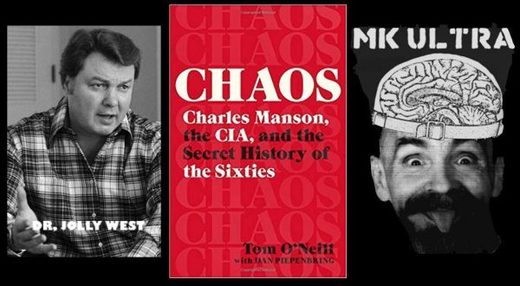
“With Alan Scheflin, a forensic psychologist and law professor who’d written a book on MKULTRA, I laid out a circumstantial case linking (CIA mind control guru Jolly) West to Manson. Was it possible, I asked, that the Manson murders were an MKULTRA experiment gone wrong? ‘No,’ he said, ‘an MKULTRA experiment gone right.’” (CHAOS , p. 369) I moved out of Southern California in the summer of 1969. I was ten years old, and my parents were fleeing decadence and depravity in favor of the more wholesome Midwest.

Before our move, a story had circulated about some local (Newport Beach) high schoolers who had "gone on an LSD trip" and gotten caught by police. As I understood it, the teenagers had "taken LSD" and started leaping from rooftop to rooftop, "tripping" all over the neighborhood and waking people up to the sound of thundering hoofbeats overhead. At the time I wondered whether LSD conferred a miraculous leaping or flying ability, since the houses in Lido Sands, though rather tightly clustered, were mostly spaced perhaps eight or ten feet apart, which seemed like a long way to jump.

I vaguely recall this "LSD-fueled teenage midnight horsemen of the apocalypse" story having something to do with my parents' decision to move back to Wisconsin. Southern California circa 1969, a few years after the hippie movement had peaked and turned into a bad trip, didn't seem like a good place to send your kids to high school. (Little did my parents know that the 60s would hit Wisconsin high schools ten years late, putting me and my siblings directly in the path of the psychedelic hurricane.) John Kenn

Years later, as an "experienced" (in the Jimi Hendrix sense) subversive teenage wannabe intellectual, I would read about the Manson murders and notice how convenient they had been for the Establishment. From the moment Charlie Manson's grinning, demonic face started leering from every front page and TV screen in America, the whole hippie-antiwar thing had seemed a whole lot scarier. I read the official version of the Manson myth, Vincent Bugliosi's Helter Skelter, and thought: This is too crazy to be true. None of the Wisconsin hippies I know are even remotely like these characters. Maybe it's something they add to the fluoride in the Southern California water.

By 1975 I had seen Mark Lane's presentation of the Zapruder film and knew that America had experienced an unspeakably evil coup d'état in 1963. In 1979 I read John Marks' The Search for the Manchurian Candidate: The CIA and Mind Control and discussed it with William S. Burroughs, who told me he had been aware of such activities for many years before they were publicly revealed by the Church and Rockefeller Commissions: "The thing about these secrets is they're not all that secret."

Well, maybe not, Bill. But if you had proclaimed in 1960 that the CIA's most heavily funded program aimed at turning people into killer zombies, you would have gotten blank stares at best. Rumors whispered in bohemian demimondes, blown up into dystopian parody in books like Naked Lunch, are hardly threats to national security secrecy.


Read more

Sunday, 26 May 2019

Trump Attacks Military Industrial Complex and Calls for Infrastructure Investments in the Middle East

Matthew Ehret
Strategic Culture

For the first time in over half a century, an American President has actually come out attacking the Military Industrial Complex. Of course, everyone knows of President Dwight D. Eisenhauer’s famous outgoing 1961 speech warning the world (and the incoming President Kennedy) what sort of monster had arisen at the heart of America’s defense institutions. Very little on the matter was said on the frightening topic by decades of political leaders who rose to prominence in the shadow of JFK’s corpse. Instead, the beast grew like a malignant cancer over the ensuing years as a major branch of the British-run deep state that carried out a coup with Sir Winston Churchill’s Iron Curtain speech in 1946 and the MI6-directed re-organization of American intelligence with the creation of the CIA in 1947.

After John F. Kennedy’s assassination, networks of neoconservative contaminated all branches of government in both parties bringing the USA into a frenzied military doctrine centered on regime change wars, oil-centered geopolitics and unipolarism totally uncharacteristic with the better constitutional traditions of the nation. This geopolitical doctrine nearly drove the west into a full military confrontation with Russia and China in recent years.

The Tide Begins to Turn

On May 20 speaking to Fox News, President Trump echoed Eisenhauer’s warnings. Under a coterie of Trump’s war-mongering advisors such as John Bolton, Gina Haspel, Terrence O’Shaughnessy and Mike Pompeo, America has recently been brought to the brink of war with Iran. While Trump has too often accommodated this hive of neocons, his recent statements and repeated calls for cooperation with Russia and China demonstrate a sound push back which should be taken very seriously. In that Fox interview Trump said:

“With all of everything that’s going on, and I’m not one that believes—you know, I’m not somebody that wants to go in to war, because war hurts economies, war kills people, most importantly—by far most importantly.”
You know, in Syria, with the caliphate, so I wipe out 100 percent of the caliphate. That doesn’t mean you’re not going to have these crazy people who run around blowing up stores and blowing up things—these are seriously ill people. I don’t want to say, ‘Oh, they’re wiped,’ you know, ISIS. But, I wiped out 100 percent of the caliphate. I say, ‘I want to bring our troops back home.’ The place went crazy. You have people here in Washington, they never want to leave.”
‘You know what I’ll do, I’ll leave a couple hundred soldiers behind,’ but if it was up to them, they’d bring thousands of soldiers in. Someday people will explain it, but you do have a group, and they call it the military-industrial complex. They never want to leave. They always want to fight.”
Read more

Tuesday, 17 July 2018

Documents Reveal Two US Soldiers Overheard Plot To Kill JFK—and Were Committed After Reporting It

Jay Syrmopoulos
Activist Post

Washington, D.C. – Despite receiving little attention in the mass media, the November 2017 and April 2018 release of more than 35,000 and 18,000 documents by the Trump Administration, relating to the assassination of former President Kennedy—which had been withheld from the public for more than 50 years—sheds new light on the president’s murder and the two soldiers who attempted to stop it.

While the mainstream media did cursorily cover the two releases, virtually none of the coverage was aimed at the most damning revelations, which included the fact that two U.S. soldiers in separate locations uncovered cryptographic messages indicating that President Kennedy was going to be assassinated, prior to his murder in Dallas.

Ominously, both of these soldiers were subsequently institutionalized after attempting to get the information they had uncovered to authorities.

The first case involves an army code breaker named Eugene V. Dinkin.

U.S. Army Private First Class Eugene Dinkin served in Metz, France, in the 599th Ordinance Group and worked in the cryptography section of his unit. His duties at Metz reportedly included deciphering cable traffic from the European Commands, NATO, etc.
A report by Citizens for Truth About the Kennedy Assassination (CTAKA) explained:
On September, 1963, Dinkin noticed material in the Army newspaper, Stars and Stripes, and other print publications, that was negative toward the president and his policies and implied that he was a weak president in dealing with the Russians. The examples that he found became more negative, the suggestion being that if he were removed as president it would be a good thing. By mid-October Dinkin had found enough information—some of it subliminal—that he was convinced that a plot was in the works. One driven by some high-ranking members of the military, some right-wing economic groups, and with support by some national media outlets…
Dinkin’s studies forced him to conclude that the plot would happen around November 28, 1963, and that the assassination would be blamed on “a Communist or a Negro”. He then sent a registered letter to Attorney General Robert Kennedy. When he got no reply, he decided on other options.
Dinkin gathered his evidentiary material in late October 1963, which included psychological sets he had uncovered that he believed were being used to induce a specific state of mind into citizens’ consciousness regarding President Kennedy in the run-up to his assassination and he went to the U.S. Embassy in Luxembourg in an effort to meet with Mr. Cunningham, the Chargé d’Affaires.

Despite Dinkin informing Cunningham by phone that he had important information about a plot to assassinate Kennedy, Cunningham refused to meet with him or look at his evidentiary data.

Upon returning to Metz, his superiors informed him that he was scheduled to undergo a psychological evaluation on November 5, 1963.  Dinkin then decided he had to leave his unit and go to Geneva, Switzerland, in an attempt to get this information to someone that could potentially assist in thwarting the assassination attempt.

Despite unsuccessfully attempting to speak to the editor of the newspaper, Geneva Diplomat, and a Newsweek reporter, who refused to listen to the information, Dinkin was able to speak to the secretary for Time-Life who was located in Zurich.

Read more

Friday, 17 March 2017

JFK - The Speech That Killed Him: As relevant today as it was then....


EuropeanWatchman2

"For we are opposed around the world, by a monolithic and ruthless conspiracy, that relies primarily on covert means for expanding its sphere of influence."

Although Kennedy was primarily referring to the Cold War ideology of the Soviets, he was also applying this as a double reference: to the dangers of such a mindset in America, reinforcing Eisenhower's warning of the Military-Industrial Complex several years before. 

The American left and the reality of 911: Beyond their wildest dreams

 Noam Chomsky: Bastion of the intellectual left in the US - and hopelessly ignorant of 911


Graeme MacQueen
Truth and Shadows


On November 23, 1963, the day after John F. Kennedy's assassination, Fidel Castro gave a talk on Cuban radio and television.[1] He pulled together, as well as he could in the amount of time available to him, the evidence he had gathered from news media and other sources, and he reflected on this evidence.

The questions he posed were well chosen: they could serve as a template for those confronting complex acts of political violence. Were there contradictions and absurdities in the story being promoted in the U.S. media? Who benefitted from the assassination? Were intelligence agencies claiming to know more than they could legitimately know? Was there evidence of foreknowledge of the murder? What was the main ideological clash in powerful U.S. circles and how did Kennedy fit in? Was there a faction that had the capacity and willingness to carry out such an act? And so on. But beneath the questions lay a central, unspoken fact: Castro was able to imagine—as a real possibility and not as mere fantasy—that the story being promoted by the U.S. government and media was radically false. He was able to conceive of the possibility that the killing had not been carried out by a lone gunman on the left sympathetic to Cuba and the Soviet Union, but by powerful, ultra-right forces, including forces internal to the state, in the United States. Because his conceptual framework did not exclude this hypothesis he was able to examine the evidence that favored it. He was able to recognize the links between those wishing to overthrow the Cuban government and take more aggressive action toward the Soviet Union and those wishing to get Kennedy out of the way.

In the immediate wake of the assassination, and after the Warren Commission's report appeared in 1964, few among the elite left leadership in the U.S. shared Castro's imagination. Vincent Salandria, one of key researchers and dissidents, said: "I have experienced from the beginning that the left was most unreceptive to my conception of the assassination."[2]


Former Malaysian Prime Minister Dr. Mahathir Mohamad challenged the official narrative at the “9/11 Revisited: Seeking the Truth” conference in Kuala Lumpur in 2012.
I.F. Stone, a pillar of the American left leadership, praised the Warren Commission and consigned critics who accused the Commission of a cover-up to "the booby hatch."[3] The contrast with Castro is sharp. Speaking well before the Warren Commission's emergence, Castro mocked the narrative it would later endorse. Several other prominent left intellectuals agreed with I. F. Stone, and declined to criticize the Warren Commission's report.[4]

Noam Chomsky, resisting serious efforts to get him to look at the evidence, said at various times that he knew little about the affair, had little interest in it, did not regard it as important, and found the idea of a "high-level conspiracy with policy significance" to be "implausible to a quite extraordinary degree."[5] He would later say almost exactly the same thing about the 9/11 attacks, finding the thesis that the U.S. administration was involved in the crime "close to inconceivable,"[6] and expressing his disinterest in the entire issue.

Not everyone on the American left accepted the FBI and Warren Commission reports uncritically. Dave Dellinger and Staughton Lynd, for example, encouraged dissident researchers.[7] In fact, several of the leading dissident investigators, such as Vincent Salandria, Mark Lane and Sylvia Meagher, were themselves, at least by today's standards, on the left of the political spectrum. But they were not among the elite left leadership in the country and they were, to a great extent, unsupported by that leadership during the most crucial period


Read more

Monday, 20 June 2016

Martin Armstrong On Assassination Conspiracies: "There's Too Much At Stake To Allow Brexit"

ArmstrongEconomics.com

There is disturbing opinion circulating about Jo Cox may have been assassinated to prevent a BREXIT vote. Many are starting to believe there is a conspiracy plot connecting the dots to ensure a sympathy vote to remain within the EU. People are pointing to the familiar tool of assassination often used to achieve political agendas.

Of course there is the Kennedy assassination that many believe was orchestrated to create the sympathy vote to start the Vietnam War when in fact Kennedy vetoed such a measure.

But the more recent assassination was on September 10th, 2003. Anna Lindh  (1957 – 2003), was a Swedish Social Democratic politician who was a member of parliament from 1982 to 1985 and 1998 to 2003. Anna was elevated to minister for foreign affairs by prime minister Göran Persson in 1998. She was widely considered to be his successor as party chairman and there was much hope that she would become prime minister.

Read more


Monday, 25 April 2016

Here Are Some Huge Lessons Truth Seekers Can Learn About The “28 Pages” Obvious Psyop

Bernie Suarez 


Do an experiment for yourself. Stop random people in the streets or wherever you are and ask them a simple question: Who killed JFK? I don’t know what the results of your survey will produce but I can guarantee one thing for sure, you are going to get a variety of answers.

There’s no telling how many answers you will get, four, five even ten different answers maybe? And that’s the whole point when you consider the role of US Intelligence and the process of government propaganda that is always used to hide US government crimes and divert attention elsewhere.


Like the JFK assassination, the crimes of September 11, 2001 is a textbook example of a State-sponsored false flag followed by years of alternate theories, deliberate confusion and now a carefully planned agenda to blame other countries for this crime which was planned and orchestrated by our own US government with the cooperation and full participation, mind you, of elements in several countries including Saudi Arabia.

I keep asking myself why and how do genuine truth seekers continue to fall for repeated government-engineered Intelligence propaganda when they know full well how this works given the historical examples we can observe. In case you still don’t know how it works, here is the sequence.
  1. Government stages an event for political reasons known as a false flag operation.
  2. Government blames an enemy patsy of choice to point blame away from the true conspirators (e.g. Lee Harvey Oswald, Bin Laden, Al Qaeda, etc.).
  3. Government demonizes those searching for truth (e.g. “conspiracy theorists,” “lunatics,” today we have “domestic extremist”).
  4. Government spends lots of money and resources to create alternate theories and point the finger at new culprits to confuse those looking for truth and create “cognitive diversity.”
Where have we heard the term “cognitive diversity” before? It was Obama’s Information Czar, Cass Sunstein, who stated in his 2008 paper “Conspiracy Theories” that the 9/11 Truth movement needed to be cognitively infiltrated in order to create “cognitive diversity.” That’s right. You heard that correctly. Sunstein was clear about his intentions to diversify the opinions and viewpoints INSIDE of the Truth movement to get them fighting over different theories and culprits. Even Salon, which is one of the primary voices of the control system today posted back in 2010 in an article written by Glenn Greenwald:
Sunstein advocates that the Government’s stealth infiltration should be accomplished by sending covert agents into “chat rooms, online social networks, or even real-space groups.” He also proposes that the Government make secret payments to so-called “independent” credible voices to bolster the Government’s messaging (on the ground that those who don’t believe government sources will be more inclined to listen to those who appear independent while secretly acting on behalf of the Government). This program would target those advocating false “conspiracy theories,” which they define to mean: “an attempt to explain an event or practice by reference to the machinations of powerful people, who have also managed to conceal their role.”
Despite this clearly documented intent to infiltrate local truth seeking groups and online blogs and social networks and chat rooms with alternate theories and propaganda for the purposes of specifically pointing the finger away from the US government, far too many truth seekers apparently think that Sunstein was either joking or speaking metaphorically. I assure readers he was not. He was telling you what the plans were from the State’s point of view at the time, and they have delivered on that promise very clearly.

This brings us to the “Saudi Arabia did 9/11” propaganda so-called “28 pages” being waved at the masses for years now, which by the way in itself is an effective strategic marketing tactic to pique your curiosity. The controllers have been waving the “28 pages” psyop papers for years on end even doubling up on their psychological tactics by having Obama recently appear as though he doesn’t want the 28 pages to be released. The cat-and-mouse game playing out for years screams of obvious Intelligence games.

For anyone who thinks this is their only game of cognitive diversity think again. I have been very vocal and often times feel alone in my argument that the “only Israel did it” movement is a psychological operation on the Truth Movement as well and one need look no further than Cass Sunstein’s paper to see how. Like the known role of Saudi Arabia, the known role of Israel and the Mossad on 9/11 – or for that matter the known role of Pakistan – those pushing these movements seek to convince you that 9/11 was about a singular mission by a singular country. This is a classic Sunstein cognitive infiltration tactic using things that are partially true to divert the blame of 9/11 away from the US government and create division within the movement.

Read more

Tuesday, 2 June 2015

Towards a militarized police state in America? Explosive new revelations over "Jade Helm 15 exercise" and potential false flags


Joachim Hagopian 
Global Research

A growing segment of the American population is waking up to the implications of the Jade Helm 15 military operation to be conducted by Special Forces in conjunction with local law enforcement, the FBI, DHS, the DEA and Border Patrol across the entire Southwest. This massive unprecedented exercise will also commence in June sooner than first announced and last for 10 weeks through the summer till September 15.

The risk of it triggering civil unrest or that it may coincide with a potential false flag scenario followed by another possibly timed crisis situation is both feasible and real, despite mainstream media's ridicule dismissing any such possibilities as pure paranoid conspiracy theory. What we do know for sure is this nation has turned into a militarized police state and that both the military and the government lie all the time.

We also are aware of the globalists' long planned agenda of a national crisis that would induce Obama to quash civil unrest by declaring martial law. A recent poll of Americans found that near half (45%) see Jade Helm as imposing more control over the states. If martial law doesn't actually come to pass this time around, it certainly sets the stage for next time in this incrementally increasing militarization of America.

We also know that a specific Department of Defense manual FM 3-39.40 has existed since 2010 delineating how the federal government in cooperation with the UN will respond to civil disturbance that includes FEMA camp roundups to fill waiting empty Haliburton-refurbished prison camps after a $385 million no bid contract during the former CEO Cheney's vice presidency. We also know that each prison camp includes a tribunal section and a mortuary section along with psychological officers responsible for reprogramming US detainees. Despite this layout presented so matter-of-fact and by-the-book, Americans will be killed. During the upheaval of a national crisis, a lethal outcome is also most probable. Meanwhile, countdown to global war appears to be ticking away as troops from virtually every nation are busily training in preparation for a likely West versus East endgame scenario of World War III.

President Kennedy spoke of subversive forces operating inside the shadow government several months prior to those same forces killing him. And those demonic forces posing as our international crime syndicate government boldly went on unconsequenced by the JFK assassination to stage the worst false flag in history on 9/11 giving birth to the neocons' war on terror. And it's been all downhill ever since with nonstop wars, a runaway deficit (over $18 trillion), a fragile and broken global economy, and within a few years after 9/11 a militarized totalitarian police state. Long gone is America's once democratic republic, replaced by a fascist oligarchy controlled by a military-security-prison complex. As Obama's personal army, Homeland Security has grown gluttonously evil bringing tyranny and oppression to the United States of America as never before.  


Tuesday, 25 November 2014

Confronting the John F. Kennedy Assassination

Want to Know
 
Where Do We Find Hope When A Peacemaking President Is Assassinated?


By James W. Douglass, author of acclaimed book JFK and the Unspeakable


I believe this experiment we are doing into the dark truth of Dallas (and of Washington, D.C.) can be the most hopeful experience of our lives. But, it does require patience and tenacity to confront the unspeakable. We, first of all, need to take the time to recognize the sources in our history for what happened in Dallas on November 22, 1963.
'Plausible deniability'
The doctrine of "plausible deniability" in an old government document provides us with a source of the assassination of President Kennedy. The document was issued in 1948, one year after the CIA was established, and 15 years before JFK's murder. That document, National Security Council directive 10/2, on June 18, 1948, "gave the highest sanction of the [U.S.] government to a broad range of covert operations" — propaganda, sabotage, economic warfare, subversion of all kinds — that were seen as necessary to "win" the Cold War against the Communists. [1]
In the 1950s, under the leadership of CIA Director Allen Dulles, the doctrine of "plausible deniability" became the CIA's green light to assassinate national leaders, conduct secret military operations, and overthrow governments that our government thought were on the wrong side in the Cold War. "Plausible deniability" meant our intelligence agencies, acting as paramilitary groups, had to lie and cover their tracks so effectively that there would be no trace of U.S. government responsibility for criminal activities on an ever-widening scale.
Truman warns about the CIA
The man who proposed this secret, subversive process in 1948, diplomat George Kennan, said later, in light of its consequences, that it was "the greatest mistake I ever made." [2] President Harry Truman, under whom the CIA was created, and during whose presidency the plausible deniability doctrine was authorized, had deep regrets. He said in a statement on December 22, 1963:
"We have grown up as a nation, respected for our free institutions and for our ability to maintain a free and open society. There is something about the way the CIA has been functioning that is casting a shadow over our historic position and I feel that we need to correct it." [3]
Truman later remarked: "The CIA was set up by me for the sole purpose of getting all the available information to the president. It was not intended to operate as an international agency engaged in strange activities." [4]
One assumption behind Kennan's proposal unleashing the CIA for its war against Communism was that the Agency's criminal power could be confined to covert action outside the borders of the United States, with immunity from its lethal power granted to U.S. citizens. That assumption proved to be wrong.
During the Cold War, the hidden growth of the CIA's autonomous power corresponded to the public growth of what was called a fortress state. A democratic national security state is a contradiction in terms.
The insecure basis of our security then became weapons that could destroy the planet. To protect the security of that illusory means of security, which was absolute destructive power, we now needed a ruling elite of national security managers with an authority above that of our elected representatives.
So from that point on, our military-industrial managers made the real decisions of state. President Truman simply ratified their decisions and entrenched their power, as he did with the establishment of the CIA, and as his National Security Council did with its endorsement of plausible deniability. 
Kennedy sacks CIA leaders
We know how JFK reacted to the CIA's setting him up. He was furious. When the enormity of the Bay of Pigs disaster came home to him, he said he wanted "to splinter the CIA in a thousand pieces and scatter it to the winds." [5]
He ordered an investigation into the whole affair, under the very watchful eyes of his brother, Attorney General Robert Kennedy. He fired CIA Director Allen Dulles, Deputy Director Richard Bissell, Jr., and Deputy Director General Charles Cabell. That was a huge decision — firing the top of the CIA's hierarchy, including the legendary leader who had come to personify the agency, Allen Dulles.
The president then took steps "to cut the CIA budget in 1962 and again in 1963, aiming at a 20 percent reduction by 1966." [6] He was cutting back the CIA's power in very concrete ways, step by step.
JFK alienates CIA and Pentagon
JFK had to confront the unspeakable in the Missile Crisis in the form of total nuclear war. At the height of that terrifying conflict, he felt the situation spiraling out of control, especially because of the actions of his generals.
The White House tapes show Kennedy questioning and resisting the mounting pressure to bomb Cuba coming from both the Joint Chiefs and the Executive Committee of the National Security Council. At the same time, John Kennedy and Nikita Khrushchev, the two men most responsible for the Cuban Missile Crisis, seemed locked in a hopeless ideological conflict. The U.S. and Soviet leaders had been following Cold War policies that now seemed to be moving inexorably toward a war of extermination.
Kennedy and Khrushchev: Two enemies become peacemakers
Yet, as we have since learned, Kennedy and Khrushchev had been engaged in a secret correspondence for over a year that gave signs of hope. Even as they moved publicly step by step toward a Cold War climax that would almost take the world over the edge with them, they were at the same time smuggling confidential letters back and forth that recognized each other's humanity and hoped for a solution. They were public enemies who, in the midst of deepening turmoil, were secretly learning something approaching trust in each other.
On what seemed the darkest day in the crisis, when a Soviet missile had shot down a U2 spy plane over Cuba, intensifying the already overwhelming pressures on Kennedy to bomb Cuba, the president sent his brother, Attorney General Robert Kennedy, secretly to Soviet Ambassador Anatoly Dobrynin. RFK told Dobrynin, as Dobrynin reported to Khrushchev, that the president "didn't know how to resolve the situation. The military is putting great pressure on him... Even if he doesn't want or desire a war, something irreversible could occur against his will. That is why the President is asking for help to solve this problem." [6]
In his memoirs, Khrushchev recalled a further, chilling sentence from Robert Kennedy's appeal to Dobrynin: "If the situation continues much longer, the President is not sure that the military will not overthrow him and seize power." [7]
At a moment when the world was falling into darkness, Kennedy did what from his generals' standpoint was intolerable and unforgivable. JFK not only rejected his generals' pressures for war. Even worse, the president then reached out to their enemy, asking for help. That was treason.
When Nikita Khrushchev had received Kennedy's plea for help in Moscow, he turned to his Foreign Minister Andrei Gromyko and said, "We have to let Kennedy know that we want to help him."
Khrushchev stunned himself by what he had just said: Did he really want to help his enemy, Kennedy? Yes, he did. He repeated the word to his foreign minister:
 "Yes, help. We now have a common cause, to save the world from those pushing us toward war." [8]
How do we understand that moment? The two most heavily armed leaders in history, on the verge of total nuclear war, suddenly joined hands against those on both sides pressuring them to attack. Khrushchev ordered the immediate withdrawal of his missiles from Cuba, in return for Kennedy's public pledge never to invade Cuba and his secret promise to withdraw U.S. missiles from Turkey — as he would in fact do.
When President Kennedy stood up to the Pentagon, the CIA, and the military-industrial complex, he was treated as a traitor. His attempt to save the planet from the weapons of his own nation was regarded as treason. The doctrine of “plausible deniability” allowed for the assassination of a president seen as a national security risk himself.
Committing heresy for peace
 At American University on June 10, 1963, President Kennedy proposed an end to the Cold War. Kennedy's rejection of "a Pax Americana" was an act of resistance to the military-industrial complex. The military-industrial complex was totally dependent on "a Pax Americana enforced on the world by American weapons of war." [9]
That Pax Americana policed by the Pentagon was considered the system's indispensable, hugely profitable means of containing and defeating Communism. At his own risk, Kennedy was rejecting the foundation of the Cold War system.
Kennedy said he wanted to negotiate a nuclear test ban treaty with the Soviet Union in Moscow — in their capitol, not ours — as soon as possible. To clear the way for such a treaty, he said he was suspending U.S. atmospheric tests unilaterally.
Kennedy's strategy of peace penetrated the Soviet government's defenses far more effectively than any missile could have done. The Soviet press, which was accustomed to censoring U.S. government statements, published the entire speech all across the country. Soviet radio stations broadcast and rebroadcast the speech to the Soviet people. In response to Kennedy's turn toward peace, the Soviet government even stopped jamming all Western broadcasts into their country.
His speech was received less favorably in his own country. The New York Times reported his government's skepticism: "Generally there was not much optimism in official Washington that the President's conciliation address at American University would produce agreement on a test ban treaty or anything else." [10]
In contrast to the Soviet media that were electrified by the speech, the U.S. media ignored or downplayed it. For the first time, Americans had less opportunity to read and hear their president's words than did the Russian people. A turn-around was occurring in the world on different levels. Whereas nuclear disarmament had suddenly become feasible, Kennedy's position in his own government had become precarious.
Nuclear test ban treaty
President Kennedy's next critical conflict with his national security state, propelling him toward the coup d'etat he saw as possible, was the Partial Nuclear Test Ban Treaty that he signed with Nikita Khrushchev on July 25, 1963, six weeks after the American University Address. The president had done an end run around the Joint Chiefs of Staff. He negotiated the Test Ban Treaty without consulting them, because they opposed it.
On September 20, Kennedy spoke to the United Nations. He suggested that its members see the Test Ban Treaty as a beginning and engage together in an experiment in peace:
 "Two years ago I told this body that the United States had proposed, and was willing to sign, a Limited Test Ban treaty. Today that treaty has been signed. It will not put an end to war. It will not remove basic conflicts. It will not secure freedom for all. But it can be a lever, and Archimedes, in explaining the principles of the lever, was said to have declared to his friends: 'Give me a place where I can stand — and I shall move the world.'" [11]
JFK reaches out to Cuba
In the month leading up to the assassination, Kennedy and Castro actually began a dialogue on normalizing U.S.-Cuban relations, through the mediation of French journalist Jean Daniel who personally visited both men. Daniel was actually eating lunch with Castro in his home on November 22, conveying Kennedy's hopeful words, when the Cuban premier was phoned with the news of Kennedy's death. Castro's somber comment to Daniel was: "Everything is changed. Everything is going to change." [12]
JFK's top-secret order to begin withdrawal from Vietnam
Kennedy decided on his policy of withdrawal from Vietnam, against the arguments of most of his advisers, at a contentious National Security Council meeting on October 2. When Defense Secretary Robert McNamara was leaving the meeting to announce the withdrawal to the White House reporters, "the President called to him, 'And tell them that means all of the helicopter pilots, too.'" [13]
In fact, it would not mean that at all. After JFK's assassination, his withdrawal policy was quietly voided. In light of the future consequences of Dallas, it was not only John Kennedy who was murdered on November 22, 1963, but 58,000 other Americans and over three million Vietnamese, Laotians, and Cambodians.
The Steel Crisis
In a head-on confrontation with the ruling elite of Big Steel, JFK ordered the Defense Department to switch huge military contracts away from the major steel companies to the smaller, more loyal contractors that had not defied him. After the big steel companies bitterly backed down from their price raises, JFK and his brother, Robert, were denounced as symbols of "ruthless power" by the Wall Street power brokers at the center of the military-industrial complex.
In an editorial titled, "Steel: The Ides of April" (the month in which Kennedy faced down the steel executives), Henry Luce's Fortune magazine called to readers' minds the soothsayer's warning in Shakespeare of the assassination of Julius Caesar. Fortune was warning Kennedy that his actions had confirmed the worst fears of corporate America about his presidency, and would have dire consequences. As interpreted by the most powerful people in the nation, the steel crisis was a logical prelude to Dallas. It was another Bay of Pigs.
JFK reaches out to third world
Yet another Bay of Pigs was Kennedy's diplomatic opening to the fiery Third-World leadership of President Sukarno of Indonesia. Sukarno was "the most outspoken proponent of Third World neutralism in the Cold War." He had actually coined the term "Third World." The CIA wanted Sukarno dead. It wanted what it saw as his pro-communist "global orientation" obliterated. During Eisenhower's presidency, the CIA repeatedly tried to kill and overthrow Sukarno but failed.
Most significantly, three days before his assassination, President Kennedy said he was willing to accept Sukarno's invitation to visit Indonesia the following spring. His visit to Indonesia would have dramatized in a very visible way Kennedy's support of Third World nationalism, a sea change in U.S. government policy.
JFK's Indonesian policy was also killed in Dallas, with horrendous consequences. After Lyndon Johnson became president, the CIA finally succeeded in overthrowing Sukarno in a massive purge of suspected Communists that ended up killing 500,000 to one million Indonesians.
Kennedy's proposal for a joint U.S.-Soviet moon landing
In his September 20, 1963, speech to the United Nations, JFK once again stated his hope for a joint expedition to the moon. However, neither American nor Soviet military leaders, jealous of their rocket secrets, were ready to accept his initiative. Nikita Khrushchev, siding with his own rocket experts, felt he was still forced to decline Kennedy's proposal.
That further visionary step to end the Cold War also died with Kennedy. The United States went to the moon alone. U.S. and Soviet rockets continued to be pointed at their opposite countries rather than being joined in a project for a more hopeful future. Sergei Khrushchev said, "I think if Kennedy had lived, we would be living in a completely different world."
JFK meets the Quakers
In the final weeks of his presidency, President Kennedy took one more risky step toward peace. It can be seen in relation to a meeting he had the year before with six Quakers who visited him in his office. Among their challenges to him was a recommendation that the United States offer its surplus food to the People's Republic of China. China was considered an enemy nation. Yet it was also one whose people were beset by a famine.
Kennedy said to the Quakers, "Do you mean you would feed your enemy when he has his hands on your throat?" [14]
The Quakers said they meant exactly that. They reminded him it was what Jesus had said should be done. Kennedy said he knew that, and knew that it was the right thing to do, but he couldn't overcome the China lobby in Washington to accomplish it.
Nevertheless, a year and a half later in the fall of 1963, against overwhelming opposition, Kennedy decided to sell wheat to the Russians, who had a severe grain shortage. His outraged critics said in effect to him what he had said to the Quakers: Would you feed an enemy who has his hands on your throat?
Vice President Lyndon Johnson said he thought Kennedy's decision to sell wheat to Russia would turn out to be the worst political mistake he ever made. Today JFK's controversial decision "to feed the enemy" has been forgotten. In 1963, the wheat sale was seen as a threat to our security — feeding the enemy to kill us. [For solid evidence Johnson's involvement in the JFK assassination, see the History Channel documentary available here.]
The violent reaction to his decision was represented on Friday morning, November 22, 1963, by a threatening, full-page advertisement addressed to him in the Dallas Morning News. The ad was bordered in black, like a funeral notice. Among the charges of disloyalty to the nation that the ad made against the president was the question: "Why have you approved the sale of wheat and corn to our enemies when you know the Communist soldiers 'travel on their stomach' just as ours do?"
JFK talks about assassination
JFK read the ad before the flight from Fort Worth to Dallas, pointed it out to Jacqueline Kennedy, and talked about the possibility of his being assassinated that day. "But, Jackie," he said, "if somebody wants to shoot me from a window with a rifle, nobody can stop it, so why worry about it?" [15]
Peacemaking was now at the top of his agenda as president. That was not the kind of leadership the CIA, the Joint Chiefs of Staff, and the military-industrial complex wanted in the White House. Given the Cold War dogmas that gripped those dominant powers, and given Kennedy's turn toward peace, his assassination followed as a matter of course.
So how can the why of his murder give us hope? Where do we find hope when a peacemaking president is assassinated by his own national security state?
The why of Kennedy’s assassination encircles the earth. Because John Kennedy chose peace on earth at the height of the Cold War, he was executed. But because he turned toward peace, in spite of the consequences to himself, humanity is still alive and struggling. That is hopeful, especially if we understand what he went through and what he has given to us as his vision.
A profile in courage
The void of the unspeakable is the dark abyss, the midnight reality of plausible deniability, that we face when we peer into our national security state's murder of President Kennedy. And that is precisely where hope begins.
At a certain point in his presidency, John Kennedy turned a corner and didn't look back. I believe that decisive turn toward his final purpose in life, resulting in his death, happened in the darkness of the Cuban Missile Crisis. Although Kennedy was already in conflict with his national security managers, the missile crisis was the breaking point.
At that most critical moment for us all, he turned from any remaining control his security managers had over him toward a deeper ethic, a deeper vision in which the fate of the earth became his priority. Without losing sight of our own best hopes in this country, he began to home in, with his new partner, Nikita Khrushchev, on the hope of peace for everyone on this earth. He made that commitment to life at the cost of his own.
What a transforming story that is.
And what a propaganda campaign has been waged to keep us Americans from understanding that story, from telling it, and from re-telling it to our children and grandchildren.
Because that's a story whose telling can transform a nation. But when a nation is under the continuing domination of an idol, namely war, it is a story that will be covered up. When the story can liberate us from our idolatry of war, then the worshippers of the idol are going to do everything they can to keep the story from being told. From the standpoint of a belief that war is the ultimate power, that's too dangerous a story. It's a subversive story. It shows a different kind of security than always being ready to go to war.
It's unbelievable — or we're supposed to think it is — that a president was murdered by our own government agencies because he was seeking a more stable peace than relying on nuclear weapons. It's unspeakable. 
For the sake of a nation that must always be preparing for war, that story must not be told. If it were, we might learn that peace is possible without making war. We might even learn there is a force more powerful than war. How unthinkable! But how necessary if life on earth is to continue.
That is why it is so hopeful for us to confront the unspeakable and to tell the transforming story of a man of courage, President John F. Kennedy. It is a story ultimately not of death, but of life — all our lives. In the end, it is not so much a story of one man as it is a story of peacemaking when the chips are down. That story is our story, a story of hope.

Important Note: To purchase the author's highly acclaimed book JFK and the Unspeakable: Why He Died and Why It Matters, click here. For a stunning History Channel documentary presenting powerful evidence that President Lyndon Johnson had a direct hand in the Kennedy assassination, click here. For documents on Kennedy stopping his generals from staging a terror attack in the U.S. and falsely accusing Cuba, click here. And for lots more reliable facts, videos, and revealing information on the John F. Kennedy assassination, click here.

References
[1] Peter Grose, Gentleman Spy: The Life of Allen Dulles (New York: Houghton Mifflin, 1994), p. 293.

[2] New York Times, March 18, 2005 in Keenan's obituary available at this link.

[3] Cited by Raymond Marcus, "Truman's Warning," in E. Martin Schotz, History Will Not Absolve Us: Orwellian Control, Public Denial, and the Murder of President Kennedy (Brookline, Mass.: Kurtz, Ulmer & DeLucia, 1996), pp. 237-38.

[4] U.S. News and World Report, July 25, 2004, Mission Impossible. Article available here. Originally in letter from Harry S. Truman to William B. Arthur, June 10, 1964.  Off the Record: The Private Papers of Harry S. Truman, edited by Robert H. Ferrell (New York: Harper & Row, 1980), p. 408.

[5] New York Times, April 25, 1966, "C.I.A.: Maker of Policy, or Tool?", See a copy of this New York Times article at this link.

[6] Sergei N. Khrushchev, Nikita Khrushchev and the Creation of a Superpower (University Park, Pa.: Pennsylvania State University, 2000), pp. 618-19.

[7] Khrushchev Remembers, ed. Edward Crankshaw (Boston: Little, Brown, 1970), p. 498. For a summary of a crucial meeting on this, click here.

[8] Ibid., p. 630.

[9] Norman Cousins, The Improbable Triumvirate (New York: W. W. Norton, 1972), p. 9. See also the PBS text of this speech at this link, and hear the audio under "American University Commencement Address" at this link.

[10] New York Times, June 12, 1963, p. 1. "Harriman to Lead Test-Ban Mission to Soviet [Union] in July." Article available at this link.

[11] Address by President John F. Kennedy to the UN General Assembly, September 20, 1963. Available for viewing at this link. Quote is in the second to last paragraph.

[12] Jean Daniel, "When Castro Heard the News," New Republic (December 7, 1963), p. 7.

[13] Kenneth P. O’Donnell and David F. Powers, Johnny, We Hardly Knew Ye (Boston: Little, Brown, 1970), p. 17.

[14] James W. Douglass, JFK and the Unspeakable: Why He Died and Why It Matters (Maryknoll, NY: Orbis Books, 2008), p. 324. Available for viewing at this link.

[15] O'Donnell and Powers, p. 25. See also the July 24, 2010 Dallas Morning News article which includes this story as reported by JFK aide and close friend Kenneth O'Donnell at this link.

Sunday, 22 December 2013

Why you should not dismiss every conspiracy theory you hear

Justin King
Digital Journal


America has always been the land of conspiracies, after all the nation was founded by a giant conspiracy hatched in taverns across the colonies. Today the term "conspiracy theory" has a dismissive air surrounding it, and maybe it shouldn't. Each section below addresses a popular theme in modern conspiracy theories and gives the details of when the United States government did exactly that.

The US government is targeting activists through surveillance, blackmailing or discrediting them... and killing them.


It's utterly insane to believe that the US government would waste its time harassing bloggers or activists of any kind. We live in a nation where we have the FBI to stop civil rights violations such as that, which is wonderful except for the fact that it is the FBI that has historically targeted activists in the past for surveillance, slander, and even tried to blackmail one into killing himself. That unfortunate victim of blackmail was a nonviolent activist in the south; a preacher even. Now his name graces street signs and schools across the country. He even has his own holiday. Of course, we are talking about Dr. Martin Luther King.

From the early 1960s the Federal Bureau of Investigation, the very agency tasked with protecting civil rights, embarked on a non-stop campaign against the activist who preached nothing but peace and love. His hotel rooms were bugged, he was followed night and day, and he was sent a letter along with audio proof of an extramarital affair. The letter ends with the subtle advice that, our now national hero, take his own life.

King, there is only one thing left for you to do. You know what it is. You have just 34 days in which to do it (this exact number has been selected for a specific reason, it has definite practical significance). You are done. There is but one way out for you. You better take it before your filthy, abnormal fraudulent self is bared to the nation.
This is the real FBI at work. Surprisingly, the FBI has not admitted taking part in his assassination. The Department of Justice has, in fact, issued a statement arguing that the 1999 federal court decision that determined that "government agencies" participated in a conspiracy to assassinate Dr. King is wrong. The King family was awarded $100 as part of the suit, which was donated to charity. The minimal amount of the settlement was to show that the family was after the truth, not financial compensation.

With this in mind, is it really so far-fetched to believe that the FBI or other government agencies are doing the same thing today? 


The President passed certain legislation or engaged in particular acts for his own personal benefit.

Nothing could be more unimaginable than a man entrusted with that high office deciding to put his own personal interests above those of the nation. Most of the time, when this charge is leveled in modern theories it is something relatively harmless in the grand scheme of things. Something as simple as letting a relative take a government contract they are not really qualified; just petty corruption really. Of course, there are those that would suggest that Presidents have gone to war to enrich themselves.

In 1968, President Nixon, deliberately sabotaged the Vietnam peace talks in order to make his political opponent's foreign policy appear flawed. His plan worked, and he won the election at the cost of an additional 22,000 American lives before an almost identical peace deal was struck a few years later.

Almost as infuriating, is that President Johnson was fully aware of Nixon's activities, and said nothing publicly to avoid disclosing his own impropriety in having the FBI and the National Security Agency (NSA) spy on Nixon. He did pass the information along to Nixon's opponent, Hubert Humphrey, but Humphrey believed he would win the election and that going public would damage the nation.

All of this was disclosed when the White House tapes of President Johnson were declassified. They are widely available for review.  


Prolonging one of the worst wars in American history was a small price to pay to pave the way to the Presidency. Is it really so hard to believe that a sitting President would use his position to enrich himself at the expense of American national interests?

The US government is lying and we are knowingly going to war under false pretenses.


This is obviously one of the craziest of all. Our leaders take putting our nation's fighting men and women at risk very seriously. To say otherwise is unpatriotic and treasonous.

Of course, this faith in the intentions of the US government is unearned. After all, The Gulf of Tonkin incident has been admitted to have been deliberately skewed to provide an excuse for war in Vietnam. That small altercation in which almost 60,000 American soldiers died and over 150,000 were wounded.

The incident was said to have involved North Vietnamese boats attacking US flagged ships in the area. However, the current story is that freak weather confused the US Navy and they were shooting at well, nothing. Even with this dubious story, it is admitted that the National Security Agency was aware that the incident did not unfold as reported to Congress, however the country needed a pretext for war. Robert J. Hanyok, an NSA historian wrote;

So a conscious effort ensued to demonstrate that an attack occurred.
Even that, if one was to believe the second story to come out from the NSA, was really just them seizing upon an unfortunate incident and using it to justify going to war. It isn't like the US government ever planned to intentionally deceive the American public to trick them into supporting an unneeded war.
Except, that it did. This formerly top secret document dated 13 March 1962 outlines the Department of Defense's (DOD) plans for lying to the American public in order to gain a much wanted war with Cuba, codenamed Northwoods. If there was ever a single document that lays bare the depths of corruption of the US government, it is this.

Some of the suggestions included attacking our own bases with mortars and then blaming the Cubans, substituting a drone aircraft for a commercial airliner that would be destroyed and blamed on the Cubans, and sinking a ship in the harbor of Guantanamo Bay.
To believe that the US government would not lie about terrorist attacks or attacks overseas to achieve a political end is, well, stupid.
The government is secretly putting something in the food, water, vaccines, or air.

If there was ever a statement that makes people want to commit someone to a mental institution, it is this. However, rather than being obviously snarky about how it has happened in the past, perhaps it would be better to simply post a partial listing of examples of the unethical human experimentation that has occurred in the US.

In 1955, the CIA intentionally caused a whooping-cough outbreak in Tampa Bay, Florida in which a dozen people died.

In 1957, the US Army funded research on schizophrenic patients that were dosed with LSD and then had electrodes inserted into their brains.

In 1962, radioactive iodine was released into the atmosphere of Washington state contaminating three small towns. The project began in 1949.

In 1967, the US Army applied blistering agents to the skin of inmates in Holmesberg prison to test the skin's reaction.

In 1968, the United States Army paid over $385,000 to professors to dose prisoners with a mind altering drug to determine the lowest possible dose that would still generate effects in at least 50% of a desired population.

Until 1971, DOD funded whole body irradiation on poor, black, cancer patients. They were told they were receiving a treatment, but in reality DOD just wanted to measure the effects of high doses of radiation.

Up until 1973, the CIA's MK-ULTRA program continued. The program included experiments with dosing unknown Americans with LSD. Another less-known element of the program, Subproject 68, attempted to completely erase people's memories and minds. Then the researchers attempted to rebuild them however they chose.

This list is just a fraction of the secret tests that became public knowledge. This article discusses how the US Army dosed predominately black, low-income areas inside the United States with radioactive particles for years to test the effects.

Conclusion


You can ignore history and repeat it, or you can wake up and accept what is going on around you. Some of this may seem like ancient history, but really consider the parallels between what was happening then and what is happening now.

To outright dismiss something simply because you don't want to believe that people can be that evil, is betrayal of common sense and decency. All it takes for evil to flourish and conquer is for the good in humanity to be silent and inactive. 

Saturday, 23 November 2013

JFK Denialism: Why does mainstream media refuse to ask the real questions about his death?


 Guests watch a JFK speech at a ceremony commemorating the 50th anniversary 
of his Cold War declaration "Ich bin ein Berliner", on June 26, 2013. His wife Jackie reportedly
told Monroe she was welcome to move into the White House

Alternet
JP Sottile

Questions about the official story are derided as "conspiracy theories" by journalists who'd rather talk about fashion.

Every day, people are charged with criminal conspiracy in courtrooms around the country. In those cases, a "conspiracy" merely describes a criminal act involving two or more individuals. Also every day, the establishment media reports on various criminal conspiracies - including racketeering, insider trading, political corruption, sex scandals and murder plots.

Murder plots are their favorite, particularly when a husband or wife or crazed lover hires an assassin to knock off a troublesome or inconvenient spouse for personal gain. The details and facts of those conspiracies attract a great deal of attention from journalists and news personalities who pore over police blotters, always looking for a good hook to a shocking story with "legs" and, therefore, a long life with lots of details and great ratings.

Yet, over the last 50 years, the simple, descriptive word "conspiracy" has taken on a double life. On one hand, a feverish "true crime" obsession has spread around the news business, turning newsmagazine shows into banal police procedurals, and transforming entire cable broadcasts into tabloid mimics fixated upon mysteries, cover-ups and conspiracies.  


 The media literally spent years on the case of Chandra Levy and never stopped asking "Who killed JonBenét Ramsey?" They've obsessed on Amanda Knox's convoluted story and eagerly entertained various theories about the death of Princess Diana. And they even jumped headfirst into the feeding frenzy around the murder of J.R. Ewing!

On the other hand, when faced with the crime of the 20th Century - the murder of President John F. Kennedy - those selfsame establishment mediacrats have relentlessly and effectively mutated the term "conspiracy" into a dismissive, all-purpose epithet: the "conspiracy theory."

Instead of handling JFK's murder like a criminal case, they've treated it like an urban legend. Rather than examining eyewitness accounts or reporting on the facts and notable names associated with the murder, they've become a pool of official stenographers. They simply ignore conspiracy facts and make offhanded remarks about conspiracy theories.

Take note that it is always the plural: "theories." It colors every critique or suspicion of the official story with the taint of alien autopsies, Bigfoot sightings and faked moon landings. Even worse, they've established a blockade around experts and researchers and best-selling authors who have - over the last 50 years - uncovered reams of new information and documents relating to the case.


Read more


Related Posts Plugin for WordPress, Blogger...