Search This Blog

Showing posts with label society. Show all posts

Sunday, 4 January 2026

Israel And Its Supporters Deliberately Foment Hate And Division In Our Society

Caitlin Johnstone | Israel-Palestine News

An influx of anti-Muslim and Islamophobic comments and content points towards the new wave of the Israeli media strategy – a strategy that has been around for quite a while.

I’ve noticed a lot of angry comments underneath my posts these past few days which bizarrely mention the words “Islam” and “Muslims” completely out of the blue.

“Why don’t you turn your attention sometimes to the genocidal intent of the radical Muslims, or does that suit your racist narrative?” reads one tweet.

“What can you say about Islamic Jihadists Muslims murdering thousands of Christians in Sudan and other parts of Africa?” reads another.

“The muslims must be irradicated,” reads another.

There are too many examples to quote here, but here’s what’s so funny about all this: I haven’t been saying anything about Islam or Muslims on Twitter — I’ve been tweeting about Israel. 

Hasbarists just babble about Islam when they can’t defend Israel’s actions.

Saturday, 11 May 2019

My Role in Weaponizing ‘Moral Equivalence’ and ‘Religious Freedom’

James George Jatras
Strategic Culture

It’s confession time …

Without getting overly autobiographical, it is worth noting that my perspectives (whatever their value) on American public policy and global affairs reflect decades of first-hand, professional experience in both the Executive and Legislative branches of the US government. The former was at the Department of State as a commissioned US Foreign Service Officer, the latter at the US Senate as a policy adviser to the Republican leadership.

I’d like to believe that at all times my intentions were to serve the best interests of my country as viewed in light of the most venerable principles of the American nation, as well as the Christian, European, and human values that once undergirded that nation.

However, the consequences of my efforts, together with those of others, sometimes went horribly wrong. On at least two occasions, there was, to say the least, a disconnect between good intention and sound judgment, between what I had hoped and expected could be achieved – and what turned out to be the results.

For example, as the (first) Cold War was entering its terminal phase, I was one of the primary planners and organizers of the May 1985 international conference in Washington, DC, “Moral Equivalence: False Images of U.S. and Soviet Values,” sponsored by the State Department and the Shavano Institute for National Leadership. As described byImprimis, a publication of Hillsdale College, which later incorporated Shavano and published the remarks of some of the speakers, the conference brought together “forty-five participants from the United States, Russia, Great Britain, France, Italy, Latin America, and Central Europe accepted the invitation to examine the issue of an alleged ‘moral equivalence’ between the two ‘superpowers.’ The attention this conference has received has been substantial. Articles have appeared in dozens of national publications such as Time, the Wall Street Journal, National Review, Policy Review, the Washington Post, the Washington Times, the New York Post, and the New York Times, as well as in over 500 other newspapers throughout the nation.”

Among the headline participants were UN Ambassador Jeane Kirkpatrick, Tom Wolfe, the late, great Joseph Sobran, Richard Pipes, Sidney Hook, and many others spanning the spectrum from paleoconservatism, to libertarianism, to social democracy. As conceived by myself and other planners, the conference had a single message: that the godless ideology of Marxism-Leninism with its record of mass murder, destruction, and degradation (exemplified then by the USSR and its satellites) was not morally comparable to normal, non-ideological societies and states (then represented – so I believed at the time – by the United States and our allies.)

The conference was a smashing success (definitely worth the $45,000 allocated by the Department, though in the end Shavano commendably declined to accept the public funds, as reported by Imprimis). The phrase “moral equivalence” – which had been launched by Kirkpatrick a year earlier – became a widespread meme, with the communist Evil Empire weighed in the balances and found wanting.

Unfortunately “moral equivalence” is a meme that now just won’t die, even though the context for it receded into history a few years following our conference. What has since become evident (and maybe already was to eyes more discerning than mine at the time) was that the US and our (let’s be honest) satellites are every bit as ideological as the old Soviet Union. In fact, in some ways ours is the same ruling ideology as communism but shifted from economic class conflict of 
Bourgeoisie/Proletariat to new Oppressor/Victim paradigms defined by sex, race, religion, ethnicity, language, sexual orientation, migration status, and so forth.

Read more

Wednesday, 8 May 2019

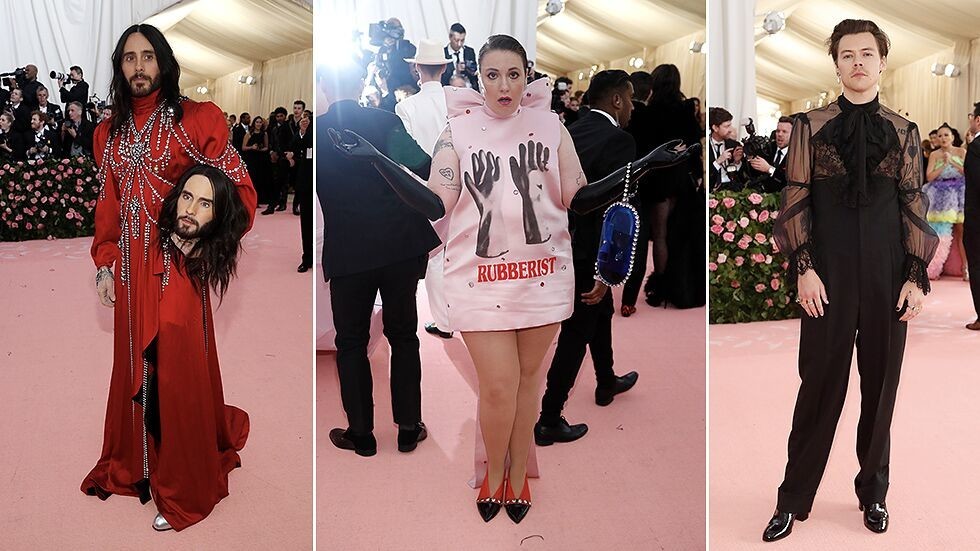
I like fashion, but the pretentious Met Gala grotesquery made me physically repulsed

Igor Ogorodnev
RT


 https://cdni.rt.com/files/2019.05/article/5cd1bbf5fc7e937b5c8b4624.jpeg


Just because “it’s like that on purpose” doesn’t mean that the look-at-me hideousness on display at the Met Gala is above criticism – in fact it arouses an almost visceral rejection. 
I don’t want to think of myself as too narrow-minded to understand the intent behind what is essentially a corporate-sponsored experimental fancy dress party for celebrities. In fact, I would venture that I myself have worn much riskier choices relative to the normal people around me (and I don’t have fawning assistants and fashion editors to validate my every sartorial idiocy).

But, seriously: Jared Leto in a crystal-harness gown holding his own head, corseted actor Ezra Miller with seven eyes on his face, performer Billy Porter carried in on a palanquin by six bare-chested buff men in lame trousers.


Yes, I know that the theme was camp, the justification for all the over-the-top gaudiness.
Yet I did not see any camp. Camp is playful and self-aware. The celebrities did not stand there and poke fun at how silly they looked, they posed with Blue Steel faces on the red carpet in the middle of not a burlesque cabaret, but one of the stuffiest invitation-only charity events in America. Pretension is the enemy of irony, and if there was any camp it was mostly unintentional. So, more like kitsch. Maybe Katy Perry, dressed as a hamburger and a chandelier, got it, though this seems to be just her taste anyway.

Read more

Thursday, 2 May 2019

Operation Mindfuck 2.0

Douglas Rushkoff
Medium.com

ropaganda used to mean getting people to believe stuff. Now it means getting them to question what they believe or whether there’s any truth at all. However disorienting this is, it may not be all bad.

The term “propaganda” originally referred to a 17th-century committee of Roman Catholic cardinals that sought to propagate the religion through foreign missions — the marginally and only temporarily benevolent face of European colonialism. In modern times, public relations guru Ed Bernays revived the term to describe the way Woodrow Wilson’s administration convinced Americans to support U.S. involvement in World War I. Propaganda was about telling the same story through so many media channels at once that there appeared to be only one story.

Today, however, the primary goal of government propaganda is to undermine our faith in everything. Not just our belief in particular stories in the news, but our trust in the people who are telling the stories, the platforms, and fact-based reality itself. Facts are, after all, the enemy of beliefs.

What many of us forget is that this new style of influence through disorientation is really an appropriation of the counterculture’s techniques. This is what the Situationists were doing. So were the hippies and “heads” of the 1960s.

Before Watergate anyway, it felt as if the press and the government were on the same side, telling the same story to us all. There was no way for the underfunded counterculture to compete with mainstream reality programming—except by undermining its premises. The flower children couldn’t overwhelm Richard Nixon’s National Guard troops, but they could put daisies in the barrels of their rifles.

Taken to the extreme, this sort of activist satire became Operation Mindfuck, first announced in 1968 by Robert Anton Wilson and Robert Shea in their Illuminatus Trilogy. The idea was to undermine people’s faith in government, authority, and the sanctity of consensus reality itself by pranking everything, all the time.

The idea of Operation Mindfuck was to break the trance that kept America at war, blindly consuming, and oblivious to its impact on the rest of the world. Destabilize the dominant cultural narrative through pranks and confusion. Say things that may or may not be true — but probably not. But maybe. 

Levitate the Pentagon as an act of protest. Publish conspiracy stories about Jackie Kennedy walking in on Lyndon Johnson sexually abusing the exit wound in JFK’s head when his body was being transported back to Washington, DC.

Read more

Sunday, 14 April 2019

The Dark History of the Minimum Wage


There's something strange about the idea of a minimum wage. It's one of those subjects that everyone has a strong opinion about, even if they have no idea what makes actual economic sense. But perhaps the most surprising thing of all is that the minimum wage has a dirty secret that most economists don't want you to know about. Today we explore The Dark History of the Minimum Wage.

Wednesday, 10 April 2019

Some social workers in denial about child psychopaths

Comment: This is a crucial subject.  We really need to see this as important as cancer in terms of public health and safety.

----------------------------

Dr. John J. Marshall
The Scotsman 


"Politically correct fears of labelling, stigma and rejection of genetic disposition science are getting in the way of truly tackling this serious problem."


Following the murder of six-year-old Alesha MacPhail by 16-year-old Aaron Campbell, psychologist Dr John J Marshall, who was involved in the case, writes that warm parenting can make a difference to children with psychopathic traits, but only at a young age, so it is vital to find those who display early warning signs.


Psychopathic traits are a devastating developmental trajectory. As the rape and murder of Alesha McPhail has shown, the ruthless self-interest and callousness associated with psychopaths lead to staggering human costs. You don’t become a psychopath on your 16th birthday. Psychopathic traits start in very early childhood, have predictable pathways and yet we do not assess children for this neurodevelopmental problem. As one of the psychologists involved in the Aaron Campbell case, having assessed psychopaths for 25 years in Scotland and carried out research on the topic, I feel determined that some good comes from this tragedy for Alesha’s family, in the form of raising awareness of the need for early prevention.

It would be tempting to think that the type of sadistic homicide carried out by Campbell is so rare that there is little we need to do about people with psychopathic traits. It is estimated that less than one to three per cent in the population will be diagnosed with these traits over their lifetime and even among offenders only around eight per cent are psychopathic. However, psychopaths are responsible for overwhelming misery, disproportionate amounts of crime, more varied offending and they are far more likely to be responsible for homicide. They may even be responsible for more than half of all persistent, violent crimes.

I assessed one psychopathic man in Scotland who was described by police as a “one-man crime wave” for his region before he was finally stopped. Other researchers also describe how people with psychopathic traits wreak havoc in relationships and organisations, bullying their staff and permeating work culture with manipulation and lying. Researchers are trying to focus on the causes of psychopathic traits and the early pathways children are launched on. 

To my own professional cost, over years I’ve repeatedly raised the issue of this devastating public health problem, along with the need to screen children referred to child and adolescent mental health services (CAHMS) and social work, for example. The response to such proposals has been highly negative. I’ve been vilified about labelling children, lectured on issues of mental health stigma, told psychopathic traits don’t exist in children despite the scientific evidence, and even faced dealing with complaints from professionals about using the term ‘callous-unemotional traits’ – a precursor to psychopathy – for a child.

Read more

Tuesday, 12 March 2019

Studying the demise of historic civilizations

"Collapse may be a normal phenomenon for civilisations, regardless of their size and technological stage"

Luke Kemp
Attack The System


Studying the demise of historic civilisations can tell us how much risk we face today, says collapse expert Luke Kemp. Worryingly, the signs are worsening.

Great civilisations are not murdered. Instead, they take their own lives.

DEEP CIVILISATION

This article is part of a new BBC Future series about the long view of humanity, which aims to stand back from the daily news cycle and widen the lens of our current place in time. Modern society is suffering from “temporal exhaustion”, the sociologist Elise Boulding once said. “If one is mentally out of breath all the time from dealing with the present, there is no energy left for imagining the future,” she wrote.

That’s why the Deep Civilisation season will explore what really matters in the broader arc of human history and what it means for us and our descendants.

So concluded the historian Arnold Toynbee in his 12-volume magnum opus A Study of History. It was an exploration of the rise and fall of 28 different civilisations.


He was right in some respects: civilisations are often responsible for their own decline. However, their self-destruction is usually assisted.

The Roman Empire, for example, was the victim of many ills including overexpansion, climatic change, environmental degradation and poor leadership. But it was also brought to its knees when Rome was sacked by the Visigoths in 410 and the Vandals in 455.

Collapse is often quick and greatness provides no immunity. The Roman Empire covered 4.4 million sq km (1.9 million sq miles) in 390. Five years later, it had plummeted to 2 million sq km (770,000 sq miles). By 476, the empire’s reach was zero.

Our deep past is marked by recurring failure. As part of my research at the Centre for the Study of Existential Risk at the University of Cambridge, I am attempting to find out why collapse occurs through a historical autopsy. What can the rise and fall of historic civilisations tell us about our own? What are the forces that precipitate or delay a collapse? And do we see similar patterns today?

Read more

Friday, 8 February 2019

35 Mind Blowing Facts About America That Previous Generations Of Americans Never Would Have Believed

Michael Snyder

The only thing that seems to be constant in our society is change, and today America is changing at a pace that is more rapid than we have ever seen before.  But is that a good thing or a bad thing?  For a moment, I would like for you to imagine what it would be like for a group of average Americans from 1919 to suddenly be transported to our time.  How do you think that they would feel about what we have become?  Certainly they would be absolutely amazed by our advanced technology, but beyond that they would almost certainly have very strong opinions about the current state of our society.  Similarly, if any of us were suddenly transported 100 years into the future, I am sure that we would be completely and utterly shocked by how things had changed.  The decisions that we make today are going to echo long into the future, and if we make very bad decisions there might not be a future for our country at all.

The following are 35 mind blowing facts about America that previous generations of Americans never would have believed…

#1 Approximately one-fourth of the entire global prison population is in the United States.
#2 By the time an American child reaches the age of 18, that child will have seen approximately 40,000 murders on television.
#3 The average U.S. adult “logs 6 hours, 43 minutes of total screen time daily”.
#4 Approximately 96 percent of all Americans use the Internet.
#5 According to the American Road and Transportation Builders Association, nearly 56,000 bridges in the United States are currently “structurally deficient”.  What makes that number even more chilling is the fact that vehicles cross those bridges a total of 185 million times a day.
#6 In more than half of all U.S. states, the highest paid public employee in the state is a football coach.
#7 The Pentagon has more square footage of office space than any other office building in the entire world.
#8 The state of Alaska is 429 times larger than the state of Rhode Island.  But Rhode Island has a significantly larger population than Alaska does.
#9 Alaska has a longer coastline than all of the other 49 U.S. states put together.
#10 The city of Juneau, Alaska is about 3,000 square miles in size. It is actually larger than the entire state of Delaware.
#11 The average age of America’s dams is now 52 years.
#12 The average supermarket in the United States wastes about 3,000 pounds of food each year.
#13 There are more than 75 million dogs in the United States, and that number is constantly growing.
#14 Montana has three times as many cows as it does people.
#15 The grizzly bear is the official state animal of California. But no grizzly bears have been seen in the state since 1922.

Read more

Sunday, 17 June 2018

1968: The Birth of New Conformism


"... the movement that emerged in response to postwar conformism was to realise a new form of conformism. In the period between 1970 and 1990, most of the ideas associated with the countercultural movement became absorbed by mainstream society. The 1960s obsession with individual self-fulfilment and emotional and personal issues was thoroughly written into society’s cultural script.

***

Frank Furedi
Spiked

From the standpoint of history, 1968 represents a brief interregnum. It did mark the end of the apathetic era of the 1950s. But it also foreshadowed the era of depoliticised conformism that kicked in in the early 1970s.

To understand the meaning of 1968, one has to understand that, during the late 1940s and 1950s, Western societies were haunted by the legacy of the interwar era – an era in which the social structure, and the largely liberal values on which it was purportedly based, were called into question. Such was the postwar fear of drawing attention to what amounted to a crisis of legitimacy that critical thought was banished to the margins of intellectual life. The marginalisation of critique and dissent was aided by the postwar boom, which served to distract society from the political impasse prevailing over public life. The Cold War was useful in this respect. It reinforced the mood of political passivity, channeling the public’s attention towards uniting against an external enemy.

But suddenly, out of nowhere, the 1960s countercultural movement appeared on the scene. To many at the time, it seemed as if the world had been turned upside down. As the head of the conservative Adenauer Foundation in West Germany put it, ‘The revolt of 1968 destroyed more values than did the Third Reich’. The 1960s countercultural movement succeeded in forcing significant sections of society to question the values that underpinned their daily existence.

The highpoint of the countercultural moment was the revolt of French students in May 1968. Their revolt, which helped mobilise French workers and precipitated a general strike, appeared to many as the precursor of an era of radicalism. With good reason: in the months after May, student protests proliferated, the civil-rights movement grew further, and mass demonstrations against the war in South-East Asia continued to dominate the headlines. Yet, in spite of what appeared to be a building momentum, the radical moment soon passed away. By the early 1970s, the counterculture had become de-radicalised, and it gradually entered the mainstream in the form of youth culture.

Read more

Wednesday, 13 June 2018

Sweden: Voyeurs Flock to Newly Gender Neutral Swimming Pool to Stare at Naked Women

Comment: Yet more insanity from the gender studies social policy groups. 

------------------------------------

breitbart.com

A programme at a Swedish open-air swimming bath in Malmö that eliminated gender-separate areas to encourage transgender bathers has resulted in men taking the opportunity to stare at naked women.

The programme, called “Queer Kallis”, is held on the first Monday of the month at the Ribersborgs kallbadhus, an open-air bath in the heavily migrant populated city of Malmö.

What organisers soon found, however, was that while very few transgender people were making use of the programme, men and boys used it as an excuse to enter women’s showers, changing rooms, and toilets, Aftonbladet reports.

“They were in the showers, in the restrooms, in the locker rooms, and on the bathing bridges. The place was invaded by men, not by transgenders from what I could see. Everything felt incredibly unpleasant,” said Jeanette Larsson, a lecturer in diversity issues, who recently attended the open-air bath.

According to Larsson, many women chose to simply leave the bath due to the presence of the men. While she did note some transgender individuals, she remarked that they were stared at and mocked by some of the men.

“It should be understood by anyone that it will be an open market for those who are only interested in looking at women’s bodies,” she added.

Read more

Monday, 11 June 2018

Tipping point for large-scale social change

Comment:  And it surely depends entirely on the quality and nature of that "tipping point". Social change is rooted in the quality of knowledge and perception - how well a group has read objective reality. The closer it is to truth the more probable it is these adopted "new norms" promote true freedom and emancipation.  Otherwise, it's just a tipping point for more social engineering which simply masks ideological subversion under the guise of "progress." 

----------------------------

Science Daily

When organizations turn a blind eye to sexual harassment in the workplace, how many people need to take a stand before the behavior is no longer seen as normal?

According to a new paper published in Science, there is a quantifiable answer: Roughly 25% of people need to take a stand before large-scale social change occurs. This idea of a social tipping point applies to standards in the workplace and any type of movement or initiative.

Online, people develop norms about everything from what type of content is acceptable to post on social media, to how civil or uncivil to be in their language. We have recently seen how public attitudes can and do shift on issues like gay marriage, gun laws, or race and gender equality, as well as what beliefs are or aren't publicly acceptable to voice.

During the past 50 years, many studies of organizations and community change have attempted to identify the critical size needed for a tipping point, purely based on observation. These studies have speculated that tipping points can range anywhere between 10 and 40%.

The problem for scientists has been that real-world social dynamics are complicated, and it isn't possible to replay history in precisely the same way to accurately measure how outcomes would have been different if an activist group had been larger or smaller.

"What we were able to do in this study was to develop a theoretical model that would predict the size of the critical mass needed to shift group norms, and then test it experimentally," says lead author Damon Centola, Ph.D., associate professor at the University of Pennsylvania's Annenberg School for Communication and the School of Engineering and Applied Science.

Drawing on more than a decade of experimental work, Centola has developed an online method to test how large-scale social dynamics can be changed.

In this study, "Experimental Evidence for Tipping Points in Social Convention," co-authored by Joshua Becker, Ph.D., Devon Brackbill, Ph.D., and Andrea Baronchelli, Ph.D., 10 groups of 20 participants each were given a financial incentive to agree on a linguistic norm. Once a norm had been established, a group of confederates -- a coalition of activists that varied in size -- then pushed for a change to the norm.

When a minority group pushing change was below 25% of the total group, its efforts failed. But when the committed minority reached 25%, there was an abrupt change in the group dynamic, and very quickly the majority of the population adopted the new norm. In one trial, a single person accounted for the difference between success and failure.

Read more

Friday, 1 June 2018

Danish Parliament Passes Ban on Burqa and Niqab

Red Ice

A majority in Denmark’s parliament has voted in favour of a ban on certain types of face-covering clothing in public, effectively banning the Islamic burqa and niqab from August 1st.

The Liberal, Conservative and Danish People’s parties all voted in favour of the bill, as did the opposition Social Democrats with the exception of MP Mette Gjerskov, thereby securing the majority.

MPs who are not ministers from Libertarian coalition partner Liberal Alliance voted against it, with the exception of one, Henrik Dahl, who voted in favour.

In total, the bill received 75 votes in favour and 30 votes against. Some MPs were absent from the vote in a so-called ‘clearing agreement’ in which all parties allow members to choose not to participate in a vote.

During the weeks-long parliamentary procedure of the bill, the government removed a provision allowing prison sentences as potential punishment for breaking the new law.

Violations of the anti-veil law will result in a 1,000 kroner (134 euros) fine for the first offence and up to 10,000 kroner for breaking the law for the fourth time or more.

The Danish People’s Party (DF) had earlier this week presented an amendment to the proposal that would have provided for prison sentences.

But with no broader support for the harsher punishment, DF voted in favour of the existing form of the bill.

Read more

Sunday, 27 May 2018

Society is not a science problem (but science's problems are social)

Martin Geddes


"Scientists are the easiest to fool. ... They think in straight, predictable, directable, and therefore misdirectable, lines. The only world they know is the one where everything has a logical explanation and things are what they appear to be. Children and conjurors—they terrify me. Scientists are no problem; against them I feel quite confident."
 
— James P. Hogan, Code of the Lifemaker
I semi-jokingly describe my job as being a "humanistic technophilosopher". It sounds a bit grandiose, but it's really an attempt to capture a simple idea: in our technological society, the most interesting stuff happens at the boundary of the humanities and the sciences.

Whilst it is common for scientists to lament the innumeracy of their artistic counterparts, it is my observation that scientists can be equally naive about the social. In fact, they can be even more profoundly ignorant, since the artists know they are mathematical weaklings, but the numerate are conceited that their reductionist rationalism is the right tool for political problems.


Understanding why this widespread arrogance exists may prove illuminating, and this is best shown via an example. Several people have pointed me at a published scientific paper by an Oxford University researcher about the scaling properties of "conspiracies". (Defining one is problematic, as we shall see, hence the scare quotes.) Can we take its conclusion — conspiracies don't scale well — at face value?


The paper's fatal flaw is easy to spot in its abstract and abstraction (my emphasis): "In this work, we establish a simple mathematical model for conspiracies involving multiple actors with time, which yields failure probability for any given conspiracy." Anyone who thinks complex historical narratives collapse to binary probabilities is already in deep trouble! Indeed, the idea that there is a single truth in the social is extremely contentious.


What this paper attempts is to produce a universal model of all phenomena whereby an intentional deception is jointly maintained over time by a closed group. It assumes there is a single and well-defined class of narrative called a "conspiracy", and furthermore presumes that the author has the superior wisdom and raw data to personally discriminate between truth and lies. The scientist, you see, is not so easily duped! These are also perfectly "true or false" phenomena in their totality, both in their construction (is it a conspiracy or not?) and their extinction (they either fail totally, or don't at all).


Having been a childhood victim of a Masonic conspiracy — the Jehovah's Witnesses cult — that operates persistently in the open, I feel in a somewhat privileged position to comment on Dr Grimes's epistemological endeavour. In short, it is demonstrably foolish, and illustrates why physics journals, for the sake of their credibility and integrity, should stay well away from commenting on sociological matters.
 

Read more

Friday, 25 May 2018

Sweden Warns Every Single Household to Prep for WAR

Daisy Luther 
The Organic Prepper 

The government of Sweden has produced a 20-page pamphlet which they’ll be sending to each of the 4.8 million households in the country urging them to get prepared for…WAR.
Although they haven’t been at war for over 200 years, for some reason, right now, they want their citizens to get prepped – and fast. This goes along with an article I wrote in January of 2018 when the government urged their people to be ready to cope “without help” for at least a week.
Shortly before Christmas, the Swedish government quietly published a paper called “Resilience.” Initially, the requirement had been for people to be prepared for 3 days without help, but it seems like that was a baby step. The government itself wants to be prepared for a 3-month long civil emergency and they’re urging citizens to take responsibility, too.
It really makes you wonder what is looming ahead, doesn’t it? (source)
This, however, is a direct approach, with the preparedness instructions delivered to their doors.

Here’s what the government of Sweden is recommending.

The booklet, titled, If Crisis or War Comes, is an updated version of one distributed in the 1980s. It was compiled by the Swedish Civil Contingencies Agency (MSB) and references several potential crises that could occur, according to the Swedish media:

  • disruptions to IT systems
  • incidents occurring in the rest of the world
  • climate change
  •  increased tension in the Baltic region
The brochure warns Swedes of things that every prepper knows. “In the event of a societal emergency, help will be provided first to those who need it most. The majority must be prepared to cope on their own for some time.” Here’s what Swedish website The Local has to say about the warnings.

Read more

Saturday, 14 April 2018

Brave New World: 64 million Americans Live in Multigenerational Households

Stock Board Asset 

The old America we knew, where living standards more than doubled each generation, has ceased to exist as new evidence suggests the percentage of Americans living in multigenerational households is at its highest since the post–World War II economic expansion.

Heavily indebted Americans are readjusting to a deterioration in living standards. Many of society’s lower-income consumers have already reshaped their lifestyles — towards living in a home with at least two adult generations. In other words, more Americans than ever in the last half-century are returning to their parents’ basement.

According to a new Pew Research Center report of census data, a record 64 million Americans, accounting for some 20 percent of the total U.S. population, lived in multigenerational family households in 2016, representing a three-decade continuous progression in this type of household formation — despite government propaganda that indicates economic improvements since the Great Recession.

Read more

Tuesday, 5 December 2017

IN SHADOW


IN-SHADOW: A Modern Odyssey from Lubomir Arsov on Vimeo.

Embark on a visionary journey through the fragmented unconscious of the West, and with courage face the Shadow. Through Shadow into Light.

“No tree, it is said, can grow to heaven unless its roots reach down to hell.”
-C.G. Jung

This film was created with earnest effort, diligence, and sacrifice. It is an urgent call to growth. If you are moved by the content, please SHARE.

Written, Directed & Produced by Lubomir Arsov

Original Soundtrack “Age of Wake” by Starward Projections

Composited by Sheldon Lisoy

Additional Compositing by Hiram Gifford

Art Directed & Edited by Lubomir Arsov

___

'IN-SHADOW' is an entirely independently funded, not-for-profit film. If you'd like to support the artist, DONATE here: (click the 'donate' tab) https://www.inshadow.net/

Gallery quality ART PRINTS available here: https://www.inprnt.com/gallery/inshadow/

Film Website: https://www.inshadow.net/

Facebook: https://www.facebook.com/inshadowmovie/

Music Composers: https://www.starwardprojections.com/

Contact: light@inshadow.net

© Lubomir Arsov 2017


Saturday, 25 March 2017

There Is Something Seriously Wrong With The World When…

The International Reporter
Katherine Frisk

There is something seriously wrong with the world: 
 
When a country, a government as well as individuals from that country fund, arm and train terrorists who have murdered thousands, tortured them, rounded up women and children and sold them on sex slave markets or used their bodies to harvest organs and yet the king of that same country flies all over the world in a disgusting display of wealth and opulence and gets to ride on golden escalators.

Those who pander to Saudi Arabia, bow and scrap before them and their arrogant princes, accept millions into their private bank accounts and ensure a steady stream of military hardware to this country, are the same people who demand that a duly elected President by the people of that country, not someone who considers himself the ultimate, infallible and unquestionable ruler due to his birth, must go.

Assad throughout the last six years has stood by Syria and the people of Syria in their time of desperate need. Although he is not a Christian he has shown support for Christians and even attended their church services. Unlike Saudi Arabia where Christians are not allowed to set foot in that country. Assad, like everyone else in Syria is fully aware that at anytime he might lose his life. And yet he has not fled to another country and taken his wealth with him as so many so-called world leaders do after they have lined their own pockets and the going has got too rough for them.

There is something seriously wrong with the world:

When thousands of people die, their families are broken up and their lives ruined due to heroin addiction and yet Afghanistan which is the world’s largest producer of opium is guarded by American military and uses NATO bases to fly out their very lucrative cargo of illegal narcotics. There is no war on drugs, it is a war for drugs.

The same can be said for the CIA who for many years now has been neck-deep in shipping cocaine out of South American countries and has infested the whole of American society to the point where cocaine usage is now considered the norm as opposed to the exception. Between heroin and cocaine it is no wonder that Western Nations have completely lost their minds, their moral compass and any semblance of integrity and real justice has been replaced by mafia criminal gangs, going by the names of the Federal Reserve Bank, the Council On Foreign Relations, Open Society Foundations,  Davos, the Bilderberg Group, the P2 lodge and so many others that now control every sector of society.

Read more

Monday, 6 March 2017

Guardian Warns Automation May Lead To Class Warfare And Genocide

SHTFPlan.com
 
Recently the establishment mouthpiece known as The Guardian, posted an article that tells you a lot about what the elites want. Specifically, how the elites want to control us with automation. The article discusses Bill Gates’ recent idea to tax robots as a way to mitigate the possibility that automation will cause more income inequality.

What’s particularly interesting about this article, is the nightmarish future that it predicts. If automation eventually eliminates all of our jobs; and with it, the political power and wealth of the common man, how will the elites respond? By separating themselves from the rest of society in private fortified communities, and then exterminating us when we grow resentful.
If that scenario isn’t bleak enough, consider the possibility that mass automation could lead not only to the impoverishment of working people, but to their annihilation. In his book Four Futures, Peter Frase speculates that the economically redundant hordes outside the gates would only be tolerated for so long. After all, they might get restless – and that’s a lot of possible pitchforks.

“What happens if the masses are dangerous but are no longer a working class, and hence of no value to the rulers?” Frase writes. “Someone will eventually get the idea that it would be better to get rid of them.” He gives this future an appropriately frightening name: “exterminism”, a world defined by the “genocidal war of the rich against the poor”.
To be fair, I don’t doubt that this is something that the elites want (and by elite, I don’t mean the 1%. More like the .00001 percent), or at least see as unfortunate and inevitable. The real propaganda in this article is the solution that is offered to this problem.

Read more

Saturday, 4 February 2017

SOTT.NET: The Health & Wellness Show: Nasty Women

sott.net

Sugar, spice and everything nice...that's what girls are made of. Society has played a role in promulgating the myth of the compassionate and tender female and people hold the belief that all women are pleasant and agreeable -- it's the males of the species who warrant suspicion. All women are kind and in touch with their emotions and the emotions of others. They're all nurturing caregivers with a strong mothering instinct. Right? Wrong! It's because of these false beliefs that people can be blindsided when a Nasty Woman crosses their path.

On this episode of the Health and Wellness Show we discuss Nasty Women -- the borderlines, the histrionics, the female psychopaths and the ones you can't quite label but you know something is off. What are their tactics, how do they differ from Nasty Men, who are their prey and how can we protect ourselves from these she-devils? 


Stay tuned for Zoya's Pet Health Segment where the topic will be species appropriate nutrition.
Running Time: 01:49:22
Download: OGG, MP3
Related Posts Plugin for WordPress, Blogger...