Search This Blog

Showing posts with label Bailout. Show all posts

Saturday, 9 June 2018

Argentina Just Made History With Biggest IMF Bailout Loan Ever

Zero Hedge

Just a few weeks after Argentina became ground zero for the coming Emerging Market crisis, when its currency suddenly collapsed at the end of April amid soaring inflation, exploding capital outflows and a central bank that was far behind the curve (as in “13% of rate hikes in a week” behind)…


… the IMF has officially bailed out the country – again – this time with a $50 billion, 36-month stand-by loan, and coming in about $10 billion more than rumored earlier in the week, it was the largest ever bailout loan in IMF history, meant to help restore investor confidence in a nation that, between its soaring external debt and current account deficit, prompted JPMorgan to suggest that along with Turkey, Argentina is in effect, doomed.

Read more

Friday, 18 May 2018

A Central Banking Insider Just Revealed the Blueprint For When the Next Crisis Hits

Zero Hedge

If you’re looking for insights into what Central Banks have planned when The Everything Bubble bursts, on Monday one of the European Central Bank’s (ECB) top bankers provided a blueprint.

Benoît Cœuré, has been a member of the Executive Board of the ECB since 2011. As such is one of SIX individuals who have dictated ECB policy during that time.
This means he’s been involved in:
  • The second and third Greek bailouts.
  • The Spain bailout.
  • The Portugal bailout.
  • The second and third Romania bailouts.
  • The Cyprus bail-ins.
Cœuré has operated at the highest level of monetary/ financial policy during a period in which numerous financial/banking systems were experiencing systemic risk.
Put simply, there are fewer than 100 people on the planet who are as familiar with how Central Banks perceive the risks in today’s financial system as well as the policies said Central Banks will unleash when the next crisis hits.

With that in mind, let’s take a look at what he had to say regarding both in the speech he gave titled The Future of Central Bank Money at the International Center for Monetary and Banking Studies in Geneva yesterday.
In my remarks this evening I would like to share some more general thoughts on the role of the central bank’s balance sheet in the economy. My focus will be on central bank liabilities – that is, money created by central banks to be used as a means of payment and store of value…
What distinguishes the discussion today from previous discussions, however, are three new facts: 
The first is that we are seeing a dramatic decline in the demand for cash in some countries, in particular Sweden and Norway.
The second is that central banks today could make use of new technologies that would enable the introduction of what is widely referred to as a “token-based” currency – one based on a distributed ledger technology (DLT) or comparable cryptographic technology.
And the third “new” fact, at least from a long-term perspective, relates to the role of central banks in setting monetary policy, and more recently to the emergence of negative rates as a policy instrument and the consequences for the transmission of monetary policy.
Source: ECB
Read more

Tuesday, 12 July 2016

Deutsche Bank requests €150 billion bailout to EU banks

Alex Christoforou
The Duran


Italy's Prime Minister, Matteo Renzi, fired shots at Germany's financial EU hegemony when, during a joint news conference with Swedish Prime Minister Stefan Lofven, said:
"If this non-performing loan problem is worth one, the question of derivatives at other banks, at big banks, is worth one hundred. This is the ratio: one to one hundred."
Renzi was referring to the massive, trillions of derivatives Deutsche Bank is carrying on its books. According to Renzi, Italy may have issues, but "other" European banks have much bigger problems.

Zerohedge provides context on Italy's banking woes..
In the aftermath of Brexit, much of the investing public's attention has turned to Italian banks which are in desperate need of a bailout as a result of €360 billion in bad loans growing worse by the day (and not a bail-in, as European regulations mandate, as that would lead to an immediate bank run) to avoid a freeze and/or collapse of Italy's banking sector. This has pushed stock prices - and default risk - on Italian banks to record levels. So far Italy's bailout requests have mostly fallen on deaf ears, as Germany's political leaders have resisted Renzi's recurring pleas for a taxpayer funded rescue. However, as we have alleged, and as the Italian Prime Minister admitted last week, the core risk for Europe is not just the Italian banking sector but the biggest bank of all in Europe: Deutsche Bank.
While we are just coming off the roller coaster ride that was the UK referendum, the European Union is about to go through another nausea inducing ride where not one, but two, very big EU players are about to get hammered. The messenger of more bad EU news, David Folkerts-Landau, the chief economist of Deutsche Bank, who has called for a multi-billion dollar bailout for European banks.

Read more

Friday, 23 October 2015

Meanwhile, in Iceland, the 26th banker has been jailed for their role in the 2008 financial crisis

The Independent i100

While British and American bankers who brought the world's economy to its knees in 2008 have barely faced the consequences for their actions, in Iceland, it's a different story.

The Nordic nation, which was one of the worst affected by the 2008 financial crisis, has sentenced 26 bankers to a combined 74 years in prison.

In two separate rulings last week, the Supreme Court of Iceland and Reykjavik District Court sentenced six top managers of two national banks for crimes committed in the lead up to the banking sector's collapse, bringing the total number of people who have faced the music for their roles in the crash to 26. 

At the moment the maximum penalty for white collar crime in Iceland is six years. 

Iceland deregulated its financial sector in 2001, and manipulation of the markets by bankers led to a system-wide meltdown when the global economy tanked in 2008. 

Iceland's economy is now in comparatively rude health since the country was forced to borrow heavily from the International Monetary Fund seven years ago. 

As Iceland's president Olafur Ragnar Grimsson said when asked how the country recovered so quickly:
"We were wise enough not to follow the traditional prevailing orthodoxies of the Western financial world in the last 30 years."
"We introduced currency controls, we let the banks fail, we provided support for the poor, and we didn’t introduce austerity measures like you’re seeing in Europe.
In the US and the UK, of course, we just bailed them out. 

HT US Uncut

More:This banker has raised millions for the Conservative party. He's just been knighted
More: Bankers more likely to lie, cheat


Friday, 11 September 2015

Brussels to embark on radical plans to create joint EMU treasury and euro parliament

Comment: You couldn't get anything more blatantly fascist...

--------------------

The Telegraph

The survival of economic and monetary union will require the creation of new supra-national institutions, including a joint eurozone treasury and a separate euro parliament, according to the single currency's bail-out chief. 

Klaus Regling, head of the European Stability Mechanism (ESM), joined a clamour of voices in Brussels who are pushing for member states to cede sovereignty in bid to establish a full-blown fiscal union on the Continent. 

The first step will be the creation of a eurozone finance ministry, backed by a separate chamber for the currency's 19 member states in the European parliament, said Mr Regling, who oversees the euro's €500bn rescue fund. 

The move is necessary to "increase the robustness and minimise the vulnerabilities of the currency union", said Mr Regling.

He added it would "imply a significant transfer of sovereignty, requiring democratic legitimacy", which could be provided by a "special chamber of the European Parliament composed of deputies solely from euro area Member States". 

Read more

Thursday, 13 August 2015

What crisis? Germany made 100 BILLION euros from Greek suffering


© Associated Press
Sputnik
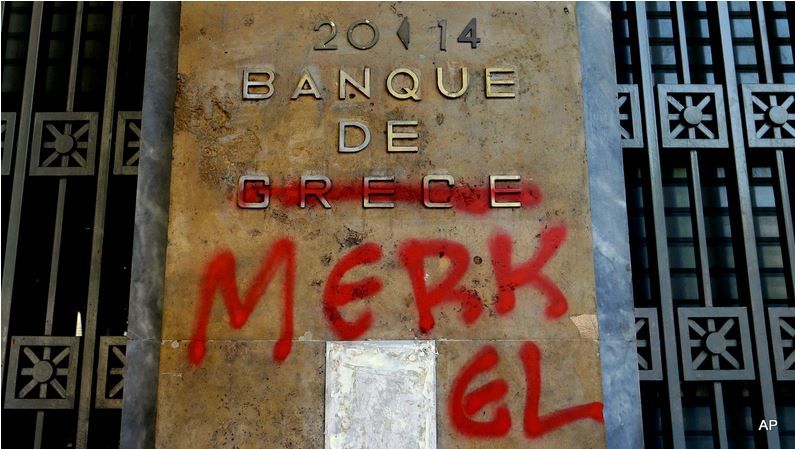
Red spray paint covers a French-language Bank of Greece sign to read ‘Bank of Merkel’ in reference to German Chancellor Angela Merkel in Athens, Monday, July 6, 2015.
The German government, which has taken a hard line on Greece, has saved some 100 billion euros ($109 billion) in the country's financial crisis thanks to lower borrowing costs, a study has found.

Germany saved through lower interest payments on funds the government borrowed amid investor "flights to safety," the German-based non-profit Halle Institute for Economic Research (IWH) said in its paper published Monday. 


"These savings exceed the costs of the crisis - even if Greece were to default on its entire debt," the study said. "Germany has clearly benefited from the Greek crisis."

In the face of turmoil, investors seeking a safe haven for their money within the euro zone turned to export champion Germany, which "disproportionately benefited" from that during the debt crisis, the IWH said.

"Every time financial markets faced negative news on Greece in recent years, interest rates on German government bonds fell, and every time there was good news, they rose."

Germany, the euro zone's effective paymaster, has demanded fiscal discipline and tough economic reforms in Greece in return for consenting to new aid from international creditors, Agence France-Presse reported.

Finance Minister Wolfgang Schaeuble has opposed a Greek debt write-down while pointing to his own government's balanced budget.

The balanced budget, however, was facilitated largely by Germany's interest savings amid the Greek debt crisis, according to the study. The estimated 100 billion euros Germany saved since 2010 accounted for more than 3% of GDP, according to the IHW.

"Even if Greece doesn't pay back a single cent, the German public purse has benefited financially from the crisis," said the paper.

At the same time, the bonds of other countries - including the United States, France and the Netherlands - also benefited, but "to a much smaller extent."

Greece and its creditors are working on the draft of a new bailout of up to 86 billion euros ($94 billion) in exchange for further reforms, AFP reported. They are aiming for a deal before Greece must repay 3.4 billion euros to the European Central Bank on August 20. 

Sunday, 2 August 2015

Anglo Irish Bank officials jailed for offences related to financial crash

The Guardian
 

The bank’s failure played a major part in forcing the government to seek help from the EU and IMF.

Three officials from the bank that almost bankrupted Ireland have become the first bankers to be jailed for offences related to the Republic’s financial crash.

The failure of Anglo Irish Bank, which became synonymous with the casino-style lending practices that drove Ireland’s “Celtic Tiger” boom and subsequent bust, cost the state €30bn (£21bn), part of what forced the government to seek a bailout from the European Union and the International Monetary Fund.

The trio worked at the now defunct bank and were found guilty on Friday afternoon at Dublin’s circuit criminal court of hiding accounts related to bank boss Sean Fitzpatrick and of conspiring to defraud the tax authorities.

On Friday the court sentenced former chief operations officer Tiarnan O’Mahoney, 56, to three years in prison and former company secretary Bernard Daly, 67, to two years. Aoife Maguire, a former assistant manager, was given 18 months.

Read More

Monday, 6 July 2015

Greece votes no - Let the chaos begin...

Michael Snyder
The Economic Collapse


The result of the referendum in Greece is a great victory for freedom, but it is also threatens to unleash unprecedented economic chaos all across Europe. With almost all of the votes counted, it is being reported that approximately 61 percent of Greeks have voted "no" and only about 39 percent of Greeks have voted "yes". This is a much larger margin of victory for the "no" side than almost everyone was anticipating, and it represents a stunning rejection of European austerity. Massive celebrations have erupted on the streets of Athens and other major Greek cities, but the euphoria may not last long. Greek Prime Minister Alexis Tsipras is promising that Greece will be able to stay in the euro, but that gives EU bureaucrats and the IMF a tremendous amount of power, because at this point the Greek government is flat broke. Without more money from the EU and the IMF, the Greek government will not be able to pay its bills and virtually all Greek banks will inevitably collapse. Meanwhile, the rest of Europe is about to experience a tremendous amount of pain as financial markets respond to the results of this referendum. The euro is already plummeting, and most analysts expect European bond yields to soar and European stocks to drop substantially when trading opens on Monday morning.

Personally, I love the fact that the Greek people decided not to buckle under the pressure being imposed on them by the EU and the IMF. But amidst all of the celebration, the cold, hard reality of the matter is that your options are extremely limited when you are out of money.

How is the Greek government going to pay its bills without any money?

How are the insolvent Greek banks going to operate without any money?

How is the Greek economy going to function without any money?

Now that the Greek people have overwhelmingly rejected the demands of the creditors, it will be very interesting to see what the EU and the IMF do. Prior to the referendum, European leaders were insisting that a "no" vote would put an end to negotiations and would force Greece to leave the euro.

Now that the results are in, are they going to change their tune? Because the ball is definitely in their court...

"This does two things: it legitimises the stance of the Greek government and it leaves the ball in Europe's court," ANZ Bank analysts said in a note.

"Europe either folds or Greece goes bankrupt; over to you Merkel."
So would they actually let Greece go bankrupt?

It is going to be fascinating to watch what happens over the next few days. Right now, Greek banks are on life support. If the European Central Bank decides to pull the plug, they would essentially destroy the entire Greek banking system. The only thing that can keep Greek banks alive and kicking is more intervention from the ECB. The following comes from the New York Times... 


Read more

Greek debt crisis: Yanis Varoufakis resigns after being forced out by EU chiefs

The Independent

Yanis Varoufakis has announced he is standing down despite Greece's No vote in the referendum on proposed austerity measures.
 

In a blog post entitled “Minister No More”, published on Monday morning, the Greek finance minister said he was standing down because of pressure from Greece’s European partners. 

Read more

More than 61% of Greeks say 'No' in crucial bailout referendum – final tally

Comment: With a little on hand advice from Putin...

----------------

RT

More than 61 percent of Greeks have voted “No” in Sunday’s referendum on the bailout deal and austerity measures, reported the Interior Ministry after 100 percent of the vote had been counted.

More than 61 percent of Greeks have voted “No” in Sunday’s referendum on the bailout deal and austerity measures, reported the Interior Ministry after 100 percent of the vote had been counted.

Thousands of people took to Syntagma square in front of the Greek parliament in Athens to celebrate the ‘No’ vote, which was called “a big Yes to democratic Europe” by the country’s finance minister, Yanis Varoufakis. 

"As of tomorrow, with this brave ‘No’ the Greek people handed us.... we will extend a helping hand towards our lenders. We will call on each one of them to find common ground. As of tomorrow, Europe, whose heart is beating in Greece tonight, is starting to heal its wounds, our wounds,” Varoufakis said, as cited by Reuters. 

Greek Prime Minister Alexis Tsipras praised the ‘No’ vote in the referendum, saying that his government is ready to return to negotiations with creditors immediately so that the country’s banks could re-open. 

Read more

Tuesday, 16 June 2015

Greece crisis: Athens poised on the verge of catastrophic debt default as bailout talks collapse


The world’s financial markets are facing up to the possibility that Greece could soon become the first country to crash out of Europe’s single currency. Talks between Athens and its eurozone creditors have collapsed in acrimony just days before a final deadline for Greece to unlock the €7.2bn (£5.2bn) in bailout funds it needs to avoid a catastrophic debt default.

The Greek Prime Minister, Alexis Tsipras, accused the creditor powers of hidden “political motives” in their demands that Greece make further cuts to public pension payments in return for the financial aid. “We are shouldering the dignity of our people, as well as the hopes of the people of Europe,” Mr Tsipras said in a defiant statement. “We cannot ignore this responsibility. This is not a matter of ideological stubbornness. This is about democracy.”

Günther Oettinger, a European Commissioner and member of the German Chancellor’s ruling Christian Demorcrat party, hit back –suggesting Greece could soon be designated an “emergency area” if it fails to pay its debts later this month.

Read more

Saturday, 4 April 2015

Greece Drawing Up Contingency Plans To Nationalize Banks, Bring In Parallel Currency: Report

IBT 

According to a report in the Telegraph, sources close to the Syriza-led government said: “We will shut down the banks and nationalize them, and then issue IOUs if we have to, and we all know what this means. What we will not do is become a protectorate of the EU.”

Greece is due to make a payment of 458 million euros ($498 million) to the International Monetary Fund (IMF) on April 9. But officials told a conference call of Euro Zone deputy finance ministers this week that the country would run out of money by then, raising the possibility of a default on the IMF loan.

Greece's leftist government was swept to power in January, pledging to renegotiate the terms of the country's international bailout, and put an end to internationally supported austerity policies that ministers have said are responsible for a “humanitarian crisis” in the country.

Interior Minister Nikos Voutsis said on Wednesday that the country would have to decide whether to pay back the IMF or pay salaries and pensions. He said it would choose the latter, Reuters reported.

Greece has submitted a list of reforms to its international creditors, which, if approved, will unlock a further tranche of bailout funds. The government is keen to increase revenue by cracking down on the tax evasion that is widespread in the country while maintaining public services.

Read more

Thursday, 5 March 2015

IMF Director Admits: Greek Bailout Was "To Save German & French Banks"

Keep Talking Greece

This was never said officially before! “They gave money to save German and French banks, not Greece,” Paolo Batista, one of the Executive Directors of International Monetary Fund told Greek private Alpha TV on Tuesday. Batista strongly criticized not only the euro zone and the European Central Bank but also the IMF and the Fund’s managing Director Christine Lagarde for defending Europe much too much.. 

He urged Greece to directly negotiate with the IMF and favored the restructuring of the Greek debt that is been hold by the European partners. 

Video: English with Greek subtitles


YouTube Direkt
 
Paulo Nogueira Batista is from Brazil and represents ten Latin America countries in the IMF board of Directors.

Alpha TV

Wednesday, 21 January 2015

Greece's Bailout Programs Are Not Working

Zero Hedge

Greece's bailout program is not working. After receiving hundreds of billions of Euros in new loans to stave off a sovereign default, Greeks are on the verge of electing a new government that may throw Eurozone politics into turmoil.

From the outset, this was always going to be a tricky one for European bureaucrats and lenders. Restoring the solvency of a state which historically had great difficulties in collecting taxes from its citizens was not going to be easy. Moreover, the crash exposed fundamental flaws in the Greek economy, which at the time turned out to be a leading indicator for other Southern Eurozone countries.

With the world still reeling from the Great Recession, in 2010 Greece applied for a rescue program as its funding costs soared once the fragility of its finances could no longer remain hidden.

It can be argued that if debt balances had been restructured there and then to levels where they could actually be paid off over an extended period of time, together with unpleasant but sensible fiscal policies – as we shall see, taking into account important differentiators of the Greek economy – the cost of the bailout could have been much more manageable.

Instead, what the Greeks got was even more debt – so much in fact that a restructuring program had to be implemented just a couple of years later – together with a strict austerity program to quickly restore the country’s fiscal position, eventually leading to rising waves of unemployment and general discontent. Greece’s sovereign debts now represent almost 180% of GDP, a jump of some 20 percentage points from the post-debt restructuring levels of 2012.

The Eurozone and the International Monetary Fund have provided an eye popping €254 billion in loans to Greece since 2010. More than half has been used for debt servicing, and another 19% to recapitalize the domestic banks. Only about 11% of the total was used by the government for non-financial items. Greek taxpayers thus underwrote the whole deal but only got a fraction of the funds, at a time of severe government cutbacks and never ending tax hikes.

It is hardly surprising that they are close to a breaking point. The radical left-wing Syriza party is now in pole position to win the elections on January 26, campaigning on a promise to write off at least a third of Greece’s total debt and alleviate the austerity measures.

How things will play out in Greece and abroad is anybody’s guess. But it is important to consider the factors which have contributed to the current state of affairs.

Read more

See also: Germany Prepares for Possible Greek Exit from Euro-zone


Tuesday, 2 December 2014

New G20 Rules: Cyprus-style Bail-ins to Take Deposits AND Pensions

Ellen Brown

On the weekend of November 16th, the G20 leaders whisked into Brisbane, posed for their photo ops, approved some proposals, made a show of roundly disapproving of Russian President Vladimir Putin, and whisked out again. It was all so fast, they may not have known what they were endorsing when they rubber-stamped the Financial Stability Board’s “Adequacy of Loss-Absorbing Capacity of Global Systemically Important Banks in Resolution,” which completely changes the rules of banking.

Russell Napier, writing in ZeroHedge, called it “the day money died.” In any case, it may have been the day deposits died as money. Unlike coins and paper bills, which cannot be written down or given a “haircut,” says Napier, deposits are now “just part of commercial banks’ capital structure.” That means they can be “bailed in” or confiscated to save the megabanks from derivative bets gone wrong.

Rather than reining in the massive and risky derivatives casino, the new rules prioritize the payment of banks’ derivatives obligations to each other, ahead of everyone else. That includes not only depositors, public and private, but the pension funds that are the target market for the latest bail-in play, called “bail-inable” bonds.

“Bail in” has been sold as avoiding future government bailouts and eliminating too big to fail (TBTF). But it actually institutionalizes TBTF, since the big banks are kept in business by expropriating the funds of their creditors.

It is a neat solution for bankers and politicians, who don’t want to have to deal with another messy banking crisis and are happy to see it disposed of by statute. But a bail-in could have worse consequences than a bailout for the public. If your taxes go up, you will probably still be able to pay the bills. If your bank account or pension gets wiped out, you could wind up in the street or sharing food with your pets.

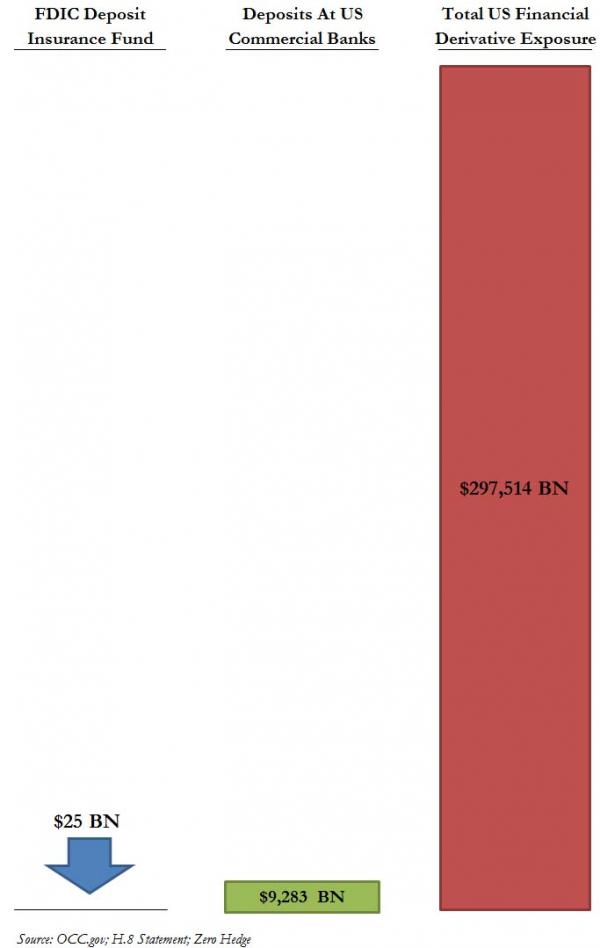
In theory, US deposits under $250,000 are protected by federal deposit insurance; but deposit insurance funds in both the US and Europe are woefully underfunded, particularly when derivative claims are factored in. The problem is graphically illustrated in this chart from a March 2013 ZeroHedge post:

Deposits vs Reserves vs Derivs_0 #2

More on that after a look at the new bail-in provisions and the powershift they represent.

Bail-in in Plain English

The Financial Stability Board (FSB) that now regulates banking globally began as a group of G7 finance ministers and central bank governors organized in a merely advisory capacity after the Asian crisis of the late 1990s. Although not official, its mandates effectively acquired the force of law after the 2008 crisis, when the G20 leaders were brought together to endorse its rules. This ritual now happens annually, with the G20 leaders rubberstamping rules aimed at maintaining the stability of the private banking system, usually at public expense.

According to an International Monetary Fund paper titled “From Bail-out to Bail-in: Mandatory Debt Restructuring of Systemic Financial Institutions”:
[B]ail-in . . . is a statutory power of a resolution authority (as opposed to contractual arrangements, such as contingent capital requirements) to restructure the liabilities of a distressed financial institution by writing down its unsecured debt and/or converting it to equity. The statutory bail-in power is intended to achieve a prompt recapitalization and restructuring of the distressed institution.
The language is a bit obscure, but here are some points to note:
  • What was formerly called a “bankruptcy” is now a “resolution proceeding.” The bank’s insolvency is “resolved” by the neat trick of turning its liabilities into capital. Insolvent TBTF banks are to be “promptly recapitalized” with their “unsecured debt” so that they can go on with business as usual.
  • “Unsecured debt” includes deposits, the largest class of unsecured debt of any bank. The insolvent bank is to be made solvent by turning our money into their equity – bank stock that could become worthless on the market or be tied up for years in resolution proceedings.
  • The power is statutory. Cyprus-style confiscations are to become the law.
  • Rather than having their assets sold off and closing their doors, as happens to lesser bankrupt businesses in a capitalist economy, “zombie” banks are to be kept alive and open for business at all costs – and the costs are again to be to borne by us.
The Latest Twist: Putting Pensions at Risk with “Bail-Inable” Bonds

First they came for our tax dollars. When governments declared “no more bailouts,” they came for our deposits. When there was a public outcry against that, the FSB came up with a “buffer” of securities to be sacrificed before deposits in a bankruptcy. In the latest rendition of its bail-in scheme, TBTF banks are required to keep a buffer equal to 16-20% of their risk-weighted assets in the form of equity or bonds convertible to equity in the event of insolvency.

Called “contingent capital bonds”, “bail-inable bonds” or “bail-in bonds,” these securities say in the fine print that the bondholders agree contractually (rather than being forced statutorily) that if certain conditions occur (notably the bank’s insolvency), the lender’s money will be turned into bank capital.
However, even 20% of risk-weighted assets may not be enough to prop up a megabank in a major derivatives collapse. And we the people are still the target market for these bonds, this time through our pension funds.

In a policy brief from the Peterson Institute for International Economics titled “Why Bail-In Securities Are Fool’s Gold”, Avinash Persaud warns, “A key danger is that taxpayers would be saved by pushing pensioners under the bus.”

It wouldn’t be the first time. As Matt Taibbi noted in a September 2013  article titled “Looting the Pension Funds,” “public pension funds were some of the most frequently targeted suckers upon whom Wall Street dumped its fraud-riddled mortgage-backed securities in the pre-crash years.”
Wall Street-based pension fund managers, although losing enormous sums in the last crisis, will not necessarily act more prudently going into the next one. All the pension funds are struggling with commitments made when returns were good, and getting those high returns now generally means taking on risk.

Other than the pension funds and insurance companies that are long-term bondholders, it is not clear what market there will be for bail-in bonds. Currently, most holders of contingent capital bonds are investors focused on short-term gains, who are liable to bolt at the first sign of a crisis. Investors who held similar bonds in 2008 took heavy losses. In a Reuters sampling of potential investors, many said they would not take that risk again. And banks and “shadow” banks are specifically excluded as buyers of bail-in bonds, due to the “fear of contagion”: if they hold each other’s bonds, they could all go down together.

Whether the pension funds go down is apparently not of concern.

Propping Up the Derivatives Casino: Don’t Count on the FDIC

Kept inviolate and untouched in all this are the banks’ liabilities on their derivative bets, which represent by far the largest exposure of TBTF banks. According to the New York Times:
American banks have nearly $280 trillion of derivatives on their books, and they earn some of their biggest profits from trading in them.
These biggest of profits could turn into their biggest losses when the derivatives bubble collapses.
Both the Bankruptcy Reform Act of 2005 and the Dodd Frank Act provide special protections for derivative counterparties, giving them the legal right to demand collateral to cover losses in the event of insolvency. They get first dibs, even before the secured deposits of state and local governments; and that first bite could consume the whole apple, as illustrated in the above chart.
The chart also illustrates the inadequacy of the FDIC insurance fund to protect depositors. In a May 2013 article in USA Today titled “Can FDIC Handle the Failure of a Megabank?”, Darrell Delamaide wrote:
[T]he biggest failure the FDIC has handled was Washington Mutual in 2008. And while that was plenty big with $307 billion in assets, it was a small fry compared with the $2.5 trillion in assets today at JPMorgan Chase, the $2.2 trillion at Bank of America or the $1.9 trillion at Citigroup.
. . . There was no possibility that the FDIC could take on the rescue of a Citigroup or Bank of America when the full-fledged financial crisis broke in the fall of that year and threatened the solvency of even the biggest banks.
That was, in fact, the reason the US Treasury and the Federal Reserve had to step in to bail out the banks: the FDIC wasn’t up to the task. The 2010 Dodd-Frank Act was supposed to ensure that this never happened again. But as Delamaide writes, there are “numerous skeptics that the FDIC or any regulator can actually manage this, especially in the heat of a crisis when many banks are threatened at once.”

All this fancy footwork is to prevent a run on the TBTF banks, in order to keep their derivatives casino going with our money. Warren Buffett called derivatives “weapons of financial mass destruction,” and many commentators warn that they are a time bomb waiting to explode. When that happens, our deposits, our pensions, and our public investment funds will all be subject to confiscation in a “bail in.” Perhaps it is time to pull our money out of Wall Street and set up our own banks – banks that will serve the people because they are owned by the people.
__________________

Ellen Brown is an attorney, founder of the Public Banking Institute, and author of twelve books including the best-selling Web of Debt. Her latest book, The Public Bank Solution, explores successful public banking models historically and globally. Her 200+ blog articles are at EllenBrown.com.

Monday, 31 March 2014

IMF to Ukraine: We'll Give You Money If You Give Us Austerity

Comment: More cartel capitalism from the "Structural Adjustment Team"

-------------------------------

Common Dreams

The International Monetary Fund announced on Thursday a $14 to $18 billion "bailout" for Ukraine that is contingent on Kiev's imposition of stringent austerity measures.


The package, which is slated for approval by the IMF's board next month, will unlock credits of up to $27 billion from the United States, European Union, Japan, and other countries over the coming years if Ukraine imposes "economic reforms."

According to Reuters, the IMF's requirements include: "allowing the national currency, the hryvnia, to float more freely against the dollar, increasing the price of gas for the domestic consumer, overhauling finances in the energy sector and following a more stringent fiscal policy."

Ukraine's new government on Wednesday passed a drastic increase in domestic gas prices, to take effect May first, and pledged to gradually reduce energy subsidies — a widely unpopular move that former President Viktor Yanukovych refused to take.

The deal comes amid ongoing anti-austerity protests across Europe, including hundreds of thousands strong protests across Spain over the weekend. Critics charge that austerity measures, by eroding vital public goods and services, deepen crises of poverty and inequality.

Saturday, 8 March 2014

8 Events That Prove Your Money Is Not Safe In Europe, Or Anywhere

Jeff Berwick

As I write this, the European Union has just announced a possible $15b aid package to Ukraine (including 8 billion euros in fresh credit).

Everybody has read the headlines about Europe: record unemployment, no end in sight, and so on.

So you might be wondering just where the European Union, and its constituent nations, scraped together the money to propose aid for Ukraine.

Well, wonder no more, because the following eight events might give you an idea of where governments go to get a little extra cash. 

1. In March, 2009, Ireland seized €4bn from its Pension Reserve fund in order to rescue its banks. In November 2010, the remaining savings of €2.5bn was seized to support the bailout of the rest of the country.

2. In December, 2010, Hungary told its citizens that they could either remit their private pension money to the state or lose their state pension funds (but still have to pay for it nonetheless).

3. In November, 2010, the French parliament decided to earmark €33bn from the national reserve pension fund FRR to reduce the short-term pension scheme deficit.

4. In early January 2011, $60 million in private retirement funds were transferred to the state's pension scheme in Bulgaria.  They wanted to transfer $300 million, but were denied on their first attempt.

5. In the Spring of 2013 Cyprus took it a step further and outright confiscated up to 50% of the funds from bank account holders in that country.

6. In the Fall of 2013 the Polish government announced it would transfer to the state (aka. confiscate) the bulk of assets owned by the country's private pension funds (many of them owned by such foreign firms as PIMCO parent Allianz, AXA, Generali, ING and Aviva), without offering any compensation. 

7.  In February 2014, Italian banks were ordered by the Italian government to withhold a 20% tax on all inbound wire transfers. Il Sole reported, "the deductions will be automatic (unless prior request for exclusion), and then it will be up to the taxpayer to prove that the money is not in the nature of compensation 'income.'"

 8. The savings of all 500 million Europeans can be stolen by the European Union. Why? Because the financial crisis is not over, according to an EU document. The Commission is looking to ask the bloc's insurance watchdog in the second half of 2014 for advice on how to draft a law "to mobilize more personal pension savings for long-term financing," the document said.

So you see, European governments and institutions have already begun seizing private pension funds, slapping 20% taxes on all incoming wire transfers, confiscating up to 50% from private bank accounts and even stating all the savings of Europe are fair game.  As we've said before, this phenomenom of wealth confiscation won't stay confined to Europe. The US has also taken measures to ensure ease of access to the funds of everyday Americans.

 We’ve said for many years now that the US government and almost all Western governments are bankrupt. This means they will try to confiscate as much wealth as possible from people who don't carefully save before the collapse. Mark our words: US 401ks and IRAs will be nationalized in the next four years as well—maybe as soon as the next one or two years.

 If you've stayed in tune with the Dollar Vigilante blog, you probably already understood this. If you haven't already, be sure to check into our subscription services to gain access to the intelligence you need to stay ahead of the pack.

Anarcho-Capitalist. Libertarian. Freedom fighter against mankind’s two biggest enemies, the State and the Central Banks. Jeff Berwick is the founder of The Dollar Vigilante, CEO of TDV Media & Services and host of the popular video podcast, Anarchast. Jeff is a prominent speaker at many of the world’s freedom, investment and gold conferences as well as regularly in the media including CNBC, CNN and Fox Business.


Monday, 27 January 2014

Bailout Architect Runs For California Governor; World Laughs

 
Neel Kashkari

Matt Taibbi
Rolling Stone

I want to apologize for this space being blank for quite some time. I actually spent the bulk of the last two days on a long blog post about the "Dr. V." story in Grantland. But then I got all the way to the end, and realized I was completely wrong about the entire thing.

So, I spiked my own piece. Now I've been in Talk Radio-style "This is totally dead air, Barry" territory for about two weeks. I could swear I saw a cobweb when I logged on this morning.

So thank God for Neel Kashkari, and the news that this goofball footnote caricature of the bailout era has decided to run for Governor of California. Never in history has there been an easier subject for a blog post.

If you don't remember Kashkari's name, you might be excused – he was actually better known, in his 15 minutes of fame five years ago, as "The 35 year-old dingbat from Goldman someone put in charge of handing out $700 billion bailout dollars."

Now you remember. That guy! Neel Kashkari when he first entered the world of politics was a line item, usually the last entry in a list of ex-Goldman employees handed prominent government and/or regulatory positions, as in, ". . . and, lastly, Neel Kashkari, the heretofore unknown Goldman banker put in charge of the TARP bailout program . . ."

Kashkari was not just a former Goldman banker handed a high government post – he was a former Goldman banker handed a high government post by a former Goldman banker, in this case former Goldman CEO and then-Treasury Secretary Hank Paulson.

Neel was also the human parallel to the original TARP proposal written by Paulson, which was famously just three pages long.

Paulson's TARP proposal was essentially the last, unaired episode of Beavis and Butthead, with the three pages of script just containing a single scene in which Butthead walks into the U.S. Senate and says, "Can you, uh, like, give us 700 billion dollars? Uh-huh-huh."

Kashkari then was more or less an equally blank slate, a little-known tech banker from Goldman's San Francisco office who somehow ended up being Paulson's choice to administer a bailout that Paulson wanted to feature no oversight whatsoever. The original three-page proposal specified no review "by any court of law or any administrative agency."

It never came to that, not exactly – Paulson had to expand his three-page proposal – but it's worth remembering now that the Treasury's original plan for the bailout was to give literally unlimited powers to distribute $700 billion of taxpayer money to a low-level banker that prior to 2006, even Hank Paulson had never heard of.

So Kashkari takes the job as bailout czar and starts hurling fistfuls of cash at the banks, in a fashion that turned out later to have been beyond haphazard. Critically, even though the Treasury promised only to give out TARP funds to institutions that were "healthy" and "viable," Kashkari had no protocol in place to even decide whether a bailout recipient was solvent or not.

They forked over billions in cash to failing institutions and then failed to enforce crucial provisions, like for instance measures put in place to prevent executives from bailout-out companies from giving themselves huge bonuses.

This latter failure was what led to one of Kashkari's more infamous public appearances, in which Maryland congressman Elijah Cummings raked Kashkari over the coals for allowing AIG executives to give themselves $503 million in bonuses. "I wouldn't want to be asking my friend for some money to stay afloat," hissed Cummings. "Then my friend, who can barely afford to go to McDonald's, sees me in a restaurant costing $150 a meal. There's absolutely something wrong with that picture!" He added:
I'm just wondering how you feel about an AIG giving $503 million worth of bonuses on the one hand, and accepting $154 billion from hard-working taxpayers. You know, because I'm trying to make sure you get it. What really bothers me is all these other people who are lined up. They say, well, is Kashkari a chump?
After this "chump" episode, and others, Kashkari apparently became despondent. He and his wife reportedly were particularly upset by a snickering item in Gawker. The item read, "Financial Crisis Taking a Toll on Our Favorite Asshole Banker," and made the neatly cruel observation that that Kashkari, who was a fit/lean/bald banker of Paulsonian persuasion when he arrived in Washington, had begun "putting on classic stress-related weight under his chin."

The item featured before and after photos. The "after" photo was shot from just below chin level. It was brutal.

Now, a lot of people have been ripped in Gawker. I think everyone with a Q rating above 0.00003 has been ripped in Gawker. I personally remember having to Google-image Peter Beinart because Gawker described me as looking like the computer-generated love child of Beinart and Ashton Kutcher. It's an Internet-age rite of passage and they give great service – I mean, Gawker's insults are almost always really good. Probably most people who get ripped on the site flip out at first, and then laugh about it later.

Not Kashkari. He was so mortified by items like the Gawker bit that he literally disappeared into the woods like Ted Kaczynski and committed himself to a vengefully ascetic fitness regimen, apparently determined to return someday to society and have the last word.

Read more


Monday, 11 November 2013

A Conspiracy to Hide the Truth: Why the True U.S. Government Debt is $205 Trillion

Economic Policy Journal 
 
Dr Laurence Kotlikoff , professor of economics at Boston University and a research associate at the  National Bureau of Economic Research, was recently interviewed by the Financial Sense Newshour  about the true state of fiscal affairs in this country. He explains how the government uses accounting tricks to hide the truth and keep everyone in the dark about the US’s actual debt-load, which runs $205 trillion versus the $17 trillion you often here in the news.

Kotlikoff also details the ongoing pattern of obfuscation, censorships, and firings of government personnel attempting to disclose budgets of prior Presidents when doing so is deemed politically inconvenient. This is a must-listen interview. Here we present a few key excerpts:

Jim Puplava: Professor, officially we’re in debt over $17 trillion but underneath it there’s a bigger problem. I wonder if you might explain to our listeners what that bigger problem is?

Professor Kotlikoff: The liabilities the government owes are mostly off the books. We have a true debt picture which is about $205 trillion. This is recording all the future obligations the government has, whether they are official obligations or not, such as paying for your social security benefits, mine, or your mother’s Medicare benefits, defense spending, etc. All of these things are really obligations that aren’t recorded on the books as debt, whereas paying off future principal and interest payments on Treasury bills and bonds are recorded. So, anyway, if you take the value of all of those commitments and subtract all the taxes coming to pay those commitments, the difference is what’s called the fiscal gap; and that fiscal gap in the U.S. is now $205 trillion. So, the true debt is $205 trillion; the official debt is only $17 trillion. So, most of the problems we’re facing, most of the debt we have, the vast majority of it is off the books and Congress has done bookkeeping to make sure the public doesn’t see it. So, when we have these big fights over the debt ceiling, it’s really laughable because at the same time we may not be expanding our official debt at a very rapid rate, we are expanding our unofficial debt or off-the-book debt, unrecorded debt, at a very high rate.

Jim Puplava: Professor, when the CBO publishes its projections they use something called the extended baseline forecast. They also have something called the alternative fiscal scenario, which is basically more realistic. This year they reported only the extended baseline forecast. Why did they do that?

Professor Kotlikoff: I don’t know. They claim it wasn’t for political reasons and I believe them. There are very good economists at the CBO. The director is a very good economist, but you have to wonder why is it that for the last 6 or 7 years they put out the extended baseline as well as the alternative fiscal scenario at the same time so everybody could see what they really project versus what really amounts to a lie about the fiscal future of the country.

I sent him [head of the CBO] an email and asked whether he was under some sort of political pressure to withhold this information and he said that was a big insult, and he was very upset with me for suggesting that. But then he said that the reason he hadn’t released it was because they didn’t think anyone was interested. I said, well obviously we’re interested—it’s the only thing worth looking at.

Everybody should be calling the CBO and asking why they’re doing this. This is a pattern, you know. The Clinton administration—we put out the fiscal gap studies for a couple of years on the President’s budget. The Clinton administration then censored it. The guys who’s now head of the National Economic Council, the Chief Economic Advisor to President Obama, was the one who did the censorship back in 1994. President Bush’s Treasury Secretary O’Neil wanted us to do a fiscal gap accounting for the President’s budget in 2003 and he was fired in December 7, 2002, and that study was censored two days after he was fired. So, this is not accidental. This is more or less a conspiracy to hide the truth to keep ourselves and our kids in the dark about what the politicians are really doing, which is trying to garner the votes of older people and then get reelected and leave a bigger mess for our kids to handle.

The rest of this MUST-LISTEN interview with Professor Laurence Kotlikoff  aired Thursday, November 7th on the Newhour page. If you would like to hear it in full, CLICK HERE.

Sunday, 15 January 2012

Greece gets closer to brink of bankruptcy


A European Union flag waves accross the Parthenon of Acropolis in Athens
The clock is ticking for Greece, as a deal must be reached before March 20.


Three months of negotiations ground to a halt on Friday night, amid a wave of downgrades by ratings agency Standard & Poor’s aimed at a clutch of European countries, including France. 

The unexpected breakdown in talks between Greece and its private-sector creditors has taken the country a step closer to bankruptcy after a failure to sign up lenders to a voluntary and “orderly” 50pc haircut to their holdings. 

Greece’s finance minister Evangelos Venizelos said talks would resume on Wednesday to “bridge differences” but insiders remained sceptical that a deal could be stitched at such a late stage. 

The clock is ticking for Greece, as a deal must be reached before March 20, when the country is due to receive a further €130bn (£107bn) bail-out tranche from the International Monetary Fund and must make a key €14.5bn bond payment. 

The problem centres on the difference between lenders agreeing to a “voluntary” and orderly default – which would mean swapping into bonds with a lower value – and lenders refusing terms, which would cause a default.


Related Posts Plugin for WordPress, Blogger...