Michael Snyder
The Economic Collapse blog
Could it be possible that we are on the verge of the next “Lehman Brothers moment”?
Deutsche Bank is the most important bank in all of Europe, it
has 49 trillion dollars in exposure to derivatives, and most of the
largest “too big to fail banks” in the United States have very deep
financial connections to the bank. In other words, the global
financial system simply cannot afford for Deutsche Bank to fail, and
right now it is literally melting down right in front of our eyes. For
years I have been warning that this day would come, and even though it
has been hit by scandal after scandal,
somehow Deutsche Bank was able to survive until now. But after what we
have witnessed in recent days, many now believe that the end is near
for Deutsche Bank. On July 7th, they really shook up investors all over
the globe when they laid off 18,000 employees and announced that they
would be completely exiting their global equities trading business…
It takes a lot to rattle Wall Street.
But Deutsche Bank managed to. The beleaguered German giant announced
on July 7 that it is laying off 18,000 employees—roughly one-fifth of
its global workforce—and pursuing a vast restructuring plan that most notably includes shutting down its global equities trading business.
Though Deutsche’s Bloody Sunday seemed to come out of the blue, it’s
actually the culmination of a years-long—some would say
decades-long—descent into unprofitability and scandal for the bank,
which in the early 1990s set out to make itself into a universal banking
powerhouse to rival the behemoths of Wall Street.
These moves may delay Deutsche Bank’s inexorable march into oblivion, but not by much.
Read more
Stephen Lendman
Global Research
When investing becomes gambling, bad endings follow. The next credit crunch could make 2008-09 look mild by comparison. Bank of International Settlements(BIS) data show around $700 trillion in global derivatives.
Along with credit default swaps and other exotic instruments, the total notional derivatives value is about $1.5 quadrillion – about 20% more than in 2008, beyond what anyone can conceive, let alone control if unexpected turmoil strikes.
The late Bob Chapman predicted it. So does Paul Craig Roberts. It could “destroy Western civilization,” he believes. Financial deregulation turned Wall Street into a casino with no rules except unrestrained making money. Catastrophic failure awaits. It’s just a matter of time.
Ellen Brown calls the “derivatives casino…a last-ditch attempt to prop up a private pyramid scheme” – slowly crumbling under its own weight.
For years, Warren Buffett called derivatives “financial time bombs” – for economies and ordinary people.
Unless collateralized or guaranteed, their worth depends on the creditworthiness of counter-parties. Earnings on derivatives are “wildly overstated,” Buffett explains – because they’re “based on estimates whose inaccuracy may not be exposed for many years.”
When corporate bosses ask financial executives how profits look in any quarter, they, in turn, ask how much do you want, then manipulate things to oblige when told.
Since 2008, too-big-to-fail banks consolidated to much greater size than ever. They’re financial and political powerhouses controlling world economies to their own advantage.
Civilization’s only hope is smashing them – dismantling them into small, impotent pieces, or ideally putting money back in public hands where it belongs.
It’s too important to be privately controlled. Financial predators entrap small/weak nations into unrepayable debt peonage like Greece, bleed them dry, and thirdworldize developed ones into dystopian backwaters – while they grow richer and more powerful than ever ahead of the whole corrupt system going bust, decimating billions worldwide in greater human misery than already.
Read more
The Guardian
Congress
has passed, and President Obama has said he would sign, a budget bill
that allows banks to use your savings when they make giant financial
bets called derivatives. Again. And because those savings are
insured by the federal government, you, the taxpayer, would be on the
hook if those bets go south. Again. This isn’t arcane financial stuff we
can ignore. These are the exact financial mechanisms that led to the global crisis just six (short!) years ago.
The Dodd-Frank reform law that was passed in the wake of that crisis
forbade this from ever happening. People in the personal finance field
love to talk about how if we could just get more Americans to save, if
we could just get more Americans to learn the basics of the stock
market, if we could just convince Americans to forego that latte at
Starbucks, if we could just put Americans on a budget, then things would
be OK. But how is any of that supposed to work when banks can use
people’s savings to play the roulette wheel that is the stock market –
and then when they lose, they just order another cup of coffee and use
the federal budget to make sure that the losses fall not on them but on
the people who just tried to save a little money in the first place?
This one is only on workers if they say nothing and fail to educate
themselves on what is being plundered from their futures. The powers
that be are counting on you not to pay attention, or to feel so impotent
that you just give up.
Read more
Ellen Brown
On the weekend of November 16th, the G20 leaders whisked
into Brisbane, posed for their photo ops, approved some proposals, made a
show of roundly disapproving of Russian President Vladimir Putin, and
whisked out again. It was all so fast, they may not have known what they
were endorsing when they rubber-stamped the Financial Stability Board’s
“Adequacy of Loss-Absorbing Capacity of Global Systemically Important
Banks in Resolution,” which completely changes the rules of banking.
Russell Napier, writing in ZeroHedge,
called it “the day money died.” In any case, it may have been the day
deposits died as money. Unlike coins and paper bills, which cannot be
written down or given a “haircut,” says Napier, deposits are now “just
part of commercial banks’ capital structure.” That means they can be
“bailed in” or confiscated to save the megabanks from derivative bets
gone wrong.
Rather than reining in the massive and risky derivatives casino, the new rules prioritize the payment of banks’ derivatives obligations to each other,
ahead of everyone else. That includes not only depositors, public and
private, but the pension funds that are the target market for the latest
bail-in play, called “bail-inable” bonds.
“Bail in” has been sold as avoiding future government bailouts and
eliminating too big to fail (TBTF). But it actually institutionalizes
TBTF, since the big banks are kept in business by expropriating the
funds of their creditors.
It is a neat solution for bankers and politicians, who don’t want to
have to deal with another messy banking crisis and are happy to see it
disposed of by statute. But a bail-in could have worse consequences than
a bailout for the public. If your taxes go up, you will probably still
be able to pay the bills. If your bank account or pension gets wiped
out, you could wind up in the street or sharing food with your pets.
In theory, US deposits under $250,000 are protected by federal
deposit insurance; but deposit insurance funds in both the US and Europe
are woefully underfunded, particularly when derivative claims are
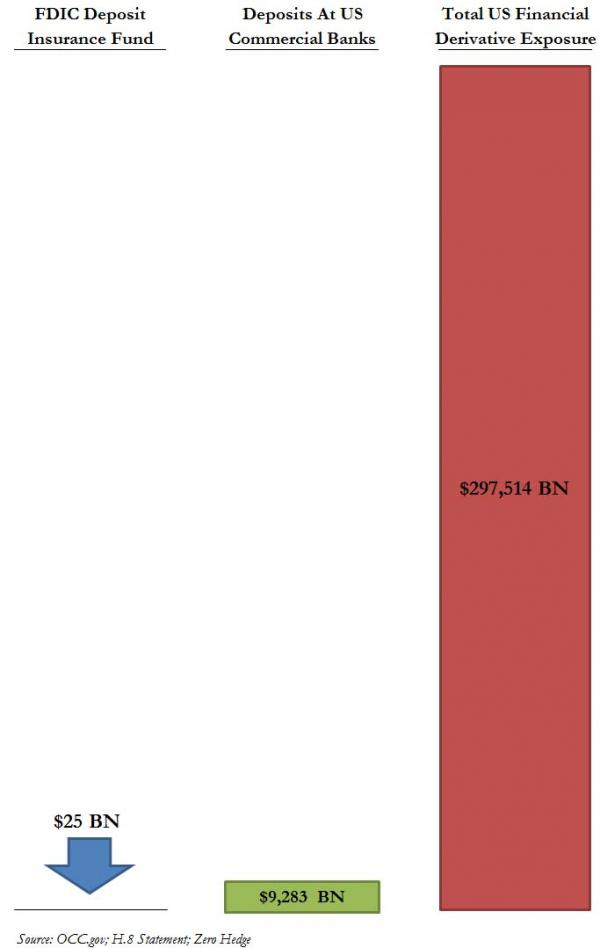
factored in. The problem is graphically illustrated in this chart from a March 2013 ZeroHedge post:
More on that after a look at the new bail-in provisions and the powershift they represent.
Bail-in in Plain English
The Financial Stability Board (FSB) that now regulates banking
globally began as a group of G7 finance ministers and central bank
governors organized in a merely advisory capacity after the Asian crisis
of the late 1990s. Although not official, its mandates effectively
acquired the force of law after the 2008 crisis, when the G20 leaders
were brought together to endorse its rules. This ritual now happens annually,
with the G20 leaders rubberstamping rules aimed at maintaining the
stability of the private banking system, usually at public expense.
According to an International Monetary Fund paper titled “From Bail-out to Bail-in: Mandatory Debt Restructuring of Systemic Financial Institutions”:
[B]ail-in . . . is a statutory power of a resolution authority (as
opposed to contractual arrangements, such as contingent capital
requirements) to restructure the liabilities of a distressed financial
institution by writing down its unsecured debt and/or converting it to
equity. The statutory bail-in power is intended to achieve a prompt
recapitalization and restructuring of the distressed institution.
The language is a bit obscure, but here are some points to note:
- What was formerly called a “bankruptcy” is now a “resolution
proceeding.” The bank’s insolvency is “resolved” by the neat trick of
turning its liabilities into capital. Insolvent TBTF banks are to be
“promptly recapitalized” with their “unsecured debt” so that they can go
on with business as usual.
- “Unsecured debt” includes deposits,
the largest class of unsecured debt of any bank. The insolvent bank is
to be made solvent by turning our money into their equity – bank stock
that could become worthless on the market or be tied up for years in
resolution proceedings.
- The power is statutory. Cyprus-style confiscations are to become the law.
- Rather than having their assets sold off and closing their doors, as
happens to lesser bankrupt businesses in a capitalist economy, “zombie”
banks are to be kept alive and open for business at all costs – and the
costs are again to be to borne by us.
The Latest Twist: Putting Pensions at Risk with “Bail-Inable” Bonds
First they came for our tax dollars. When governments declared “no
more bailouts,” they came for our deposits. When there was a public
outcry against that, the FSB came up with a “buffer” of securities to be
sacrificed before deposits in a bankruptcy. In the latest rendition of its bail-in scheme,
TBTF banks are required to keep a buffer equal to 16-20% of their
risk-weighted assets in the form of equity or bonds convertible to
equity in the event of insolvency.
Called “contingent capital bonds”, “bail-inable bonds” or “bail-in
bonds,” these securities say in the fine print that the bondholders
agree contractually (rather than being forced statutorily) that if
certain conditions occur (notably the bank’s insolvency), the lender’s
money will be turned into bank capital.
However, even 20% of risk-weighted assets may not be enough to prop
up a megabank in a major derivatives collapse. And we the people are
still the target market for these bonds, this time through our pension
funds.
In a policy brief from the Peterson Institute for International Economics titled “Why Bail-In Securities Are Fool’s Gold”, Avinash Persaud warns, “A key danger is that taxpayers would be saved by pushing pensioners under the bus.”
It wouldn’t be the first time. As Matt Taibbi noted in a September 2013 article titled “Looting the Pension Funds,”
“public pension funds were some of the most frequently targeted suckers
upon whom Wall Street dumped its fraud-riddled mortgage-backed
securities in the pre-crash years.”
Wall Street-based pension fund managers, although losing enormous
sums in the last crisis, will not necessarily act more prudently going
into the next one. All the pension funds are struggling with commitments
made when returns were good, and getting those high returns now
generally means taking on risk.
Other than the pension funds and insurance companies that are
long-term bondholders, it is not clear what market there will be for
bail-in bonds. Currently, most holders of contingent capital bonds are
investors focused on short-term gains, who are liable to bolt at the
first sign of a crisis. Investors who held similar bonds in 2008 took
heavy losses. In a Reuters sampling of potential investors,
many said they would not take that risk again. And banks and “shadow”
banks are specifically excluded as buyers of bail-in bonds, due to the
“fear of contagion”: if they hold each other’s bonds, they could all go
down together.
Whether the pension funds go down is apparently not of concern.
Propping Up the Derivatives Casino: Don’t Count on the FDIC
Kept inviolate and untouched in all this are the banks’ liabilities
on their derivative bets, which represent by far the largest exposure of
TBTF banks. According to the New York Times:
American banks have nearly $280 trillion of derivatives on their
books, and they earn some of their biggest profits from trading in them.
These biggest of profits could turn into their biggest losses when the derivatives bubble collapses.
Both the Bankruptcy Reform Act of 2005 and the Dodd Frank Act provide
special protections for derivative counterparties, giving them the
legal right to demand collateral to cover losses in the event of
insolvency. They get first dibs, even before the secured deposits of state and local governments; and that first bite could consume the whole apple, as illustrated in the above chart.
The chart also illustrates the inadequacy of the FDIC insurance fund
to protect depositors. In a May 2013 article in USA Today titled “Can FDIC Handle the Failure of a Megabank?”, Darrell Delamaide wrote:
[T]he biggest failure the FDIC has handled was Washington Mutual in
2008. And while that was plenty big with $307 billion in assets, it was a
small fry compared with the $2.5 trillion in assets today at JPMorgan
Chase, the $2.2 trillion at Bank of America or the $1.9 trillion at
Citigroup.
. . . There was no possibility that the FDIC could take on the rescue
of a Citigroup or Bank of America when the full-fledged financial
crisis broke in the fall of that year and threatened the solvency of
even the biggest banks.
That was, in fact, the reason the US Treasury and the Federal Reserve
had to step in to bail out the banks: the FDIC wasn’t up to the task.
The 2010 Dodd-Frank Act was supposed to ensure that this never happened
again. But as Delamaide writes, there are “numerous skeptics that the
FDIC or any regulator can actually manage this, especially in the heat
of a crisis when many banks are threatened at once.”
All this fancy footwork is to prevent a run on the TBTF banks, in
order to keep their derivatives casino going with our money. Warren
Buffett called derivatives “weapons of financial mass destruction,” and
many commentators warn that they are a time bomb waiting to explode.
When that happens, our deposits, our pensions, and our public
investment funds will all be subject to confiscation in a “bail in.”
Perhaps it is time to pull our money out of Wall Street and set up our
own banks – banks that will serve the people because they are owned by
the people.
__________________
Ellen Brown is an attorney, founder of the Public Banking Institute, and author of twelve books including the best-selling Web of Debt. Her latest book, The Public Bank Solution, explores successful public banking models historically and globally. Her 200+ blog articles are at EllenBrown.com.