Search This Blog

Showing posts with label Greece. Show all posts

Sunday, 15 July 2018

Greek Court Rules To Extradite Alexander Vinnik, Accused Of Laundering $4 Billion In Bitcoin

Zero Hedge

A Greek court has ruled to extradite the alleged former operator of crypto exchange BTC-eAlexander Vinnik, to France, local news outlet CNN Greece reported Friday, July 13.

The 39-year old Russian national Vinnik, also known colloquially as “Mr. Bitcoin,” was indicted by U.S. authorities on charges of fraud and money laundering last year, reportedly involving up to $4 billion in Bitcoin (BTC).

Vinnik’s Greek lawyer Ilias Spyrliadis confirmed to Russian news agency TASS that “the court has granted France’s request for Vinnik’s extradition.” Spyrliadis also revealed that he is planning to appeal against the court’s decision in the Greek Supreme Court.

According to CNN Greece, Vinnik himself challenged the decision of the Greek court on extradition to France, denying the allegations of French authorities, who issued a warrant, in which the alleged BTC-e owner was accused of “defraud[ing] over 100 people in six French cities between 2016 and 2018.”

Vinnik responded that he was "transferring e-money through a platform," considering it as "legitimate personal transactions.”



Friday, 17 February 2017

Greek Bank Run Re-accelerates: Massive Deposit Withdrawals Despite Capital Controls

Zero Hedge

Delays in the talks between Greece and its lenders have brought back the ghost of Grexit.

The grave disagreement between the International Monetary Fund and the European lenders, Grexit bombshells flying around and Greece’s reluctance to accept additional austerity measures have increase uncertainty among citizens – for one more time.

And so, as KeepTalkingGreece.com notes, what do citizens do when they feel political and economical insecurity? The run to banks and withdraw deposits.

Read more

Thursday, 5 January 2017

Greece bans cash: Tax-allowance possible only through payments via plastic money

Keep Talking Greece

Greece is banning the use of cash the soft way. As of 1.1. 2017, taxpayers will be granted tax-allowance and tax deduction only when they have made payments via credit or debit cards. The new guidelines refer to employees, pensioners, farmers but also unemployed.

Accepted expenditure will be:

purchases for food and supermarket products, electronic and electric devices, household equipment, footwear, clothing, fuel, furniture, cigarettes*, drinks
Restaurants, cafeterias,bars and hotels
Services like by hairdressers and beauty parlors, gyms and dance schools, car repair, plumbers, electricians, painters, carpenters, lawyers and accountants.

For doctors and pharmacy the same practice will be valid as in last year. The tax office will accept the expenditure only if payments are made per credit card or bank transfer. 

Expenditure for utility bills, landlines and mobile phones, heating, rent, loan repayments that in fact swallow the largest amount of monthly expenditure for private households will not be accepted. Also not accepted is expenditure for toll and transport tickets.

Read more

Saturday, 30 July 2016

IMF admits disastrous love affair with the euro and apologises for the immolation of Greece

Comment: This is tragi-comedy. What this shows above anything else that the sheer stupidity of these people is beyond dispute. They were not informed?? Really? They're like spoilt children playing with people's lives. "Sorry, we destroyed a country and its its citizens. We'll do better next time and put in measures that ensure a country's wealth passes into our and the banking fraternity's coffers in a more civilised and less transparent way."

The IMF is an enabler and tool of neo-liberal economic policy thus it cannot be reformed. The only course of action is to erase it from existence as soon as humanly possible.

---------------------- 

Telegraph


“The possibility of a balance of payments crisis in a monetary union was thought to be all but non-existent,” it said. As late as mid-2007, the IMF still thought that “in view of Greece’s EMU membership, the availability of external financing is not a concern".

At root was a failure to grasp the elemental point that currency unions with no treasury or political union to back them up are inherently vulnerable to debt crises. States facing a shock no longer have sovereign tools to defend themselves. Devaluation risk is switched into bankruptcy risk.

“In a monetary union, the basics of debt dynamics change as countries forgo monetary policy and exchange rate adjustment tools,” said the report. This would be amplified by a “vicious feedback between banks and sovereigns”, each taking the other down. That the IMF failed to anticipate any of this was a serious scientific and professional failure.

In Greece, the IMF violated its own cardinal rule by signing off on a bailout in 2010 even though it could offer no assurance that the package would bring the country’s debts under control or clear the way for recovery, and many suspected from the start that it was doomed.

The organisation got around this by slipping through a radical change in IMF rescue policy, allowing an exemption (since abolished) if there was a risk of systemic contagion. “The board was not consulted or informed,” it said. The directors discovered the bombshell “tucked into the text” of the Greek package, but by then it was a fait accompli.

The IMF was in an invidious position when it was first drawn into the Greek crisis.  The Lehman crisis was still fresh. “There were concerns that such a credit event could spread to other members of the euro area, and more widely to a fragile global economy,” said the report.

The eurozone had no firewall against contagion, and its banks were tottering. The European Central Bank had not yet stepped up to the plate as lender of last resort. It was deemed too dangerous to push for a debt restructuring in Greece.

Read More

Tuesday, 21 June 2016

It’s Not Just the UK – Widespread Support for EU Referendums Seen Across the Continent

Michael Krieger


Actions have consequences, and people can only be pushed so far before they snap. I believe the Paris terror attacks will be a major catalyst that will ultimately usher in nationalist type governments in many parts of Europe, culminating in an end of the EU as we know it and a return to true nation-states.

Although I think a return to regional government and democracy is what Europeans need and deserve, the way in which it will come about, and the types of governments we could see emerge, are unlikely to be particularly enlightened or democratic after the dust has settled.

My thoughts and prayers go out to all the victims of these horrific events, but the Paris attacks didn’t happen in a vacuum. The people of Europe have already become increasingly resentful against the EU,  something which is not debatable at this point. This accurate perception of an undemocratic, technocratic Brussels-led EU dictatorship was further solidified earlier this year after the Greek people went to the polls and voted for one thing, only to be instructed that their vote doesn’t actually matter.

– From last year’s post: A Message to Europe – Prepare for Nationalism

If you aren’t paying close attention to what’s happening in Europe, you may be surprised by the extent of “elite” panic at the notion that the British people could decide to leave the EU. Here’s just one example, from Donald Tusk, president of the European Council.
Why is it so dangerous? No one can foresee what the long-term consequences would be. As a historian, I fear that Brexit could be the beginning of the destruction of not only the E.U., but also of Western political civilization.
While there’s no doubt that a Brexit will result in major disruptions to the status quo system, isn’t that the point? Moreover, that’s some downright apocalyptic talk by Mr. Tusk. What’s driving it?


Read more


Thursday, 16 June 2016

Thousands of Greeks demand PM Tsipras to resign

Comment: Tsipras has lasted longer than I thought, but the Greeks don't forget....

-----------------

PressTV

Thousands of dissatisfied Greeks have staged a protest rally in Athens and another major city to ask the government to resign over continued austerity.

At least 10,000 Greeks gathered outside the parliament in Athens on Wednesday, demanding the resignation of the leftist government of Prime Minister Alexis Tsipras.

The protesters were supporters of the "Resign" movement, which perceives Tsipras's policies a failure, driving the country into more poverty.

They addressed the premier in their slogans, chanting "Resign!" and "People don't want you, take your junta and leave!"

A similar demonstration was held at Thessaloniki, the second largest city in the country and the capital of Greek Macedonia in northern Greece. 


Read more
 

Friday, 6 May 2016

German Study Proves It – 95% Of Greek "Bailout" Money Went To The Banks

Mike Krieger
Liberty Blitzkrieg
I simply cannot stress enough how important Greece is to freedom, liberty and civilization across the globe. Greece is not a one-off, or merely a small nation in big trouble that holds little relevance for the rest of us. Greece is everything.
What is happening to Greece follows the exact same game plan of what will eventually happen to every other supposedly sovereign nation. First there is an explosion of debt. Then a crisis. Then a bailout. Then creditor imposed hardship is forced upon the average population, in conjunction with unlimited bailouts for the bankers and other oligarch criminals.
Finally, when a public which mistakenly believes it is living in a democracy exercises its right to national sovereignty, the sad truth is exposed. They are not a people living under a free political system.

– From last year’s post: This is Sparta – 1,000 Bitcoin ATMs are Coming to Greece
A recent German study just confirmed what tens of millions of Greeks already knew. That they are a people fully conquered by criminal mega banks and the corrupt politicians and technocrats in their employ.

Get ready for another epic screw job this summer.

From Ekathimerini:
Some 95 percent of the 220 billion euros disbursed to Greece since the start of the financial crisis as loans from the bailout mechanism has been directed toward saving the European banks. That means about 210 billion euros was eventually channeled to the eurozone credit sector while just 5 percent ended up in state coffers, according to a study by the European School of Management and Technology (ESMT) in Berlin.
“Europe and the International Monetary Fund have in previous years mainly saved the banks and other private creditors,” concluded the report, published yesterday in German newspaper Handelsblatt. ESMT director Jorg Rocholl told the financial newspaper that “the bailout packages mainly saved the European banks.”
The economists who took part in the study have analyzed each loan separately to established where the money ended up, and concluded that just 9.7 billion euros – less than 5 percent – actually found its way into the Greek budget for the benefit of citizens.
“This is something that everyone suspected, but few people actually knew. That has now been confirmed by the study.
For related articles, see:

Yanis Varoufakis Reveals – Berlin Blocked Greece From Chinese Funding During Crisis
“This is a Coup” – The Story of How Greece Lost Democracy
This is Sparta – 1,000 Bitcoin ATMs are Coming to Greece
Yanis Varoufakis on “Europe’s Vindictive Privatization Plan for Greece”
Yanis Varoufakis Issues a Major Warning to the Greek People

Thursday, 13 August 2015

What crisis? Germany made 100 BILLION euros from Greek suffering


© Associated Press
Sputnik
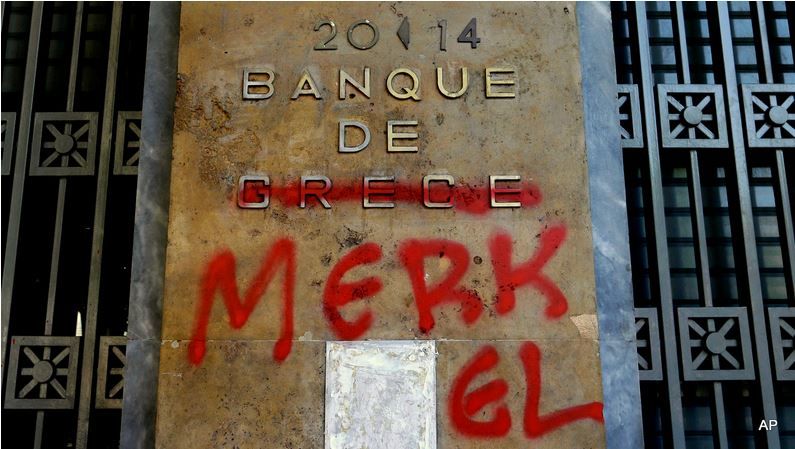
Red spray paint covers a French-language Bank of Greece sign to read ‘Bank of Merkel’ in reference to German Chancellor Angela Merkel in Athens, Monday, July 6, 2015.
The German government, which has taken a hard line on Greece, has saved some 100 billion euros ($109 billion) in the country's financial crisis thanks to lower borrowing costs, a study has found.

Germany saved through lower interest payments on funds the government borrowed amid investor "flights to safety," the German-based non-profit Halle Institute for Economic Research (IWH) said in its paper published Monday. 


"These savings exceed the costs of the crisis - even if Greece were to default on its entire debt," the study said. "Germany has clearly benefited from the Greek crisis."

In the face of turmoil, investors seeking a safe haven for their money within the euro zone turned to export champion Germany, which "disproportionately benefited" from that during the debt crisis, the IWH said.

"Every time financial markets faced negative news on Greece in recent years, interest rates on German government bonds fell, and every time there was good news, they rose."

Germany, the euro zone's effective paymaster, has demanded fiscal discipline and tough economic reforms in Greece in return for consenting to new aid from international creditors, Agence France-Presse reported.

Finance Minister Wolfgang Schaeuble has opposed a Greek debt write-down while pointing to his own government's balanced budget.

The balanced budget, however, was facilitated largely by Germany's interest savings amid the Greek debt crisis, according to the study. The estimated 100 billion euros Germany saved since 2010 accounted for more than 3% of GDP, according to the IHW.

"Even if Greece doesn't pay back a single cent, the German public purse has benefited financially from the crisis," said the paper.

At the same time, the bonds of other countries - including the United States, France and the Netherlands - also benefited, but "to a much smaller extent."

Greece and its creditors are working on the draft of a new bailout of up to 86 billion euros ($94 billion) in exchange for further reforms, AFP reported. They are aiming for a deal before Greece must repay 3.4 billion euros to the European Central Bank on August 20. 

Thursday, 30 July 2015

Global Derivatives: $1.5 Quadrillion Time Bomb

Stephen Lendman
Global Research


When investing becomes gambling, bad endings follow. The next credit crunch could make 2008-09 look mild by comparison. Bank of International Settlements(BIS) data show around $700 trillion in global derivatives.

Along with credit default swaps and other exotic instruments, the total notional derivatives value is about $1.5 quadrillion – about 20% more than in 2008, beyond what anyone can conceive, let alone control if unexpected turmoil strikes.

The late Bob Chapman predicted it. So does Paul Craig Roberts. It could “destroy Western civilization,” he believes. Financial deregulation turned Wall Street into a casino with no rules except unrestrained making money. Catastrophic failure awaits. It’s just a matter of time.

Ellen Brown calls the “derivatives casino…a last-ditch attempt to prop up a private pyramid scheme” – slowly crumbling under its own weight.

For years, Warren Buffett called derivatives “financial time bombs” – for economies and ordinary people.

Unless collateralized or guaranteed, their worth depends on the creditworthiness of counter-parties. Earnings on derivatives are “wildly overstated,” Buffett explains – because they’re “based on estimates whose inaccuracy may not be exposed for many years.”

When corporate bosses ask financial executives how profits look in any quarter, they, in turn, ask how much do you want, then manipulate things to oblige when told.

Since 2008, too-big-to-fail banks consolidated to much greater size than ever. They’re financial and political powerhouses controlling world economies to their own advantage.

Civilization’s only hope is smashing them – dismantling them into small, impotent pieces, or ideally putting money back in public hands where it belongs.

It’s too important to be privately controlled. Financial predators entrap small/weak nations into unrepayable debt peonage like Greece, bleed them dry, and thirdworldize developed ones into dystopian backwaters – while they grow richer and more powerful than ever ahead of the whole corrupt system going bust, decimating billions worldwide in greater human misery than already.

Read more

Tuesday, 21 July 2015

So you say you don't want a revolution?

Club Orlov

Over the past few months we have been forced to bear witness to a humiliating farce unfolding in Europe. Greece, which was first accepted into the European Monetary Union under false pretenses, then saddled with excessive levels of debt, then crippled through the imposition of austerity, finally did something: the Greeks elected a government that promised to shake things up. The Syriza party platform had the following planks, which were quite revolutionary in spirit.
  • Put an end to austerity and put the Greek economy on a path toward recovery
  • Raise the income tax to 75% for all incomes over 500,000 euros, adopt a tax on financial transactions and a special tax on luxury goods.
  • Drastically cut military expenditures, close all foreign military bases on Greek soil and withdraw from NATO. End military cooperation with Israel and support the creation of a Palestinian State within the 1967 borders.
  • Nationalize the banks.
  • Enact constitutional reforms to guarantee the right to education, health care and the environment.
  • Hold referendums on treaties and other accords with the European Union.
Of these, only the last bullet point was acted on: there was a lot made of the referendum which returned a resounding “No!” to EU demands for more austerity and the dismantling and selling off of Greek public assets. But a lot less was made of the fact that the results of this referendum were then ignored.
But the trouble started before then. 


Read more

Sunday, 19 July 2015

Varoufakis Slams Bailout #3 As "Greatest Macroeconomic Disaster In History" While Tsipras "Doesn't Eat Or Sleep"

Zero Hedge

In an rare convergence of Greek and German viewpoints, overnight former Greek finance minister Yanis Varoufakis told the BBC that "economic reforms imposed on his country by creditors are "going to fail", ahead of talks on a huge bailout. At the same time, Germany's most noted Eurosceptic, Hans-Werner Sinn, in an interview with the newspaper "Passauer Neue Presse" also earlier today warned that any new aid would be "totally worthless" and "would never come back."

In what was practically a race who can find harsher terms to describe the Greek bailout, Varoufakis said that Greece was subject to a programme that will "go down in history as the greatest disaster of macroeconomic management ever".

As reported yesterday, the German parliament approved the opening of negotiations of Greece's third €86 billion bailout when it rushed to vote through a bridge loan to Greece so the insolvent nation had some funds to repay the ECB's Monday debt maturity, as well as repay the roughly €2 billion for Greece is in default to the IMF. Of note was the jump in German MPs who voted "no" to 119 from just 32 in the February vote to extend the Greek bailout.

In a damning assessment, Varoufakis told the BBC's Mark Lobel: "This programme is going to fail whoever undertakes its implementation."

Asked how long that would take, he replied: "It has failed already."

He also said Greek Prime Minister Alexis Tsipras, who has admitted that he does not believe in the bailout, had little option but to sign. "We were given a choice between being executed and capitulating. And he decided that capitulation was the ultimate strategy." 

Which also happens to be Varoufakis' biggest failure: his strategy was accurate and his math was correct that to Europe a Grexit would be far more expensive than keeping Greece in the Euro, however Europe was just as accurate in realizing Greece has no Plan B for its banking system as Greece had never prepared either a plan for a parallel currency nor how to obtain Debtor in Possession funding, which is what a bankrupt Greece would need - ostensibly either from China or Russia - to fund it in the interim period in which it was ending its tumultuous relationship with Europe. 

Understandably Greece did not want to push the Grexit line too hard for obvious reasons - it was all part of the "blame game" - however now that Germany itself has opened a Pandora's box it can't close ever again when it brought up the possibility of a temporary Grexit, Greece should most certainly prepare for the worst case the next time it has to rerun the entire bailout tragedy in 6-9 months, or perhaps sooner. 

However, none of this will be Varoufakis' problem any more - instead we hope his successor learns from Yanis' mistakes. And speaking of his successors, late yesterday Tsipras has announced a cabinet reshuffle, sacking several ministers who voted against the reforms in parliament this week. But he opted not to bring in technocrats or opposition politicians as replacements.

As a result, it now seems that Tsipras will preside over ministers who, like himself, harbor serious doubts about the reform program. Which is why we truly hope they are prepared to implement the missing Plan B when the time comes next. 

Finally, in what is perhaps the best anecdote about Greece right now, AFP reported that "embattled Greek Prime Minister Alexis Tsipras eats and sleeps poorly and rarely manages to see his family, his mother told a tabloid on Saturday."

"Alexis lately does not eat, does not sleep, but he has no choice -- he has a debt to the people who put their faith in him," Aristi Tsipras, 73, told Parapolitika weekly.

"I rarely see him any more. He goes from the airport straight to parliament. He has no time to see his children, how can he see me?" Aristi Tsipras said.

"When we speak, I tell him to do the best for the country and take care of himself. He tells me not to worry, and that everything will be fine," she said.

Unfortunately it won't be, however that will only be revealed when not only the PM can "no longer eat or sleep", but the entire country of Greece, too. 

Friday, 17 July 2015

Greece: Sound and Fury Signifying Much

Paul Craig Roberts

All of Europe, and insouciant Americans and Canadians as well, are put on notice by Syriza’s surrender to the agents of the One Percent. The message from the collapse of Syriza is that the social welfare system throughout the West will be dismantled.

The Greek prime minister Alexis Tsipras has agreed to the One Percent’s looting of the Greek people of the advances in social welfare that the Greeks achieved in the post-World War II 20th century. Pensions and health care for the elderly are on the way out. The One Percent needs the money.

The protected Greek islands, ports, water companies, airports, the entire panoply of national patrimony, is to be sold to the One Percent. At bargain prices, of course, but the subsequent water bills will not be bargains.

This is the third round of austerity imposed on Greece, austerity that has required the complicity of the Greeks’ own governments. The austerity agreements serve as a cover for the looting of the Greek people literally of everything. The IMF is one member of the Troika that is imposing the austerity, despite the fact that the IMF’s economists have said that the austerity measures have proven to be a mistake. The Greek economy has been driven down by the austerity. Therefore, Greece’s indebtedness has increased as a burden. Each round of austerity makes the debt less payable.

But when the One Percent is looting, facts are of no interest. The austerity, that is the looting, has gone forward despite the fact that the IMF’s economists cannot justify it.

Read more
 

Thursday, 16 July 2015

The Euro-Summit ‘Agreement’ on Greece – annotated by Yanis Varoufakis

Yanis Varoufakis

The Euro Summit statement (or Terms of Greece’s Surrender – as it will go down in history) follows, annotated by yours truly. The original text is untouched with my notes confined to square brackets (and in red). Read and weep… [For a pdf copy click here.]

Euro Summit Statement Brussels, 12 July 2015


The Euro Summit stresses the crucial need to rebuild trust with the Greek authorities [i.e. the Greek government must introduce new stringent austerity directed at the weakest Greeks that have already suffered grossly] as a pre-requisite for a possible future agreement on a new ESM programme [i.e. for a new extend-and-pretend loan].

In this context, the ownership by the Greek authorities is key [i.e. the Syriza government must sign a declaration of having defected to the troika’s ‘logic’], and successful implementation should follow policy commitments.

A euro area Member State requesting financial assistance from the ESM is expected to address, wherever possible, a similar request to the IMF This is a precondition for the Eurogroup to agree on a new ESM programme. Therefore Greece will request continued IMF support (monitoring and financing) from March 2016 [i.e. Berlin continues to believe that the Commission cannot be trusted to ‘police’ Europe’s own ‘bailout’ programs].
Given the need to rebuild trust with Greece, the Euro Summit welcomes the commitments of the Greek authorities to legislate without delay a first set of measures [i.e. Greece must subject itself to fiscal waterboarding, even before any financing is offered]. These measures, taken in full prior agreement with the Institutions, will include:

By 15 July
  • the streamlining of the VAT system [i.e. making it more regressive, through rate rises that encourage more VAT evasion]and the broadening of the tax base to increase revenue [i.e. dealing a major blow at the only Greek growth industry – tourism].
  • upfront measures to improve long-term sustainability of the pension system as part of a comprehensive pension reform programme [i.e. reducing the lowest of the low of pensions, while ignoring that the depletion of pension funds’ capital due to the 2012 troika-designed PSI and the ill effects of low employment & undeclared paid labour].
  • the safeguarding of the full legal independence of ELSTAT [i.e. the troika demands complete control of the way Greece’s budget balance is computed, with a view to controlling fully the magnitude of austerity it imposes on the government.]
  • full implementation of the relevant provisions of the Treaty on Stability, Coordination and Governance in the Economic and Monetary Union, in particular by making the Fiscal Council operational before finalizing the MoU and introducing quasi-automatic spending cuts in case of deviations from ambitious primary surplus targets after seeking advice from the Fiscal Council and subject to prior approval of the Institutions [i.e. the Greek government, which knows that the imposed fiscal targets will never be achieved under the imposed austerity, must commit to further, automated austerity as a result of the troika’s newest failures.]
Read more

Wednesday, 15 July 2015

Greece Today, America Tomorrow?

Ron Paul
Information Liberation

The drama over Greece’s financial crisis continues to dominate the headlines. As this column is being written, a deal may have been reached providing Greece with yet another bailout if the Greek government adopts new “austerity” measures. The deal will allow all sides to brag about how they came together to save the Greek economy and the European Monetary Union. However, this deal is merely a Band-Aid, not a permanent fix to Greece’s problems. So another crisis is inevitable.

The Greek crisis provides a look into what awaits us unless we stop overspending on warfare and welfare and restore a sound monetary system. While most commentators have focused on Greece’s welfare state, much of Greece’s deficit was caused by excessive military spending. Even as its economy collapses and the government makes (minor) cuts in welfare spending, Greece’s military budget remains among the largest in the European Union. 

Despite all the handwringing over how the phony sequestration cuts have weakened America’s defenses, the United States military budget remains larger than the combined budgets of the world’s next 15 highest spending militaries. Little, if any, of the military budget is spent defending the American people from foreign threats. Instead, the American government wastes billions of dollars on an imperial foreign policy that makes Americans less safe. America will never get its fiscal house in order until we change our foreign policy and stop wasting trillions on unnecessary and unconstitutional wars. 

Excessive military spending is not the sole cause of America’s problems. Like Greece, America suffers from excessive welfare and entitlement spending. Reducing military spending and corporate welfare will allow the government to transition away from the welfare state without hurting those dependent on government programs. Supporting an orderly transition away from the welfare state should not be confused with denying the need to reduce welfare and entitlement spending.

One reason Greece has been forced to seek bailouts from its EU partners is that Greece ceded control over its currency when it joined the European Union. In contrast, the dollar’s status as the world’s reserve currency is the main reason the US has been able to run up huge deficits without suffering a major economic crisis. The need for the Federal Reserve to monetize ever-increasing levels of government spending will eventually create hyperinflation, which will lead to increasing threats to the dollar’s status. China and Russia are already moving away from using the dollar in international transactions. It is only a matter of time before more countries challenge the dollar’s reserve currency status, and, when this happens, a Greece-style catastrophe may be unavoidable.

Despite the clear dangers of staying on our recent course, Congress continues to increase spending. The only real debate between the two parties is over whether we should spend more on welfare or warfare. It is easy to blame the politicians for our current dilemma. But the politicians are responding to demands from the people for greater spending. Too many Americans believe they have a moral right to government support. This entitlement mentally is just as common, if not more so, among the corporate welfare queens of the militarily-industrial complex, the big banks, and the crony capitalists as it is among lower-income Americans.

Congress will only reverse course when a critical mass of people reject the entitlement mentality and understand that the government is incapable of running the world, running our lives, and running the economy. Therefore, those of us who know the truth must spread the ideas of, and grow the movement for, limited government, free markets, sound money, and peace.

Tuesday, 14 July 2015

It Starts: Greeks Rebel Against Bailout, Risk Collapse

Wolf Street

Greece’s union of civil servants, Adedly, called for a 24-hour strike on Wednesday, and for a series of demonstrations, the first one tonight at Syntagma Square, just below the Parliament, and another one on Wednesday evening, when Parliament is expected to vote on the new, even tougher, and immensely hated bailout package. The union for local government employees, Poe-Ota, also called for a 24-hour strike on Wednesday, the AFP reported. Two other demonstrations against austerity and the “euro” are planned for Monday night, one organized via social networks, the other by Antarsya, an anti-euro party that didn’t make it into Parliament. 

It would be the first strike against the leftwing Syriza coalition since it came to power six months ago. An ironic plot twist in this tragedy.

Syriza was the big force in the demonstrations against the two prior bailout packages, totaling over €240 billion from taxpayers in other countries, conditioned on economic reforms pushed through Parliament by the conservative governments at the time. Now Syriza is looking at having to pass even tougher measures, including an increase in the Value Added Tax and pension reform, in return for only €86 billion in new money from taxpayers in other countries.

Syriza’s junior coalition partner, the Independent Greeks, is already getting cold feet.
“The agreement speaks of €50 billion worth of guarantees concerning public property, of changes to the law including the confiscation of homes… We cannot agree to that,”explained Panos Kammenos, the party’s leader, adding that the party would nevertheless remain in the coalition. With “confiscation of homes” he probably meant foreclosing on homes with defaulted mortgages.

Read more

Monday, 13 July 2015

The Euro Is Finished: Reporter Catches First Glimpse of Drachma in Greece

The Daily Sheeple

With the situation rapidly deteriorating in Greece, many experts have predicted that Greece may be forced from the Euro. If that happens, then Greece will have to go through the lengthy and complicated process of creating a new currency, which would most likely carry the namesake of their pre-Euro currency, known as the “Drachma.” For now the Euro is still their official currency, but it seems that hasn’t stopped some financial institutions from jumping the gun.

A reporter for Bloomberg stayed at a hotel in Athens from June 28th to July 4th, but when they charged his Visa debit card, the online statement didn’t show his charge in Euros. Instead, it was recorded as “Drachma EQ.” Even stranger, it was in name only. The number of “Drachmas” he was charged was exactly the same as the number of Euros he would have paid. The reporter contacted the companies involved, which included Visa and Citigroup, and their representatives seemed genuinely confused by his statement. The next day, his financial statement went back to being listed in Euros. So far, neither company has offered an explanation for the “mistake” for lack of a better word.
 
Read More

Monday, 6 July 2015

Greece votes no - Let the chaos begin...

Michael Snyder
The Economic Collapse


The result of the referendum in Greece is a great victory for freedom, but it is also threatens to unleash unprecedented economic chaos all across Europe. With almost all of the votes counted, it is being reported that approximately 61 percent of Greeks have voted "no" and only about 39 percent of Greeks have voted "yes". This is a much larger margin of victory for the "no" side than almost everyone was anticipating, and it represents a stunning rejection of European austerity. Massive celebrations have erupted on the streets of Athens and other major Greek cities, but the euphoria may not last long. Greek Prime Minister Alexis Tsipras is promising that Greece will be able to stay in the euro, but that gives EU bureaucrats and the IMF a tremendous amount of power, because at this point the Greek government is flat broke. Without more money from the EU and the IMF, the Greek government will not be able to pay its bills and virtually all Greek banks will inevitably collapse. Meanwhile, the rest of Europe is about to experience a tremendous amount of pain as financial markets respond to the results of this referendum. The euro is already plummeting, and most analysts expect European bond yields to soar and European stocks to drop substantially when trading opens on Monday morning.

Personally, I love the fact that the Greek people decided not to buckle under the pressure being imposed on them by the EU and the IMF. But amidst all of the celebration, the cold, hard reality of the matter is that your options are extremely limited when you are out of money.

How is the Greek government going to pay its bills without any money?

How are the insolvent Greek banks going to operate without any money?

How is the Greek economy going to function without any money?

Now that the Greek people have overwhelmingly rejected the demands of the creditors, it will be very interesting to see what the EU and the IMF do. Prior to the referendum, European leaders were insisting that a "no" vote would put an end to negotiations and would force Greece to leave the euro.

Now that the results are in, are they going to change their tune? Because the ball is definitely in their court...

"This does two things: it legitimises the stance of the Greek government and it leaves the ball in Europe's court," ANZ Bank analysts said in a note.

"Europe either folds or Greece goes bankrupt; over to you Merkel."
So would they actually let Greece go bankrupt?

It is going to be fascinating to watch what happens over the next few days. Right now, Greek banks are on life support. If the European Central Bank decides to pull the plug, they would essentially destroy the entire Greek banking system. The only thing that can keep Greek banks alive and kicking is more intervention from the ECB. The following comes from the New York Times... 


Read more

Greek debt crisis: Yanis Varoufakis resigns after being forced out by EU chiefs

The Independent

Yanis Varoufakis has announced he is standing down despite Greece's No vote in the referendum on proposed austerity measures.
 

In a blog post entitled “Minister No More”, published on Monday morning, the Greek finance minister said he was standing down because of pressure from Greece’s European partners. 

Read more

More than 61% of Greeks say 'No' in crucial bailout referendum – final tally

Comment: With a little on hand advice from Putin...

----------------

RT

More than 61 percent of Greeks have voted “No” in Sunday’s referendum on the bailout deal and austerity measures, reported the Interior Ministry after 100 percent of the vote had been counted.

More than 61 percent of Greeks have voted “No” in Sunday’s referendum on the bailout deal and austerity measures, reported the Interior Ministry after 100 percent of the vote had been counted.

Thousands of people took to Syntagma square in front of the Greek parliament in Athens to celebrate the ‘No’ vote, which was called “a big Yes to democratic Europe” by the country’s finance minister, Yanis Varoufakis. 

"As of tomorrow, with this brave ‘No’ the Greek people handed us.... we will extend a helping hand towards our lenders. We will call on each one of them to find common ground. As of tomorrow, Europe, whose heart is beating in Greece tonight, is starting to heal its wounds, our wounds,” Varoufakis said, as cited by Reuters. 

Greek Prime Minister Alexis Tsipras praised the ‘No’ vote in the referendum, saying that his government is ready to return to negotiations with creditors immediately so that the country’s banks could re-open. 

Read more

Nine myths about the Greek crisis

James K. Galbraith
Politico

The citizens of Greece face a referendum Sunday that could decide the survival of their elected government and the fate of the country in the Eurozone and Europe. Narrowly, they’re voting on whether to accept or reject the terms dictated by their creditors last week. But what’s really at stake? The answers aren’t what you’d think.

I have had a close view of the process, both from the US and Athens, after working for the past four years with Yanis Varoufakis, now the Greek finance minister. I’ve come to realize that there are many myths in circulation about this crisis; here are nine that Americans should see through.
  1. The referendum is about the Euro. As soon as Greek Prime Minister Alexis Tsipras announced the referendum, François Hollande, David Cameron, Matteo Renzi, and the German Deputy Chancellor Sigmar Gabriel told the Greeks that a “no” vote would amount to Greece leaving the Euro. Jean-Claude Juncker, President of the European Commission, went further: he said “no” means leaving the European Union. In fact the Greek government has stated many times that – yes or no – it is irrevocably committed to the Union and the Euro. And legally, according to the treaties, Greece cannot be expelled from either.
  2. The IMF has been flexible. IMF Managing Director Christine Lagarde claims that her institution has shown “flexibility” in negotiations with the Greeks. In fact, the IMF has conceded almost nothing over four months: not on taxes, pensions, wages, collective bargaining or the amount of Greece’s debt. Greek chief negotiator Euclid Tsakalatos circulated a briefing on the breakdown that gives details, and concludes: “So what does the Greek government think of the proposed flexibility of the Institutions? It would be a great idea.”
  3. The creditors have been generous. Angela Merkel has called the terms offered by the creditors “very generous” to Greece. But in fact the creditors have continued to insist on a crushing austerity program, predicated on a target for a budget surplus that Greece cannot possibly meet, and on the continuation of draconian policies that have already cost the Greeks more than a quarter of their income and plunged the country into depression. Debt restructuring, which is obviously necessary, has also been refused.
  4. The European Central Bank has protected Greek financial stability. A central bank is supposed to protect the financial stability of solvent banks. But from early February, the ECB cut off direct financing of Greek banks, instead drip-feeding them expensive liquidity on special “emergency” terms. This promoted a slow run on the banks and paralyzed economic activity. When the negotiations broke down, the ECB capped the assistance, prompting a fast bank run and giving them an excuse to impose capital controls and effectively shut them down.
  5. The Greek government is imperiling its American alliance. This is a particular worry of some US conservatives, who see a leftist government in power and assume it is pro-Russian and anti-NATO. It is true that the Greek Left has historic complaints against the US, notably for CIA support of the military junta that ruled from 1967 to 1974. But in fact, attitudes on the Greek Left have changed, thanks partly to experience with the Germans. This government is pro-American and firmly a member of NATO.
  6. Alexis Tsipras called the IMF a “criminal” organization. That was, charitably, an overheated headline slapped by Bloomberg onto a very moderate parliamentary speech, which correctly pointed out that the IMF’s economic and debt projections for Greece back when austerity was first imposed in 2010 were catastrophically optimistic. In fact, every letter from Tsipras to the creditors has been couched in formal and respectful language.
  7. The Greek government is playing games. Because Finance Minister Varoufakis knows the economic field of game theory, lazy pundits have for months opined that he is playing “chicken” or “poker” or some other game. In Heraklion two weeks ago, Varoufakis denied this as he has done many times: “We’re not bluffing. We’re not even meta-bluffing.” Indeed there are no hidden cards. The Greek red lines – the points of principle on which this government refuses to budge – on labor rights, against cuts in poverty-level pensions and fire-sale privatizations – have been in plain view from day one.
  8. A “Yes” vote will save Europe. “Yes” would mean more austerity and social destruction, and the government that implements it cannot last long. The one that follows will not be led by Alexis Tsipras and Yanis Varoufakis – the last leaders, perhaps anywhere in Europe, of an authentic pro-European left. If they fall, the anti-Europeans will come next, possibly including ultra-right elements such as the Greek Nazi party, Golden Dawn. And the anti-European fire will spread, to France, the UK and Spain, among other countries.
  9. A “No” vote will destroy Europe. In fact, only the “No” can save Greece – and by saving Greece, save Europe. A “No” means that the Greek people will not bend, that their government will not fall, and that the creditors need, finally, to come to terms with the failures of European policy so far. Negotiations can then resume – or more correctly, proper negotiations can then start. This is vital, if Europe is to be saved. If there ever was a moment when the United States should speak for decency and democratic values – as well as our national interest – it is right now.
James K. Galbraith holds the Lloyd M. Bentsen Jr. Chair in Government/Business Relations at the Lyndon B. Johnson School of Public Affairs, the University of Texas at Austin. He has followed the Greek drama in Greece, Brussels, Paris and Berlin since January. His most recent book is “The End of Normal: The Great Crisis and the Future of Growth.”
Related Posts Plugin for WordPress, Blogger...