Search This Blog

Showing posts with label Romania. Show all posts

Friday, 24 October 2025

EU Declares War On Its Own Members

Simplicus The Thinker

Yesterday, two near-simultaneous acts of sabotage saw explosions ripping through oil refineries in both Hungary and Romania. In Hungary it was the MOL in Százhalombatta, which reportedly receives Russian oil, while in Romania the Petrotel-Lukoil, a subsidiary of the Russian parent company.

As one commentator writes, these attacks came literally hours after the European Council had just approved to ban Russian gas starting in 2026:

The timing here is exceptionally curious because this attack came just hours after the European Council essentially locked in its position to almost completely ban Russian gas imports, with new contracts being outlawed at the beginning of 2026, and all long term contracts forcibly expiring in 2028. A similar ban on oil imports is expected in the near future. Hungary and Slovakia have pledged to issue legal challenges to the ban.

As of this writing, there were reports that a new explosion lit up a refinery in Bratislava, Slovakia—which allegedly processes Russian oil from the Druzhba pipeline. But subsequent follow-ups appear to show these were fake—though it’s as of yet uncertain.

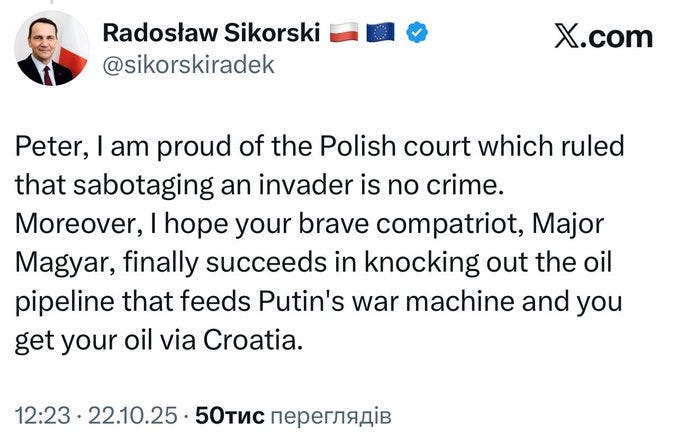
The real attacks on Romania and Hungary came just days after Europe essentially gave carte blanche for terror attacks across the EU by way of several top European officials openly condoning not only the Nord Stream attacks, but even attacks against Hungarian oil pipelines. Here Polish Foreign Minister Sikorski addresses Hungary’s Peter Szijjarto:
  

Read more

Sunday, 24 February 2019

Pepe Escobar: Putin rattles sabre as nuclear pact collapses

Pepe Escobar
Asia Times


President Putin's state of the nation address to the Federal Assembly in Moscow this week was an extraordinary affair. While heavily focused on domestic social and economic development, Putin noted, predictably, the US decision to pull out of the Intermediate-Range Nuclear Forces (INF) treaty and clearly outlined the red lines in regard to possible consequences of the move.

It would be naïve to believe that there would not be a serious counterpunch to the possibility of the US deploying launchers "suitable for using Tomahawk missiles" in Poland and Romania, only a 12-minute flight away from Russian territory.
Putin cut to the chase: "This is a very serious threat to us. In this case, we will be forced - I want to emphasize this - forced to take tit-for-tat steps."

Later that night, many hours after his address, Putin detailed what was construed in the US, once again, as a threat.

"Is there some hard ideological confrontation now similar to what was [going on] during the Cold War? There is none. We surely have mutual complaints, conflicting approaches to some issues, but that is no reason to escalate things to a stand-off on the level of the Caribbean crisis of the early 1960s".

This was a direct reference to the Cuban missile crisis in 1962 when President Kennedy confronted USSR's Nikita Khrushchev over missiles deployed off the US mainland.

The Russian Defense Ministry, meanwhile, has discreetly assured that conference calls with the Pentagon are proceeding as scheduled, every week, and that this bilateral dialogue is "working".

In parallel, tests of state-of-the-art Russian weaponry such as the Sarmat intercontinental ballistic missile and the hypersonic Khinzal also proceed, alongside mass production of the hypersonic Avangard. The first regiment of the Russian Strategic Missile Forces will get the Avangard before the end of this year.
 

Read more

Wednesday, 8 June 2016

Weaponizing the crosshairs: Putin foiling NATO plans to protect Romania, Poland from Iran

Rob Slane
TheBlogMire


At a recent ceremony in Deveselu, Romania, the Aegis Ashore Missile Defense System (AAMDS) was declared operationally certified — a key milestone in Phase II of the European Phased Adaptive Approach (EPAA). According to U.S. Naval Forces Europe-Africa/U.S. 6th Fleet Public Affairs:
This Ballistic Missile Defense (BMD) System represents a significant increase in the capability to defend NATO European territory from attacks originating outside the Euro-Atlantic area, and is a key milestone in the development of NATO Ballistic Missile Defense.
If you happen to live in Romania, this is of course great news, since it means that your country is now fully protected from attack by Iran. This is especially critical for the security of Romania because, as is widely known, Iran, just like Saddam Hussein's Iraq, possesses a variety of Weapons of Mass Destruction (WMDs), which can be unleashed at 45 minutes notice. What is especially pleasing to me, as an Englishman married to a Polish lady, is that Poland is also on its way to introducing the system on its territory, and the knowledge of a system protecting my in-laws from President Hassan Rouhani's burning desire to seize control of Lower Silesia is bound to make me sleep soundly.

Or at least it would, but for those pesky Russians again and their unlimited propensity for unbridled aggression. What is it with them? Though the Aegis system is so clearly intended to protect Europe against the Iranian menace, sadly the government of the Russian Federation seems to have got the idea that it is actually directed at them. They have expressed, on numerous occasions, fears that the system is intended to neutralise their ability to withstand and retaliate against an invasion, that it can also be used as an offensive weapon to attack the Russian Federation, and that it is therefore a grave threat to their national security.

It is of course a groundless assumption. What possible reason would Russia have for thinking that the United States/NATO would want to aim such a system at them? Why, except for reneging on the promise not to move NATO East of Germany, an unprecedented propaganda and demonization campaign against the country and its leader, the placing of 1000s of troops right up to its border, the imposition of unlawful and unjustified sanctions aimed at crippling the country, and the policy of fomenting regime change in countries within its sphere of influence — apart from all that, where on earth did Russia ever get the idea that the West wanted to attack, destroy and Balkanise it, and that the systems in Romania and Poland are a part of this plan? Paranoid or what!

So instead of accepting the repeated assurances that the system is aimed at preventing Iran's planned conquest of Europe, Mr Putin has instead used this harmless system as a pretext for yet further aggression:

"At the moment the interceptor missiles installed have a range of 500 kilometers, soon this will go up to 1000 kilometers, and worse than that, they can be rearmed with 2400km-range offensive missiles even today, and it can be done by simply switching the software, so that even the Romanians themselves won't know...If yesterday people simply did not know what it means to be in the crosshairs in those areas of Romania, then today we will be forced to carry out certain measures to ensure our security. And it will be the same with Poland."
Did you hear that correctly? Poor Romania and poor Poland. They were only trying to do their bit to protect themselves and Europe from Iran's huge arsenal of WMDs, and lo and behold they end up with "aggressive Russian" missiles pointing directly at them!

Read more
 

Tuesday, 31 May 2016

Putin gives grave warning to Romania and Poland against installing NATO's ABM missiles, "no one is listening"

Eric Zeusse
Sott.net


On Friday, May 27th, Russia's President Vladimir Putin again said that American President Barack Obama lies when saying that the reason America's anti-ballistic missile ("ABM") or Ballistic Missile Defense ("BMD") system is being installed in Romania, and will soon be installed in Poland, is to protect Europe from Iranian missiles that don't even exist and that Obama himself says won't exist because of Obama's deal with Iran. Putin is saying: I know that you are lying there, not being honest. You're aiming to disable our retaliatory capacity here, not Iran's. I'm not so dumb as to believe so transparent a lie as your assurances that this is about Iran, not about Russia.

Putin says that ABMs such as America is installing, disable a country's (in this case, Russia's) ability to retaliate against a blitz invasion — something increasingly likely from NATO now as NATO has extended right up to Russia's very borders — and that Russia will not allow this disabling of Russia's retaliatory forces. 


He said that "NATO fends us off with vague statements that this is no threat to Russia ... that the whole project began as a preventive measure against Iran's nuclear program. Where is that program now? It doesn't exist. ... We have been saying since the early 2000s that we will have to react somehow to your moves to undermine international security. No one is listening to us."

In other words, he is saying that the West is ignoring Russia's words, and that therefore Russia will, if this continues, respond by eliminating the ABM sites before they become fully operational. To do otherwise than to eliminate any fully operational ABM system on or near Russia's borders would be to leave the Russian people vulnerable to a blitz attack by NATO, and this will not be permitted.  


Read more

Friday, 9 December 2011

CIA 'Secret Prison' Found in Romania


The Orniss building in Bucharest identified as a CIA secret prison in a German media investigation (8 December 2011)  
Former CIA operatives said the building 
was used to interrogate terrorism suspects, 
including Khaled Sheikh Mohammed


The CIA operated a secret prison in the Romanian capital Bucharest where terrorism suspects were interrogated, an investigation by the Associated Press and German media has found.

Former CIA operatives identified the building where, they said, detainees were held and tortured.

The building belongs to a Romanian agency, Orniss, which stores classified information from the EU and Nato.

Orniss has denied hosting a CIA prison and the CIA has refused to comment.

The investigation, by the Sueddeutsche Zeitung newspaper and the German TV network ARD, said those held in the secret prison included Khaled Sheikh Mohammed, who has admitted organising the 9/11 attacks.

He was seized in Pakistan in March 2003 under the US programme known as "extraordinary rendition" - the extra-judicial detention and transfer of terrorism suspects.

He has been in the US detention centre at Guantanamo Bay since 2006, where he is awaiting trial. 


Sunday, 3 April 2011

Thursday, 3 February 2011

The Romanian Connection Part I

 
There was one police agency which rivalled the MOSSAD for its tactics of repression and secrecy, taking centre stage as an exemplar of ruthlessness during the cold war and beyond. Like the Nazi scientists who were spirited away by the Americans after the Second World War, members of the disbanded and infamous Securitate of Romania could now represent another player on the field of exploitation. It is not coincidence that Romania, Russia and the destination and transit country of Israel form a triangle of trafficking in prostitution.

Sex traffickers have found fertile ground in neighbouring Moldova, Europe's poorest nation and brake away region of Romania and the then Soviet Union. Economic collapse is rampant, the average monthly income a mere $56 and the unemployment rate for women ranges as high as 68 percent. The United States has ironically identified Moldova as the largest source of persons trafficked for the sex trade and as a lead supplier of illegal-organ harvesting for Europe and Israel. To augment its anti-trafficking information campaign, in 2001 the U.S. State Department established Chisinau’s Center for Prevention of Trafficking in Women. A branch office was opened in Uenghi in July 2002. Since the fall of the Soviet Union between 200,000 and 400,000 women have been sold into prostitution. This may total up to 10 percent of the female population.

However, unlike Moldova which serves predominantly as a resource for traffickers, Romania remains a vacuum for most of the Balkan region, victims coming from Albania, Serbia, Bulgaria and Montenegro. In Bosnia alone, there are up to 900 brothels. Ukraine and Russia are also primary hotspots where scores of women and girls are syphoned into brothels and "specialist requirements" right across Europe and the Middle East. Even though there are many initiatives and governmental financial patronage being secured within Romania, stemming the tide of organised crime and corruption is proving to be woefully under-funded and lacklustre. The country's children are also suffering from the organised crime monopoly with governmental reforms remaining painfully slow. Over 200 street children in Bucharest alone are being kidnapped, where according to Marian Zaharia of the charity City of Hope: "They are taken in a car and sold like an animal, and used for prostitution in different houses..."

Although responsible for collaboration with the Nazis during the Second World War and assisting in the murder of thousands of its Jewish citizens, Romania still has a peculiar link to Israel. According to the Jewish Virtual Library: "Israel-Romania relations over the past few years have proceeded on a fairly even keel. Many Romanian laborers work in Israel, while Israeli students, particularly of medicine, study in Romania. Some 400 Romanians emigrate annually to Israel, the majority of them partners in mixed marriage." The Jewish population in Romania is now fragmented and dwindling.

As the Second World War ended, Romania had the second-largest surviving Jewish population in Europe after the 3 million Jews inhabiting the Soviet Union. According to Radu Ioanid and his book The Ransom of the Jews: The Story of The Extraordinary Secret Bargain Between Romania and Israel "Romania was selling its Jews, and Israel was buying," much the same as in Russia and the Ukraine. Israel buttressed Romania's despotic regime by funnelling cash in exchange for exit visas ($3,000 a head) in order to guarantee the steady flow of Jewish emigration. As is usually the case, such operations were run in secret between the countries' intelligence agencies under the cover of normal foreign relations. Interestingly, Israel was also supplying the ailing Romanian oil industry with American drills and pipes in exchange for 100,000 exit visas even then. Clearly, it has been a fruitful practice where moral and ethical obligations play no part.

After the Six day war and when diplomatic relations between Israel and the Warsaw pact countries was strained Nicolae Ceausescu kept quiet, kept his diplomatic ties and by 1969, decided to restart the trade in Jews which were to him, a source of consistent revenue. He desired money and a lots of it. Not for his people of course, but for his lavish life-style, the true depth of which was only discovered after the revolution. This continued until Ceausescu and his wife's death in 1989 by firing squad. According to Ioanid: "Ceausescu sold 40,577 Jews to Israel for $112,498,800, at a price of $2,500 and later at $3,300 per head." Israel secured loans, paid off interest and bought military equipment, the latter deal brokered by none other than Ariel Sharon himself back in 1982, offering timely "technological assistance." Indeed, like attracts like, and Sharon's covert affinity to dictators and despots, and his abiding hatred for all things arabic has served him well on the Zionist battlefield. Like Sadaam Hussein, Ceausescu was using the oppression of his people - in this case communism - as a means to secure his own personality cult. Sharon and the Zionists controlling the entity that is Israel have never thought twice about using such people to gain leverage for their ideological extremes. In this case, Israel was to willingly prolong a particularly brutal regime most effectively channelled through the Securitate. Did Israel know the full extent of Ceausescu's vision? No doubt. Ethics and human rights have never been at the forefront of the Zionist game-plan. They are of course, no different to most agencies and their governments enmeshed into ruthless ideologies within the inner circles of various cabals.

Most of the dire problems for Romanian society, not least the thousands of unwanted children came from Ceausescu's program of forced breeding. According to one female Romanian source of mine, (we will call her “Z”) every married couple was expected to produce at least five children. Those who did not produce any children, or were not deemed to be producing the required quota had a fine deducted from their wages on every payday, until such time as this quota was met, effectively like an enforced papal edict. State orphanages were built for the forced breeding program's overflow because there was simply no way that the average Romanian couple could possibly afford to provide sustenance for five or more children dependably. The 1966 campaign to increase the population by banning abortion, divorce and birth control (the latter to be physically verified monthly by gynaecologists) went horribly wrong after a doubling of the birth rate was not accompanied by any basic medical improvements. Babies sickened and died for lack of medical care, food, and maternity beds. Desperate women braved machine guns to flee to Hungary, leaving a legacy of millions of hungry orphans, many of them seriously retarded through neglect.

In the 1980's, thanks to Ceausescu's refusal to admit the problem existed, thousands of children were infected with the AIDS virus through vaccination because of the lack of syringes. Now, according to the Philadelphia Inquirer (12/6/98): “[I]nternational health officials believe Romania has the highest incidence of juvenile AIDS in Europe." And according to La Republica (2/21/97), the International Health Organization reports that "50% of the children of this planet who tested seropositive or are infected with AIDS live in Romania." And as in its neighbouring countries which encircle Romania, because of poverty and the state’s lack of power, 2,000 children are now on the streets. One in five of them has run away from an orphanage. Two-thirds of them prefer cold and hunger, and even begging and petty theft, to the daily violence that went on in their families. Yet as in Russia the tidal wave of capitalism drove the country from one extreme to another and highly likely it was designed that way for the elite to benefit while, as ever, the children picked up the bill.

Unlike other religions who traditionally opposed dictatorships and unwarranted state control The Romanian Orthodox Church was subservient to and a tool of the government and thus contributed to the problem, if indirectly. The most important positions in the Orthodox hierarchy were filled by party nominees, and the church remained submissive to the regime, even in the face of repeated attacks on the most basic religious values and continued violations of church rights. Today it is hierarchical, dogmatic and wealthy and must consequently be viewed with suspicion very like the Roman Catholic Church which continues to be steeped in corruption.

By the late eighties the ROC enjoyed a healthy following reaching by 2002, according to the census of that year,18,817,975 members (86.8 percent of the population). According to a nationwide poll conducted in October 2002, 88 percent of citizens say that church is the institution they trust most, where 99.3 percent of Romanians describe themselves as religious. As under the communist regime, the Romanian Orthodox religion receives the largest share of governmental financial support. Although the recent report of a young nun who died after being "bound to a cross, gagged and left alone for three days in a cold room in a convent" under highly suspicious circumstances and suggestive of more than just a simple case of religious fanaticism - there is scant information of other scandals.

While abortions were illegal in pre-Ceausescu Romania, the selling of condoms - or "Little Butterflies" as they were known due to the wrapper logo, - was not. But this was to change by the mid 1960s introducing yet another spoke in the wheel of fear where possession of condoms resulted in a prison sentence.  As no other birth control was available and albeit an extremely risky enterprise, a black market began to appear and rapidly flourished in a relatively short period of time. However, even under Ceaucescu, the rate of abortion was the same 10 years after the ban was passed compared to when abortion was legal despite the danger of complications from abortion which was the major cause of death for women. Indeed, Romania continues to have the highest death rate for women, even with abortion legalized three days after the revolution in 1989. Since then, there has been a drop in the birth rate. Women now use abortion as their only means of birth control because abortion is paid for by the state, while people must buy their own contraceptives. The Roma don't use abortion and have a high birth rate; ethnic Romanians have 1 or 2 children, while Roma have 6 or more.

My Romanian friend Z. also said that doctors were required to turn patients in to the Securitate for requesting it. "No one she knew of knew any doctors that were 'safe' to go to." Couples were required to have five children and childless marriages were forced to pay a penalty. She shared a rather dark joke that was common at the time:

Q - Why must every Romanian produced 5 children?
A - Two for the good of the country and 3 for export.

And it seems this may not have been far from the truth. She could not provide written evidence for this number but insisted that "It was the quota. Everyone knew it."

Z. began paying the "childless fine" when she was 25, as soon as she started her first assigned teaching job after finishing her degree and some graduate work. It was 250 lei (equivalent to a dime) per month, deducted directly from wages. All wages were paid in cash, weekly, by the administrator of an employee's unit: i.e.; a school, a factory, a collective farm, medical clinic or hospital, etc. It applied to all Romanians of breeding age, without regard to marriage. For each child produced, mothers received 100 lei per month, per child, from birth until the child turned 18. For women who gave birth to 10 or more children, there was some special award granted, an "Heroic Mother" label with a plague and a ceremony. She was unsure if there was also a financial reward. The 100 lei monthly stipend was discontinued if a child was taken to an orphanage. It transferred with the child, to whoever had custody. Z. went on to mention that the 100 lei monthly stipend would not have been enough to feed a child, let alone provide for it entirely, thus was not enough to encourage women to have many children just for the money.

As we have seen time and time again, from the recent tsunami in Indonesia to UN personnel in the Congo, vulnerable children are a commodity, a product to buy and sell. But there was something more to Ceausescu's dictatorship. He not only favoured Hitler's vision of racial purity but was eager to implement an identical form of eugenics using modern genetic engineering techniques, experimenting on the Romanian Gypsies or "Roma." The horrific repeat of Nazi atrocities inflicted on Jews and gypsies alike echoes the Romanian Nazi sympathizer Ion Antonescu who oversaw thousands of Jewish deaths. It seems Ceausescu continued where Hitler and Antonescu left off. And the tragedy of more than 140,000 children left without anyone to care for them in around 600-700 institutions across Romania is a direct result of Ceausescu's hybrid of neo-Stalinist-fascism, as contradictory as that sounds. What is generally not known is that most of these painfully neglected and often psychologically damaged children are from gypsy families:
Although Romani Romanians constitute only between 10% and 20% of the national population, they make up as much as 80% of the children in many of these homes. Some are orphans, but others have been voluntarily placed in foster homes and orphanages by their parents, who maintain that they believe their children's chances for survival in an increasingly hostile society would be greater in a state institution than in the Romani community, which is under increasing attack. In a number of these establishments, especially as one travels further east in Romania, the children are given minimal routine care, and receive no physical attention, sometimes being left bound in urine-soaked sheets on the ground all day or tightly handcuffed to their beds. Many have open sores because of this, and the arms and legs of others have become deformed. Incidents of AIDS, hepatitis, and more recently cholera, have been reported, the result of unsanitary equipment and blood transfusions. Because of a lack of human love and contact during their first years of life, a frightening number of the children have underdeveloped motor and communication skills; some are unable to speak or walk or feel normal human emotions. Some are filled with an excruciating rage which they don't understand and cannot control. 1
The Ministry of Health seemed to have more than a suspicious agenda regarding just what was normal and abnormal:
Under the old regime, up until the age of three, children were placed in institutions called orphanages or leagane. These residential facilities were under the direction of the Ministry of Health. It appears that, at around the age of 3, the children in these orphanages were divided into two or three groups. The first group were 'normal children.' Children were classified as normal if they could pass an assessment conducted by a physician or, in some institutions, a team of professionals. There was little training in child development for the persons conducting the assessments and a lack of uniformity in assessment techniques; children were generally considered normal if they could talk, were toilet trained, and suffered no apparent physical difficulty. These children were sent to training schools where they were fed, clothed, sheltered, and received an education. Interestingly, few gypsy children were judged normal. The "normal" children were under the guidance of the Ministry for Education until the age of 18. 2
What exactly does "under the guidance of the Ministry of Health" mean? Romania was not unique in this system of institutions. It appears that there are similar tiered systems in Russia and the Baltic States, with a range of quality in their atmosphere, staff, and programs. The net result of this appalling corruption and inefficiency is the neglect and abuse of children. Romania is most certainly a special case. Tragically, as of January 2005 as new child rights legislation enters into force in Romania, a UNICEF report finds that “babies are just as likely to be abandoned in the country’s maternity and paediatric hospitals as they were three decades ago.” 3


Notes 

1  From The Patrin Web Journal of Romani Culture and History  By Ian Hancock.
2  See: A Peacock or a Crow: Stories, Interviews, and Commentaries on Romanian Adoptions by Vcitor Groza, Daniela F. IIeana and Ivor Irwin
3  Press release Babies still abandoned in Romanian hospitals: pattern unchanged for 30 years, says UNICEF BUCHAREST / GENEVA, Thursday, 20 January 2005


Related Posts Plugin for WordPress, Blogger...