Search This Blog

Showing posts with label NDAA. Show all posts

Sunday, 28 May 2017

The U.S. Army Says It Doesn’t Know What It Did with $1 Billion in Weapons

Anti-Media


Iraq — According to a government audit from 2016, through shoddy record-keeping, the United States Army has lost track of $1 billion worth of military material sent to Iraq. The equipment, intended to aid Iraqi forces, is part of the Iraq Train and Equip Fund, a program born out of the 2015 National Defense Authorization Act (NDAA).

“This audit provides a worrying insight into the U.S. Army’s flawed — and potentially dangerous — system for controlling millions of dollars’ worth of arms transfers to a hugely volatile region,” said Patrick Wilcken of Amnesty International in a statement.

The audit, conducted by the Department of Defense, found that hundreds of mortar rounds and Humvee armored vehicles and tens of thousands of assault rifles were unaccounted for.  This latest audit echoes findings from a 2015 audit.

Highlighting the fact that the Middle East is — as the Washington Post puts it, “awash in U.S. weapons and equipment” — Wilcken says the audit brings to mind a troubling pattern that seems to plague the United States military:

“It makes for especially sobering reading given the long history of leakage of US arms to multiple armed groups committing atrocities in Iraq, including the armed group calling itself the Islamic State.”

Congress initially allocated $1.6 billion for the Iraq Train and Equip Fund. The 2017 NDAA is set to give the program an additional $920 million. For Wilcken, this latest audit should be a reminder to governments of the consequences of their current approach to the Middle East:

“This should be an urgent wake-up call for the US, and all countries supplying arms to Iraq, to urgently shore up checks and controls. Sending millions of dollars’ worth of arms into a black hole and hoping for the best is not a viable counter-terrorism strategy; it is just reckless.”

Read more

Tuesday, 21 February 2017

The police state and the illusion of freedom

John W. Whitehead
The Rutherford Institute

"What happened here was the gradual habituation of the people, little by little, to being governed by surprise; to receiving decisions deliberated in secret; to believing that the situation was so complicated that the government had to act on information which the people could not understand, or so dangerous that, even if the people could understand it, it could not be released because of national security... This separation of government from people, this widening of the gap, took place so gradually and so insensibly, each step disguised (perhaps not even intentionally) as a temporary emergency measure or associated with true patriotic allegiance or with real social purposes. And all the crises and reforms (real reforms, too) so occupied the people that they did not see the slow motion underneath, of the whole process of government growing remoter and remoter."—Historian Milton Mayer, They Thought They Were Free: The Germans, 1933-45
Brace yourself.

There is something being concocted in the dens of power, far beyond the public eye, and it doesn't bode well for the future of this country.

Anytime you have an entire nation so mesmerized by the antics of the political ruling class that they are oblivious to all else, you'd better beware. Anytime you have a government that operates in the shadows, speaks in a language of force, and rules by fiat, you'd better beware. And anytime you have a government so far removed from its people as to ensure that they are never seen, heard or heeded by those elected to represent them, you'd better beware.

The world has been down this road before.

As historian Milton Mayer recounts in his seminal book on Hitler's rise to power, They Thought They Were Free, "Most of us did not want to think about fundamental things and never had. There was no need to. Nazism gave us some dreadful, fundamental things to think about—we were decent people‑—and kept us so busy with continuous changes and 'crises' and so fascinated, yes, fascinated, by the machinations of the 'national enemies', without and within, that we had no time to think about these dreadful things that were growing, little by little, all around us."

We are at our most vulnerable right now. 


Read more

Sunday, 25 December 2016

Obama Quietly Signs The "Countering Disinformation And Propaganda Act" Into Law

Zero Hedge

Late on Friday, with the US population embracing the upcoming holidays and oblivious of most news emerging from the administration, Obama quietly signed into law the 2017 National Defense Authorization Act (NDAA) which authorizes $611 billion for the military in 2017.

In a statement, Obama said that:
Today, I have signed into law S. 2943, the “National Defense Authorization Act for Fiscal Year 2017.” This Act authorizes fiscal year 2017 appropriations principally for the Department of Defense and for Department of Energy national security programs, provides vital benefits for military personnel and their families, and includes authorities to facilitate ongoing operations around the globe. It continues many critical authorizations necessary to ensure that we are able to sustain our momentum in countering the threat posed by the Islamic State of Iraq and the Levant and to reassure our European allies, as well as many new authorizations that, among other things, provide the Departments of Defense and Energy more flexibility in countering cyber-attacks and our adversaries’ use of unmanned aerial vehicles."
Much of the balance of Obama's statement blamed the GOP for Guantanamo's continued operation and warned that "unless the Congress changes course, it will be judged harshly by history," Obama said. Obama also said Congress failed to use the bill to reduce wasteful overhead (like perhaps massive F-35 cost overruns?) or modernize military health care, which he said would exacerbate budget pressures facing the military in the years ahead.

But while the passage of the NDAA - and the funding of the US military - was hardly a surprise, the biggest news is what was buried deep inside the provisions of the Defense Authortization Act.

[...]

And so, with the likes of WaPo having already primed the general public to equate "Russian Propaganda" with "fake news" (despite admitting after the fact their own report was essentially "fake"), while the US media has indoctrinated the public to assume that any information which is not in compliance with the official government narrative, or dares to criticize the establishment, is also "fake news" and thus falls under the "Russian propaganda" umbrella, the scene is now set for the US government to legally crack down on every media outlet that the government deems to be "foreign propaganda."

Just like that, the US Ministry of Truth is officially born.


Read more

Friday, 17 June 2016

National Defense Authorization Act 2017 includes draft for women & indefinite detention of American citizens

Derrick Broze
Activist Post


The U.S. Congress has passed the National Defense Authorization Act (NDAA) 2017 with provisions that will force women to sign up for potential military draft and continues the practice of indefinite detention.

On Tuesday, the U.S. Senate approved a $602 billion annual defense budget that President Obama has promised to veto because the bill does not allow for the closing of the military prison at Guantanamo Bay, Cuba. Senate Bill 2943, the National Defense Authorization Act for Fiscal Year 2017, passed with a vote of 85 Senators in favor and 13 against.

Before the vote, Senator John McCain tweeted that "It's never been more urgent to give our troops the resources they need to succeed." The majority of Congress have no issue taking money from the American people and redistributing it to fund their empire. The conflict arises when lawmakers begin debating whose pet projects are going to get a boost. The major conflicts in passing the bill stemmed from various amendments dealing with how the military budget will be spent.

One issue the entire Congress seemed to agree on was voting against closing military bases around the world. While the Pentagon called for budget cuts stating that the military has more space than they need, Congress refused to go along with the cuts. "Besides, several lawmakers have argued that the Pentagon has cooked the books to justify its conclusions or at least didn't do the math completely," the Associated Press reports. The Senate also voted against an amendment to close the infamous military detention center at Guantanamo Bay, Cuba.

Another contentious area of debate was the mandate to force women who turn 18 on or after Jan. 1, 2018 to register for Selective Service. Males are already required register within 30 days of their 18th birthday. The United States has maintained a volunteer military force since 1973, but through Selective Service the military could reinstate a draft and call upon registered males and females. Those who do not register could face up to five years in prison and a fine of up to $250,000, although the penalty has rarely been enforced.


Read more
  

Tuesday, 1 December 2015

Obama approves $800m funding for terrorist groups in Syria and Ukraine

Hang the Bankers

President Barack Obama has signed the Pentagon funding bill giving $800 million in aid to both “moderate rebels” in Syria and the Kiev regime.

Obama also vowed to work around provisions blocking the closure of the Guantanamo Bay detention camp.

Obama signed the National Defense Authorization Act (NDAA) of 2015 on the eve of Thanksgiving, a four-day holiday for most Americans. He previously vetoed the $612 billion bill in a well-publicized ceremony in October, arguing that the lawmakers dodged the spending limits by shifting money into the warfighting slush fund.

Although Congress then trimmed the bill down to $607 billion, the cuts did not affect the $300 million aid to the Ukrainian government, or the “zombie” surveillance blimp program that has cost nearly $3 billion so far. It also left almost $500 million dedicated to arming and training “moderate rebels” in Syria – a program the Pentagon had already abandoned.

Originally intended to produce a 15,000-strong force by 2016, the program ended up with fewer than 200 fighters, who never even got to fight Islamic State militants. After training in Turkey and entering Syria, the first group of US-trained fighters was ambushed and captured by the Al-Qaeda affiliate Jabhat al-Nusra in August. The second group surrendered to Al-Nusra in September, turning over all their US-supplied weapons and equipment. Only “four or five” US-trained fighters were operating in Syria, Central Command head General Lloyd Austin told shocked lawmakers on September 16.

Read more
 

Saturday, 20 December 2014

Pentagon War Plans in 2001: Iraq, Syria, Lebanon, Libya, Somalia, Sudan, & Iran

Comment: Just in case we forget the reasons for the current chaos...

-----------------

Police State USA

U.S. General Wesley Clark (ret.) revealed that he was informed, in the days following 9/11/2001, that the Department of Defense was planning wars with Iraq, Syria, Lebanon, Libya, Somalia, Sudan,  Iran.

Clark was regarded as an esteemed commander during his service from 1966 to 2000, and obtained the rank of 4-star general. He discussed the matter in an interview with Amy Goodman of Democracy Now on March 2, 2007.

Here is the transcript of Gen. Clark’s account:
CLARK: About 10 days after 9/11, I went to the Pentagon, and I saw [Defense] Secretary [Donald] Rumsfeld and Deputy Secretary [Paul] Wolfowitz. I went downstairs to say hello to some of the people on the joint staff that used to work for me.
One of the generals called me in and said, “Sir, you gotta come in and talk to me.” I said, “Sir, you’re too busy.” And he said, “No, no! We’ve made the decision — we’re going to war with Iraq!” This is on or about the 28th of September. I said, “We’re going to war with Iraq? Why!?” He said, “I don’t know!” He said, “I guess they don’t know what else to do.” So I said, “Did they find some information connecting Saddam to al Qaeda?” He said, “No, no, there’s nothing new that way. They just made the decision to go to war with Iraq.” He said, “I guess its like we don’t know what to do about terrorists, but we’ve got a good military and we can take down governments.”
So I came back to see him a few weeks later, and by that time, we were bombing in Afghanistan. And I said, “Are we still going to war with Iraq?” And he said, “Oh, its worse than that.” He said– he reached over on his desk and he picked up a piece of paper, and he said, “I just got this from upstairs,” meaning the Secretary of Defense’s office. And he said, “This is a memo that describes how we’re going to take out seven countries in five years. Starting with Iraq, and then Syria, Lebanon, Libya, Somalia, Sudan, and finishing off Iran.”


What can be made of this?

One explanation, as some suggest, is that it is not unexpected for the Pentagon to maintain ongoing contingency plans; keeping ready to pursue various far-fetched wars at all times. But even if that much is true, why would this seven-country invasion plan be put into official memos in the weeks following the 9/11/2001 attack? Those countries had nothing to do with the hijackings — yet American generals were being briefed about serious plans to attack. Why?

The proposed plan obviously did not pan out exactly as written, but it may have very well given us a look at the agenda of some very bloodthirsty policy-makers, as they tried to exploit the anguish felt following the collapse of the Twin Towers.

Disturbingly, we cannot even be sure that “the plan” is not still being pursued. The Pentagon has maintained a steady course of aggressive foreign interventionism throughout both the Bush and Obama administrations. As we have witnessed, much of what General Clark revealed has ultimately moved forward, albeit with a modified timeline.

Iraq’s government was toppled by the U.S. during the bloody full-scale invasion in 2003. U.S. commandos have been operating clandestinely in Sudan since at least 2005. The U.S. has been operating Somalia since 2007, clandestinely and through missile strikes. Libya’s government was toppled with the help of U.S. missile support in 2009. The U.S. began its bombing campaign in Syria in 2014. Iran’s fate remains yet to be determined, but was a frequent target of pro-war rhetoric in the ’12 election cycle.

If one subscribes to the idea that it is the U.S. military’s proper role (and the U.S. taxpayers’ economic burden) to clean up every undemocratic cesspool on the planet, then this brand of foreign policy might make sense or seem appealing. But even if that much is accepted, one must acknowledge that the leaders and policymakers clamoring for war are the same folks who gave us the Patriot Act, the NDAA, the ACA, the TSA, mass domestic spying, giant bailouts, exponential debt growth, and so many other harmful policies.

Americans’ patriotism and support of democracy have long been exploited by leaders with a far less altruistic foreign policy agenda. The country is not being kept in a state of perpetual conflict because it is good for the USA, good for the world, or destined to promote freedom.

Could it be that the purpose of pursuing war is to be at war? War is the perfect tool to centralize and expand government, degrade civilian liberties, suppress dissenting voices, maintain high levels of state secrecy, unaccountably disperse large sums of taxpayer money, militarize law enforcement, spy on the people, among other things. As Randolph Bourne famously wrote, “War is the health of the state.”

{ Support Police State USA }

Tuesday, 20 May 2014

Spying Is Meant to Crush Citizens’ Dissent, Not Catch Terrorists

Washington's Blog

While many Americans understand why the NSA is conducting mass surveillance of U.S. citizens, some are still confused about what’s really going on. 

In his new book, No Place to Hide, Glenn Greenwald writes:


Spying Is Meant to Crush Citizens’ Dissent, Not Catch Terrorists 150514nsa
Image: NSA HQ (Wiki Commons).

The perception that invasive surveillance is confined only to a marginalised and deserving group of those “doing wrong” – the bad people – ensures that the majority acquiesces to the abuse of power or even cheers it on. But that view radically misunderstands what goals drive all institutions of authority. “Doing something wrong” in the eyes of such institutions encompasses far more than illegal acts, violent behaviour and terrorist plots. It typically extends to meaningful dissent and any genuine challenge. It is the nature of authority to equate dissent with wrongdoing, or at least with a threat.
The record is suffused with examples of groups and individuals being placed under government surveillance by virtue of their dissenting views and activism – Martin Luther King, the civil rights movement, anti-war activists, environmentalists. In the eyes of the government and J Edgar Hoover’s FBI, they were all “doing something wrong”: political activity that threatened the prevailing order.
The FBI’s domestic counterintelligence programme, Cointelpro, was first exposed by a group of anti-war activists who had become convinced that the anti-war movement had been infiltrated, placed under surveillance and targeted with all sorts of dirty tricks. Lacking documentary evidence to prove it and unsuccessful in convincing journalists to write about their suspicions, they broke into an FBI branch office in Pennsylvania in 1971 and carted off thousands of documents.
Files related to Cointelpro showed how the FBI had targeted political groups and individuals it deemed subversive and dangerous, including the National Association for the Advancement of Colored People, black nationalist movements, socialist and communist organizations, anti-war protesters and various rightwing groups. The bureau had infiltrated them with agents who, among other things, attempted to manipulate members into agreeing to commit criminal acts so that the FBI could arrest and prosecute them.
Those revelations led to the creation of the Senate Church Committee, which concluded: “[Over the course of 15 years] the bureau conducted a sophisticated vigilate operation aimed squarely at preventing the exercise of first amendment rights of speech and association, on the theory that preventing the growth of dangerous groups and the propagation of dangerous ideas would protect the national security and deter violence.”
These incidents were not aberrations of the era. During the Bush years, for example, documents obtained by the American Civil Liberties Union (ACLU) revealed, as the group put it in 2006, “new details of Pentagon surveillance of Americans opposed to the Iraq war, including Quakers and student groups“. The Pentagon was “keeping tabs on non-violent protesters by collecting information and storing it in a military anti-terrorism database”. The evidence shows that assurances that surveillance is only targeted at those who “have done something wrong” should provide little comfort, since a state will reflexively view any challenge to its power as wrongdoing.
The opportunity those in power have to characterise political opponents as “national security threats” or even “terrorists” has repeatedly proven irresistible. In the past decade, the government, in an echo of Hoover’s FBI, has formally so designatedenvironmental activists, broad swaths of anti-government rightwing groups, anti-war activists, and associations organised around Palestinian rights. Some individuals within those broad categories may deserve the designation, but undoubtedly most do not, guilty only of holding opposing political views. Yet such groups are routinely targeted for surveillance by the NSA and its partners.
One document from the Snowden files, dated 3 October 2012, chillingly underscores the point. It revealed that the agency has been monitoring the online activities of individuals it believes express “radical” ideas and who have a “radicalising” influence on others.
***
The NSA explicitly states that none of the targeted individuals is a member of a terrorist organisation or involved in any terror plots. Instead, their crime is the views they express, which are deemed “radical“, a term that warrants pervasive surveillance and destructive campaigns to “exploit vulnerabilities”.
Among the information collected about the individuals, at least one of whom is a “US person”, are details of their online sex activities and “online promiscuity” – the porn sites they visit and surreptitious sex chats with women who are not their wives. The agency discusses ways to exploit this information to destroy their reputations and credibility.
The NSA’s treatment of Anonymous, as well as the vague category of people known as “hacktivists”, is especially troubling and extreme. That’s because Anonymous is not actually a structured group but a loosely organised affiliation of people around an idea: someone becomes affiliated with Anonymous by virtue of the positions they hold. Worse still, the category “hacktivists” has no fixed meaning: it can mean the use of programming skills to undermine the security and functioning of the internetbut can also refer to anyone who uses online tools to promote political ideals. That the NSA targets such broad categories of people is tantamount to allowing it to spy on anyone anywhere, including in the US, whose ideas the government finds threatening.
Greenwald told Democracy Now yesterday:

People are aware of J. Edgar Hoover’s abuses. The nature of that series of events is that the United States government looks at people who oppose what they do as being, quote-unquote, “threats.” That’s the nature of power, is to regard anybody who’s a threat to your power as a broad national security threat.

***

There has already been reporting that shows that—the document, for example, in the book that shows the NSA plotting about how to use information that it collected against people it considers, quote, “radicalizers.” These are people the NSA itself says are not terrorists, do not belong to terrorist organizations, do not plan terrorist attacks. They simply express ideas the NSA considers radical. The NSA has collected their online sexual activity, chats of a sexual nature that they’ve had, pornographic websites that they visit, and plans, in the document, on how to use this information publicly to destroy the reputations or credibility of those people to render them ineffective as advocates. There are other documents showing the monitoring of who visits the WikiLeaks website and the collection of data that can identify who they are. There’s information about how to use deception to undermine people who are affiliated with the online activism group Anonymous.
Recent stories show that Greenwald is right:


And it’s not just spying …

The government may treat anyone who challenges its policies as terrorists.  For example:


The indefinite detention law may be used against American dissenters. Specifically, the trial judge in the lawsuit challenging the law had asked the government attorneys 5 times whether journalists like Pulitzer prize-winning reporter Chris Hedges could be indefinitely detained simply for interviewing and thenwriting about bad guys.   The government refused to promise that journalists like Hedges won’t be thrown in a dungeon for the rest of their lives without any right to talk to a judge.

Constitutional attorney John W. Whitehead writes:

No matter what the Obama administration may say to the contrary, actions speak louder than words, and history shows that the U.S. government is not averse to locking up its own citizens for its own purposes. What the NDAA does is open the door for the government to detain as a threat to national security anyone viewed as a troublemaker. According to government guidelines for identifying domestic extremists—a word used interchangeably with terrorists, that technically applies to anyone exercising their First Amendment rights in order to criticize the government.
Daniel Ellsberg notes that Obama’s claim of power to indefinitely detain people without charges or access to a lawyer or the courts is a power that even King George – the guy we fought the Revolutionary War against – didn’t claim.  (And former judge and adjunct professor of constitutional law Andrew Napolitano points out that Obama’s claim that he can indefinitely detain prisoners even after they are acquitted of their crimes is a power that even Hitler and Stalin didn’t claim.)

And the former top NSA official who created NSA’s mass surveillance system says, “We are now in a police state“.

Tuesday, 6 May 2014

“The U.S. Supreme Court Decision … Means the Nation Has Entered a Post-Constitutional Era”


Washington's Blog

“We Are No Longer a Nation Ruled By Laws”


Pulitzer prize winning reporter Chris Hedges – along with journalist Naomi Wolf, Pentagon Papers whistleblower Daniel Ellsberg, activist Tangerine Bolen and others – sued the government to join the NDAA’s allowance of the indefinite detention of Americans.

The trial judge in the case asked the government attorneys 5 times whether journalists like Hedges could be indefinitely detained simply for interviewing and then writing about bad guys.

The government refused to promise that journalists like Hedges won’t be thrown in a dungeon for the rest of their lives without any right to talk to a judge.

The trial judge ruled that the indefinite detention bill was unconstitutional, holding:
This Court rejects the government’s suggestion that American citizens can be placed in military detention indefinitely, for acts they could not predict might subject them to detention.
But the court of appeal overturned that decision, based upon the assumption that limited the NDAA to non-U.S. citizens:
We thus conclude, consistent with the text and buttressed in part by the legislative history, that Section 1021 [of the 2012 NDAA] means this: With respect to individuals who are not citizens, are not lawful resident aliens, and are not captured or arrested within the United States, the President’s [Authorization for Use of Military Force] authority includes the authority to detain those responsible for 9/11 as well as those who were a part of, or substantially supported, al-Qaeda, the Taliban, or associated forces that are engaged in hostilities against the United States or its coalition partners—a detention authority that Section 1021 concludes was granted by the original AUMF. But with respect to citizens, lawful resident aliens, or individuals captured or arrested in the United States, Section 1021 simply says nothing at all.
The court of appeal ignored the fact that the co-sponsors of the indefinite detention law said it does apply to American citizens, and that top legal scholars agree.

Last week, the U.S. Supreme Court declined to hear an appeal of the case, thus blessing and letting the indefinite detention law stand unchanged.

The court of appeal’s Orwellian reasoning may sound – at first blush – like it might be a good thing. After all, the court said there’s no indication that the indefinite detention provision will be applied against U.S. citizens.

However, by refusing to strike down the law and insist that any future laws explicitly exempt U.S. citizens, it leaves discretion in the hands of the executive branch.

The effect of the decision will be to allow the U.S. government to kidnap and indefinitely detain U.S. citizens who protest or dissent against the government … and the courts will never hear any legal challenge from the prisoners. The detainee will not get to say:
The courts said the indefinite detention law isn’t written to apply to U.S. citizens, so you have to let me go!
And he won’t get to say:
You’re confusing me with another John Smith, and I can prove it!
After all, prisoners can be held under the indefinite detention bill without trial, without being allowed to present evidence or hearing the evidence against them, without letting the citizen consult with a lawyer, and without even charging the citizen with any crime.

So – if you’re thrown into a hole somewhere – no one will even hear your story.

Read more

Sunday, 26 January 2014

Contrary to Its Claims of “Openness” and “Transparency”, This Administration Is the Most Secretive and Closed EVER

Washington's Blog

New York Times Executive Editor and Veteran Reporters: Obama Administrative Most Secretive EVER


New York Times Executive Editor Jill Abramson says:
This is the most secretive White House that I have ever been involved in covering, and that includes — I spent 22 years of my career in Washington and covered presidents from President Reagan on up through now, and I was Washington bureau chief of the Times during George W. Bush’s first term.
I dealt directly with the Bush White House when they had concerns that stories we were about to run put the national security under threat. But, you know, they were not pursuing criminal leak investigations. The Obama administration has had seven criminal leak investigations. That is more than twice the number of any previous administration in our history. It’s on a scale never seen before. This is the most secretive White House that, at least as a journalist, I have ever dealt with.
[Q: And do you think this comes directly from the president?]
I would think that it would have to. I don’t know that, but certainly enough attention has been focused on this issue that, if he departed from the policies of his government, I think we’d know that at this point.
Abramson is not alone …

Veteran CNN, New York Times and CBS reporters say that the Obama Administration is the most “manipulative”, “the most closed, control freak”, “secretive”, “hostile to media” in history. 

While Obama says he’s running the most transparent administration ever, he’s actually running the most secretive administration ever (background).

The government has taken to protecting criminal wrongdoing by attacking whistleblowers … and any journalists who have the nerve to report on the beans spilled by the whistleblowers.  (The government has also repealed long-standing laws against using propaganda against Americans on U.S. soil, and the government is manipulating social media – more proof here and here).

The Obama administration has prosecuted more whistleblowers than all other presidents combined

And it goes out of its way to smear whistleblowers, threaten reporters who discuss whistleblower information and harass honest analysts.

Journalism is not only being criminalized in America, but investigative reporting is actually treated like terrorism.

The government admits that journalists could be targeted with counter-terrorism laws (and here). For example, after Pulitzer Prize winning journalist Chris Hedges, journalist Naomi Wolf, Pentagon Papers whistleblower Daniel Ellsberg and others sued the government to enjoin the NDAA’s allowance of the indefinite detention of Americans – the judge asked the government attorneys 5 times whether journalists like Hedges could be indefinitely detained simply for interviewing and then writing about bad guys. The government refused to promise that journalists like Hedges won’t be thrown in a dungeon for the rest of their lives without any right to talk to a judge.

After the government’s spying on the Associated Press made it clear to everyone that the government is trying to put a chill journalism, the senior national-security correspondent for Newsweek tweeted:
Serious idea. Instead of calling it Obama’s war on whistleblowers, let’s just call it what it is: Obama’s war on journalism.
Moreover:
  • The Bush White House worked hard to smear CIA officers, bloggers and anyone else who criticized the Iraq war
And the American government has been instrumental in locking up journalists in America (and here), Yemen and elsewhere for the crime of … embarrassing the U.S. government.

Postscript: At the same time, this administration is spying on us – the American people – more than any other administration in history.


Sunday, 17 November 2013

Blinded by the blackness: Is Obama getting on your nerves yet?

 
 sott.net / photobucket

sott.net
Odyssey Jackson

I'd like to direct these words to my fellow black people. (This, by no means, excludes non-blacks so feel free to read on cause this definitely affects you too.) Specifically those of you who remain spellbound by the POTUS. Looking back to 2008, I can remember the cheshire cat smiles, the secret, gloating conversations away from the ears of white folks, the misplaced sense of pride when Obama took to the podium and gave one of his erudite and articulate speeches. Older black men -- Dad, this includes you -- who looked dreamily into space saying, "I never thought it would happen in my lifetime...." It was as if Uncle Sam himself kissed the boo-boo of 400 years of slavery, jim crow segregation, lynchings and rampant discrimination, wrapped it in a bandage and gently swatted us all on our collective butts urging us back outside to play cause it'll all get better.

There was so much talk about how cool Obama was, how he had "swag". Besides being an actual black person, he was way cooler than our ostensible first black president, Bill Clinton, when he got down on the saxaphone on the Arsenio Hall show. Then there was Obama showing off his super smoothe dance moves with Ellen, playing pick up basketball games and wonder of wonders, crooning an Al Green tune at the Apollo!
Are you too blinded by the blackness to notice that interspersed with all this Super Soul Brother Number One activity there are some very nefarious deeds taking place?

Didja notice that Guantanamo Bay, the very prison that Obama pledged to close before he was elected, is still up and running? The medical and military staff have the green light to torture the prisoners who are being held there without charge.

Didja notice that Obama signed the NDAA which gives the government the right to indefinitely detain American citizens suspected of so-called terrorism without due process of law or charges filed against them? The law also overturns the Posse Comitatus Act which forbids military personnel from policing private citizens. (However, there's no need to worry because Obama claimed to feel a little conflicted about it and pledged not to use it against Americans.) He probably took a break from perusing his kill list and went ahead and signed it anyway.

Didja notice that while Obama was campaigning he was all for the labeling of GMO's...but then he went ahead and signed the Monsanto Protection Act anyway? This act gives Monsanto the right to grow and thereby distribute genetically modified crops against all the evidence of how damaging they are to human beings and no one -- not the FDA nor the USDA -- can stop them. Oh, and Obama also appointed a former Monsanto lobbyist as the deputy commissioner for foods at USDA which is certainly convenient. Meanwhile, he and Michele keep their own organic garden at the White House.

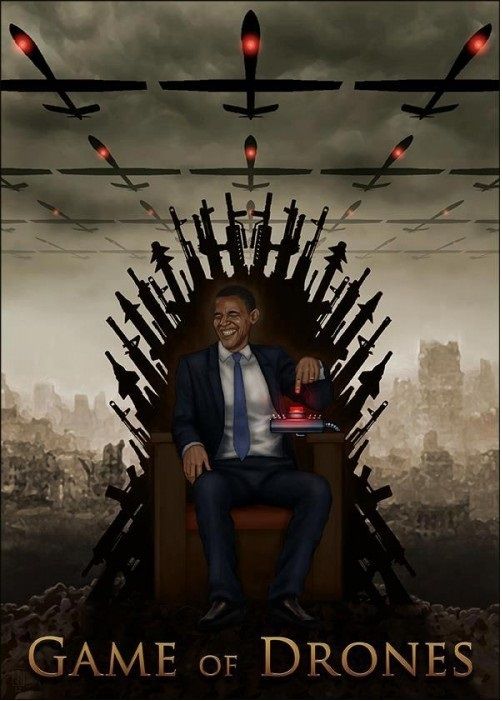
Didja know that Obama authorized overseas drone strikes that have killed and injured thousands of people including children? And if that's not enough the military can conduct a 'double tap' where they strike the same area just as rescue personnel arrive at the scene. The prez even bragged to one of his aides that he's "really good at killing people." Thanks for keeping it real, Barry Soetoro.

Obama game of drones
© Random pictures blog
Is this the behavior of a Super Soul Brother Number One? Martin Luther King was surely spinning in his grave when he was lovingly compared to this imposter.

I can hear the arguments now: You can't expect Obama to be able to clean up all the mess from the Bush years; Obama can't police everyone in his administration; There's too much bipartisan bickering to get anything done; His critics are just racists and ridicule everything he does; Obama has to play nice and just do what he can or there'll never be another black president again. These are all red herrings. They're distractions to keep people busy while the elite are making off in the getaway car. Obama is responsible. And guess what? If you voted for him, support his policies and continue to give him his props in the face of all evidence to the contrary, you are too. 

 
People I know are still blinded by the blackness. Recently, when discussing Obama's drone strike atrocities a friend nodded in agreement at the horror of it all then said, "but I still like him (and she meant that in a hubba-hubba kind of way)." After pausing to wrap my head around the complete thick-headedness of it I said, "So, murderers are attractive to you then?" Crickets. I guess as long as it's not your house being 'double-tapped' it's all good in the neighborhood.

Another friend expressed his displeasure with the commander in chief. Oh great, I thought, someone who can see through the facade. Turns out he was just upset because Obama hadn't populated his cabinet with enough black people. Obama's cabinet could be the political equivalent of Soul Train but it still doesn't change the fact that he is not a man for the people. Never has been. Never will be.

And speaking of soul, there's a high probability that the CEO of the USA does not have one. See, there's this little subset of humanity called psychopaths. It's estimated that they comprise about 6% of the global population. Psychopaths are incapable of feeling empathy or compassion for others. They lust for power over others and often rise to high positions. Essentially, they rule the world. They can be very charming. They can be expert liars. They can be well spoken with the gift of gab. They can destroy a whole village with a drone strike and not lose one wink of sleep over it. Now, I'm not saying that Obama is definitely a psychopath... but the evidence is compelling. His blackness is obviously irrelevant to his functioning as America's leader. See, it was never a matter of 'us and them'. The only true division regarding humanity has nothing to do with race. It's about psychopaths versus normal people with conscience.

Blinders still on? Is Obama working your nerves just a little bit? Is there even the slightest, niggling doubt that Obama is not the black messiah he was trumped up to be? As Obama is slithering his way through his second term in office are you feeling any HOPE? Experiencing any CHANGE? Nobody even caught a glimpse of their 40 acres and a mule. Everybody is struggling just as much -- if not more -- as they were when President Obama took office. (And just wait until that colossal wallet-gouging scheme that is ObamaCare kicks in and adds one more bill to the pile.) Historically, it's never been a hard task to convince people of color that politicians don't work in their best interests. I suppose that picturing a black man who wasn't relegated to the kitchen of the White House was enough to cause one hell of an about-face on that issue.

So, to paraphrase a true man for the people, Martin Luther King: Don't judge a man by the color of his skin but by the content of his character. Barack Obama is just another puppet of the elites wrapped in an Al Green crooning, hoop shooting, move-busting, drone-striking, Wall Street ass-kissing, Monsanto-loving, kill list-having, torture-dealing, wire-tapping, neat, brown package.

Peace out.


Thursday, 12 January 2012

The Streets of 2012


Project Syndicate / Naomi Wolf

NEW YORK – What does the New Year hold for the global wave of protest that erupted in 2011? Did the surge of anger that began in Tunisia crest in lower Manhattan, or is 2012 likely to see an escalation of the politics of dissent?

The answers are alarming but quite predictable: we are likely to see much greater centralization of top-down suppression – and a rash of laws around the developed and developing world that restrict human rights. But we are also likely to see significant grassroots reaction.

What we are witnessing in the drama of increasingly globalized protest and repression is the subplot that many cheerleaders for neoliberal globalization never addressed: the power of globalized capital to wreak havoc with the authority of democratically elected governments. From the perspective of global corporate interests, closed societies like China are more business-friendly than troublesome democracies, where trade unions, high standards of human-rights protection, and a vigorous press increase costs.

All over the world, the pushback against protest looks similar, suggesting that state and corporate actors are learning “best practices” for repressing dissent while maintaining democratic facades. In the United Kingdom, Prime Minister David Cameron routinely impugns human-rights laws; the Metropolitan Police have sought authority to use baton rounds – foot-long projectiles that have caused roughly a dozen deaths, including that of children, in Northern Ireland – on peaceful protesters; and a police report on the threat of terrorism, distributed to “trusted partners” among London businesses, included updates about Occupy protests and referred to “suspected activists.”

The UK has stringent internal-security legislation, but it never had a law like the United States Patriot Act. After anti-austerity protests in early 2011, followed by riots in major cities in August, the Metropolitan Police claimed powers to monitor private social-media accounts and smartphones. And, under the guise of protecting this summer’s Olympics against terrorism, the British military is establishing a massive base in London from which SAS (special forces) teams will operate – a radical departure from Britain’s traditional civil policing.

In Israel, Ha’aretz reports that Occupy-type protests have been met with police violence, including a beating of a 15-year-old girl, and threats of random arrest. Israel, like Britain, has seen a push, seemingly out of nowhere, to enact new laws crippling newsgathering and criminalizing dissent: a new law makes it potentially a crime to donate to left-wing organizations, human-rights laws have been weakened, and even investigative reporting has become more dangerous, owing to stricter libel penalties. Ha’aretz calls the push “the new feudalism.”

Finally, in America, the National Defense Authorization Act, enacted by Congress in December, allows the president to suspend due process for US citizens, detain them indefinitely, and render them for torture. One should not be surprised to see similar legislation adopted in democracies worldwide.

Not only are laws criminalizing previously legal dissent, organizing, and reporting being replicated in advanced democracies; so are violent tactics against protesters, backed by the increasing push in countries with long traditions of civil policing to militarize law enforcement.

Indeed, increasingly sophisticated weapons systems and protective equipment are being disseminated to civilian police officers. In the US, the federal government has spent an estimated $34 billion since the September 11, 2001, terrorist attacks to arm state and local police forces with battlefield-grade hardware. Investigative reporting has also revealed cross-pollination of anti-protest training: local police from cities like Austin, Texas, have been sent to Israel for training in crowd control and other tactics.

The globalization of mercenaries to crack down on dissent is also proceeding apace. Mercenaries are important in a time of global grassroots protest, because it is easier to turn a foreigner’s guns or batons against strangers than it is to turn the military or police against fellow citizens. Erik Prince, the head of the most infamous outfit, Academi (formerly Xe Services, formerly Blackwater), has relocated to the UAE, while Pakistani mercenaries have been recruited in large numbers to Bahrain, where protesters have been met with increasingly violent repression.

But this apparently coordinated pushback against global protest movements is not yet triumphant – not even in China, as the people of Wukan have shown. While the outcome of the villagers’ protest against the local government’s confiscation of their land remains uncertain, the standoff reveals new power at the grassroots level: social media allows sharper, coordinated gatherings and the rapid dissemination of news unfiltered by official media. The Internet is also disseminating templates of what real democracy looks like – instantly and worldwide.

Not surprisingly, people use this technology in ways that indicate that they have little interest in being cordoned off into conflicting and competing ethnicities, nationalities, or religious identities. Overwhelmingly, they want simple democracy and economic self-determination.

That agenda is in direct conflict with the interests of global capital and governments that have grown accustomed to operating without citizen oversight. It is a conflict that can be expected to heighten dramatically in 2012, as protesters’ agendas – from Occupy Wall Street to Occupy Moscow – gain further coherence.

Much is at stake. Depending on the outcome, the world will come to look either more like China – open for business, but closed for dissent – or more like Denmark. 

Naomi Wolf is a political activist and social critic whose most recent book is Give Me Liberty: A Handbook for American Revolutionaries.


You might also like to read more from  


Tuesday, 3 January 2012

Every American Needs To Hear This: Ex-CIA Analyst Ray McGovern


Bill of Rights R.I.P. (1789 - 2011)


One of the most extraordinary documents in human history -- the Bill of Rights -- has come to an end under President Barack Obama.

Derived from sacred principles of natural law, the Bill of Rights has come to a sudden and catastrophic end with the President's signing of the National Defense Authorization Act (NDAA), a law that grants the U.S. military the "legal" right to conduct secret kidnappings of U.S. citizens, followed by indefinite detention, interrogation, torture and even murder.

This is all conducted completely outside the protection of law, with no jury, no trial, no legal representation and not even any requirement that the government produce evidence against the accused. It is a system of outright government tyranny against the American people, and it effectively nullifies the Bill of Rights.

In what will be remembered as the most traitorous executive signing ever committed against the American people, President Obama signed the bill on New Year's Eve, a time when most Americans were engaged in the consumption of alcohol.


Monday, 2 January 2012

THE INAUGURATION OF POLICE STATE USA 2012. Obama Signs the “National Defense Authorization Act "


With minimal media debate, at a time when Americans were celebrating the New Year with their loved ones,  the “National Defense Authorization Act " H.R. 1540 was signed into law by President Barack Obama. The actual signing took place in Hawaii on the 31st of December.

According to Obama's "signing statement", the threat of Al Qaeda to the Security of the Homeland constitutes a justification for repealing fundamental rights and freedoms, with a stroke of the pen. 

The controversial signing statement (see transcript below) is a smokscreen. Obama says he disagrees with the NDAA but he signs it into law.

"[I have] serious reservations with certain provisions that regulate the detention, interrogation, and prosecution of suspected terrorists."
Obama implements "Police State USA", while acknowledging that certain provisions of  the NDAA are unacceptable. If such is the case, he could have either vetoed the NDAA (H.R. 1540) or sent it back to Congress with his objections.

He justifies the signing of the NDAA as a means to combating terrorism, as part of a "counter-terrorism" agenda.  But in substance, any American opposed to the policies of the US government can --under the provisions of the NDAA-- be labelled a "suspected terrorist" and arrested under military detention. Already in 2004 Homeland Security defined  several categories of potential "conspirators" or "suspected terrorists" including  "foreign [Islamic] terrorists" , "domestic radical groups", [antiwar and civil rights groups],  "disgruntled employees" [labor and union activists] and "state sponsored adversaries" ["rogue states", "unstable nations"]. The unspoken objective in an era of war and social crisis is to repress all forms of domestic protest and dissent.

The “National Defense Authorization Act " (H.R. 1540) is Obama's New Year's "Gift" to the American People. 

"Moreover, I want to clarify that my Administration will not authorize the indefinite military detention without trial of American citizens. Indeed, I believe that doing so would break with our most important traditions and values as a Nation. My Administration will interpret section 1021 in a manner that ensures that any detention it authorizes complies with the Constitution, the laws of war, and all other applicable law." (emphasis added0
Barack Obama is a lawyer (a graduate from Harvard Law School). He knows fair well that his signing statement --which parrots his commitment to democracy-- is purely cosmetic. It has no force of law.

His adminstration "will not authorize" what? The implementation of a Law endorsed by the Executive and signed by the President of the United States?

Section  1021 is crystal clear. The Executive cannot refuse to implement it.  The signing statement does not in any way invalidate or modify the actual signing by President Obama of NDAA (H.R. 1540) into law. It does not have any bearing on the implementation/ enforcement of the Law. 

Read more


Sunday, 18 December 2011

Three myths about the detention bill


This article is extremely important for everyone to read, especially Americans.

------------------- 

Glenn Greenwald

Condemnation of President Obama is intense, and growing, as a result of his announced intent to sign into law the indefinite detention bill embedded in the 2012 National Defense Authorization Act (NDAA). These denunciations come not only from the nation’s leading civil liberties and human rights groups, but also from the pro-Obama New York Times Editorial Page, which today has a scathing Editorial describing Obama’s stance as “a complete political cave-in, one that reinforces the impression of a fumbling presidency” and lamenting that “the bill has so many other objectionable aspects that we can’t go into them all,” as well as from vocal Obama supporters such as Andrew Sullivan, who wrote yesterday that this episode is “another sign that his campaign pledge to be vigilant about civil liberties in the war on terror was a lie.” In damage control mode, White-House-allied groups are now trying to ride to the rescue with attacks on the ACLU and dismissive belittling of the bill’s dangers.

For that reason, it is very worthwhile to briefly examine — and debunk — the three principal myths being spread by supporters of this bill, and to do so very simply: by citing the relevant provisions of the bill, as well as the relevant passages of the original 2001 Authorization to Use Military Force (AUMF), so that everyone can judge for themselves what this bill actually includes (this is all above and beyond the evidence I assembled in writing about this bill yesterday):

Myth # 1: This bill does not codify indefinite detention


Section 1021 of the NDAA governs, as its title says, “Authority of the Armed Forces to Detain Covered Persons Pursuant to the AUMF.”  The first provision — section (a) — explicitly “affirms that the authority of the President” under the AUMF  ”includes the authority for the Armed Forces of the United States to detain covered persons.” The next section, (b), defines “covered persons” — i.e., those who can be detained by the U.S. military — as “a person who was a part of or substantially supported al-Qaeda, the Taliban, or associated forces that are engaged in hostilities against the United States or its coalition partners.” With regard to those “covered individuals,” this is the power vested in the President by the next section, (c):


It simply cannot be any clearer within the confines of the English language that this bill codifies the power of indefinite detention. It expressly empowers the President — with regard to anyone accused of the acts in section (b) – to detain them “without trial until the end of the hostilities.” That is the very definition of “indefinite detention,” and the statute could not be clearer that it vests this power. Anyone claiming this bill does not codify indefinite detention should be forced to explain how they can claim that in light of this crystal clear provision.

It is true, as I’ve pointed out repeatedly, that both the Bush and Obama administrations have argued that the 2001 AUMF implicitly (i.e., silently) already vests the power of indefinite detention in the President, and post-9/11 deferential courts have largely accepted that view (just as the Bush DOJ argued that the 2001 AUMF implicitly (i.e., silently) allowed them to eavesdrop on Americans without the warrants required by law). That’s why the NDAA can state that nothing is intended to expand the 2001 AUMF while achieving exactly that: because the Executive and judicial interpretation being given to the 20o1 AUMF is already so much broader than its language provides.

But this is the first time this power of indefinite detention is being expressly codified by statute (there’s not a word about detention powers in the 2001 AUMF). Indeed, as the ACLU and HRW both pointed out, it’s the first time such powers are being codified in a statute since the McCarthy era Internal Security Act of 1950, about which I wrote yesterday.

Myth #2: The bill does not expand the scope of the War on Terror as defined by the 2001 AUMF

This myth is very easily dispensed with. The scope of the war as defined by the original 2001 AUMF was, at least relative to this new bill, quite specific and narrow. Here’s the full extent of the power the original AUMF granted:
(a) IN GENERAL- That the President is authorized to use all necessary and appropriate force against those nations, organizations, or persons he determines planned, authorized, committed, or aided the terrorist attacks that occurred on September 11, 2001, or harbored such organizations or persons, in order to prevent any future acts of international terrorism against the United States by such nations, organizations or persons.
Under the clear language of the 2001 AUMF, the President’s authorization to use force was explicitly confined to those who (a) helped perpetrate the 9/11 attack or (b) harbored the perpetrators. That’s it. Now look at how much broader the NDAA is with regard to who can be targeted:


Section (1) is basically a re-statement of the 2001 AUMF. But Section (2) is a brand new addition. It allows the President to target not only those who helped perpetrate the 9/11 attacks or those who harbored them, but also: anyone who “substantially supports” such groups and/or “associated forces.” Those are extremely vague terms subject to wild and obvious levels of abuse (see what Law Professor Jonathan Hafetz told me in an interview last week about the dangers of those terms). This is a substantial statutory escalation of the War on Terror and the President’s powers under it, and it occurs more than ten years after 9/11, with Osama bin Laden dead, and with the U.S. Government boasting that virtually all Al Qaeda leaders have been eliminated and the original organization (the one accused of perpetrating 9/11 attack) rendered inoperable.

It is true that both the Bush and Obama administration have long been arguing that the original AUMF should be broadly “interpreted” so as to authorize force against this much larger scope of individuals, despite the complete absence of such language in that original AUMF. That’s how the Obama administration justifies its ongoing bombing of Yemen and Somalia and its killing of people based on the claim that they support groups that did not even exist at the time of 9/11 – i.e., they argue: these new post-9/11 groups we’re targeting are associated forcesof Al Qaeda and the individuals we’re killing “substantially support” those groups. But this is the first time that Congress has codified that wildly expanded definition of the Enemy in the War on Terror. And all anyone has to do to see that is compare the old AUMF with the new one in the NDAA.

Myth #3: U.S. citizens are exempted from this new bill

This is simply false, at least when expressed so definitively and without caveats. The bill is purposely muddled on this issue which is what is enabling the falsehood.

There are two separate indefinite military detention provisions in this bill. The first, Section 1021, authorizes indefinite detention for the broad definition of “covered persons” discussed above in the prior point. And that section does provide that “Nothing in this section shall be construed to affect existing law or authorities relating to the detention of United States citizens, lawful resident aliens of the United States, or any other persons who are captured or arrested in the United States.” So that section contains a disclaimer regarding an intention to expand detention powers for U.S. citizens, but does so only for the powers vested by that specific section. More important, the exclusion appears to extend only to U.S. citizens “captured or arrested in the United States” — meaning that the powers of indefinite detention vested by that section apply to U.S. citizens captured anywhere abroad (there is some grammatical vagueness on this point, but at the very least, there is a viable argument that the detention power in this section applies to U.S. citizens captured abroad).

But the next section, Section 1022, is a different story. That section specifically deals with a smaller category of people than the broad group covered by 1021: namely, anyone whom the President determines is “a member of, or part of, al-Qaeda or an associated force” and “participated in the course of planning or carrying out an attack or attempted attack against the United States or its coalition partners.” For those persons, section (a) not only authorizes, but requires (absent a Presidential waiver), that they be held “in military custody pending disposition under the law of war.” The section title is “Military Custody for Foreign Al Qaeda Terrorists,” but the definition of who it covers does not exclude U.S. citizens or include any requirement of foreignness.
That section — 1022 — does not contain the broad disclaimer regarding U.S. citizens that 1021 contains. Instead, it simply says that the requirement of military detention does not apply to U.S. citizens, but it does not exclude U.S. citizens from the authority, the option, to hold them in military custody. Here is what it says:


The only provision from which U.S. citizens are exempted here is the “requirement” of military detention. For foreign nationals accused of being members of Al Qaeda, military detention is mandatory; for U.S. citizens, it is optionalThis section does not exempt U.S citizens from the presidential power of military detention: only from the requirement of military detention.

The most important point on this issue is the same as underscored in the prior two points: the “compromise” reached by  Congress includes language preserving the status quo. That’s because the Obama administration already argues that the original 2001 AUMF authorizes them to act against U.S. citizens (obviously, if they believe they have the power to target U.S. citizens for assassination, then they believe they have the power to detain U.S. citizens as enemy combatants). The proof that this bill does not expressly exempt U.S. citizens or those captured on U.S. soil is that amendments offered by Sen. Feinstein providing expressly for those exemptions were rejected. The “compromise” was to preserve the status quo by including the provision that the bill is not intended to alter it with regard to American citizens, but that’s because proponents of broad detention powers are confident that the status quo already permits such detention.

In sum, there is simply no question that this bill codifies indefinite detention without trial (Myth 1). There is no question that it significantly expands the statutory definitions of the War on Terror and those who can be targeted as part of it (Myth 2). The issue of application to U.S. citizens (Myth 3) is purposely muddled — that’s why Feinstein’s amendments were rejected — and there is consequently no doubt this bill can and will be used by the U.S. Government (under this President or a future one)  to bolster its argument that it is empowered to indefinitely detain even U.S. citizens without a trial (NYT Editorial: “The legislation could also give future presidents the authority to throw American citizens into prison for life without charges or a trial”; Sen. Bernie Sanders: “This bill also contains misguided provisions that in the name of fighting terrorism essentially authorize the indefinite imprisonment of American citizens without charges”).

Even if it were true that this bill changes nothing when compared to how the Executive Branch has been interpreting and exercising the powers of the old AUMF, there are serious dangers and harms from having Congress — with bipartisan sponsors, a Democratic Senate and a GOP House — put its institutional, statutory weight behind powers previously claimed and seized by the President alone. That codification entrenches these powers. As the New York Times Editorial today put it: the bill contains “terrible new measures that will make indefinite detention and military trials a permanent part of American law.

What’s particularly ironic (and revealing) about all of this is that former White House counsel Greg Craig assured The New Yorker‘s Jane Mayer back in February, 2009 that it’s “hard to imagine Barack Obama as the first President of the United States to introduce a preventive-detention law.Four months later, President Obama proposed exactly such a law — one that The New York Times described as “a departure from the way this country sees itself, as a place where people in the grip of the government either face criminal charges or walk free” — and now he will sign such a scheme into law.

UPDATE: There’s an interview with me in Harper’s today regarding American justice and With Liberty and Justice for Some.

Related Posts Plugin for WordPress, Blogger...