Search This Blog

Showing posts with label Hungary. Show all posts

Monday, 22 December 2025

EU blocks protesting farmers in Brussels using barbed wire, tear gas and water cannons, while Orbán says farmers are ‘100% right’

Remix

As the EU moves to crush protesting farmers demonstrating in Brussels, Hungarian Prime Minister Viktor Orbán offered full backing to the farmers and their efforts to stop the EU’s Mercosur free trade deal, which threatens to destroy food security in Europe. [That's the idea...]


“Farmers are 100 percent right,” said Orbán, who is currently in Brussels attending the EU Summit.

He added that the farmers have obvious issues with the Mercosur package, a free trade agreement with Latin American countries, because it “kills the farmers.”


“Hungary is one of the countries that does not support the Mercosur agreement. There were serious professional debates about this in Hungary, and the Hungarian position was that we do not support this,” said the prime minister.

Viktor Orbán reminded that the agreement would require a qualified majority, and according to his expectations, there is not enough support.


Saturday, 1 November 2025

Poland, Slovakia, Hungary Defy EU By Keeping Bans On Ukraine Imports

 
A new European Union deal to liberalize trade with Ukraine took effect Wednesday, but Poland, Hungary and Slovakia are defying it, maintaining their protectionist bans on imports from the country. Their defiance comes amid mounting grievances over EU prioritization of the West's proxy war on Russia over the prosperity of EU member states and their citizens.

Approved on Oct 13, the new EU arrangement expands tariff-free Ukrainian access to European markets, replacing a temporary lowering of trade barriers adopted after Russia invaded Ukraine in 2022. "We believe (the agreement) is a stable, fair framework, that can be reliable both for the EU and for Ukraine, to ensure a gradual integration in our single market, while providing stable trade flows," said European Commission spokeswoman Ariana Podesta. The European Commission (EC) is the EU's principal executive branch.

Rebelling against the Brussels regime, Poland, Hungary and Slovakia say they will maintain the bans on agricultural imports from Ukraine they put in place in 2023. The three countries' bans were a reaction to a wartime glut of Ukrainian products, which resulted from Black Sea ports being disrupted by the war with Russia. The glut sank prices and hammered domestic producers.
 

Friday, 24 October 2025

EU Declares War On Its Own Members

Simplicus The Thinker

Yesterday, two near-simultaneous acts of sabotage saw explosions ripping through oil refineries in both Hungary and Romania. In Hungary it was the MOL in Százhalombatta, which reportedly receives Russian oil, while in Romania the Petrotel-Lukoil, a subsidiary of the Russian parent company.

As one commentator writes, these attacks came literally hours after the European Council had just approved to ban Russian gas starting in 2026:

The timing here is exceptionally curious because this attack came just hours after the European Council essentially locked in its position to almost completely ban Russian gas imports, with new contracts being outlawed at the beginning of 2026, and all long term contracts forcibly expiring in 2028. A similar ban on oil imports is expected in the near future. Hungary and Slovakia have pledged to issue legal challenges to the ban.

As of this writing, there were reports that a new explosion lit up a refinery in Bratislava, Slovakia—which allegedly processes Russian oil from the Druzhba pipeline. But subsequent follow-ups appear to show these were fake—though it’s as of yet uncertain.

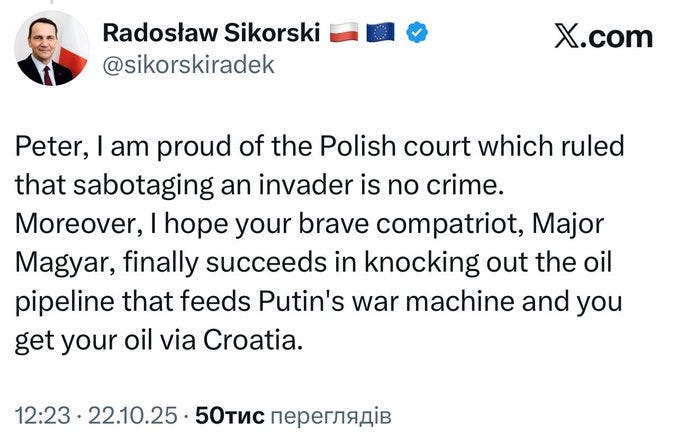
The real attacks on Romania and Hungary came just days after Europe essentially gave carte blanche for terror attacks across the EU by way of several top European officials openly condoning not only the Nord Stream attacks, but even attacks against Hungarian oil pipelines. Here Polish Foreign Minister Sikorski addresses Hungary’s Peter Szijjarto:


Read more

Tuesday, 19 July 2016

De-Globalization: Hungary asks IMF to leave the country after early payback

RT 


Hungary has announced plans to repay its bailout loan from the International Monetary Fund early and asked the organization to leave the country.


The head of Hungary’s Central Bank Gyorgy Matolcsy wrote a letter to IMF Managing Director Christine Lagarde on Monday asking for it to close its representative office in Budapest as it was "not necessary to maintain" it any longer.

The IMF says it is ready to agree since the current IMF representative in Hungary is due to leave soon anyway.

Hungary is heading for a general election next year, and many see the move as an attempt to show the government’s ability to avoid austerity programs and to act without outside help.

In 2008, amid the global crisis Hungary was saved from bankruptcy with a $26 billion rescue package from the IMF and the EU. Two years later Prime Minister Viktor Orban's government decided not to renew the deal to avoid closer IMF scrutiny of its economic policies.

However, in 2011, Economy Minister Matolcsy turned to IMF for a precautionary deal but didn’t get any reply.

In February 2013 Prime Minister Orban issued the country’s first international bond since 2011, thus demonstrating the country could go it alone by borrowing on global financial markets.

Relations between Orban’s government and the IMF have always been strained. In 2010, when Orban came to power, his government issued new laws, which were criticized as curtailing democracy, the justice system and freedom of speech. 

The European Parliament responded with a resolution calling on Hungary to repeal the "anti-democratic changes."

Hungary still owes $2.125 billion to the IMF from its original credit line of $25.5 billion.


Sunday, 24 November 2013

Physicists find doubly transient chaos can emerge due to dissipation


phys.org

A team of researchers, one from the U.S. and the others from Hungary, has found that a condition they've dubbed doubly transient chaos can emerge from a system due to dissipation. In their paper they've had published in the journal Physical Review Letters, the team describes how their experiments with a triple-magnet pendulum showed that even systems that come to stop eventually can have chaos attributes.

At first blush, most people recognize chaos when they see it—a crowd of people, each behaving unpredictably, for example. In physics, chaos can be seen with examples such as the constantly changing images that result from fractal geometry. One property that all chaotic systems have in common is that changes continue occurring (due either to an external force or lack of one such as gravity or friction), aka, transient chaos, as long as the system is in existence—otherwise, the system would dissipate to a non-changing state. But, is that system that results chaotic as well? The researchers in this new effort say yes, but not in the same way as other chaotic systems. For that reason, they have called it doubly transient chaos.

Chaos can exist in even the simplest of systems, such as a pendulum, for example. If it's started and left to swing till it stops, it will follow a routine that can be accurately described mathematically—but not if it is disturbed periodically by an external energy source—say a person reaching over and pushing it a little bit to keep it going. If that extra push can't be described in an orderly way, then the motion and duration of the pendulum's swing can be described as chaotic. The researchers used just such an example to prove their idea about transient chaos. They used a pendulum with three magnets attached to a triangle—suggesting three final states for the pendulum when it finally stops moving. In such a setup, the pendulum was subject to magnetic forces, gravity, and air drag.

In studying the ways in which the pendulum swung and eventually stopped, the researchers found that it conformed to doubly transient chaos—one of whose hallmarks is that parameters describing its rate of change to a final state are not constant as they are with transient chaos, but are instead exponential.

The researchers believe that doubly transient chaos may be at play in many other systems (chemical reactions, binary star behavior, etc.) and because of that are likely far less predictable than has been previously thought. 

Read more


Related Posts Plugin for WordPress, Blogger...