Search This Blog

Showing posts with label Comets. Show all posts

Saturday, 11 May 2019

Hyperactive Comets Hint at Origins of Earth’s Oceans

Nola Taylor
Scientific American

A new study suggests primordial seawater may lurk hidden at the hearts of many comets

The mysterious source of Earth’s water has intrigued generations of scientists. Learning how this liquid—the cornerstone of life as we know it—made its way to our planet has sweeping implications, for the possibility of alien biospheres not only elsewhere in the solar system but also on worlds orbiting other stars. But understanding how water arrived on Earth has proven surprisingly difficult.

After the sun formed from a cloud of dust and gas, the remaining protoplanetary disk of material was probably rich in water’s raw ingredients, hydrogen and oxygen. But conventional wisdom holds that the newborn star’s radiance boiled away much of those volatile gases from the inner solar system, leaving mostly dry material from which to build Earth and the other rocky planets. The majority of Earth’s moisture must have arrived later, by some other means.

For decades, scientists considered icy comets of the outer solar system as the most likely suspects, until observations revealed that most comets’ compositions did not quite match that of Earth’s oceans. And so consensus shifted toward asteroids as the source of Earth’s seas, since these rocky bodies also contain nontrivial amounts of water and are conveniently located close by, where they could have easily rained down on the young Earth. Now, however, an investigation of comet 46P/Wirtanen suggests that the bulk of Earth’s water may have come from comets after all, even though asteroids likely still played an important role.

Read more

Wednesday, 20 March 2019

A Meteor More Powerful Than 10 Atomic Bombs Exploded Over the Bering Sea

Motherboard


The December 18 fireball created the biggest airburst since the Chelyabinsk meteor of 2013.


A meteor that exploded over the Bering Sea in December released 10 times the energy of an atomic bomb into the atmosphere. 

The asteroid, which was about 10 meters wide, disintegrated in the skies off the coast of Russia’s Kamchatka peninsula on December 18. It unleashed 173 kilotons of energy, making it the second-biggest fireball in recent decades next to the 440-kiloton meteor that rocked the Russian city of Chelyabinsk on February 15, 2013. 

Unlike the Chelyabinsk event, the Bering Sea fireball did not make a big news splash immediately after it impacted in part because it occurred over a remote and unpopulated area. Chelyabinsk, in contrast, is home to more than one million people, many of whom witnessed or were injured by the explosion. Some even captured the dazzling airburst on camera, which instantly enabled viewers around the world to share the sight of the blast.

Read more

See also: More Evidence of a Comet Catastrophe 13,000 Years Ago, This Time From South America

Tuesday, 16 June 2015

Why has NASA announced that a meteor is NOT going to hit the Earth in September?

Michael Snyder
End of the American Dream


 Internet buzz about a giant meteor that is going to strike our planet in September has become so intense that NASA has been forced to issue a statement publicly denying that it is going to happen. NASA insists that the agency knows of "no asteroid or comet currently on a collision course with Earth", and that "no large object is likely to strike the Earth any time in the next several hundred years". To be honest, NASA should perhaps hold off on making such bold statements concerning what will happen in the future considering the fact that the Chelyabinsk meteor that exploded over Russia in 2013 took them totally by surprise. In any event, what we do know is that our region of space is absolutely packed with meteors and asteroids. At this point, approximately 10,000 major near earth objects have been discovered by scientists, and about 10 percent of them are one kilometer or larger in size. If any of those big ones were to hit us, we would be looking at another Tunguska event or worse. Very large meteors have struck our planet before, and they will hit us again. It is only a matter of time.

But of most immediate concern to lots of people out there are the various theories that are floating around about September. The following is an excerpt from an article that appeared in a British news source just this week... 


Read more
 

Friday, 5 December 2014

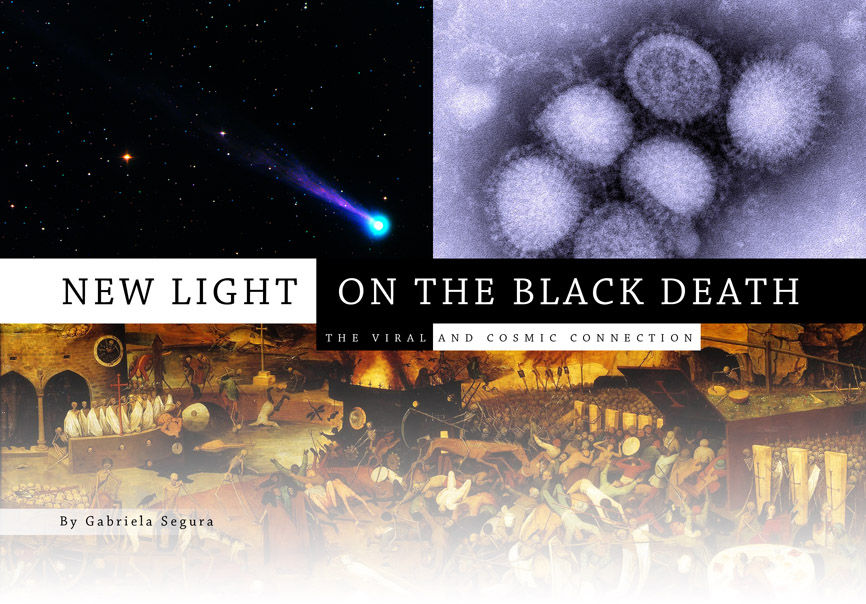
New Light on the Black Death: The Viral and Cosmic Connection

Gabriela Segura, M.D.
The Dot Connector Magazine


This article was first published in issue 13, volume 1 / 2011 of The Dot Connector Magazine, official publication of Sott.net.
"Comets are vile stars. Every time they appear in the south, they wipe out the old and establish the new. Fish grow sick, crops fail, Emperors and common people die, and men go to war. The people hate life and don't even want to speak of it." -Li Ch'un Feng, Director, Chinese Imperial Astronomical Bureau, 648, A.D.


In 2007, a meteorite fell in Puno, Southeastern Perú. José Macharé - scientist of the Geologic, Mining and Metallurgic Institute in Perú - said that the space rock fell near a muddy area by Lake Titicaca, making the water boil for around ten minutes, and mixing with the soil and emanating a gray cloud, the components of which remain unknown. Having discarded radioactive poisons, this toxic cloud is said to have caused headaches and respiratory problems in at least 200 persons from a population of 1500 inhabitants. Other than this event, how often do we hear about people getting sick due to a rock coming from space? How about birds, fish or other animals? Ancient astrologers cite comets as ill omens of death and famine, but are there any other causes other than the ones due to physical/mechanical consequences of comet impact devastation in our fragile environment of which we should be aware?

As a physician, I usually concentrate strictly on medical and health-related issues, not history or catastrophism. However, like so many other people, I see signs of atmospheric changes on our planet which, according to many experts, may well be due to increasing comet dust loading. When I read about increasing reports of fireballs all around the world, and I know that these factors must have an effect on the health of individuals and societies, it motivates me to do the research to find the connections so that I am better prepared for what may lie in our future. If our planet is entering a new cometary bombardment cycle, and if these comets harbor new species of microbes unknown to mankind's collective immunological systems (as may well be the case), then being forewarned is being forearmed. 


Read more

Related Posts Plugin for WordPress, Blogger...