Search This Blog

Showing posts with label Wind Farms. Show all posts

Tuesday, 9 July 2019

The Appalling Environmental Cost Of Wind Energy


The Global Warming Policy Foundation

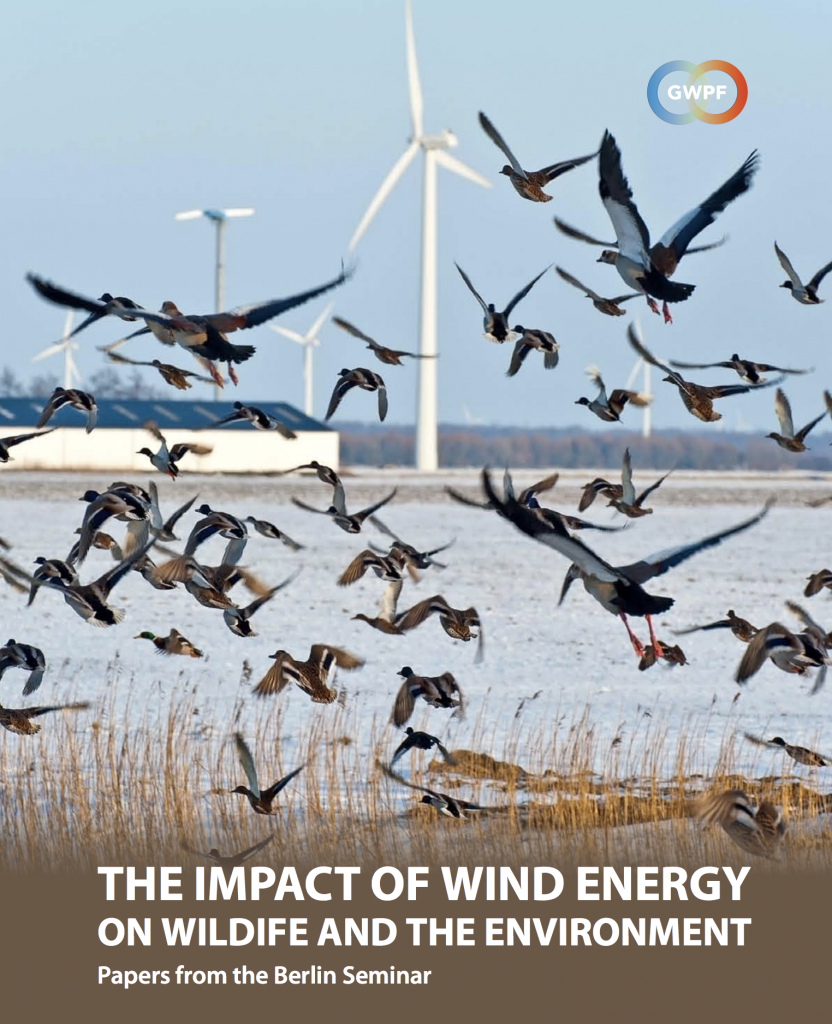
A new publication from the Global Warming Policy Foundation reviews the impact of wind energy on the environment and finds that it is already doing great harm to wildlife.

“The Impact of Wind Energy on Wildlife and the Environment” contains contributions from both researchers and campaigners, with a focus on birdlife. 

Professor Oliver Krüger describes his cutting-edge research, which has shown how birds of prey and ducks are being killed in their thousands in Germany. The risk to these species is so great that there is a possibility of whole populations being wiped out. 

Klaus Richarz, the former head of a major bird reserve in Germany, describes how windfarm operators are evading strict compliance with the rules, to the detriment of both birds and bats.
Dr Peter Henderson, of the University of Oxford, reviews the effects of wind turbines on a wide variety of animals. He suggests that death toll on bats may already be ecologically significant:
“About 200,000 bats are annually killed at onshore wind turbines in Germany alone. These numbers are sufficient to produce concern for future populations, as bats are long-lived and reproduce slowly, so cannot quickly replace such losses.”
Lastly, Paula Byrne of WindAware Ireland describes how windfarms in her native country have desecrated landscapes, and have even threatened the endangered Nore Freshwater Pearl Mussel.
With an extraordinary expansion of renewable energy planned, there is potential for these serious environmental impacts to become catastrophic.

The Impact of Wind Energy on Wildlife and the Environment (PDF)

Throughout this week, GWPF will be releasing a series of publications and videos on the subject of renewable energy’s impact on the environment.

Friday, 16 May 2014

The Windfarm Delusion

The Spectator
Matt Ridley
March 3, 2012

The government has finally seen through the wind-farm scam – but why did it take them so long?
To the nearest whole number, the percentage of the world’s energy that comes from wind turbines today is: zero. Despite the regressive subsidy (pushing pensioners into fuel poverty while improving the wine cellars of grand estates), despite tearing rural communities apart, killing jobs, despoiling views, erecting pylons, felling forests, killing bats and eagles, causing industrial accidents, clogging motorways, polluting lakes in Inner Mongolia with the toxic and radioactive tailings from refining neodymium, a ton of which is in the average turbine — despite all this, the total energy generated each day by wind has yet to reach half a per cent worldwide.

If wind power was going to work, it would have done so by now. The people of Britain see this quite clearly, though politicians are often wilfully deaf. The good news though is that if you look closely, you can see David Cameron’s government coming to its senses about the whole fiasco. The biggest investors in offshore wind — Mitsubishi, Gamesa and Siemens — are starting to worry that the government’s heart is not in wind energy any more. Vestas, which has plans for a factory in Kent, wants reassurance from the Prime Minister that there is the political will to put up turbines before it builds its factory.

This forces a decision from Cameron — will he reassure the turbine magnates that he plans to keep subsidising wind energy, or will he retreat? The political wind has certainly changed direction. George Osborne is dead set against wind farms, because it has become all too clear to him how much they cost. The Chancellor’s team quietly encouraged MPs to sign a letter to No. 10 a few weeks ago saying that ‘in these financially straitened times, we think it is unwise to make consumers pay, through taxpayer subsidy, for inefficient and intermittent energy production that typifies onshore wind turbines’.

Putting the things offshore may avoid objections from the neighbours, but (Chancellor, beware!) it makes even less sense, because it costs you and me — the taxpayers — double. I have it on good authority from a marine engineer that keeping wind turbines upright in the gravel, tides and storms of the North Sea for 25 years is a near hopeless quest, so the repair bill is going to be horrific and the output disappointing. Already the grouting in the foundations of hundreds of turbines off Kent, Denmark and the Dogger Bank has failed, necessitating costly repairs.

In Britain the percentage of total energy that comes from wind is only 0.6 per cent. According to the Renewable Energy Foundation, ‘policies intended to meet the EU Renewables Directive in 2020 will impose extra consumer costs of approximately £15 billion per annum’ or £670 per household. It is difficult to see what value will be got for this money. The total carbon emissions saved by the great wind rush is probably below 1 per cent, because of the need to keep fossil fuels burning as back-up when the wind does not blow. It may even be a negative number.

America is having far better luck. Carbon emissions in the United States fell by 7 per cent in 2009, according to a Harvard study. But the study concluded that this owes less to the recession that year than the falling price of natural gas — caused by the shale gas revolution. (Burning gas emits less than half as much carbon dioxide as coal for the same energy output.) The gas price has fallen even further since, making coal seem increasingly pricey by comparison. All over America, from Utah to West Virginia, coal mines are being closed and coal plants idled or cancelled. (The US Energy Information Administration calculates that every $4 spent on shale purchases the same energy as $25 spent on oil: at this rate, more and more vehicles will switch to gas.)

Wednesday, 5 March 2014

Wind2050: a dystopian society?

Comment: Wind farms are seriously bad news for a whole host of reasons. Yet they remain a tenacious icon within the green movement. I consider myself ecologically minded and passionate about Nature. Yet, seldom have I come across more fanatical and authoritarian followers than within climate change science and some environmental movements of today. They don't seem to realise that green ideology is just as open to green-washing and scientific distortion as anything else. 

------------------------------


Wind Power Opponents in the Cross Hairs

  
 Press release 
February 28th 2014 
Wind2050: a dystopian society?


World Council for Nature 
Via www.windwahn.de/

The World Council for Nature (WCFN) has been informed that Danish taxpayers' money is being spent to the tune of 2,665,688 to spy on associations and citizens' groups of windfarm victims (present or potential). The name of the program is "Wind2050 Multidisciplinary study on local acceptance and development of wind power projects" (1). It is administered chiefly by the Danish multinational company Vestas, the Danish government, and Denmark's Aarlborg University. Its aim is to break the resistance of windfarm neighbors and opponents to Big Wind in Denmark and around the world. Note: in Denmark alone there are more than 200 associations of neighbors fighting the windfarm scourge, and Vestas' profits have taken a big plunge.

The anti-democratic nature of this surveillance and targeting of windfarm victims is disturbing. WCFN warns that the obsession of the Danish government with wind farms, anchored as elsewhere in the world in the financing needs of political parties (1), is driving it dangerously close to paternalistic totalitarianism.

Below is a map that the Wind2050 study has made of the web-links that connect most of the world's windfarm victim groups to each other. It is a form of saying: we have identified the enemy, here he is.  The CIA would proceed likewise with al Qaeda.


WCFN wishes to remind the public that the worst crimes against nature are or have been perpetrated by political regimes which are not balanced by effective counter-powers such as investigative media and an independent judicial system. In the former Soviet Union, the Sea of Aral was practically eraced from the map by the regime's obsession with cotton production. In very much the same way, the Golden Eagle, other raptors and extremely useful species of bats are being wiped out from countries like the UK and the US because of their governments' obsession with wind farms.

The much feared Orwellian society is dawning upon us, and "green shirts" are in the process of taking control of our lives, complete with "smart meters", "smart grids" and imbecilic directives, with the help of self-serving politicians and pharaonic subsidies that corrupt anything they touch.

"Orwellian" is an adjective describing "the societal condition that George Orwell identified as being destructive to the welfare of a free and open society. It connotes an attitude and a brutal policy of draconian control by propaganda, surveillance, misinformation, denial of truth" (Wikipedia).


Indeed, the denial of any of the ill-effects of wind turbines is particularly obvious in today’s society: denial of the harm done to residents, and to biodiversity, landscapes, tourism, property values, the economy, sovereign debt and the price of electricity. Paid propagandists troll the Internet with a mission: to drown wind farm opponents under a deluge of half-truths so as to whitewash their industry which is essentially non-performing, extremely costly and harmful to people and the environment.

Are political correctness, corruption, and wind farms leading us to a dystopian society?


Mark Duchamp
Chairman
+34 693 643 736
wcfn@live.com


Source: 
 
press release from Windwahn:
http://www.windwahn.de/


References:

(1) – Wind250 program: http://bit.ly/1fO8eDX

(2) – financing of political parties through wind farms http://wcfn.org/2014/02/10/not-renewable/


Tuesday, 4 February 2014

Ireland's rural protests over wind energy

Comment: Wind Power remains the icon for renewable energies. It's just a tragedy that it is uneconomic, has dangerous health effects and a corporate green-washing exercise to make as much money as possible. And I passionately support green issues and the search for genuine alternative forms of sustainable energy. But I know when environmentalism has been co-opted for corporatism and wind farms are, I'm afraid a prime example

------------------------
BBC News

Ireland is short of money but not wind, which now forms a central plank of its energy policy.
But plans to develop wind power and export it to Britain are sparking a rural revolt, with local protest groups uniting through social media. Some claim Ireland will become a wind farm for Britain. 

Turbines up to 180m (590ft) tall - half the height of the Empire State Building - are cropping up as part of a drive to meet EU green energy targets and generate 40% of Ireland's electricity from wind. Revenue, too, will flow by exporting power to Britain under inter-governmental plans.


More than 100 opposition groups have sprung up against new wind farms - all in rural areas - claiming the turbines will ruin the landscape, with noise and shadows blighting homes nearby. 

Some have joined forces with groups opposing planned new electricity pylons to upgrade the national power grid.  Wind energy companies say they follow strict Irish planning guidelines, now under review due to new larger turbines and local opposition. 

'Ruined landscape'
 
A country pub in County Laois is packed on a Monday night for a meeting of the Laois Energy Awareness Group. Ray Conroy helped set it up, he says, after energy companies suddenly appeared, doing deals with some locals for turbine sites. 

"The first we knew was when our local authorities and government announces 'wey hey - wind farms are coming, and it's a boom for everyone'. It's nonsense," he says. 

Read more

Thursday, 14 November 2013

Why are you Green?

Comment: Response to Liberal Democrats' data mining question "Why are you Green?" Like most political parties the LDP have bought the idea that wind farms are part of the answer for the future of green technologies rather than the uneconomic environmental con that they are. Most people are bamboozled by the iconic status that the wind farm image holds but seldom realise that it is the most economically nonviable form of alternative energy  there is. However, energy companies are planning to make a killing nonetheless, following the same formula of corporate hijacking that routinely takes place in so many other sectors. Ecological awareness is just as vulnerable to corruption as anything else yet we are strangely blind to the fact. 

------------------


Gaining and achieving a beneficial energy policy for our country is a cross party problem and should be, but clearly isn’t, above petty party politics.  It is at the heart of all present and future needs. Only those with open minds, who can appreciate that it is both possible and necessary to hold on to the basic ethics of supporting the wish to change damaging environmental behaviour, while also accepting that it must be accompanied by a healthy scepticism on any emerging questionable dogma, or high jacking of original principles, will read on.  If considering renewable energy technologies, this is an admittedly complex area to fully understand.

Before imposing an energy policy upon a population however, a responsible government must first prove claims made relating to emission savings and benefits  - and that it is being done without inflicting actual or indirect harm to a vulnerable  electorate. This includes full transparency of plans and compliance with International Treaty legal obligations.  In this respect the UK has been found to be non compliant with Article 7 of the Aarhus Convention regulations to which it is signed up. For those interested in protecting the democratic process, that ratified ruling  and the complaint which led to it, can be found at the UNECE website under ACCC/C/2012/68.   One clear point of agreement, is that everyone can support authorities being held to account as to object would be illogical.

No rational or compassionate person would wish to do otherwise than the best they can for our planet - as its health and functioning are directly linked to the survival of our own and all other species. It is however, of extreme importance that we do not allow vested interests or political agendas to mask problems relating to energy production technologies which have the capacity, through excessive implementation, to cause the opposite effect.  Wind power is one such technology as is being graphically demonstrated by negative effects both to the environment and economy. There is no proof for claims made relating to :-

1.           monitoring of investments
2.           assessment of cost
3.           assessment of security of supply
4.           assessment of emissions saving

See Scottish Audit report: http://www.audit-scotland.gov.uk/docs/central/2013/nr_130912_renewable_energy.pdf

Para 67  Total investment in the Scottish Economy by the renewable energy industry is not monitored.

Para 72  However the number of jobs specifically in the renewable energy sector is not monitored or reported.   

It is correct that the Scottish Government commissioned a report (October 2010) that gave information on items 3 and 4.  This was however an 'Energy Storage and Management Study' and the investigation was not based on the present targets for renewable energy production.  No other report on these issues in the public domain is known.  Engineers have so far been ignored in their requests for independent reports on these issues.  We need to know why these are not being produced and made public.   

Since wind energy needs to be subsidized by increasingly unsustainable amounts, it is not presently cost competitive with thermal generation.  The real cost can only go up, not down, because expensive thermal generators will need to be kept available to meet demand.

There are many good and valid reasons why the air quality of the planet needs to be protected and improved by removing toxic emissions produced by the industrial world. Ditto the serious and burgeoning earth pollution problems.  Many are reasoning that it is becoming clear that climate change events are cyclical and/or cannot be avoided, citing various bases for their scientific beliefs and studies.  Should they be even partially correct, vast funding and subsidies for wind power whilst emerging and powerful nations revert to traditional forms of energy production, is denying the urgent need for such resources to be switched to means of protection of those at risk from inevitable events. 

Food sources and new methods of production for more adverse conditions also desperately need funding.   What must be avoided is the rapid imposition of policies based largely upon weak/unproven theories, ideologies, or political expediency - while having the real capacity for economic and environmental harm and disproportionately benefiting the few, to the detriment of others.

History can teach us much about the adoption of such routes, and some of the Committee members considering our UN complaint had experienced exactly what it is like living with a loss of democracy. 

It is worth noting that the Committee had never before had so many observers for one case present at a Hearing. They came from all over Europe, e.g. Spain, Germany, Portugal, Switzerland, Belgium the UK and Eire. Due to their own experiences relating to wind power’s negative effects, the integrity of the submissions made were clearly recognised as important to support.  If we do not insist that those in power act in our best interests via the rule of law and compliance with treaties involving human rights and aspects involved, we are risking a similar loss of democracy evolving.

Related Posts Plugin for WordPress, Blogger...