Search This Blog

Showing posts with label Africa. Show all posts

Monday, 29 July 2019

Violence Has Spiked in Africa Since the Military Founded AFRICOM, Pentagon Study Finds

Nick Turse
 
Since U.S. Africa Command began operations in 2008, the number of U.S. military personnel on the African continent has jumped 170 percent, from 2,600 to 7,000. The number of military missions, activities, programs, and exercises there has risen 1,900 percent, from 172 to 3,500. Drone strikes have soared and the number of commandos deployed has increased exponentially along with the size and scope of AFRICOM’s constellation of bases.
 
The U.S. military has recently conducted 36 named operations and activities in Africa, more than any other region of the world, including the Greater Middle East. Troops scattered across Africa regularly advise, train, and partner with local forces; gather intelligence; conduct surveillance; and carry out airstrikes and ground raids focused on “countering violent extremists on the African continent.”

AFRICOM “disrupts and neutralizes transnational threats” in order to “promote regional security, stability and prosperity,” according to its mission statement. But since AFRICOM began, key indicators of security and stability in Africa have plummeted according to the Defense Department’s Africa Center for Strategic Studies, a Pentagon research institution. “Overall, militant Islamist group activity in Africa has doubled since 2012,” according to a recent analysis by the Africa Center.

There are now roughly 24 “active militant Islamist groups” operating on the continent, up from just five in 2010, the analysis found. Today, 13 African countries face attacks from these groups — a 160 percent increase over that same time span. In fact, the number of “violent events” across the continent has jumped 960 percent, from 288 in 2009 to 3,050 in 2018, according to the Africa Center’s analysis.

While a variety of factors have likely contributed to the rise in violence, some experts say that the overlap between the command’s existence and growing unrest is not a coincidence.

Read more

Tuesday, 7 May 2019

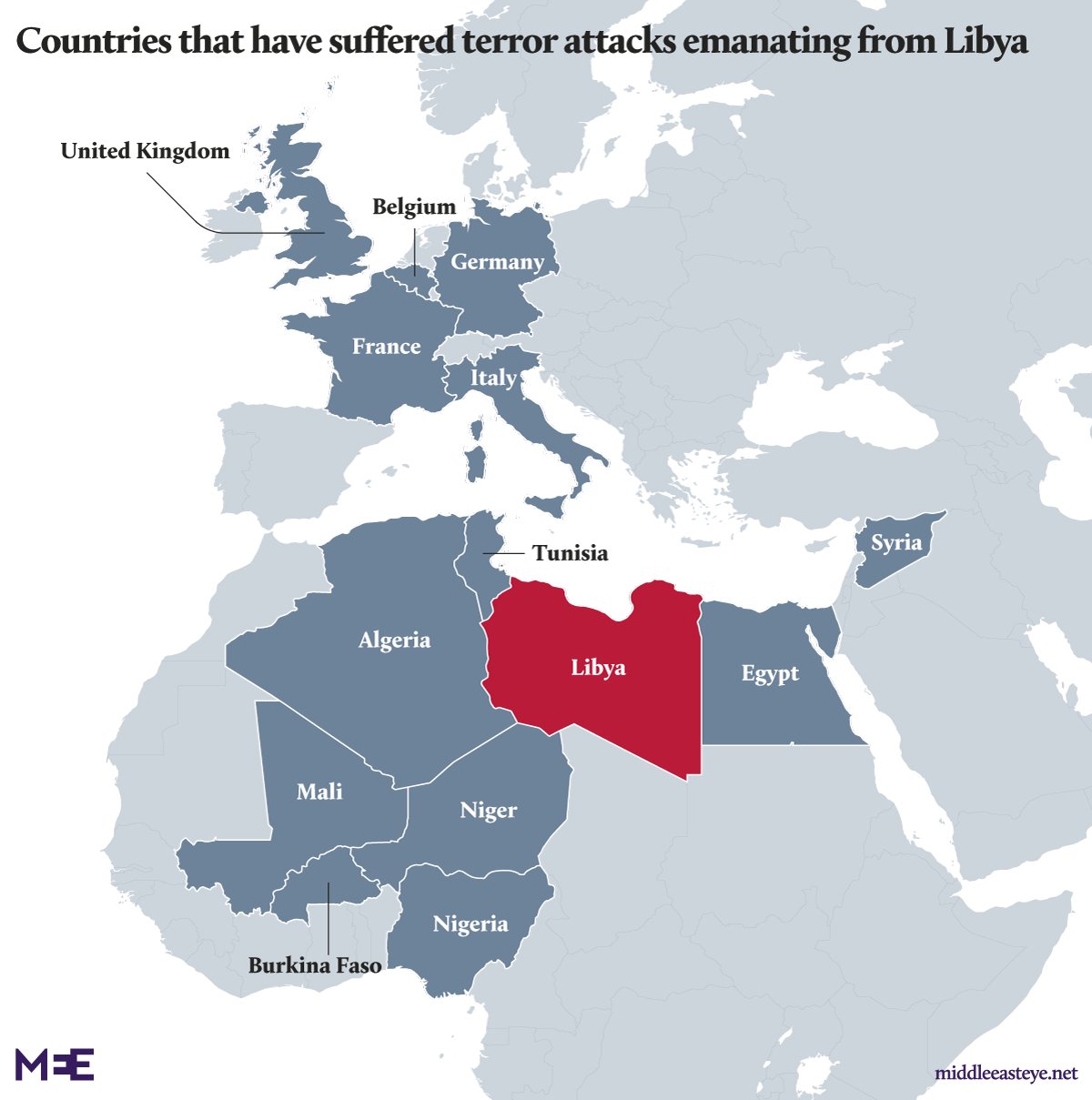
How the West’s War in Libya Has Spurred Terrorism in 14 Countries


https://www.middleeasteye.net/sites/default/files/libya-terror-attacks.png


Mark Curtis
Middle Eastern Eye

Eight years on from Nato's war in Libya in 2011, as the country enters a new phase in its conflict, I have taken stock of the number of countries to which terrorism has spread as a direct product of that war.
 
The number is at least 14. The legacy of David Cameron's, Nicolas Sarkozy's and Barack Obama's overthrow of Libyan leader Muammar Gaddafi has been gruesomely felt by Europeans and Africans.

Yet holding these leaders accountable for their decision to go to war is as distant as ever.  

Ungoverned space

The 2011 conflict, in which Nato worked alongside Islamist forces on the ground to remove Gaddafi, produced an ungoverned space in Libya and a country awash with weapons, ideal for terrorist groups to thrive.

But it was Syria that suffered first.

After civil war broke out there in early 2011, at the same time as in Libya, the latter became a facilitation and training hub for around 3,000 fighters on their way to Syria, many of whom joined al-Qaeda affiliate, Jabhat al-Nusra and the Islamic State-affiliated Katibat al-Battar al-Libi (KBL), which was founded by militants from Libya.

In Libya itself, a rebranding of existing al-Qaeda-linked groups in the north-eastern area of Derna produced Islamic State's first official branch in the country in mid-2014, incorporating members of the KBL.

During 2015, IS Libya conducted car bombings and beheadings and established territorial control and governance over parts of Derna and Benghazi in the east and Sabratha in the west. It also became the sole governing body in the north-central city of Sirte, with as many as 5,000 fighters occupying the city.

By late 2016, IS in Libya was forced out of these areas, largely due to US air strikes, but withdrew to the desert areas south of Sirte, continuing low-level attacks.

In the last two years, the group has re-emerged as a formidable insurgent force and is again waging high-profile attacks on state institutions and conducting regular hit-and-run operations in the southwestern desert.

Last September, UN Special Representative to Libya Ghassan Salame told the UN Security Council that the IS "presence and operations in Libya are only spreading".

Read more

Sunday, 21 April 2019

Africa Gets ‘Smart Housing’ While Buried In Poverty

  
The UN is pledged to “End poverty in all its forms” (SDG #1) and Africa is its poster child. Instead of providing energy, property rights and capital, they get 3-D printed housing made from waste products. TN Editor
 

Technocracy News

Africa is urbanizing fast, as its population grows and many flocks to cities in search of jobs, education and healthcare.

Studies show that hundreds of millions more Africans will live in cities over the next three decades.

Many of these new urban Africans, however, are likely to end up in informal settlements. Already an estimated 200 million Africans live in informal settlements—often without access to energy and sanitation.

The growing class of urban poor need access to decent housing. But the challenge is that the global housing sector already emits almost a third of global greenhouse gas emissions and uses up to 40 per cent of the planet’s total resources. New approaches are clearly needed.

As the housing sector grows—and it must grow if we want an equitable world—we need to reduce its environmental impact, not raise it,” said UN Environment Acting Executive Director, Joyce Msuya. “Smart design is the only way to meet our housing needs and stay within planetary boundaries.”

Read more

Saturday, 2 March 2019

BRICS countries to create smartphone payment system to cut dependence on West

RT 

The five major emerging economies - Brazil, Russia, India, China, and South Africa - are developing a joint new payment system called BRICS Pay, the Russian media has reported.

BRICS countries want to create a special online wallet to integrate the payment systems of its five member states, Izvestia said on Friday citing the Russian Direct Investment Fund (RDIF). Russia's wealth fund is reportedly working on the project alongside its partners from China and India, who have the necessary technologies to launch the system.

The service will be similar to existing Apple Pay and Samsung Pay, allowing users to pay with a smartphone app no matter what currency the customer's account is linked to. A special cloud platform is to be created to link BRICS countries' national payment systems. 


Read more

Thursday, 12 July 2018

The City of London and Grand Theft Ethiopia

Thomas C. Mountain  
Intrepidreport.com

For decades now, going back to when Bob Geldoff handed over millions in cash to Meles Zenawi during “We Are the World” circa 1983-4 supposedly for food aid for the victims of what was then the Great Ethiopian Famine, the City of London has been at the heart of Grand Theft Ethiopia, grand theft Africa really.

Without a place to stash your loot, why steal in the first place? If you can’t hide your dirty money where no one can take it from you, why bother? And this is just what the City of London has been doing, laundering billion$, some say tens of billion$, of stolen “aid” money for the late Ethiopian gangster government lead by Meles Zenawi. War, drought, famine followed by more war, drought and famine, The Horn of Africa maybe better called the Horn of Hunger and thanks to the City of London what was supposed to be used to feed the starving, house the homeless, nurture the sick and educate the illiterate was instead deposited in the financial cesspool calling itself a “City,” population seven thousand.

Read more

See also: Good Intentions II: Feed the World

Thursday, 5 July 2018

Israel Still Deporting Africans to Uganda, Reveals Amnesty International

Red Ice TV

Even though the Israeli plan to forcibly mass deport all African invaders in that country back to Africa—or to white countries—is on hold, the Jewish ethnostate continues to deport blacks to Uganda, regardless of their nationality, and these deportations are not truly “voluntary,” a new report from Amnesty International has revealed.

The report, titled “Forced And Unlawful Israel’s Deportation of Eritrean and Sudanese Asylum seekers to Uganda,” says that between 2015 and March 2018, Israel deported 1,700 Sudanese and Eritreans to Uganda.

“Upon arrival in Uganda, deportees find a shambolic reception, which leaves them without papers, without protection and without sustainable resources,” the report continues.

“This pushes many to continue their journeys to other African countries or to Europe.”

This report says that “Israel’s deportations to Uganda violate Israel’s obligations under international law. Israel’s deportation policy is a way to abdicate its responsibility towards the refugees and asylum-seekers under its jurisdiction and shift it to less wealthy countries with bigger refugee populations.”

Please read the entire article at The New Observer.

Tuesday, 26 June 2018

Western intervention obstructs peace in Africa

Comment: Not exactly a new revelation but a good reminder of how modern corporatism operates in Africa.

-------------------------------

The Duran 

Western business interests create and maintain conflict in order to exploit African resources

It’s no secret that foreign interventions have been helping to create and stoke conflicts all over the over world, but most famously in the Middle East, as the US has armed and trained proxy forces known as ‘moderates’ to help overthrow the Assad regime in Syria. However, these sorts of activities are conducted in other nations and on other continents as well. In Africa, conflicts are often initiated and prolonged over economic interests tied to Africa’s natural resources. In a recent interview with Sophie Shevardnadze on RT’s Sophie & Co, a South African private military contractor delves into the topic and explains how and why Western interests are so interested in prolonging conflicts on the African continent.

RT reports:

The Western powers are interested in prolonging conflicts in Africa as they crave after the continent’s resources, a private military company founder told RT. Most African forces are “set up to fail” by foreign advisors, he added.

The Western nations see prolonged African wars and chaos as just a means to get their hand on the rich African resources, Eeben Barlow, the founder of Executive Outcomes, the South African firm that started a private soldier boom, told RT’s Sophie Shevardnadze. “As long as there is conflict on the go, certain deals can be struck with governments,” which allow foreign powers to “get hold on these resources for own use,” he said.

Read more

Sunday, 24 June 2018

Russia Russia and Africa to strengthen ties further

Kester Kenn Klomegah 

Modern Diplomacy

Faced with persistent criticisms, Russia has finally announced it will most likely host the first high-level Russia-African Union forum next year, a replica or a carbon copy of Forum on China Africa Cooperation (FOCAC) or European Union–African Union summit, signaling its readiness to work towards deepening and strengthening multifaceted engagement with Africa.

Working on a new paradigm collaboratively with African Union, Russia hopes to fill up pitfalls and cracks in the existing relationship, reinforce diplomatic ties and raise its staggering economic profile on the continent similar to the levels of China, India, Japan, South Korea, Turkey, U.S. and Europe.

On his official visit to Rwanda early June, Foreign Affairs Minister Sergey Lavrov hinted that the forum rolls out a comprehensive strategic roadmap for more economic cooperation and wide-range of investment possibilities, find effective ways of addressing regional security issues and that of improving public diplomacy in Africa.

“We discussed Russia’s idea of holding a large African Union business forum with AU member states and Russia to be attended by entrepreneurs and politicians, possibly next year,” Lavrov said at a media conference after meeting with Minister of Foreign Affairs, Cooperation and East African Community Louise Mushikiwabo in Kigali, Rwanda.

“We have agreed to prepare a framework political document that will set out a concept for cooperation in the next few years and also several practical projects for implementation in the near future. We are now preparing for a meeting of Russian and AU experts,” he assertively added.

Just before his African tour early March, Lavrov also told Hommes d’Afrique magazine “we carefully study the practice of summits between African countries and their major partners abroad. At present, Russia’s relations with African countries are progressing both on a bilateral basis and along the line of African regional organisations, primarily the African Union and the Southern African Development Community.”

Read more

Thursday, 21 June 2018

Rwanda Joins France and Outlaws the Use of Cell Phones in Schools So Students Can Concentrate on Education

B.N. Frank
Activist Post

Announced last week in Rwanda, The Ministry of Education decided that primary and secondary schools students will no longer be allowed to own or use a cell phone at school, citing distraction.

According to Education Minister, Dr Eugène Mutimura, “…a study conducted by the ministry revealed that when students use phones at school, it affects their studies as they spend most of their time on them and forget about their core duty of studying.”

Gender and Family Promotion minister, Espérance Nyirasafari stated. “How can a student follow classes while chatting on social media, share photos and everything else?”

France has also decided to take the same approach citing the same reasons.

Many schools in the U.S. and around the world have already done this as well.

Research and media reports continue to confirm that we can’t expect all children to practice discipline with their phones and other digital devices.  We can’t expect it from all adults either.  These devices and their software was deliberately designed to be addictive.  Many tech inventors have expressed remorse for their role in this.

Research has also confirmed that cell phone and other sources of wireless WiFi radiation exposure can cause a multitude of health issues including increased cancer risk and disrupting the blood-brain barrier which can cause it to leak.  Exposure is especially hard on children.  No safe level of exposure has yet been scientifically determined for children or pregnant women. 

Read more

Thursday, 10 May 2018

Mass vaccinations will not prevent Ebolavirus outbreaks

Science Daily

Prophylactic mass vaccination programmes are not a realistic option in the battle to prevent new Ebolavirus outbreaks, a University of Kent-led research team has shown.

The findings come as the World Health Organisation has announced a new Ebola virus outbreak in the Democratic Republic of Kongo.

The team analysed the prospects for various Ebolavirus vaccines and found that, for the foreseable future at least, Ebolavirus outbreak control depends on surveillance and the isolation of cases.

The researchers' analysis revealed that very high proportions of potentially affected populations would need to be protected by vaccination to establish herd immunity, i.e. the level of immunity that prevents virus transmission within a population.

The study, entitled Herd immunity to Ebolaviruses is not a realistic target for current vaccination strategies identified that, in the critical phases of many Ebola virus outbreaks, the average infected individual infects four or more other people, which enables the virus to spread rapidly.

At this level, 80% of a population would need to be immunised to prevent outbreaks, even if a highly effective vaccine that protects 90% of individuals after vaccination was available.

Read more

Sunday, 12 November 2017

Plague Fears Grow As New Virus With No Cure Appears: "This Is Worse Than The 'Black Death'"

Zero Hedge

Malawi is bracing itself for an outbreak of the plague after the Daily Mail reports that deadly disease continues to spread across the island nation of Madagascar. At least 143 people have died and more than 2,000 others have been infected in Madagascar since an outbreak in early August this year which has now spread to its 10th African nation.

Malawi's health secretary confirmed the country is ready for any reported cases of the disease amid mounting concerns of Africa's 'porous borders'.

He said: 'We have infection prevention materials ready and groups and teams ready to be activated if there is a trigger.'

South Africa, Mauritius, Seychelles, Tanzania, La Réunion, Mozambique, Kenya, Ethiopia and Comoros have all been warned they could be at risk from a possible outbreak as well...

The strain can be cured with antibiotics and the WHO money will go towards paying for extra medical personnel, the disinfection of buildings and fuel for ambulances.

Cases have risen by eight per cent in just the space of one week and scientists are now working hard to ensure the disease does not spread from Madagascar to mainland Africa.

Health expert Professor Jimmy Whitworth described the current outbreak as the 'worst in 50 years or more'.

But as SHTFplan.com's Mac Slavo notes, a new virus for which medical officials have no remedy is spreading. The infectious disease also has a fatality rate of almost 90% making it much more deadly than the black death plaguing Madagascar.

Read more

Tuesday, 21 March 2017

The Global Famine Begins: UN Announces That The Worst Food Crisis Since World War II Is Happening Right Now

Michael Snyder
The Economic Collapse Blog

We always knew that this would start happening.  Earlier this month, I wrote about the severe economic problems that are plaguing South America, but up to this point I have neglected to discuss the horrific famines that are breaking out all over Africa.  Right now there is a desperate need for food in South Sudan, Somalia, northeast Nigeria, Eritrea and Kenya.  And Yemen, even though it is not technically part of Africa, is being affected by many of the same factors that are crippling nations all over eastern Africa.  The United Nations says that more than 20 million people could die from starvation and disease if nothing is done.  When I write about economic collapse, this is the kind of thing that I am talking about, and we are starting to see alarming conditions spread across the globe.  Many believe that we could never possibly face this kind of food crisis in the western world, but unfortunately wishful thinking will only get you so far.

The United Nations was formed in 1945, and the UN has just announced that what we are facing this year is “the largest humanitarian crisis since the creation of the UN”.  The following comes from a CNN article entitled “20 million at risk of starvation in world’s largest crisis since 1945, UN says“…
“We stand at a critical point in history. Already at the beginning of the year we are facing the largest humanitarian crisis since the creation of the UN,” UN humanitarian chief Stephen O’Brien said Friday.
Now, more than 20 million people across four countries face starvation and famine. Without collective and coordinated global efforts, people will simply starve to death. Many more will suffer and die from disease.”
It would be hard to overstate the level of human suffering that we are witnessing in many parts of Africa at this moment.  In Somalia, the UN estimates that more than 6 million people are in desperate need of food aid

Read more

Monday, 20 February 2017

Mercenary Group “Blackwater” Receives $204m Government Contract

Daily Beast 


A mercenary air force that became a symbol of the U.S. occupation of Iraq is back in action—this time in Central Africa, supporting a shadowy American U.S. Special Forces commando operation targeting the Lord’s Resistance Army. 


In late January, a source on the ground in Central African Republic spotted a Sikorsky S-61 helicopter with the registry number N408RC carrying American Special Forces troops. The LRA, a cultish band of thieves and rapists led by warlord Joseph Kony, is most active in the forested region where Central African Republic, South Sudan, and the Democratic Republic of Congo meet.

In 2010, President Barack Obama deployed around 100 Green Berets and other personnel to Central Africa to help local forces hunt down Kony and the LRA. Seven years later, Operation Observant Compass continues, mostly unnoticed by the press. The Pentagon asked Congress for $23 million to extend the operation through 2017.

According to the Federal Aviation Administration, the Sikorsky helicopter that The Daily Beast’s source observed in Central African Republic belongs to Illinois-based EP Aviation, LLC. 

EP Aviation was once a subsidiary of Academi, the Virginia-based company that was formerly known as Blackwater. The “EP” stands for “Erik Prince,” Blackwater’s founder and the younger brother of billionaire U.S. Secretary of Education Betsy DeVos.

Sunday, 4 December 2016

Corporate Exploitation of Global Refugee Crisis Masked as Humanitarianism

Project Censored

According to a June 2015 United Nations report, sixty million people worldwide are now refugees due to conflict in their home nations. The UN report indicated that during 2014 one out of every 122 people was a refugee, internally displaced, or an asylum seeker; and over half of these refugees were children. (For previous Project Censored coverage of the global refugee crisis, see “Global Forced Displacement Tops Fifty Million,” Censored story #14 in Censored 2016: Media Freedom on the Line.)

While Syrian refugees account for the largest number (an estimated 11.5 million people), other places such as Colombia, parts of sub-Saharan Africa, and Asia have large refugee populations that remain largely unreported. According António Guterres, the UN High Commissioner for Refugees at the time of the report, “We are witnessing a paradigm change, an unchecked slide into an era in which the scale of global forced displacement as well as the response required is now clearly dwarfing anything seen before.”

Although the extent of the global refugee crisis has been covered in the corporate media (including, for example, the New York Times and the Washington Post), the exploitation of refugees has been less well covered. In February 2016, Sarah Lazare published an article on AlterNet that warned of the World Bank’s private enterprise solution to the Syrian displacement crisis. “Under the guise of humanitarian aid,” Lazare wrote, “the World Bank is enticing Western companies to launch ‘new investments’ in Jordan in order to profit from the labor of stranded Syrian refugees. In a country where migrant workers have faced forced servitude, torture and wage theft, there is reason to be concerned that this capital-intensive ‘solution’ to the mounting crisis of displacement will establish sweatshops that specifically target war refugees for hyper-exploitation.”

Read more
 

Friday, 15 July 2016

Reviewing Mark Curtis' new report: The New Colonialism, Britain's Scramble for Africa

Colin Todhunter
Global Research


Africa is facing a new and devastating colonial invasion driven by a determination to plunder the natural resources of Africa, especially its strategic energy and mineral resources. That's the message from a damning new report from War On Want 'The New Colonialism: Britain's scramble for Africa's energy and mineral resources' that highlights the role of the British government in aiding and abetting the process.

Written and researched by Mark Curtis, the report reveals the degree to which British companies now control Africa's key mineral resources, notably gold, platinum, diamonds, copper, oil, gas and coal. It documents how 101 companies listed on the London Stock Exchange (LSE) - most of them British - have mining operations in 37 sub-Saharan African countries and collectively control over $1 trillion worth of Africa's most valuable resources.

The UK government has used its power and influence to ensure that British mining companies have access to Africa's raw materials. The report exposes the long-term involvement of the British government (Labour and Conservative) to influence and control British companies' access to raw materials. Access has been secured through a revolving door between the political establishment and British mining companies, with at least five British government officials taking up seats on the boards of mining companies operating in Africa.

Augmented by WTO rules, Britain's leverage over Africa's political and economic systems has resulted in a company like Glencore being able to to show revenues 10 times that of the gross domestic product (GDP) of Zambia.

Under the guise of the UK helping Africa in its economic development (a continuation of the colonial paternal narrative), $134 billion has flowed into the continent each year in the form of loans, foreign investment and aid, while British government has enabled the extraction of $192 billion from Africa mainly in profits by foreign companies, tax dodging and the cost of adapting to climate change.

The report highlights the roles played by major companies, such as Rio Tinto, Glencore and Vedanta. From the displacement of people and killings to labour rights violations, environmental degradation and tax dodging, Africa appears to have become a free for all. In only a minority of mining operations do African governments have a shareholding in projects. And even if they do, it tends to be small at 5-20%.


Read more
 

Sunday, 3 July 2016

"EU Wants An Empire" - Brussels Plans To Expand Into Middle East, Africa

Joseph Jankowski via PlanetFreeWill


The latest EU foreign policy document, titled “A Global Strategy for the European Union’s Foreign And Security Policy“, calls for an extension of the Union's influence in regions as far as Central Asia and Central Africa.

It also outlines “gradual synchronisation and mutual adaptation” between different member states’ individual defence strategies.
The executive summary of the document reads:
It is in the interests of our citizens to invest in the resilience of states and societies to the east stretching into Central Asia, and to the south down to Central Africa. Under the current EU enlargement policy, a credible accession process grounded in strict and fair conditionality is vital to enhance the resilience of countries in the Western Balkans and of Turkey. Under the European Neighbourhood Policy (ENP), many people wish to build closer relations with the Union: our enduring power of attraction can spur transformation in these countries.
The documents speaks of transforming the current EU system and commits to the deliverance of a global governing body.

EU Foreign Policy Cheif Federica Mogherini writes in the foreword:
We will invest in regional orders, and in cooperation among and within regions. And we will promote reformed global governance, one that can meet the challenges of this 21st century. We will engage in a practical and principled way, sharing global responsibilities with our partners and contributing to their strengths. We have learnt the lesson: my neighbour’s and my partner’s weaknesses are my own weaknesses. So we will invest in win-win solutions, and move beyond the illusion that international politics can be a zero-sum game.
The latest plan outlines how how the EU wants autonomy in defence and security matters.
“European security and defence efforts should enable the EU to act autonomously while also contributing to and undertaking action in co-operation with NATO,” the Brussels document reads.
  
Read more

Wednesday, 22 June 2016

African Union plans to introduce single passport to create EU-style 'continent without borders'

The Independent


African leaders plan to turn the continent into one of "seamless borders” with the introduction of a single passport allowing free movement between countries.

The idea from the African Union has been modelled on the controversial EU Schengen free movement deal, which has abolished many internal borders to enable passport-free movement across the bloc.

Currently, 13 African countries have visa-free deals in place with each other. These allow citizens to visit another country without a visa, or offer them visas on arrival.

In comparison, Americans are able to travel to 20 of the continent’s countries without a visa, or a secure visa on arrival.

The African Union (AU), which represents 54 states, wants to abolish the need for Africans visiting African counties to require a visa by 2018.

Read More

Wednesday, 8 June 2016

Empire on steroids: The expansion of U.S. secret wars in Africa

Justin Yun
Chimes


The secret expansion of U.S. military bases and special operations in Africa has initiated a new and lightweight style of warfare and welcomes the next phase of American military imperialism. Unlike the highly publicized U.S. military "pivot to Asia," the proliferation of drones, special ops, mercenary spies, classified bases, proxy fighters and cyber warfare constitute what the journalist Nick Turse calls a "new light-footprint Obama doctrine" that "seems to be making war an ever more attractive and seemingly easy option."

A New Style of Fighting

On any day, elite U.S. forces conduct covert missions in an estimated 70 to 90 countries. According to Turse, special forces have been sent to an unprecedented 147 countries — 75 percent of the world's nations last year alone. This is a 145 percent increase from the rate of operations conducted under the Bush administration.

Wars conventionally fought by large infantry forces and full-scale invasions of foreign countries have made way for a new style of fighting — one that has become increasingly dependent on special forces, drones and private defense contractors. Because of the confidential nature of special ops, the Pentagon can essentially keep foreign military involvement secret from the American public. The U.S. has always had troops in Africa since the Cold War but the rate of its expansion dangerously indicates a lack of public accountability.

A Naive Claim

The shadow wars in Africa are now fought by members of the U.S. Special Operations Command and JSOC — a clandestine organization that carries out kill/capture missions. JSOC has been called "an almost industrial-scale counterterrorism killing machine" by counterinsurgency advisor John Nagl and many have described it as the president's "private assassination squad." The group reports directly to the White House. It is the military's secret military.

The notion the U.S. would someday pull its troops out of the Middle East is a rather naive claim considering the fact we have nothing short of a permanent war economy. From main operating bases that house thousands of soldiers to single airstrips used by the C.I.A. to taxi their blacked-out turboprops, the U.S. continues to maintain over 800 to 1,000 bases around the world — making us the most expansive military empire in history. Nobody really knows the exact figure — not even the military experts. The late scholar Chalmers Johnson wrote in his book, "The Sorrows of Empire: Militarism, Secrecy, and the End of the Republic" on how the Pentagon and an uncontrollable military-industrial complex have turned the U.S. into "a new kind of military empire — a consumerist Sparta." Chalmers declares, "Another crucial characteristic that distinguished the American empire from empires of the past is that bases are not needed to fight wars but are instead pure manifestations of militarism and imperialism."

Global Instability

Military expansion does not make us safe since it cultivates global instability. The uncontrollable growth into Africa has resulted in the funding and training of proxy armies with atrocious human-rights records and has attracted mercenaries such as Erik Prince — founder of the infamous Blackwater private army hired by the D.O.D to provide security to high-level diplomats during the Iraq war.

With military presence in 53 of 54 of Africa's nations, the American empire has emerged to pick up where the former European colonial powers have left off. 

Friday, 13 May 2016

Insider report forecasts multi-billion-dollar profits from global riot 'contagion': Elites poised for global chaos?

Nafeez Ahmed
Insurge Intelligence

via Sott.net

Forecasts of relentless civil unrest in the US, Europe, Middle East, Africa and Asia seen as massive 'investment opportunity'

The next five years will see the international market for 'riot control systems' boom to a value of more than $5 billion at an annual growth rate of 5%, according to a new report by a global business intelligence firm


The report forecasts a dramatic rise in civil unrest across the world, including in North America and Europe, driven by an increase in Ferguson-style incidents and "extremist attacks."

The Middle East, North Africa and Asia-Pacific regions will also experience a persistent rise in conflicts.

This increasing trend in instability promises billions of dollars of profits for global defence firms, concludes the report, published last month by Infiniti Research Ltd., a market intelligence firm whose clients include Fortune 500 companies.

"Protests, riots, and demonstrations are major issues faced by the law enforcement agencies across the world," said Abhay Singh, a lead defence technology analyst at the firm. "In addition the increase in incidents of civil wars in countries such as Syria, Iraq, Lebanon, and Egypt along with an increase in the global defence budget will generate demand for riot control systems."

Europe, the Middle East and Africa will be the largest market, collectively experiencing a rate of growth at over 5%, exceeding $2 billion by 2020. Under the subheading, 'EMEA: increase in extremist attacks to boost growth', the report, priced at over $2,000, explains:

"Over the past years, Europe witnessed an increase in extremist attacks, which has raised concerns among the law enforcement and defense industries to equip themselves with modern equipment and protect civilians from external threats. In 2015, the Paris attacks and the killing of journalists in France are some of the examples of growing terrorism in Europe."
The combination of intensifying conflict, terrorism, and civil unrest will lead to rocketing demand for riot control systems over the next 5 years "led by Germany, Russia, France, Poland, Saudi Arabia, Turkey, the UAE, Iran, and South African countries."

Read more

Tuesday, 26 April 2016

Would Career Criminal Killary Clinton Pose a Threat to the World?

Martin Berger
New Eastern Outlook

The faster the situation in Libya deteriorates, and the stronger ISIS becomes in this war-torn land, the more people start asking who’s responsible for this nightmare in order to avoid a repetition of the such a scenario in the future.

According to various Western experts, the actions taken by the United States, NATO and Gulf monarchies against Libya in 2011 constitute a war crime, no matter how you define the term. At a result, hundreds of thousands perished, including a massacre targeting dark skinned Libyans and immigrants from other African countries in particular. Entire cities were turned to rubble by America’s terrorist proxies. President Muammar Gaddafi was murdered by these forces who could only have succeeded in this crime with Western financial and military support.

The American-led military intervention in Libya resulted in the devastation of this nation which to this day is still being ravaged by violence. Libya has no government and has become a safe haven for ISIS terrorists. It’s curious that ISIS has achieved the most in Iraq, Libya and Syria, all of which were targets of Western regime change.

In a bid to find those responsible for this mayhem, The Huffington Post would note:
Hillary Clinton’s support for “regime change” in countries such as Iraq, Syria, Libya, Iran and Honduras. Thousands of Americans died in the Iraq War, and many more were wounded. Hundreds of thousands of Iraqis and Syrians have died and millions have been wounded or displaced; and President Obama has said specifically the “mess“ in Libya was his “worst mistake,” in which Clinton played a decisive role.
Read more
 
Related Posts Plugin for WordPress, Blogger...