Search This Blog

Showing posts with label Deepwater Horizon. Show all posts

Saturday, 5 December 2015

Not even the scapegoat supervisors will go to jail for BP's murder of the Gulf Coast

Cory Doctorow
Boing Boing

After the 2010 Deepwater Horizon disaster in which BP killed 12 people, millions of marine and land animals, and one ecosystem, two scapegoats were located to fit up for criminal manslaughter charges: the supervisors aboard the platform at the time of its explosion

After years of courtroom wrangling, prosecutors dropped criminal charges against these Lynndie Englands, charging them instead with misdemeanors and taking parole and community service for their role in one of the human race's worst environmental disasters.

BP has to pay billions in settlements, of course, but no human will be held accountable for the decisions that led to the disaster.
The father of Gordon Jones, a rig worker who died in the explosion, was unhappy with the government's decision.
"As a result of this court proceeding today, no man will ever spend a moment behind bars for killing 11 men for reasons based entirely on greed," Keith Jones told reporters after Wednesday's hearing.
The Justice Department said in a statement that it dropped the felony charges against the two "because circumstances surrounding the case have changed since it was originally charged, and after a careful review the department determined it can no longer meet the legal standard for instituting the involuntary manslaughter charges."
Manslaughter charges dropped in BP spill case—nobody from BP will go to prison [David Kravets/Ars Technica]


Thursday, 15 December 2011

BP Awarded $27 Million in Leases for Gulf Oil, Gas Exploration


What this article doesn't mention is the deaths, destroyed livelihoods and toxic legacy from Corexit, let alone the oil itself that still contaminates much of the environment in many parts of the Gulf. It is a huge environmental and social catastrophe. After what BP did it's nauseating that they're actually being rewarded for it. Rather like Obama and his nobel peace prize.

---------------------------

Olga Belogolova 

BP is officially getting back into deep water exploration in the Gulf of Mexico, the Interior Department announced on Wednesday.

The British energy giant, responsible for the biggest offshore oil spill in U.S. history last year in the Gulf, won $27 million worth of leases to conduct new oil-and-gas exploration in the Gulf. The awards from the Interior Department came in the first Gulf lease sale since the BP spill last year, with all winning bids bringing $337.6 million into government coffers.

The lease sale, which involved oil and gas rights for tracts in the western Gulf, attracted 241 bids from 20 companies totaling $712 million, Interior Secretary Ken Salazar said.

BP bid a total of $109.9 million on 15 leases and won 11 for $27.4 million, Interior's Bureau of Ocean Energy Management reported in a list of sales posted on its website.

The lease sale, which involved oil and gas rights for tracts in the western Gulf, attracted 241 bids from 20 companies totaling $712 million, Interior Secretary Ken Salazar said from the site of the sale in New Orleans.

ConocoPhillips made the highest total bids in the lease sale, offering $173.2 million for 97 leases; the company received 75 leases for $157.8 million, according to a list released by Interior on Wednesday afternoon.

BP bid a total of $109.9 million on 15 leases and won 11 for $27.4 million, Interior's Bureau of Ocean Energy Management reported.

"This marks a milestone with respect to the greatest overhaul in the America’s history,” Salazar said of the offshore-drilling safety reforms and changes implemented by Interior since the April 2010 explosion of a BP well in the Gulf led to the worst offshore oil spill in U.S. history. “We believe we can move forward with oil and gas development.”

Salazar's initial announcement did not include any mention of whether BP was awarded any leases, but the British oil giant had made clear for months that it intended to get back into deepwater exploration in the Gulf as quickly as possible. BP was not excluded from bidding on any leases, much to the chagrin of environmentalists who say the company should be banned from further drilling until last year's spill has been fully cleaned up.

Former Bureau of Safety and Environmental Enforcement Director Michael Bromwich in October defended the Interior’s decision to include BP in the lease sale.

“They don’t have a deeply flawed record offshore,” he said of BP. “We’ve done analyses over time on the relative safety records of offshore operators and they were in close to the top crew.”

“The question is, do you administer the administrative death penalty based on one incident?," Bromwich told reporters. “And we've concluded, I’ve concluded, that's not appropriate in these circumstances."

Wednesday, 16 November 2011

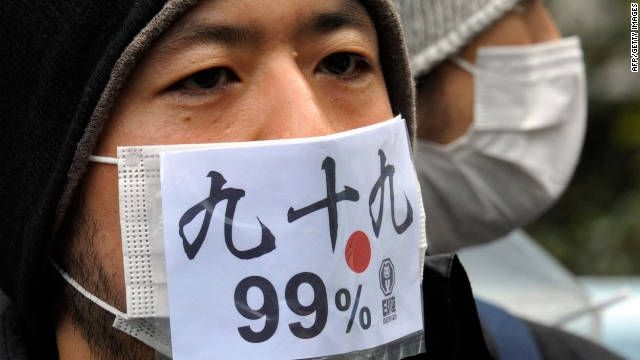
Occupy Tokyo: Mass demonstrations go unreported by Japanese media

 
Sott.net

You've heard about the Occupy Wall Street protests in New York, Los Angeles, London, Toronto, Berlin, Tel Aviv and elsewhere around the world. But did you know that huge demonstrations have been taking place in Tokyo as well? We certainly didn't until a SOTT forum member sent us the details. The general lack of awareness of the protests in Japan is probably due to the fact that there has been zero coverage of 'Occupy Tokyo' - which has grown out of the country's large (and growing) grassroots anti-nuclear movement - in Japan's mainstream media.

Several large demonstrations have taken place all over Japan in recent months, especially in Tokyo. The general mood is the same as elsewhere: ordinary people in Japan are fed up with their leaders' lies, particularly the lies told by TEPCO, the Tokyo Electric Power Company, and how the government has handled the Fukushima disaster. Or rather, how it has avoided handling it. This should all be eerily familiar to Americans of course; BP's lies and the US government's enabling role from the moment the Deepwater Horizon rig exploded in April 2010 has continued to this day, with the tragedy continuing to unfold in deathly silence. What is happening in Japan is almost a carbon copy; denial, smear campaigns, heavy-handed tactics and, of course, total media blackout. Up to one million people may have died as a result of Chernobyl, although we'll never really know the true death toll. Fukushima is many orders of magnitude worse...


People in Japan are very angry. Even though the Fukushima disaster is nowhere near ending (in fact, it is getting worse), Japanese media are simply not covering the fallout of the worst nuclear accident in history. Aftershocks from the Magnitude 9 earthquake which struck off the coast of Japan on March 11th are hardly mentioned in the Japanese media, but the fact is they are still ongoing and people are constantly stressed out by them. The economic aftershock is also beginning to take hold in a big way. The good news, says the SOTT forum member in Japan, is that people are now starting to wake up the fact that the Japanese government, TEPCO, and the media have been lying all this time and that more people are starting to take action to actually deal with the situation rather than wishfully think it will just blow away out into the Pacific Ocean.


Saturday, 22 October 2011

BP wins approval to resume drilling in Gulf of Mexico


We truly... TRULY... live in a world ruled by Psychopaths. After the utter destruction these bastards have caused... Well, money talks.  And off New Orleans no less...

------------


BP has won approval to resume drilling in the Gulf of Mexico, 18 months after a well blowout killed 11 workers and caused an environmental disaster.


Regulators approved plans for drilling to depths of up to 6,000ft about 200 miles off the coast of New Orleans.


US officials said in a statement: "Our review of BP's plan included verification of BP's compliance with the heightened standards."


The Gulf's Kaskida oilfield could contain up to 3bn barrels of crude.


The US Bureau of Ocean Energy Management said BP's exploration plan meets the stringent standards issued by the government after last year's Deepwater Horizon disaster, as well as the additional self-imposed standards that BP has taken.


In the months following the Deepwater affair, many analysts questioned whether BP had a future in the US.


Last week, there were reports in the US that BP would not be barred from participating in an upcoming offshore oil and gas lease sale.

Tuesday, 20 September 2011

Sick Gulf Residents Continue to Blame BP


Just weeks after BP’s oil disaster in the Gulf of Mexico began on April 20, 2010, Fritzi Presley knew something was very wrong with her health.

The 57-year-old singer/songwriter from Long Beach, Mississippi began to feel sick, and went to her doctor.

“I began getting treatments for bronchitis, was put on several antibiotics and rescue inhalers, and even a breathing machine,” she told Al Jazeera. The smell of chemicals on the Mississippi coastline is present on many days when wind blows in from the Gulf.

Read more

Saturday, 3 September 2011

New Evidence of Massive Oil Slick Near Deep Water Horizon


A California nonprofit organization dedicated to the protection and preservation of wildlife has discovered what seems to be a massive oil slick in the Gulf of Mexico near the area of the original Deepwater Horizon spill.

In a flight over the Gulf Tuesday, OnWingsOfCare.org founder and pilot Dr. Bonny Schumaker spotted an oil slick that stretched for nearly 10 miles.

Last week, two Louisiana State University men took a boat into the Gulf and returned with video evidence of large blooms of crude oil swelling up to the water’s surface where the doomed oil rig once hovered.

BP had firmly denied that the well is continuing to leak.

None of this is true,” they said in a statement.

Watch this video from OnWingsOfCare.org, uploaded Aug. 30, 2011


Monday, 29 August 2011

Fresh oil slicks forming over Deepwater Horizon spill site


Raw Story

Despite
assurances from British oil company BP that no oil was present at the Deepwater Horizon site in the Gulf of Mexico, two Louisiana State University men have returned with video evidence of large blooms of crude oil swelling up to the water’s surface where the doomed oil rig once hovered.

Tests on the oil were inconclusive as far as linking it to the now-plugged oil well, but if it is from the Deepwater Horizon spill it could indicate the formation of fissures on the seabed, seeping oil into the ecosystem anew.


If so, that would mean the worst accidental release of oil in human history — a spill so bad, it took five months just to stop crude from flowing — isn’t quite over.


Thursday, 9 June 2011

Gulf Dispersants: BP and Nalco Play Toxic Roulette

corpwatch

In the months since the Deepwater Horizon drilling rig exploded, and the well beneath spewed millions of gallons of crude into the Gulf of Mexico, BP has been accused of moving too slowly to clean its gigantic mess. Yet in one respect the oil giant acted swiftly. Shortly after the accident, BP began applying vast quantities of chemical dispersants in an effort to break up the torrent of oil from the mile-deep blowout. By mid-July, BP had released almost two million gallons of the dispersant Corexit.

BP and Corexit manufacturer Nalco claim that the chemicals will reduce the impact of the spill on coastal environments. Their lobbyists and executives say that the chemical is not only essential, but as harmless as dish soap.

 But a fundamental question lingers like the petrochemical smell over the gulf: Is Corexit doing more harm than good? Dispersants, all agree, do not lessen the amount of oil in the environment. Rather, they break it into tiny drops that have different, but not necessarily less toxic properties.

 "[Dispersants] make the oil more soluble in water, so it won't just sit on the surface," Jackie Savitz, senior scientist with Oceana told CNN. "Whether that's good or bad depends on whether you're a fish or a seabird."

 But whether or not the dispersants work as promised, they are effective in other ways, critics charge. By breaking the peanut-butter thick sludge into tiny droplets, Nalco's Corexit has made the oil less visible, thereby disguising the full environmental impact of the spill, and helping BP limit its legal and financial liability. The availability of dispersants also gives the oil industry cover by allowing it to assure government agencies and the public that in the in the "unlikely" event of a spill, there is a quick, safe fix. [...]


Related Posts Plugin for WordPress, Blogger...