Search This Blog

Showing posts with label China. Show all posts

Wednesday, 24 December 2025

Israel's growing role in Taiwan's air defense alarms Beijing

Uriel Araujo | Infobrics.org

Israel's expanding ties with Taiwan, particularly in missile defense, are quietly reshaping regional geopolitics and alarming Beijing. In this context, even small defense transfers could undermine years of careful diplomatic calibration.

Israeli-Taiwanese cooperation, long discreet and underreported, is now moving into far more sensitive terrain. Recent reports indicate that Israeli know-how has been quietly feeding into Taiwan's emerging missile-defense architecture, the so-called "T-DOME," a system explicitly inspired by Israel's Iron Dome. As a matter of fact, this development has already triggered a blunt diplomatic rebuke from Beijing, raising uncomfortable questions about Israel's long-standing balancing act between rival global powers.

A detailed account of this growing cooperation comes from Nadia Helmy, Visiting Senior Researcher at the Centre for Middle Eastern Studies (CMES), who notes that Chinese intelligence agencies have detected expanding Israeli assistance to Taiwan's missile shield, particularly in radar integration, command-and-control architecture, and layered interception concepts. According to Helmy, Beijing views this cooperation not as an isolated commercial exchange but as a strategic signal, thereby crossing a political red line.

Monday, 1 December 2025

China is driving global governance for biospheric transformation

Alfredo Jalife-Rahme | voltairenet.org

During his participation in the Greater Bay Area Dialogue in Guangzhou, Alfredo Jalife-Rahme assessed China's progress in artificial intelligence and analyzed its impact on global governance.

In my presentation at the plenary session "Mid-Century Global Governance Defining Transformation," in Guangzhou, sponsored by the prestigious China Institute for Innovation & Development Strategy, I will address the current chaotic phase, with its "fractals of peace," which highlights a redemptive global governance. This is a Chinese initiative promoting a just and equitable global system to preserve the life of all beings in the biosphere.

Already on September 13, 2023, Antony Blinken, then Secretary of State, at Johns Hopkins University in Washington, accepted the "decisive turn" of the end of the old world order dominated by the United States. which sounded like a platitude.

Now it is Chancellor Merz of Germany, partner of BlackRock, who announced in Berlin on November 17 the end of the decadent world order; he accepts the withdrawal of the United States as well as the rise of China and Russia.

The dynamics of trends towards a new tripolar world order of China/Russia/United States are as if written on the wall when one perceives the "fractals of peace", which tend towards the return of civilizations, coupled with new technologies, where China possesses a millennial advantage which it has recovered and forged as a new tool.

Wednesday, 5 November 2025

Miles Harris: The Coming CBDC Unified Ledger or Global Digital Gulag


Geopolitics & Empire 

Miles Harris discusses the state of the global financial system, China’s role in the economy, how we’re due for a reset, the intricacies of the coming CBDC Unified Ledger or Global Digital Gulag, and why we must resist and slow down its implementation.

Monday, 13 October 2025

AI could wipe out 100 million US jobs - Bernie Sanders report

RT / Sott.net

The technology is being developed not for public benefit, but to increase corporate profits, Senator Benie Sanders has claimed.

Artificial intelligence and automation technologies pose a threat to nearly 100 million jobs in the US over the next decade, according to a report released on Monday by Senator Bernie Sanders.

The report suggests the disruption will be widespread, affecting both white- and blue-collar professions.

According to Sanders, the ranking member of the Senate Committee on Health, Education, Labor and Pensions, AI and automation could replace 40% of registered nurses, 47% of truck drivers, 64% of accountants, 65% of teaching assistants, and 89% of fast food workers.

The report said:
"The agricultural revolution unfolded over thousands of years. The industrial revolution took more than a century. Artificial labor could reshape the economy in less than a decade."
The warning contrasts with the stance of the Trump administration, which has championed American leadership in AI development, arguing that losing the technological race to China poses a national security threat.

Read more 

Friday, 3 October 2025

“Farmageddon” – Farmers Across the U.S. Sound the Alarm on the Disaster Unfolding from Trump’s Tariffs

Health Impact News

As the U.S. now heads into the Fall harvest season, the impacts of Trump’s tariffs are being more clearly seen, where farmers all across the U.S. are sounding the alarm about the collapse of our agricultural system, with one out of every three farms going out of business in certain parts of the country.

What we are seeing this Fall in the U.S. are the effects of a mass loss of farm labor due to deportations, increased prices on farm equipment and other farm materials that are mostly imported (like parts for John Deere tractors), and of course the loss of the China market, the country where most U.S. farm products have been exported to in past years.

Read more

Monday, 29 September 2025

Xinjiang as It Really Is

Felix Abt | Covert Action Magazine

An on-the-ground account challenging Western propaganda

Upon landing in Urumqi, the capital of the Xinjiang Uyghur Autonomous Region (commonly known as Xinjiang), it is evident that the Uyghurs, a Turkic-speaking Muslim minority, call this home. 

As I exited the airport arrivals hall, I noticed a restaurant sign reading “EGG BOMB.” The moniker cleverly implies that Xinjiang would rather be renowned for its “food bombs” than for the explosive devices employed by the terrorists who formerly tormented the region and the rest of China. 

In contrast to the U.S.’s so-called worldwide War on Terror, which has claimed countless victims among innocent civilians, the Chinese government’s strict counterterrorism measures have been the subject of massive criticism in Western media, including accusations of physical and cultural genocide. Uyghur terrorism, which once posed a real threat in Xinjiang and beyond—as documented by headlines from the Associated Press—has been almost entirely erased from Western discussions, leaving a one-sided narrative that ignores the region’s serious security challenges.

While Western media reports had painted a grim picture, my on-the-ground experience told a different story.

My journey started on the city’s modern transit system, where all signage was presented in Uyghur, Mandarin and English. At one stop, three young Uyghur women boarded and sat across from me, their curious glances and cheerful conversation a testament to the normal, everyday life that continues here. When I asked to take their photo, they responded not with suspicion, but with bright, agreeing smiles.

Read more

Monday, 22 September 2025

Pepe Escobar: The Choice is Stark - Global Governance or Barbarism

 Sputnik International
 
There is something ineffably eternal about the “drum beating and bell chiming from sundown to daybreak” when it comes to the Bell Tower and the Drum Tower standing in the north end of ancient Beijing.
 
There can hardly be equal structures around the world when it comes to architecture as music. They are like two powerful, solemn notes being played over and over again for centuries – the sounds and echoes reverberating across the mega-metropolis.
 
Both towers are part of the so-called Beijing Central Axis – and serious scholars make no bones about their essential role in reflecting people’s existence in History. In China after all, architecture is regarded as frozen music.
 
Liang Sicheng, the father of modern Chinese architecture, regarded the Beijing Central Axis as the world’s greatest urban symphony - sorry Place de la Concorde or Piazza San Marco – with the Drum Tower and the Bell Tower as the grand finale.
 
The same might apply to the Drum/Bell couple in Xian, former Chang’an, the imperial capital, which today is the privileged stage for scores of young Tang Barbies from all parts of China posing night after night.
 
In Beijing of course it’s way more solemn. The Bell/Drum couple is regarded as the guardian buildings of the Forbidden City – announcing time after time the proper regulation of people’s lives.
 
But it’s a stele built during the Qing dynasty, with an inscription written by Emperor Qianlong, that provides us with an intriguing parallel with our current geopolitical volatility.
 
It reads: “The resonant sound of the Bell heralds good governance. The magnificent buildings of the Bell and Drum Towers symbolize the loftiness of imperial power. The bell chimes and drum beats tell time to regulate people’s lives. These solid towers stand forever to carry forward benevolent governance.”
 
Read more 

Monday, 26 August 2019

South American Shockwaves Bring the New Silk Road Into the Americas as Neo-Liberal Order Crumbles

Matthew Ehret
Strategic Culture

Over the past several years Latin America has become a strategic battleground which involves much more than merely “geopolitical power plays” between the USA vs China as many commentators are asserting. Of course this is not to say that there are no geopolitical battles occurring. The entire western sponsored regime change operation in Venezuela couldn’t be understood unless one realized that China and Russia see Venezuela as a strategic ally in the Americas and a future zone for Belt and Road projects which are sweeping across the world… but something more is happening.

Over the past three years, over 17 Latin American and Caribbean (LAC) nations have signed onto the new operating framework of the Belt and Road Initiative which extends far beyond the limited China-to-Europe corridor which many presumed it to be when it was announced in 2013. With its focus on long term planning and interconnectivity, China is already number one in vital infrastructure investments globally and while not number one in overall trade in the Americas, has now produced over six times more investment into Latin American energy infrastructure than the World Bank.

This new paradigm has been a breath of fresh air for many nations of the south that have been gripped by Western drug money laundering, poverty, debt slavery and organized crime which has been kept in place by over four decades of IMF-World Bank dictates enforced by London/Harvard trained economists positioned as local governors over the bodies of nationalist leaders.

In spite of the 17 nations on board the BRI, the big four powers (Mexico, Argentina, Brazil and Colombia) have not yet joined, which has been a frustrating obstacle for the greater vision of integrated infrastructure to blossom. However, in the past few weeks, even this has begun to change.

Read more

Wednesday, 7 August 2019

‘Increased mortality’: 1st generation CRISPR babies will likely die young, scientists warn

RT

It is now six months since the world’s first gene-edited babies were born in China, but researchers in the US warn that, though the twin girls may be more resistant to HIV, they also have “significantly increased mortality.”
 
Geneticist He Jiankui, dubbed the 'Chinese Frankenstein,' shocked the world in November 2018 when he announced that he had created the first gene-edited babies. He and his team edited the gene CCR5 from two twin babies (a third gene-edited child is due to be born this summer) in a bid to make them immune from HIV.

However, it turns out that people with the variant of that genome that He and his team gave the children are 21 percent more likely to die younger according to researchers from UC Berkeley.

Read more

Sunday, 21 July 2019

Space Exploration and Humanity’s Struggle for Open System Economics

Matthew Ehret
Strategic Culture

The 50th anniversary of mankind’s first landing on the moon on July 20, 1969 has created an opportunity to rethink some of the fateful decisions that set western society onto a trajectory of zero-technological growth and mindless consumerism in the early 1970s. Rather than speed up the momentum of ambitious goals for a permanent lunar settlement, nuclear rockets, terraforming and Mars colonization which leading NASA administrators had promoted after the successful landing of 1968, the very opposite occurred.

First the dollar was floated onto the international speculative markets on August 15, 1971 followed by the destruction of the Apollo program in 1975 and cancellation of most of the cutting edge projects that were meant to break humanity out of the closed system of geopolitics and finiteness of the earth’s limits for the first time in history.

Today, America has not only lost the capability to place a man on the moon, but cannot even send an astronaut into orbit without hitching a ride on a Russian Soyuz shuttle. While certain forces within America led by current NASA Administrator Jim Bridenstine and the sitting President earnestly do wish to revive those capabilities, America’s 50 year visionless dance with monetarism have annihilated the memory of how such funding and long term planning occurred in the post war decades. Ironically, nations like China, Russia and India have discovered these modes of thought and economic practice to such an extent that China has quickly become a leader in Space technology, being the first nation to land a rover on the far side of the moon while all three Eurasian nations have unveiled ambitious programs for lunar-Mars development.

The fact that America put itself onto a course of action that has hollowed out its technological capabilities, and brought about the creation of the largest speculative bubble in history, can be largely accounted for by recognizing the existence of two worldviews at war. Only one of which will win.

Read more

Thursday, 13 June 2019

Putin Sets The Table To Leave The Dollar Behind

Rory Hall
The Daily Coin

This is twice that Russian President Putin has said on the global stage the Federal Reserve Note no longer deserves the status and privilege of “world reserve currency” that allows unlimited printing of the currency. The first time he made mention he actually said that it was a threat to Russia’s national security.

In a speech at the International Economic Forum, in St. Petersburg, Russia, “Russian Davos”, President Putin reaffirmed his position regarding the Federal Reserve Note and it’s international role. For the record, we see the abuse of the Federal Reserve and the Federal Reserve Note, U.S. dollar, in similar light as President Putin. The current status of “world reserve currency” should not be allowed in this day and time. The absolute abuse of power, excessive power granted and the ability to shackle entire nations through the use of a currency that is not even their own should have never been allowed but it is way past time for this system to be dissolved.
In a speech at a plenary session, Mr Putin accused Washington of seeking to “extend its jurisdiction to the whole world.” “But this model not only contradicts the logic of normal international communication. The main thing is, it does not serve the interests of the future.” Source
As recently we pointed out Russia has been and is, apparently readying, a gold backed cryptocurrency to use as global trade settlement. When a man steps up to the microphone and says to the world – “The main thing is, it (U.S. dollar) does not serve the interests of the future.” while at the same time announcing that Russia, along with China, are working on a global trade settlement mechanism outside the dollar, well, you would have to be some kind serious stupid to ignore those words. 

Read more

Tuesday, 11 June 2019

The long arm of the Bilderberg Group

Manlio Dinucci
Voltairenet.org

For the last few years, many ridiculous stories have been written about the Bilderberg Group. However, working from the documents, it is possible to piece together a reliable vision. Numerous researchers have been working on this. It is absolutely not a world government, but a network of influence, composed by the CIA and MI6, intended to support NATO.

hree Italians were invited to this year’s meeting of the Bilderberg Group, which was held at Montreux in Switzerland, between 30 May and 2 June. Another journalist was invited with Lili Gruber, the host of the TV channel La7, and now the permanent host of the Bilderberg Group – this was Stefano Feltri, assistant director of Fatto Quotidiano, directed by Marco Travaglio. The « third man » chosen by the Bilderberg is Matteo Renzi, senator for the Partito Democratico, and ex-President of the Council.

The Bilderberg Group, constituted formally in 1954 on the initiative of certain US and European « eminent citizens », was in reality created by the CIA and the British secret service MI6, in order to support NATO against the USSR [1]. After the Cold War, it continued to play the same role in support of the strategy of the USA and NATO.

The guests of these annual meetings are almost exclusively citizens of Western Europe and North America. They number approximately 130 representatives from the world of politics, economy, the military, the major media and the secret services, who, formally speaking, participate in a personal capacity. They gather behind closed doors in luxurious hotels, each year in a different country, and are protected by draconian military security systems. No journalists or observers are allowed access, and no communiqué is ever published. The participants are sworn to silence – they are not even allowed to reveal the identity of the speakers who may have given them information (in total disregard of their proclaimed « transparency »). We only know that this year, they talked mostly about Russia and China, spatial installations, a stable strategic order, and of the future of capitalism.

Read more

Monday, 10 June 2019

Washington's "Tiananmen" Lies Begin to Fray

Joseph Thomas 
NEO

Washington and its allies across the Western World have been particularly eager in observing this year's anniversary of their version of the 1989 Tiananmen protests.

It has become an opportunity to add political pressure atop economic pressure already being exerted on Beijing by Washington in its bid to encircle and contain China's rise.

This pressure comes mainly through the Western media.


But the monopoly the US once enjoyed over the flow of global information is coming to an end. The more attention the US tries to draw to certain events, the more objective scrutiny others apply resulting in growing, irreversible damage to some of Washington's most valuable propaganda narratives.


Attempts to characterise the Tiananmen protests as a violent crackdown on peaceful protesters is meant to portray China, then and now, as an violent authoritarian regime and a threat to not only freedom in China, but freedom worldwide.


But as this lie is exposed, the US itself appears to be the real risk to global peace and freedom.


US State Department Cables Contradict US Secretary of State's Version of Events 

The US State Department itself would set the tone of Washington's annual propaganda drive. In a press statement titled, "On the 30th Anniversary of Tiananmen Square," US Secretary of State Mike Pompeo would claim:

On June 4, we honor the heroic protest movement of the Chinese people that ended on June 4, 1989, when the Chinese Communist Party leadership sent tanks into Tiananmen Square to violently repress peaceful demonstrations calling for democracy, human rights, and an end to rampant corruption. The hundreds of thousands of protesters who gathered in Beijing and in other cities around China suffered grievously in pursuit of a better future for their country. The number of dead is still unknown.
Yet according to the US State Department's own cables, thanks to Wikileaks, what Secretary Pompeo stated is categorically untrue.

Read more

Friday, 7 June 2019

Bipartisan Support for Trump’s Aggressive Iran Policy Reveals the Hollowness of Russiagate

Whitney Webb
Mint Press News

In early May, MSNBC news host Rachel Maddow — known as one of the top promoters of the new Cold War and Russiagate in American media — emphatically endorsed regime change in Venezuela after she claimed that President Donald Trump’s hawkishness towards the South American country had changed, all because of a single phone call with his Russian counterpart Vladimir Putin. 
 
Though Maddow’s claims were arguably the most extreme in suggesting that Trump was “taking orders” from Putin on Venezuela, she wasn’t alone in making them. For instance, Cenk Uygur of the Young Turks also made the claim that the Trump-Putin phone call on Venezuela was “direct evidence that he is literally taking orders from Putin.” In addition, several corporate media outlets supported this narrative by suggesting that Trump “echoed” Putin’s Venezuela stance after the phone call and directly contradicted his top staffers and even himself in doing so.

Yet now, strangely, those same corporate media voices remain silent on the Trump administration’s other regime-change project — in Iran — despite the fact that the Putin-led Russian government is set to be the biggest winner as tensions between the U.S. and the Islamic Republic boil over and threaten to send the Middle East into a fresh bout of destruction and chaos.  

As tensions between the U.S. and Iran have grown in recent months, analysts in both corporate and independent media have speculated about what country is set to benefit the most from the U.S.’ campaign of “maximum pressure” and regime change against the Islamic Republic. Of the many analyses, two countries have stood out as likely beneficiaries: Russia and China.

The cases for China and Russia’s benefit are somewhat similar given that the Trump administration’s focus on Iran results in less pressure on both Russia and China. This is despite the fact that, officially, the U.S.’ current National Defense Strategy explicitly calls for focusing attention on preparing for a “long war” against Russia and China to prevent either from superseding the U.S. as a global superpower. Yet, with the U.S. focused on regime change in Iran and Venezuela, Russia and China can avoid bearing the brunt of U.S. military adventurism, either directly or by proxy, while the U.S. wears itself thin by trying to do it all at once.

Read more

Wednesday, 5 June 2019

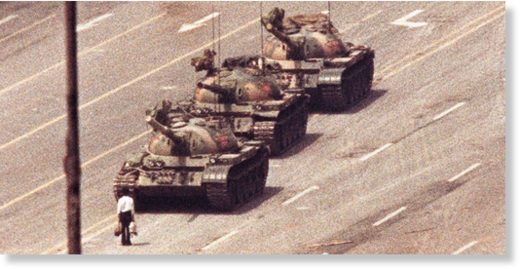
The Tiananmen Square 'Massacre' - Facts, Fiction and Propaganda

Tianenmen square tank man

Chris Kanthan
Sott.net


"As far as can be determined from the available evidence, NO ONE DIED that night in Tiananmen Square."

If after reading that you're thinking: 'nonsense! that's just a blatant propagandist claim by China's communist party!', you'd be wrong. It was, in fact, Jay Mathews, the Washington Post's Beijing Bureau Chief in 1989. He wrote this article on the topic of the June 4th 1989 Tiananmen square protests for Columbia Journalism Review.

Many western papers have, in fact, occasionally admitted that this report and other similar reports exist, only to go back to the "massacre" narrative, for some unknown reason. For example, in June 13, 1989, NY Times reporter Nicholas Kristoff - who was in Beijing at the time - wrote: "State television has even shown film of students marching peacefully away from the [Tiananmen] square shortly after dawn as proof that they [protesters] were not slaughtered." In that article, he also debunked a sensational article's claim that Chinese soldiers with machine guns simply mowed down peaceful protesters in Tiananmen Square.

A Wikileaks cable from July 1989 also reveals the eyewitness accounts of a Latin American diplomat and his wife: "They were able to enter and leave the [Tiananmen] square several times and were not harassed by troops. Remaining with students ... until the final withdrawal, the diplomat said there were no mass shootings in the square or the monument."

It is true, of course, that about 200-300 people died in clashes in various parts of Beijing around June 4th 1989 - but about half of those who died were soldiers and police officers.

But what about the iconic "tank man"? Well, if you watch the whole video, you can see that the tanks stopped and let the man jump on the tank. He eventually walks away unharmed. In fact, there are almost no pictures or videos of soldiers actually shooting at or killing people (which doesn't mean it didn't happen, but it's a point to keep in mind).

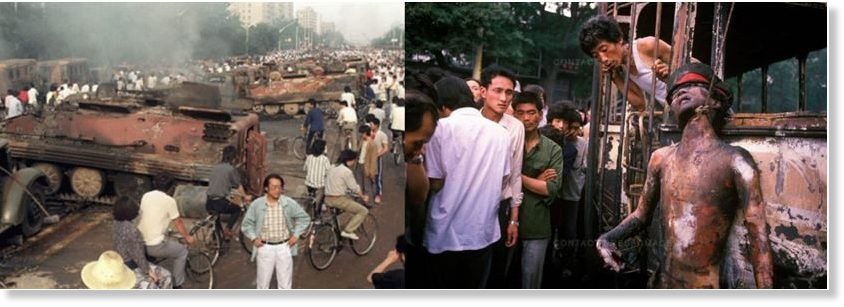
Propaganda involves not only exaggeration, but also omission. Western media now rarely show pictures of tanks and military vehicles burned down or Chinese soldiers brutally killed by the Beijing protesters.

In an article from June 5, 1989, the Wall Street Journal described some of this violence: "Dozens of soldiers were pulled from trucks, severely beaten and left for dead. At an intersection west of the square, the body of a young soldier, who had been beaten to death, was stripped naked and hung from the side of a bus."

Tianenment police killed
So what exactly did happen? What's the complete story?
Read more

Tuesday, 4 June 2019

Do We Face a Global Food Disaster?

F. William Engdahl
NEO

No, this is not at all an endorsement of the apocalyptic scenarios of AOC or that famous young Swedish climate expert, Greta. It is, however, a look at unusual weather disasters in several key growing regions from the USA to Australia, the Philippines and beyond that could dramatically affect food availability and prices in the coming year. That in turn could have major political implications depending on how the rest of the growing season develops.

USA Midwest Waterlogged

According to the latest May 20 report of the National Agricultural Statistics Service (NASS) of the US Department of Agriculture, corn and soybean crops are well behind the planting growth levels normal this time of the planting season. They report that only 49% of all planned corn acreage in the US has been planted compared with 78% at this time a year ago. Of that only 19% has yet emerged from the ground compared to 47% in May 2018. In terms of soybeans, barely 19% of crops have yet been planted compared with 53% a year before. Rice acreage planted is down to 73% compared to 92% a year ago in the six US rice-growing states. Of course, should weather dramatically improve the final harvest numbers could improve. It is simply too early to predict.

The USA is by a wide margin the world largest soybean producer with 34 percent of the world’s soybean production and 42% of world exports prior to the China trade battles. The US is also the world largest corn or maize producer, almost double China, the number two. A serious harvest failure in these two crops could significantly affect world food prices, leaving aside the unfortunate fact that almost all US soybeans and corn are GMO crops. They are mainly used in animal feed. 

A major factor in the disruption of the US Midwest growing season is the fact that the past 12 months have seen the greatest precipitation levels since the US Government began keeping statistics in 1895, according to the US NOAA National Centers for Environmental Information. Record snowfall followed by abnormally heavy rains are the reason.

Read more

Sunday, 26 May 2019

Trump Attacks Military Industrial Complex and Calls for Infrastructure Investments in the Middle East

Matthew Ehret
Strategic Culture

For the first time in over half a century, an American President has actually come out attacking the Military Industrial Complex. Of course, everyone knows of President Dwight D. Eisenhauer’s famous outgoing 1961 speech warning the world (and the incoming President Kennedy) what sort of monster had arisen at the heart of America’s defense institutions. Very little on the matter was said on the frightening topic by decades of political leaders who rose to prominence in the shadow of JFK’s corpse. Instead, the beast grew like a malignant cancer over the ensuing years as a major branch of the British-run deep state that carried out a coup with Sir Winston Churchill’s Iron Curtain speech in 1946 and the MI6-directed re-organization of American intelligence with the creation of the CIA in 1947.

After John F. Kennedy’s assassination, networks of neoconservative contaminated all branches of government in both parties bringing the USA into a frenzied military doctrine centered on regime change wars, oil-centered geopolitics and unipolarism totally uncharacteristic with the better constitutional traditions of the nation. This geopolitical doctrine nearly drove the west into a full military confrontation with Russia and China in recent years.

The Tide Begins to Turn

On May 20 speaking to Fox News, President Trump echoed Eisenhauer’s warnings. Under a coterie of Trump’s war-mongering advisors such as John Bolton, Gina Haspel, Terrence O’Shaughnessy and Mike Pompeo, America has recently been brought to the brink of war with Iran. While Trump has too often accommodated this hive of neocons, his recent statements and repeated calls for cooperation with Russia and China demonstrate a sound push back which should be taken very seriously. In that Fox interview Trump said:

“With all of everything that’s going on, and I’m not one that believes—you know, I’m not somebody that wants to go in to war, because war hurts economies, war kills people, most importantly—by far most importantly.”
You know, in Syria, with the caliphate, so I wipe out 100 percent of the caliphate. That doesn’t mean you’re not going to have these crazy people who run around blowing up stores and blowing up things—these are seriously ill people. I don’t want to say, ‘Oh, they’re wiped,’ you know, ISIS. But, I wiped out 100 percent of the caliphate. I say, ‘I want to bring our troops back home.’ The place went crazy. You have people here in Washington, they never want to leave.”
‘You know what I’ll do, I’ll leave a couple hundred soldiers behind,’ but if it was up to them, they’d bring thousands of soldiers in. Someday people will explain it, but you do have a group, and they call it the military-industrial complex. They never want to leave. They always want to fight.”
Read more

Friday, 24 May 2019

The Next Economic Crisis, The Looming Post-Multipolar System And Hybrid War Forever

The Impending Crisis

At one time, specifically during the post-World War 2 Bretton Woods era, it looked like as if the capitalist model could be indefinitely sustainable and avoid plunging the world into major world conflicts. That era began to come to an end during the stagflation crisis of the 1970s, and came to a complete end at the end of the Cold War which ushered in the era of the so-called "globalization" which took form of unbridled competition for markets and resources. At first this competition did not show many signs of trouble. There were many "emerging markets" created as a result of the collapse of the Soviet bloc into which Western corporations could expand. However, the law of diminishing returns being what it is, the initial rapid economic growth rates could not be sustained and attempts to goose it using extremely liberal central bank policies, to the point of zero and even negative interest rates, succeeded in inflating-and bursting-several financial "bubbles". 


Even today's US economy bears many hallmarks of such a bubble, and it is only one of many. Sooner or later the proverbial "black swan" event will unleash a veritable domino effect of popping bubbles and plunge the global economy into a crisis of a magnitude it has not seen since the 1930s. A crisis against which the leading world powers have few weapons to deploy, since they have expended their monetary and fiscal "firepower" on the 2008 crisis, to little avail. The low interest rates and high levels of national debt mean that the next big crisis will not be simply "more of the same." It will fundamentally rearrange the global economy. 


Read more

Thursday, 2 May 2019

The Race to Develop the Moon

Rivka Galchen
The New Yorker

n January, the China National Space Administration landed a spacecraft on the far side of the moon, the side we can’t see from Earth. Chang’e-4 was named for a goddess in Chinese mythology, who lives on the moon for reasons connected to her husband’s problematic immortality drink. The story has many versions. In one, Chang’e has been banished to the moon for elixir theft and turned into an ugly toad. In another, she has saved humanity from a tyrannical emperor by stealing the drink. In many versions, she is a luminous beauty and has as a companion a pure-white rabbit.

Chang’e-4 is the first vehicle to alight on the far side of the moon. From that side, the moon blocks radio communication with Earth, which makes landing difficult, and the surface there is craggy and rough, with a mountain taller than anything on Earth. Older geologies are exposed, from which billions of years of history can be deduced. Chang’e-4 landed in a nearly four-mile-deep hole that was formed when an ancient meteor crashed into the moon—one of the largest known impact craters in our solar system.

You may have watched the near-operatic progress of Chang’e-4’s graceful landing. Or the uncannily cute robotic amblings of the lander’s companion, the Yutu-2 rover, named for the moon goddess’s white rabbit. You may have read that, aboard the lander, seeds germinated (cotton, rapeseed, and potato; the Chinese are also trying to grow a flowering plant known as mouse-ear cress), and that the rover survived the fourteen-day lunar night, when temperatures drop to negative two hundred and seventy degrees Fahrenheit. Chang’e-4 is a step in China’s long-term plan to build a base on the moon, a goal toward which the country has rapidly been advancing since it first orbited the moon, in 2007.

If you missed the Chinese mission, maybe it’s because you were focussed on the remarkably inexpensive spacecraft from SpaceIL, an Israeli nonprofit organization, which crash-landed into the moon on April 11th, soon after taking a selfie while hovering above the lunar surface. The crash was not the original plan, and SpaceIL has already announced its intention of going to the moon again. But maybe you weren’t paying attention to SpaceIL, either, because you were anticipating India’s Chandrayaan-2 moon lander, expected to take off later this year. Or you were waiting for Japan’s first lunar-lander-and-rover mission, scheduled to take place next year. Perhaps you’ve been distracted by the announcement, in January, on the night of the super blood wolf moon, that the European Space Agency plans to mine lunar ice by 2025. Or by Vice-President Mike Pence’s statement, in March, that the United States intends “to return American astronauts to the moon within the next five years.”

Fifty years ago, three men journeyed from a small Florida peninsula to a dry crater some two hundred and forty thousand miles away called the Sea of Tranquillity. Hundreds of millions of people watched on black-and-white TVs as a man from Wapakoneta, Ohio, climbed slowly down a short ladder and reported in a steady voice that his footprint had depressed the soil only a fraction of an inch, that “the surface appears to be very fine-grained as you get close to it, it’s almost like a powder down there, it’s very fine.”

Shortly before NASA launched Apollo 11, it received a letter from the Union of Persian Storytellers, begging NASA to change the plan: a moon landing would rob the world of its illusions, and rob the union’s members of their livelihood. During the spacecraft’s flight, the Mission Control Center, in Houston, asked the crew to look out for Chang’e, and for her bunny, too. Houston said that the bunny would be “easy to spot, since he is always standing on his hind feet in the shade of a cinnamon tree.” Buzz Aldrin responded, “We’ll keep a close eye out for the bunny girl.” 

Read more

Ignorance and Russophobia

Gordon Duff
NEO 

The roots of Russophobia run deep in the US. They go much further than censored or slanted media or political gameplaying in Washington. What has to, or at least should be accepted is that Russophobia is a belief system, just like a religion, but with no spiritual nature, no holy prophets but resembling the worst of religion. Russophobia is a religion of hate that no one understand or will acknowledge the root cause of.

Perhaps we might want to take a look.

We will examine how America’s view of the world took root due to the efforts of religious missionaries and was eventually hijacked by the Deep State.

We’re going to show how a powerful group, called the China Lobby, financed by massive American military aid, intended to fund Chaing Kai Shek’s fake war against Japan, bought Washington, “lock stock and barrel,” and began blaming Russia for the world’s ills.

Though Chaing himself was a lifelong communist and close friend of Stalin, as the Chinese rose against his ineffective rule after the defeat of Japan and began backing Mao tse Tung, a witch hunt began targeting pro-Russian Americans, anti-fascists, and blaming them for “losing China.”

A similar “blame Russia” effort went on when the US “lost Vietnam” to Ho Chi Minh. Few Americans remember or take note that Ho was America’s “man in Vietnam” against the Vietnamese and was, in actuality, placed in control of Vietnam by the US after the war.

It was only when France threatened to elect a communist government did the US back their colonial return to Vietnam which ended in the military defeat at Dien Bien Phu in 1954.

Similarly, in Korea, the US continued to back the Japanese puppet, Syngman Rhee, after Japan’s surrender in 1945. While MacArthur democratized Japan, America oversaw the slaughter of democratic elements in South Korea which led to the overall uprising that eventually brought in North Korea in what the US termed an “invasion.”

If this smells a bit of America’s actions in Syria more than half a century later, I think we can say that the pattern continues. 

Read more
Related Posts Plugin for WordPress, Blogger...