Search This Blog

Showing posts with label Banksters. Show all posts

Sunday, 21 July 2019

A Bank With $49 Trillion In Derivatives Exposure Is Melting Down Before Our Eyes

Michael Snyder
The Economic Collapse blog

Could it be possible that we are on the verge of the next “Lehman Brothers moment”?  

Deutsche Bank is the most important bank in all of Europe, it has 49 trillion dollars in exposure to derivatives, and most of the largest “too big to fail banks” in the United States have very deep financial connections to the bank.  In other words, the global financial system simply cannot afford for Deutsche Bank to fail, and right now it is literally melting down right in front of our eyes.  For years I have been warning that this day would come, and even though it has been hit by scandal after scandal, somehow Deutsche Bank was able to survive until now.  But after what we have witnessed in recent days, many now believe that the end is near for Deutsche Bank.  On July 7th, they really shook up investors all over the globe when they laid off 18,000 employees and announced that they would be completely exiting their global equities trading business

It takes a lot to rattle Wall Street.
But Deutsche Bank managed to. The beleaguered German giant announced on July 7 that it is laying off 18,000 employees—roughly one-fifth of its global workforce—and pursuing a vast restructuring plan that most notably includes shutting down its global equities trading business.
Though Deutsche’s Bloody Sunday seemed to come out of the blue, it’s actually the culmination of a years-long—some would say decades-long—descent into unprofitability and scandal for the bank, which in the early 1990s set out to make itself into a universal banking powerhouse to rival the behemoths of Wall Street.
These moves may delay Deutsche Bank’s inexorable march into oblivion, but not by much. 

Read more

Tuesday, 16 July 2019

Bank Run: Deutsche Bank Clients Are Pulling $1 Billion A Day

Zero Hedge

There is a reason James Simons' RenTec is the world's best performing hedge fund - it spots trends (even if they are glaringly obvious) well ahead of almost everyone else, and certainly long before the consensus.

That's what happened with Deutsche Bank, when as we reported two weeks ago, the quant fund pulled its cash from Deutsche Bank as a result of soaring counterparty risk, just days before the full - and to many, devastating - extent of the German lender's historic restructuring was disclosed, and would result in a bank that is radically different from what Deutsche Bank was previously (see "The Deutsche Bank As You Know It Is No More").

In any case, now that RenTec is long gone, and questions about the viability of Deutsche Bank are swirling - yes, it won't be insolvent overnight, but like the world's biggest melting ice cube, there is simply no equity value there any more - everyone else has decided to cut their counterparty risk with the bank with the €45 trillion in derivatives, and according to Bloomberg Deutsche Bank clients, mostly hedge funds, have started a "bank run" which has culminated with about $1 billion per day being pulled from the bank.

As a result of the modern version of this "bank run", where it's not depositors but counterparties that are pulling their liquid exposure from DB on fears another Lehman-style lock up could freeze their funds indefinitely, Deutsche Bank is considering how to transfer some €150 billion ($168 billion) of balances held in it prime-brokerage unit - along with technology and potentially hundreds of staff - to French banking giant BNP Paribas.

Read more

Monday, 20 May 2019

The Spider's Web: Britain's Second Empire (Documentary)


At the demise of empire, City of London financial interests created a web of secrecy jurisdictions that captured wealth from across the globe and hid it in a web of offshore islands. Today, up to half of global offshore wealth is hidden in British jurisdictions and Britain and its dependencies are the largest global players in the world of international finance. 
 
The Spider's Web was written, directed and produced by Michael Oswald, you can sponsor his future films on Liberapay (supports one time donations) and Patreon: https://liberapay.com/IndependentPOV https://www.patreon.com/independentdo... 
 
Share this documentary with your friends, and ask sites to feature it:  
https://twitter.com/spiderswebfilm  


The Spider's Web was substantially inspired by Nicholas Shaxson's book Treasure Islands you can read an extract of it here: https://www.theguardian.com/theguardi... 
 
Translate this documentary here on youtube or contact us for the .srt file 
 
contact@independentpov.org 
 
For those interested to learn more about tax justice and financial secrecy, read about the Tax Justice Network's campaigning and regular blogs - become part of the movement for change and listen to the Tax Justice Network's monthly podcast/radio show the Taxcast https://www.taxjustice.net/taxcast/ 
 
 
Review on Open Democracy: https://www.opendemocracy.net/en/open... 
 
Website: www.spiderswebfilm.com 
 
German Version: https://youtu.be/1ZZR8vBKqwc 
 
Subtitles: French, Spanish, German, Italian, Russian, Arabic, Korean, Hungarian, English, Turkish, Portugese.

Tuesday, 7 May 2019

Money laundering - Why the UK does not prosecute it

"Despite the UK’s rhetoric about wanting a “world-leading reputation for integrity” as a financial centre, it has never prosecuted a single company or bank for money laundering."

True Publica

A study by the CCP Research Foundation – which analyses banks’ so-called ‘conduct costs’ – revealed that the biggest 20 banks worldwide, including the biggest four in Britain, had paid or set aside £264 billion for fines in the five years to 2017. Britain’s biggest banks have paid out £71 billion for misconduct in the decade since the financial crisis. Much of these fines have related to money laundering but they were not prosecuted in the UK.

Lloyds is the bank that has suffered the heaviest penalties with at least £23.4 billion in conduct-related costs and write-offs since 2008.  RBS is second on the list. Its conduct and litigation costs since 2008, including amounts it has earmarked but not yet used, add up to £20.6 billion. The bailed-out bank also agreed to pay £3.6 billion to settle an investigation by the US Department of Justice (DoJ) for misselling mortgage-backed securities – the bonds at the heart of the 2008 crisis in America.

RBS and Lloyds were bailed out when the financial crisis broke out to the tune of £45.5 billion and £20.3 billion respectively.

Barclays avoided a UK state bailout – but only by taking £12 billion what looks like illegal emergency funding from the state of Qatar. The Serious Fraud Office is involved.

HSBC has forked out nearly £10 billion in fines and other costs for its conduct since 2008.
In the last few weeks – Standard Chartered, the British bank has been ordered to pay $1.1bn (£842m) by US and UK authorities to settle allegations for breaching sanctions against countries including Iran.

But it doesn’t end there does it – it just keeps on going.

In 2019 alone, leaving aside Standard Chartered, the Financial Conduct Authority has dished out fines to the financial services sector at the rate of more than one a month. In total, to the 9th April, they have fined the industry or people in it collectively to the tune of £272,487,887.

What is interesting here is the missing link. British banks are world leaders in shovelling trillions into tax havens, most of it to evade taxation but a very good chunk of it is pure money laundering. 

Tyrants, despots, mass murderers, terrorists, traffickers – they are just as good a customer as any as far as the banks are concerned. Here, the British government and its toothless Financial Conduct Authority fail in every sense of the word. Money laundering through British tax haven islands and crown dependencies is something the state approves of – hence the lack of fines or punishment dished out for it.

Donald Toon, director at the National Crime Agency, admitted that money laundering in the UK was “a very big problem” and estimated that the amount of money laundered here each year has now risen to a staggering £150 billion. I would think that is on the light side.

Susan Hawley is Policy Director of Corruption Watch. She worked for six years at the Corner House on corruption issues, having previously worked in the policy team at Christian Aid on ethics and corruption issues. Here is her take, (originally published a year ago), on money laundering by British banks.

Read more

Tuesday, 30 April 2019

Countries Around The World Are Bringing Gold Home

Zero Hedge

European Central Bank’s President Mario Draghi recently announced that the ECB would be required to approve any management of gold reserves within the euro zone countries. The statement was specifically directed at two Italian members.

Why was Italy singled out? According to the Wall Street Journal, Italian citizens are preparing to take control of Italy’s gold reserves. During the past few years, a multitude of small investors lost billions of dollars due to the failure of several Italian banks. The Bank of Italy is seen as an elitist, inefficient entity indifferent to the needs of ordinary people. Deputy Prime Minister Luigi Di Maio is leading the attack against Italy’s central bank, along with the “5 Star Movement” and the nationalist “League,” all of whom blame the countries financial woes on the incompetence of the central bank.

The 5 Star Movement is asking Italy’s Parliament to approve measures that would allow private banks to sell their share in The Bank of Italy at 1930’s prices. Taking it a step further, they are also demanding that ownership of the Bank of Italy’s 2,451.8 tons of gold be taken over by the country’s citizens and spent on populist policies. The current value of these gold reserves is $102 billion.

If these laws are passed, investors would be able to sell gold and greatly deplete the central bank’s reserves. As Giorgia Meloni of the Brothers of Italy states, “The gold belongs to the Italians, not the bankers.” 

Read more

Tuesday, 3 July 2018

How $21 Trillion in U.S. Tax Money Disappeared. “Full Scope Audit” of the Pentagon

David DeGraw
Global Research

This is part of our series on the unaccounted for $21 Trillion in taxpayer money. As unbelievable and absurd as that sounds, the actual total of unaccounted for money at the Pentagon is most likely significantly more than $21 trillion. The First ever “full-scope audit” of the Pentagon is presently underway. Read the first report from this series here. 
 *
According to the Department of Defense Inspector General and the Defense Finance and Accounting Service, $21 Trillion in Taxpayer Funding Is Unaccounted For.

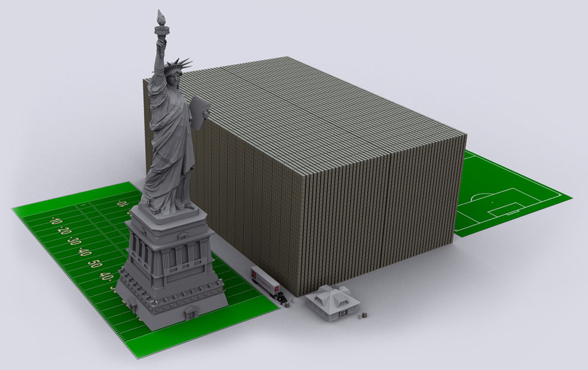
To help people comprehend the scale of this, $1 Trillion is $1000 Billion. This means that $21,000 Billion in taxpayer money has gone missing.

Image: a stack of one trillion dollars. Multiply that by 21

How can this be possible? 

We outlined the “Unaccountable System of Global War Profiteers” in detail here.

For further understanding, we are featuring another mind-blowing Department of Defense Inspector General (DOD IG) report. 

Read more

Friday, 18 May 2018

A Central Banking Insider Just Revealed the Blueprint For When the Next Crisis Hits

Zero Hedge

If you’re looking for insights into what Central Banks have planned when The Everything Bubble bursts, on Monday one of the European Central Bank’s (ECB) top bankers provided a blueprint.

Benoît Cœuré, has been a member of the Executive Board of the ECB since 2011. As such is one of SIX individuals who have dictated ECB policy during that time.
This means he’s been involved in:
  • The second and third Greek bailouts.
  • The Spain bailout.
  • The Portugal bailout.
  • The second and third Romania bailouts.
  • The Cyprus bail-ins.
Cœuré has operated at the highest level of monetary/ financial policy during a period in which numerous financial/banking systems were experiencing systemic risk.
Put simply, there are fewer than 100 people on the planet who are as familiar with how Central Banks perceive the risks in today’s financial system as well as the policies said Central Banks will unleash when the next crisis hits.

With that in mind, let’s take a look at what he had to say regarding both in the speech he gave titled The Future of Central Bank Money at the International Center for Monetary and Banking Studies in Geneva yesterday.
In my remarks this evening I would like to share some more general thoughts on the role of the central bank’s balance sheet in the economy. My focus will be on central bank liabilities – that is, money created by central banks to be used as a means of payment and store of value…
What distinguishes the discussion today from previous discussions, however, are three new facts: 
The first is that we are seeing a dramatic decline in the demand for cash in some countries, in particular Sweden and Norway.
The second is that central banks today could make use of new technologies that would enable the introduction of what is widely referred to as a “token-based” currency – one based on a distributed ledger technology (DLT) or comparable cryptographic technology.
And the third “new” fact, at least from a long-term perspective, relates to the role of central banks in setting monetary policy, and more recently to the emergence of negative rates as a policy instrument and the consequences for the transmission of monetary policy.
Source: ECB
Read more

Thursday, 10 May 2018

Nomi Prins: Collusion! How central bankers rigged the world

Adam Taggert
Peak Prosperity

Nomi Prins, Wall Street veteran turned financial industry reformist returns to the podcast this week to explain the findings within her new book Collusion: How Central Bankers Rigged The World. 

Nomi has put together a timeline of exactly when and how the central banks have plundered the wealth of the masses since 2008, either directly or indirectly through the loss of purchasing power of the currencies they control:
The relationship between the Central Banks, the major ones — the Fed, Europe Central Bank, Bank of Japan — all the larger Central Banks in the world and their private banks was effectively, and is effectively, kept secret. The relationships they have with each other, a lot of it is secret; so you have to really dig in to it to find out what’s really going on.
What I did was dig into the documents that I could find and create a timeline. That’s why each chapter in each region starts in 2008. It works with Mexico, Brazil, Japan, China and Europe and juxtaposes that with what the Fed was doing at that time to see how that collusive behavior wound up happening. The secret-ness is in the relationships of the banks, where that money that was fabricated by these institutions actually went, and when — or if — it’s coming back.
The ‘cheat and deceiving’ part of that definition is also apparent: people have been cheated out of their futures from the standpoint of the central banks’ strategies. So when the Feds creates cheap money, companies and banks and countries borrow more from the future because it is so cheap and easy. This deceives many people into thinking that the economy is somehow therefore being helped by this strategy, which is in acutality an emergency strategy. It’s an emergency that’s gone on now for ten years.
Yes there have been some tweaks here and there — interest rates have gone up a little bit in the United States — but all in all, rates are still pretty much 0% on average globally and quantitative easing still exists. The books of the major Central Banks are as big as they were at their heights through this last ten-year period…and they’re still growing. Just look at Europe and Japan.
Look at the stock market. The stock market is really high right now in a lot of different places. Why is it so high? Because a lot of this money went into debt which was borrowed to buy corporate stock, to buy the stock of banks, or to buy the banks themselves. That’s a major form of manipulation and deception as well.
Why is JP Morgan’s stock going up? Is it just because JP Morgan is such a great bank and so helping? Well, no. It’s because it received a lot of help from the Federal Reserve. It funneled that help into its own shares, and it has continued to pay settlements and be fined on egregious activity against its own clients, which are many because it’s the largest bank in the United States among the largest banks in the world.
There are multiple points of cheating and deception that have been enabled or that occur because of Central Banks policies. Some of those policies are secret; but a lot of them are public. You just have to piece the documents and the timelines together.
Read more

Sunday, 19 March 2017

Banks are evil - it's time to get painfully honest about this

Adam Taggart
Peak Prosperity 


I don't talk to my classmates from business school anymore, many of whom went to work in the financial industry.

Why?

Because, through the lens we use here at PeakProsperity.com to look at the world, I've increasingly come to see the financial industry -- with the big banks at its core -- as the root cause of injustice in today's society. I can no longer separate any personal affections I might have for my fellow alumni from the evil that their companies perpetrate.

And I'm choosing that word deliberately: Evil.

In my opinion, it's long past time we be brutally honest about the banks. Their influence and reach has metastasized to the point where we now live under a captive system. From our retirement accounts, to our homes, to the laws we live under -- the banks control it all. And they run the system for their benefit, not ours.

While the banks spent much of the past century consolidating their power, the repeal of the Glass-Steagall Act in 1999 emboldened them to accelerate their efforts. Since then, the key trends in the financial industry have been to dismantle regulation and defang those responsible for enforcing it, to manipulate market prices (an ambition tremendously helped by the rise of high-frequency trading algorithms), and to push downside risk onto "muppets" and taxpayers.

Oh, and of course, this hasn't hurt either: having the ability to print up trillions in thin-air money and then get first-at-the-trough access to it. Don't forget, the Federal Reserve is made up of and run by -- drum roll, please -- the banks.

How much 'thin air' money are we talking about? The Fed and the rest of the world's central banking cartel has printed over $12 Trillion since the Great Recession. Between the ECB and the DOJ, nearly $200 Billion of additional liquidity has been -- and continues to be -- injected into world markets each month(!) since the beginning of 2016:  


Read more

Friday, 17 February 2017

Greek Bank Run Re-accelerates: Massive Deposit Withdrawals Despite Capital Controls

Zero Hedge

Delays in the talks between Greece and its lenders have brought back the ghost of Grexit.

The grave disagreement between the International Monetary Fund and the European lenders, Grexit bombshells flying around and Greece’s reluctance to accept additional austerity measures have increase uncertainty among citizens – for one more time.

And so, as KeepTalkingGreece.com notes, what do citizens do when they feel political and economical insecurity? The run to banks and withdraw deposits.

Read more

Saturday, 30 July 2016

IMF admits disastrous love affair with the euro and apologises for the immolation of Greece

Comment: This is tragi-comedy. What this shows above anything else that the sheer stupidity of these people is beyond dispute. They were not informed?? Really? They're like spoilt children playing with people's lives. "Sorry, we destroyed a country and its its citizens. We'll do better next time and put in measures that ensure a country's wealth passes into our and the banking fraternity's coffers in a more civilised and less transparent way."

The IMF is an enabler and tool of neo-liberal economic policy thus it cannot be reformed. The only course of action is to erase it from existence as soon as humanly possible.

---------------------- 

Telegraph


“The possibility of a balance of payments crisis in a monetary union was thought to be all but non-existent,” it said. As late as mid-2007, the IMF still thought that “in view of Greece’s EMU membership, the availability of external financing is not a concern".

At root was a failure to grasp the elemental point that currency unions with no treasury or political union to back them up are inherently vulnerable to debt crises. States facing a shock no longer have sovereign tools to defend themselves. Devaluation risk is switched into bankruptcy risk.

“In a monetary union, the basics of debt dynamics change as countries forgo monetary policy and exchange rate adjustment tools,” said the report. This would be amplified by a “vicious feedback between banks and sovereigns”, each taking the other down. That the IMF failed to anticipate any of this was a serious scientific and professional failure.

In Greece, the IMF violated its own cardinal rule by signing off on a bailout in 2010 even though it could offer no assurance that the package would bring the country’s debts under control or clear the way for recovery, and many suspected from the start that it was doomed.

The organisation got around this by slipping through a radical change in IMF rescue policy, allowing an exemption (since abolished) if there was a risk of systemic contagion. “The board was not consulted or informed,” it said. The directors discovered the bombshell “tucked into the text” of the Greek package, but by then it was a fait accompli.

The IMF was in an invidious position when it was first drawn into the Greek crisis.  The Lehman crisis was still fresh. “There were concerns that such a credit event could spread to other members of the euro area, and more widely to a fragile global economy,” said the report.

The eurozone had no firewall against contagion, and its banks were tottering. The European Central Bank had not yet stepped up to the plate as lender of last resort. It was deemed too dangerous to push for a debt restructuring in Greece.

Read More

Tuesday, 12 July 2016

Deutsche Bank requests €150 billion bailout to EU banks

Alex Christoforou
The Duran


Italy's Prime Minister, Matteo Renzi, fired shots at Germany's financial EU hegemony when, during a joint news conference with Swedish Prime Minister Stefan Lofven, said:
"If this non-performing loan problem is worth one, the question of derivatives at other banks, at big banks, is worth one hundred. This is the ratio: one to one hundred."
Renzi was referring to the massive, trillions of derivatives Deutsche Bank is carrying on its books. According to Renzi, Italy may have issues, but "other" European banks have much bigger problems.

Zerohedge provides context on Italy's banking woes..
In the aftermath of Brexit, much of the investing public's attention has turned to Italian banks which are in desperate need of a bailout as a result of €360 billion in bad loans growing worse by the day (and not a bail-in, as European regulations mandate, as that would lead to an immediate bank run) to avoid a freeze and/or collapse of Italy's banking sector. This has pushed stock prices - and default risk - on Italian banks to record levels. So far Italy's bailout requests have mostly fallen on deaf ears, as Germany's political leaders have resisted Renzi's recurring pleas for a taxpayer funded rescue. However, as we have alleged, and as the Italian Prime Minister admitted last week, the core risk for Europe is not just the Italian banking sector but the biggest bank of all in Europe: Deutsche Bank.
While we are just coming off the roller coaster ride that was the UK referendum, the European Union is about to go through another nausea inducing ride where not one, but two, very big EU players are about to get hammered. The messenger of more bad EU news, David Folkerts-Landau, the chief economist of Deutsche Bank, who has called for a multi-billion dollar bailout for European banks.

Read more

New Evidence Proves HSBC Avoided Criminal Prosecution Due to “Market Risk”

Michael Krieger 
Liberty Blitzkrieg 

All that said, if anyone is a top contender for the worst of the worst of the Obama Administration, it’s Eric Holder. As head of the Department of Justice, he was the one man who could’ve played an enormously positive role in American society, by punishing those responsible for creating the financial crisis that destroyed tens of millions of lives globally. Instead, he chose to actively protect the financial oligarchs and ushered in a tragic new era for these United States. One in which the world suddenly realized that the U.S. is little more than a glorified oligarchy. Essentially an aggressive Banana Republic armed with nuclear weapons and the swagger of a third world dictator.

– From the post: Cronyism Pays – Eric “Too Big to Jail” Holder Triumphantly Returns to His Prior Corporate Law Firm Job

The precedent was set with the TBTF mega banks, and it was continued last week with the non-indictment of Hillary Clinton.

The rule of law simply no longer exists in America. Laws do not apply to the rich and powerful, only apply to the peasant citizens.

The following is absolutely disgusting. From the BBC:

US officials refused to prosecute HSBC for money laundering in 2012 because of concerns it would cause a “global financial disaster”. 
A US Congressional report released Monday also accused former Attorney General Eric Holder of misleading congress about the decision. 
In 2012 HSBC was accused of violating US sanctions and allowing drug cartels to use its branches to launder funds. 
The bank paid a $1.92bn settlement but did not face criminal charges.
No top officials at HSBC were charged with any crimes.
The report says Mr Holder ignored the recommendations of more junior staff to prosecute HSBC because of the bank’s “systemic importance” to the financial markets.
Read more

See also: HSBC reportedly got top govt help to hamper money laundering probe- reports
 

Wednesday, 15 June 2016

Banksters Threaten Brits: Don’t Brexit!….or else!

James Corbett
TheInternationalForecaster.com
 

One by one, the Brexit dominoes are falling.

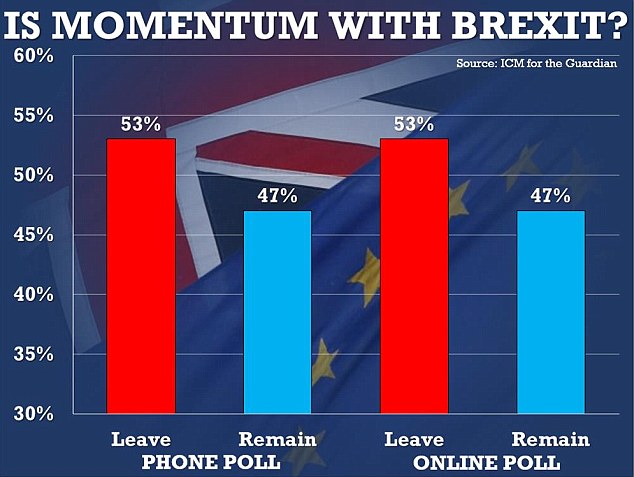
First it was the surprise ORB poll last Friday showing those in favor of Britain’s departure from the EU a whopping 10 points in the lead.

Then it was two new polls this week confirming that the “Leave” camp has taken a convincing lead with just 10 days left to go before the vote.

Then it was Murdoch’s Sun urging its readers in its typical low key and understated fashion to “BeLEAVE in Britain!”

Now even serious journalists like The Telegraphs’s Ambrose Evans-Pritchard are encouraging Britons to vote for separation from the EU in next week’s referendum:
“Stripped of distractions, [the referendum] comes down to an elemental choice: whether to restore the full self-government of this nation, or to continue living under a higher supranational regime, ruled by a European Council that we do not elect in any meaningful sense, and that the British people can never remove, even when it persists in error.
“[…]We are deciding whether to be guided by a Commission with quasi-executive powers that operates more like the priesthood of the 13th Century papacy than a modern civil service; and whether to submit to a European Court of Justice (ECJ) that claims sweeping supremacy, with no right of appeal.”
I couldn’t have said it better myself. Well, actually I could, but fewer people would listen.

Brexitmomentum 

So the bookmakers may still be giving the winning odds to the “Stay” camp (for the compulsive gamblers out there, it’s 4-7 for stay vs. 7-4 for leave), there is significant movement behind the push to extricate the UK from its 43 year entanglement with the EUreaucracy.

So of course the banksters are doing what they always do when things are not going their way: threatening, intimidating and generally trying to scare the living daylights out of the public.

Read more

Friday, 6 May 2016

German Study Proves It – 95% Of Greek "Bailout" Money Went To The Banks

Mike Krieger
Liberty Blitzkrieg
I simply cannot stress enough how important Greece is to freedom, liberty and civilization across the globe. Greece is not a one-off, or merely a small nation in big trouble that holds little relevance for the rest of us. Greece is everything.
What is happening to Greece follows the exact same game plan of what will eventually happen to every other supposedly sovereign nation. First there is an explosion of debt. Then a crisis. Then a bailout. Then creditor imposed hardship is forced upon the average population, in conjunction with unlimited bailouts for the bankers and other oligarch criminals.
Finally, when a public which mistakenly believes it is living in a democracy exercises its right to national sovereignty, the sad truth is exposed. They are not a people living under a free political system.

– From last year’s post: This is Sparta – 1,000 Bitcoin ATMs are Coming to Greece
A recent German study just confirmed what tens of millions of Greeks already knew. That they are a people fully conquered by criminal mega banks and the corrupt politicians and technocrats in their employ.

Get ready for another epic screw job this summer.

From Ekathimerini:
Some 95 percent of the 220 billion euros disbursed to Greece since the start of the financial crisis as loans from the bailout mechanism has been directed toward saving the European banks. That means about 210 billion euros was eventually channeled to the eurozone credit sector while just 5 percent ended up in state coffers, according to a study by the European School of Management and Technology (ESMT) in Berlin.
“Europe and the International Monetary Fund have in previous years mainly saved the banks and other private creditors,” concluded the report, published yesterday in German newspaper Handelsblatt. ESMT director Jorg Rocholl told the financial newspaper that “the bailout packages mainly saved the European banks.”
The economists who took part in the study have analyzed each loan separately to established where the money ended up, and concluded that just 9.7 billion euros – less than 5 percent – actually found its way into the Greek budget for the benefit of citizens.
“This is something that everyone suspected, but few people actually knew. That has now been confirmed by the study.
For related articles, see:

Yanis Varoufakis Reveals – Berlin Blocked Greece From Chinese Funding During Crisis
“This is a Coup” – The Story of How Greece Lost Democracy
This is Sparta – 1,000 Bitcoin ATMs are Coming to Greece
Yanis Varoufakis on “Europe’s Vindictive Privatization Plan for Greece”
Yanis Varoufakis Issues a Major Warning to the Greek People

Monday, 30 November 2015

HSBC Whistleblower: The Biggest Bank Fraud in British History Carried Out on UK Shoppers and Covered Up

Real Media 


“In my position, as you can imagine, I’ve got a few enemies.” An anonymous tip off has contacted the DWP to suggest that Nicholas Wilson is frauding the benefits office. “They sent a letter calling me in for a compliance interview.”


The irony is that Nicholas Wilson is a whistleblower, who has been trying to expose what would be the largest bank fraud in the history of the UK, totalling over £1bn. This is made up of illegal charges imposed by HFC Bank – previously a subsidiary of HSBC, onto unsuspecting UK customer debts on high street store cards.

“Everything I do on my campaign with HSBC, it’s all about fraud and corruption and underhand dealings. I do everything up front and transparent and that’s how I have to be. I haven’t got anything up my sleeve.”

Wilson was head of debt recovery for Weightmans LLP – a national solicitors firm which acted for John Lewis – for over 25 years. However, in 2003 when John Lewis sold their accounts to HFC Bank, Wilson noticed they immediately began adding “collection charges” of 16.4% to customer store cards in arrears. These charges were illegal.

Wilson spoke up, complaining to staff and colleagues and refusing to work on the HFC account. The charges were being applied to customers already in debt and hardship; a fraud by the second biggest bank on the some of the nation’s poorest, and yet for standing against this, Wilson’s boss dubbed him ‘Mr Ethical.’

Read more


Friday, 23 October 2015

Meanwhile, in Iceland, the 26th banker has been jailed for their role in the 2008 financial crisis

The Independent i100

While British and American bankers who brought the world's economy to its knees in 2008 have barely faced the consequences for their actions, in Iceland, it's a different story.

The Nordic nation, which was one of the worst affected by the 2008 financial crisis, has sentenced 26 bankers to a combined 74 years in prison.

In two separate rulings last week, the Supreme Court of Iceland and Reykjavik District Court sentenced six top managers of two national banks for crimes committed in the lead up to the banking sector's collapse, bringing the total number of people who have faced the music for their roles in the crash to 26. 

At the moment the maximum penalty for white collar crime in Iceland is six years. 

Iceland deregulated its financial sector in 2001, and manipulation of the markets by bankers led to a system-wide meltdown when the global economy tanked in 2008. 

Iceland's economy is now in comparatively rude health since the country was forced to borrow heavily from the International Monetary Fund seven years ago. 

As Iceland's president Olafur Ragnar Grimsson said when asked how the country recovered so quickly:
"We were wise enough not to follow the traditional prevailing orthodoxies of the Western financial world in the last 30 years."
"We introduced currency controls, we let the banks fail, we provided support for the poor, and we didn’t introduce austerity measures like you’re seeing in Europe.
In the US and the UK, of course, we just bailed them out. 

HT US Uncut

More:This banker has raised millions for the Conservative party. He's just been knighted
More: Bankers more likely to lie, cheat


Monday, 6 July 2015

Greece votes no - Let the chaos begin...

Michael Snyder
The Economic Collapse


The result of the referendum in Greece is a great victory for freedom, but it is also threatens to unleash unprecedented economic chaos all across Europe. With almost all of the votes counted, it is being reported that approximately 61 percent of Greeks have voted "no" and only about 39 percent of Greeks have voted "yes". This is a much larger margin of victory for the "no" side than almost everyone was anticipating, and it represents a stunning rejection of European austerity. Massive celebrations have erupted on the streets of Athens and other major Greek cities, but the euphoria may not last long. Greek Prime Minister Alexis Tsipras is promising that Greece will be able to stay in the euro, but that gives EU bureaucrats and the IMF a tremendous amount of power, because at this point the Greek government is flat broke. Without more money from the EU and the IMF, the Greek government will not be able to pay its bills and virtually all Greek banks will inevitably collapse. Meanwhile, the rest of Europe is about to experience a tremendous amount of pain as financial markets respond to the results of this referendum. The euro is already plummeting, and most analysts expect European bond yields to soar and European stocks to drop substantially when trading opens on Monday morning.

Personally, I love the fact that the Greek people decided not to buckle under the pressure being imposed on them by the EU and the IMF. But amidst all of the celebration, the cold, hard reality of the matter is that your options are extremely limited when you are out of money.

How is the Greek government going to pay its bills without any money?

How are the insolvent Greek banks going to operate without any money?

How is the Greek economy going to function without any money?

Now that the Greek people have overwhelmingly rejected the demands of the creditors, it will be very interesting to see what the EU and the IMF do. Prior to the referendum, European leaders were insisting that a "no" vote would put an end to negotiations and would force Greece to leave the euro.

Now that the results are in, are they going to change their tune? Because the ball is definitely in their court...

"This does two things: it legitimises the stance of the Greek government and it leaves the ball in Europe's court," ANZ Bank analysts said in a note.

"Europe either folds or Greece goes bankrupt; over to you Merkel."
So would they actually let Greece go bankrupt?

It is going to be fascinating to watch what happens over the next few days. Right now, Greek banks are on life support. If the European Central Bank decides to pull the plug, they would essentially destroy the entire Greek banking system. The only thing that can keep Greek banks alive and kicking is more intervention from the ECB. The following comes from the New York Times... 


Read more

Wednesday, 11 March 2015

Greece threatens to seize German property as Berlin refuses to pay WWII reparations

RT

Greek PM Alexis Tsipras has accused Germany of using legal tricks to avoid paying Athens billions of dollars in World War 2 reparations. With Berlin saying it’s honored its obligations, Greece warns it could start seizing German property in the country.

With Germany refusing to budge from its position concerning the payment of war reparations, Greece’s Justice Minister said Wednesday that Athens could start seizing German assets. 

Nikos Paraskevopoulos said he was “ready to approve” a Greek Supreme Court ruling in 2000 that would allow the appropriation of assets belonging to Germany’s archaeological school and the Goethe Institute. Proceeds from the property would be used to compensate the relatives of 218 civilians who were massacred by Nazi troops in a village in central Greece in June 1944. 

"The law states that the minister must give the order for the Supreme Court ruling to be carried out.... I am ready to give that order," Paraskevopoulos told Antenna TV, AFP reported. 

Read more

Thursday, 5 March 2015

IMF Director Admits: Greek Bailout Was "To Save German & French Banks"

Keep Talking Greece

This was never said officially before! “They gave money to save German and French banks, not Greece,” Paolo Batista, one of the Executive Directors of International Monetary Fund told Greek private Alpha TV on Tuesday. Batista strongly criticized not only the euro zone and the European Central Bank but also the IMF and the Fund’s managing Director Christine Lagarde for defending Europe much too much.. 

He urged Greece to directly negotiate with the IMF and favored the restructuring of the Greek debt that is been hold by the European partners. 

Video: English with Greek subtitles


YouTube Direkt
 
Paulo Nogueira Batista is from Brazil and represents ten Latin America countries in the IMF board of Directors.

Alpha TV

Related Posts Plugin for WordPress, Blogger...