Search This Blog

Showing posts with label Drone Attacks. Show all posts

Friday, 29 March 2019

WikiLeaks Calls QAnon A Likely ‘Pied Piper’ Operation

Comment: A bit rich coming from Wikileaks, but true nonetheless...

-------------

Caitlin Johnstone
Medium.com
 
A few months back I started having bizarre interactions on social media of a kind I’d never experienced previously. Suddenly, whenever I’d write about President Trump’s nonstop warmongering and capitulations to longstanding neoconservative agendas like implementing aggressive new cold war escalations against Russia along multiple fronts, the illegal occupation of Syria with the stated goal of effecting regime changeincreasing troop presence in Afghanistanunprecedented civilian deaths in drone strikesfacilitating the slaughter of civilians in Yemen, or the administration’s open regime change policy against Iran, I’d get all these weird accounts telling me things like “Trust the plan” and “This is the Art of the Deal, Trump is playing 4-D chess”, and saying I should research something called “QAnon” or “Q”.

It happens literally every time I write anything critical of this administration; a deluge of commenters telling me in effect, “Shush. Calm down. This is nothing. What looks like Trump facilitating longtime establishment agendas just like his predecessors is actually brilliant strategic maneuvering.” Every single time, without a single solitary exception.

It got particularly frustrating when I’d try to talk about Attorney General Jeff Sessions’ statement that arresting WikiLeaks editor-in-chief Julian Assange is a high priority for this administration, a statement Trump personally supported. These Q people told me they had great news for me: Assange is no longer languishing in London’s Ecuadorian embassy. No, some clever researchers had deciphered some cryptic statements from an anonymous poster on 8chan, and it turns out that Assange is now walking free and enjoying a full presidential pardon. Some even say it to Assange’s own mother.

Saturday, 10 December 2016

Obama’s Legacy: Human Cost Of Eight Years Of War

Shadowproof


President Barack Obama declared during his second inauguration speech, “We, the people, still believe that enduring security and lasting peace do not require perpetual war.” However, one of the main legacies of Obama’s presidency may be that his administration further institutionalized a framework for a global “war on terrorism” with no end in sight.

In a report released on December 5 on the “legal and policy frameworks” for pursuing war, Obama suggests the frameworks show the U.S. is capable of defending its interests at home and around the world in a manner consistent with the “laws, values, and traditions” that are a “source” of America’s “greatest strength.”

There are six “theaters” of war, which the report highlights: Afghanistan, Iraq, Syria, Somalia, Libya, and Yemen. It omits Pakistan, where the CIA has launched drone strikes, as well as countries in Africa, like Mali.

How many civilians have died as a result of these wars? How many civilians have been displaced and turned into refugees, as a result of U.S. warfare in these countries?

The report does not address the human cost of the global “war on terrorism.” It does not suggest whether any goals or objectives in this endless war have been achieved over the past 15 years. Instead, with the ominous election of Donald Trump looming over the country, the report serves as a document capable of insulating the Obama administration from criticism that officials may have gone too far in expanding the presidential power to wage war and carry out “national security operations.”

The track record of the U.S. in “theaters” of war is to pursue war policies, which aid in destabilization and spur the rise of extremist groups that become enemies of the U.S. These enemies provide the U.S. justification for expanded war efforts and touch off a deadly cycle that guarantees countries transform into failed states that may never be hospitable for humanity ever again.

Read more

Tuesday, 10 May 2016

Drone ‘kill list’ could leave MPs, military & spies ‘facing murder charges’

Comment: Good luck with bringing those guys to court...

--------------------

RT 

Britain’s drone ‘kill list’ could leave politicians, pilots and intelligence personnel facing murder charges unless rules of engagement are quickly clarified, a parliamentary report has warned.

The joint committee on human rights warned on Tuesday that killing with drones outside warzones could lead to “criminal prosecution for murder or complicity in murder.”

The report also warned that the widely-used term “targeted killing” sounded “uncomfortably close to assassination“ and took the view that the UK pursues an active policy “to use lethal force abroad outside armed conflict” under the banner of “counter-terrorism.”

The committee acknowledged the likelihood of the Crown Prosecution Service (CPS) pursuing a case is slim, but said authorities in other countries may if their citizens are killed.

Chaired by Labour‘s Harriet Harman, the committee also said the UK owed it “to all those involved in the chain of command for such uses of lethal force to provide them with absolute clarity about the circumstances in which they will have a defense against any possible future criminal prosecution.”

The investigation began in August 2014 after it was announced a UK targeted drone strike had killed British Islamic State (IS, formerly ISIS/ISIL) fighter Reyaad Khan in Syria.

The killing took place prior to December’s parliamentary vote on military action in the country. The US had developed a pattern of carrying out drone strikes in regions which are not official warzones such as Yemen and Pakistan, a trend which critics find worrying.

Harman’s panel said it is “vital that the legal line between counter-terrorism law enforcement and the waging of war by military means does not become blurred, leading to the use of lethal force in circumstances not permitted by law.”

Human rights NGO Reprieve warned on Tuesday the report highlighted some of the risks involved in an assassination policy.

Reprieve staff attorney Jennifer Gibson said “this is a wakeup call.”

She warned there is a “very real danger that the UK is following the US down the slippery slope of kill lists and targeted killings.”

“This is alarming, given the CIA’s secret drone war has killed hundreds of civilians and been described as a ‘failed strategy’ by [US President Barack] Obama’s own former head of defense intelligence,” she added.

While UK Prime Minister David Cameron acknowledged at the time that the Khan killing was a “new departure,” the government maintains it only uses such methods in cases where there is an “immediate” or “imminent” threat to the UK.


Thursday, 26 November 2015

Drone Whistleblower Claim – Pilots Often High on Drugs; Refer to Children as “Fun Size Terrorists”

Michael Krieger

The killings, part of the Obama administration’s targeted assassination program, are aiding terrorist recruitment and thus undermining the program’s goal of eliminating such fighters, the veterans added. Drone operators refer to children as “fun-size terrorists” and liken killing them to “cutting the grass before it grows too long,” said one of the operators, Michael Haas, a former senior airman in the Air Force. Haas also described widespread drug and alcohol abuse, further stating that some operators had flown missions while impaired.

Haas also described widespread alcohol and drug abuse among drone pilots. Drone operators, he said, would frequently get intoxicated using bath salts and synthetic marijuana to avoid possible drug testing and in an effort to “bend that reality and try to picture yourself not being there.” Haas said that he knew at least a half-dozen people in his unit who were using bath salts and that drug use had “impaired” them during missions.

Friday, 20 November 2015

Former Drone Operators Say They Were “Horrified” By Cruelty of Assassination Program

The Intercept

U.S. drone operators are inflicting heavy civilian casualties and have developed an institutional culture callous to the death of children and other innocents, four former operators said at a press briefing today in New York.

The killings, part of the Obama administration’s targeted assassination program, are aiding terrorist recruitment and thus undermining the program’s goal of eliminating such fighters, the veterans added. Drone operators refer to children as “fun-size terrorists” and liken killing them to “cutting the grass before it grows too long,” said one of the operators,  Michael Haas, a former senior airman in the Air Force. Haas also described widespread drug and alcohol abuse and said some operators had flown missions while impaired.

In addition to Haas, the operators are former Air Force Staff Sergeant Brandon Bryant along with former senior airmen Cian Westmoreland and Stephen Lewis. The men have conducted kill missions in many of the major theaters of the post-9/11 war on terror, including Iraq, Afghanistan and Pakistan.

“We have seen the abuse firsthand,” said Bryant, “and we are horrified.”

The Department of Defense did not immediately respond to a request for comment.

Beyond the press conference, the group also denounced the program yesterday in an interview with the Guardian and in an open letter addressed to President Obama.

Read more

Saturday, 24 January 2015

The US Military Is Building Gangs of Autonomous Flying War Bots

Defense One 

For the Pentagon, drones are cheaper to buy and to operate than regular fighter jets. An armed MQ-9 Reaper drone runs about $14 million, compared to $180 million or more for an F-35 Joint Strike Fighter. But unlike barrel-rolling a jet, the business of actually operating a unmanned aerial vehicle, UAV, for the military is lonely, thankless, and incredibly difficult. It’s no wonder the Pentagon doesn’t have enough drone pilots to meet its needs, a problem certain to persist as the military increases its reliance on unmanned systems, especially in areas where it has no interest in putting boots on the ground, like Pakistan or Iraq. The solution that the military is exploring: increasing the level of autonomy in UAVs to allow one pilot to manage several drones at once.

The Defense Advanced Projects Research Agency, DARPA, put out a call for ideas this week as part of the “Collaborative Operations in Denied Environment” or CODE project. Today, the majority of the drones that the military is using in the fight against ISIL require two pilots. The agency is looking to build packs of flying machines that communicate more with one another as with their operator, which, in turn, would allow a single operator to preside over a unit of six or more drones. Together, the flying robot pack would “collaborate to find, track, identify and engage targets,” according to a press release.

It’s the “engage” portion of that release that rings of Skynet, the robotic tyrant system made famous by the “Terminator” movie franchise. But the drones that DARPA is envisioning would not be firing on human targets without approval from another human. The request also states that the targeting would be under “under established rules of engagement.” What are those rules when it comes to robots? In deciding what drones should and should not be allowed to do, the Defense Department relies on a 2012 directive that states that autonomous weapons “shall be designed to allow commanders and operators to exercise appropriate levels of human judgment over the use of force.” DOD officials are always eager to remind reporters that, when it comes to armed robots being allowed to select and fire on targets, the department doesn’t want to take humans out of the loop.

Even so, the legality of U.S. drone strikes, particularly those in which civilians die as a result of the strike, remains a matter of some dispute. Ben Emmerson, the United Nation’s special rapporteur on human rights and counter-terrorism, authored a report in 2013 that found that 33 drone strikes may have violated International Humanitarian Law.
 

Thursday, 27 November 2014

U.S. Celebrates 500th “Targeted Killing” Since 2002: 3,674 Dead including 473 Civilians

All Gov.

Another milestone has been reached in the ongoing war against suspected terrorists in the Middle East and elsewhere—the United States has launched 500 attacks, or “targeted killings” in governmentspeak. 

Micah Zenko at the Council on Foreign Relations published an accounting of attacks, overwhelmingly by drones, against people in Pakistan, Yemen and Somalia. Although sources don’t always agree on the number of attacks, the realistic number reached through averaging is 500. The “targeted killings” aren’t as well targeted as they might be; 473 civilians are among the 3,674 who have died in the attacks.

Four hundred fifty of the attacks have come during the administration of President Barack Obama with George W. Bush ordering the first 50.

Despite all those attacks, the number of al-Qaeda affiliates remains about the same, according to the State Department. The only category where the numbers appear to have fallen is among Al-Qaeda in the Arabian Peninsula, where the population has fallen from “several thousand” to 1,000.   

Last month, according to The Bureau of Investigative Journalism, there were nine U.S. drone strikes in Pakistan and at least one and as many as three in Yemen. Between 33 and 83 people were reported to have been killed in the October strikes. Previous counts of those killed by drone strikes in Pakistan reveal that as few as 12% of the dead were identified as militants, according to the Bureau.
-Steve Straehley

To Learn More:
America’s 500th Drone Strike (by Micah Zenko, Council on Foreign Relations)
October 2014 Update: U.S. Covert Actions in Pakistan, Yemen and Somalia (by Jack Serle and Abigail Fielding-Smith, Bureau of Investigative Journalism)
Total Drone Deaths in Pakistan Top 2,000 (by Steve Straehley, AllGov)


Thursday, 13 March 2014

Drones will cause an upheaval of society like we haven’t seen in 700 years


Quartz

The human race is on the brink of momentous and dire change. It is a change that potentially smashes our institutions and warps our society beyond recognition. It is also a change to which almost no one is paying attention. I’m talking about the coming obsolescence of the gun-wielding human infantryman as a weapon of war. Or to put it another way: the end of the Age of the Gun.

You may not even realize you have been, indeed, living in the Age of the Gun because it’s been centuries since that age began. But imagine yourself back in 1400. In that century (and the 10 centuries before it), the battlefield was ruled not by the infantryman, but by the horse archer—a warrior-nobleman who had spent his whole life training in the ways of war. Imagine that guy’s surprise when he was shot off his horse by a poor no-count farmer armed with a long metal tube and just two weeks’ worth of training. Just a regular guy with a gun.

That day was the end of the Middle Ages and the beginning of modernity. For centuries after that fateful day, gun-toting infantry ruled the battlefield. Military success depended more and more on being able to motivate large groups of (gun-wielding) humans, instead of on winning the loyalty of the highly trained warrior-noblemen. But sometime in the near future, the autonomous, weaponized drone may replace the human infantryman as the dominant battlefield technology. And as always, that shift in military technology will cause huge social upheaval.

The advantage of people with guns is that they are cheap and easy to train. In the modern day, it’s true that bombers, tanks, and artillery can lay waste to infantry—but those industrial tools of warfare are just so expensive that swarms of infantry can still deter industrialized nations from fighting protracted conflicts. Look at how much it cost the United States to fight the wars in Afghanistan and Iraq, versus how much it cost our opponents. The hand-held firearm reached its apotheosis with the cheap, rugged, easy-to-use AK-47; with this ubiquitous weapon, guerrilla armies can still defy the mightiest nations on Earth.

The Age of the Gun is the age of People Power. The fact that guns don’t take that long to master means that most people can learn to be decent gunmen in their spare time. That’s probably why the gun is regarded as the ultimate guarantor of personal liberty in America—in the event that we need to overthrow a tyrannical government, we like to think that we can put down our laptops, pick up our guns, and become an invincible swarm.

Of course, it doesn’t always work out that way. People Power has often been used not for freedom, but to establish nightmarish tyrannies, in the Soviet Union, Mao’s China, and elsewhere. But Stalin, Mao, and their ilk still had to win hearts and minds to hold power; in the end, when people wised up, their nightmare regimes were reformed into something less horrible.

But another turning point in the history of humankind may be on the horizon. Continuing progress in automation, especially continued cost drops, may mean that someday soon, autonomous drone militaries become cheaper than infantry at any scale. 


Read more


Monday, 17 February 2014

The world cannot turn a blind eye to America’s drone attacks in Pakistan

Why was Karim Khan prevented from speaking out against drone warfare?


Robert Fisk
Voices /The Independent 

Karim Khan is a lucky man. When you’re picked up by 20 armed thugs, some in police uniform – aka the Pakistani Inter-Services Intelligence (ISI) – you can be “disappeared” forever. A mass grave in Balochistan, in the south-west of the country, has just been found, filled with the “missing” from previous arrests. But eight days after he was lifted and – by his own testimony, that of his lawyer Shasad Akbar and the marks still visible on his body – tortured, Mr Khan is back at his Pakistani home. His crime: complaining about US drone attacks – American missiles fired by pilotless aircraft – on civilians inside Pakistan in President Obama’s Strangelove-style operation against al-Qa’ida. 

There are, as the cops would say, several facts “pertaining” to Mr Khan’s kidnapping. Firstly, his son Hafiz Zaenullah, his brother Asif Iqbal and another man – a stonemason called Khaliq Dad – were killed by a drone attack on Mr Khan’s home in December 2009. Secondly, he had filed a legal case in Pakistan against the American drone strikes, arguing that they constituted murder under domestic law. And thirdly – perhaps Mr Khan’s most serious crime – he was about to leave for Brussels to address European Union parliamentarians on the dangers of American drone strikes in Pakistan.

In Madiha Tahir’s recent documentary film Wounds of Waziristan, Mr Khan had talked about his family loss. His son Hafiz was a security guard at a local girls’ school, and also studying for Grade 10. Asif, who had a Master’s in English, was a government employee. Karim Khan saw what was left of their bodies, “covered in wounds”. He found some of their fingers in the rubble of his home.

Thanks to constant reports of his kidnapping in the courageous Pakistani media and to the Rawalpindi bench of the Lahore High Court who ordered the Pakistani government to produce Karim Khan by next Thursday, the anti-drone campaigner is safe. For the moment.

But this is going to set the world on fire. The “drone war”, as American journalists inevitably call it – after all, it’s not as if al-Qa’ida or the innocent victims are firing back with drones of their own – started under George W Bush, but most of the attacks, 384 of them since 2008, have been authorised by Mr Obama.

The statistics of civilian deaths fluctuate wildly since most of the missiles are fired into the Pakistani frontier districts in which the government has little power. The minimum figure for civilian victims is almost 300 dead – some say almost 900 – out of a total of 2,500 killed. At least 50 people are believed to have been killed in follow-up strikes which slaughtered those going to the rescue of the wounded.

Of course, the drone syndrome has spread across the Middle East. The missiles rain down on al-Qa’ida and civilians alike in Yemen. The Israelis fired them into Lebanon in 2006; when a youth on a motorcycle fired at a night-time drone over Beirut, it fired back a missile that destroyed a downtown civilian apartment block. In Gaza, the Palestinian Centre for Human Rights reported 825 deaths from Israeli drones during the 2008-09 war, a large percentage of them civilians.

Pakistani witnesses have told me that the missiles don’t just appear suddenly in the sky. The drones arrive in clusters – 10 or 12 at a time, circling villages for an hour or two – a looking for targets on behalf of their “pilots” in the United States. Until at least 2009, the Americans flew drones – the most impressive was called the Reaper – from air bases inside Pakistan. Hence the sensitivities of the boys from the ISI and their irritation with Karim Khan.

The ethical disgrace of the drone syndrome is not that Mr Obama – or some US officer near Las Vegas – decides on the basis of satellite pictures, mobile phone calls, numbers dialled and the speed of vehicles, who should live or die. The really shameful aspect is that the drone war has become normal. It has gone on so long – and been the subject of so much protest, so regularly – that it has become banal, boring, matter-of-fact.

It was just the same in the 1990s when the US and Brits went hunting for Iraqi targets over the so-called “no-fly zones” in Iraq. For years they bombed and missiled “military targets” that supposedly threatened them. In the eight months up to August 1999, US and British pilots had fired more than 1,100 missiles against 359 Iraqi targets, flying about two-thirds as many missions as Nato pilots conducted over Yugoslavia during the 78-day bombardment of the same year. As well as anti-aircraft batteries, oil pipelines were blown up, storage depots destroyed and dozens of civilians killed, including several in a Basra housing estate. But each air raid was merely “nibbed” in our newspapers – a nib is a single paragraph in an inside-page News in Brief column – so that an entire air campaign was effectively carried out behind the backs of the US and British public in the years before the 2003 invasion.

In southern Lebanon, the Israelis controlled for 28 years a torture prison at Khiam for insurgents and their families – women as well as men – and electricity was frequently used on inmates by Israel’s “South Lebanon Army” thugs. Amnesty, Human Rights Watch and the International Red Cross complained. But I will always remember the words of a Swiss Red Cross official when I asked him, within sight of Khiam, why the world did not condemn this dreadful place. “It has become normal,” he replied.

And that’s it. Kill or torture often enough, over a long enough time – not too many massacres, just a dribble of deaths over months and years – and you’ll get away with it. If you kill the bad guys, it’s OK. Pity about the rest. Just make sure that the war is sufficiently prosaic, and don’t listen to Karim Khan.

Monday, 10 February 2014

The NSA’s Secret Role in the U.S. Assassination Program

Comment: Not convinced at all by Edward Snowden or Glenn Greenwald sad to say, though I was initially cheerleading along with every other alternative blogger at first.

Then reality sunk in ... 

Whether the media grouping will deliver some REAL news remains to be seen. Snowden has yet to reveal anything that wasn't known already and that implies that this is nothing more than a limited hangout. 

We'll see where this goes and how far it rocks the boat - if at all. Either way, the First Look media venture and The Intercept is up and running care of Greenwald and Omidyar.

---------------------------

Credit: Kirsty Wigglesworth/Associated Press.

The Intercept

The National Security Agency is using complex analysis of electronic surveillance, rather than human intelligence, as the primary method to locate targets for lethal drone strikes – an unreliable tactic that results in the deaths of innocent or unidentified people.

According to a former drone operator for the military’s Joint Special Operations Command (JSOC) who also worked with the NSA, the agency often identifies targets based on controversial metadata analysis and cell-phone tracking technologies. Rather than confirming a target’s identity with operatives or informants on the ground, the CIA or the U.S. military then orders a strike based on the activity and location of the mobile phone a person is believed to be using.

The drone operator, who agreed to discuss the top-secret programs on the condition of anonymity, was a member of JSOC’s High Value Targeting task force, which is charged with identifying, capturing or killing terrorist suspects in Yemen, Somalia, Afghanistan and elsewhere.

His account is bolstered by top-secret NSA documents previously provided by whistleblower Edward Snowden. It is also supported by a former drone sensor operator with the U.S. Air Force, Brandon Bryant, who has become an outspoken critic of the lethal operations in which he was directly involved in Iraq, Afghanistan and Yemen.

In one tactic, the NSA “geolocates” the SIM card or handset of a suspected terrorist’s mobile phone, enabling the CIA and U.S. military to conduct night raids and drone strikes to kill or capture the individual in possession of the device.

The former JSOC drone operator is adamant that the technology has been responsible for taking out terrorists and networks of people facilitating improvised explosive device attacks against U.S. forces in Afghanistan. But he also states that innocent people have “absolutely” been killed as a result of the NSA’s increasing reliance on the surveillance tactic.

One problem, he explains, is that targets are increasingly aware of the NSA’s reliance on geolocating, and have moved to thwart the tactic. Some have as many as 16 different SIM cards associated with their identity within the High Value Target system. Others, unaware that their mobile phone is being targeted, lend their phone, with the SIM card in it, to friends, children, spouses and family members.

Some top Taliban leaders, knowing of the NSA’s targeting method, have purposely and randomly distributed SIM cards among their units in order to elude their trackers. “They would do things like go to meetings, take all their SIM cards out, put them in a bag, mix them up, and everybody gets a different SIM card when they leave,” the former drone operator says. “That’s how they confuse us.”

As a result, even when the agency correctly identifies and targets a SIM card belonging to a terror suspect, the phone may actually be carried by someone else, who is then killed in a strike. According to the former drone operator, the geolocation cells at the NSA that run the tracking program – known as Geo Cell –sometimes facilitate strikes without knowing whether the individual in possession of a tracked cell phone or SIM card is in fact the intended target of the strike.

Read more


Wednesday, 6 November 2013

Drone Wars: Pilots Reveal Debilitating Stress Beyond Virtual Battlefield


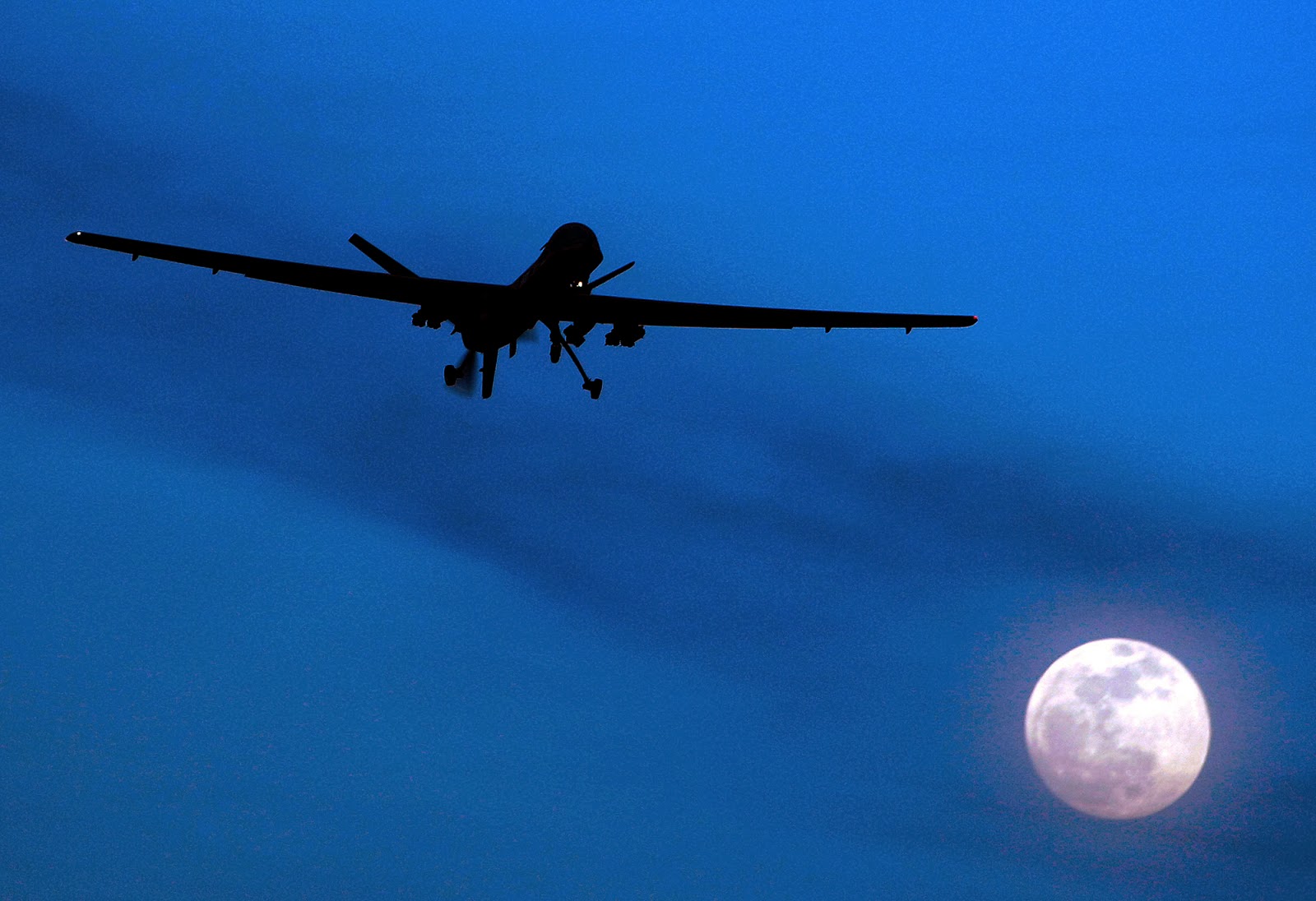
 An MQ-9 Reaper Drone at Creech Airforce Base in Nevada

Live Science
By Denise Chow

In the final years of his nearly 30-year career in the U.S. Air Force, Slim spent 10 to 12 hours a day in a cool, dark room in the Arizona desert, stationed in front of monitors that beamed back aerial footage from Afghanistan.

Slim's unit operated around the clock, flying Predator drones thousands of miles away over Afghanistan, to monitor — and sometimes eliminate — "targets" across the war-ridden country. As a sensor operator for these remotely piloted aircraft, or RPAs, it was his job to coordinate the drones' onboard cameras, and, if a missile was released, to laser-guide the weapon to its destination.

These types of missions are part of the military's expanding drone program, which has developed a reputation for carrying out shadowy and highly classified operations — ones that sometimes blur legal or moral lines. As such, their use in warfare has been steeped in controversy. [How Unmanned Drone Aircraft Work (Infographic)

Critics say firing weapons from behind a computer screen, while safely sitting thousands of miles away, could desensitize pilots to the act of killing. What separates this, they argue, from a battlefield video game?

But war is rarely so simple, and distance does nothing to numb the emotional impact of taking a life, said Slim (who is referred to here by his Air Force call sign in order to protect his identity).

"People think we're sitting here with joysticks playing a video game, but that's simply not true," Slim, who retired from the Air Force in 2011, told LiveScience. "These are real situations and real-life weapons systems. Once you launch a weapon, you can't hit a replay button to bring people back to life."

Killing machines?

In video games, players rarely make a human connection with the characters on their screen, but Predator drone operators often monitor their targets for weeks or months before ever firing a weapon, he added.

"While the enemy is the enemy, you still understand that they are a real person," Slim said. "To extinguish a person's life is a very personal thing. While physically we don't experience the five senses when we engage a target — unlike [how] an infantryman might — in my experience, the emotional impact on the operator is equal."

Still, the idea that being far away from the front lines could desensitize people to killing is not a new one. Arguably, the first weapon to give humans standoff distance in battle was the bow and arrow, said Missy Cummings, an associate professor of aeronautics and engineering systems at MIT in Cambridge, Mass., and director of the school's Humans and Automation Laboratory.
Cummings, who served as a naval officer from 1988 to 1999 and was one of the Navy's first female fighter pilots, said the argument that killing at a distance could desensitize soldiers has evolved in tandem with advances in war-fighting technology. The issue was similarly discussed when airplanes were introduced into warfare.

"You could make the argument that pilots haven't really been on the front lines since before World War II," Cummings said. "With some of the high-altitude bombing in World War II, pilots became pretty far removed from the actual combat." [Rise of the Drones: Photos of Unmanned Aircraft]

But drone pilots are sometimes thousands of miles away from the battlefield, and their physical distance takes on another dimension, since the entire operation is controlled across a network of computers rather than by soldiers on radios in the field. Yet, Cummings said the only difference is the location of the pilot and the amount of danger he or she may be in.

"Whether you're 5,000 miles away or 5 miles up, there aren't huge differences," Cummings told LiveScience. "When I flew F-18s, you saw everything through cameras and TV screens, just like how drone operators see today. I can't think of anybody now who releases a weapon purely on sight — you just don't do that anymore, because you have computer systems that do it for you."

Read more

Tuesday, 5 November 2013

Amnesty Intl. Explains Why It Won’t Oppose All Drone Murders

I was on Margaret Flowers’ and Kevin Zeese’s Clearing the Fog Radio today ( http://clearingthefogradio.org ) together with Naureen Shah of Amnesty International.  The show ought to appear soon on iTunes here, and mixcloud here, and is already on UStream here although it seems to be missing the audio.  I had earlier published a critique of AI’s report on drones.

On this show, Shah explained that Amnesty International cannot oppose all drone strikes in an illegal war, because Amnesty International has never opposed a war, because doing so would make it look biased, and A.I. wants to appear to be an unbiased enforcer of the law.  But, of course, an illegal war is a violation of the law — usually of the U.N. Charter which most lawyers whom A.I. hangs out with recognize, never mind the Kellogg-Briand Pact which they don’t.

Refusing to recognize the UN Charter, in order to appear unbiased, is a twisted notion to begin with, but perhaps it had good intentions at one time.  However, now the U.N. special rapporteur finds that drones are making war the norm rather than the exception.  That’s a serious shifting of the ground, and might be good reason to reconsider the ongoing feasibility of  a human rights group avoiding the existence of laws against war.

Shah also argued against banning weaponized drones on the grounds that they could be used legally.  That is, there could be a legal war (ignoring Kellogg-Briand) and during that legal war a drone could legally kill people in accordance with someone’s interpretation of necessity, discrimination, proportionality, intention, and so forth.  Shah contrasts this with chemical weapons, even though I could imagine a theoretical scenario in which a targeted murder in a closed space could use chemical weapons in plausible accord with all of the lawyerly notions of “legal war” other than the ban on chemical weapons.

Of course, practically speaking, weaponized drones are slaughtering and traumatizing innocent people and will do so as long as they’re used.  The notion of civilizing and legalizing atrocity-free war was ludicrous enough before the age of drone murder.  It’s beyond outrageous now.

Monday, 4 November 2013

2009 Nobel Peace Prize winner: Last year President Obama reportedly told his aides that he's 'really good at killing people'

If that's what he said then it's hardly a surprise. Actions sure do speak louder than words. 

--------------

By Michael Kelley Sott.net via Timesunion.com
02 Nov 2013

This will not go over well for the 2009 Nobel Peace Prize winner.

According to the new book Double Down, in which journalists Mark Halperin and John Heilemann chronicle the 2012 presidential election, President Barack Obama told his aides that he's "really good at killing people" while discussing drone strikes.

Peter Hamby of The Washington Post noted the moment in his review of the book.

The reported claim by the commander-in-chief is as indisputable as it is grim.

Obama oversaw the 2009 surge in Afghanistan, 145 Predator drone strikes in NATO's 2011 Libya operations, the May 2011 raid that killed Osama bin Laden, and drone strikes that killed the Pakistani Taliban leader and a senior member of the Somali-based militant group al-Shabab this week.

His administration also expanded the drone war: There have been 326 drone strikes in Pakistan, 93 in Yemen, and several in Somalia under Obama, compared to a total of 52 under George Bush.

In 2011 two of those strikes killed American-born al-Qaeda propagandist Anwar al-Awlaki and his American-born, 16-year-old son within two weeks.

Under Obama U.S. drone operators began practicing "signature strikes," a tactic in which targets are chosen based on patterns of suspicious behavior and the identities of those to be killed aren't necessarily known. (The administration counts all "military-age males" in a strike zone as combatants.)

Furthermore, the disturbing trend of the "double tap" - bombing the same place in quick succession and often hitting first responders - has become common practice.

Obama has also embraced the expansion of capture/kill missions by Joint Special Operations Command (JSOC) after it developed into the primary counterterrorism tool of the Bush administration.

One JSOC operator told investigative journalist Jeremy Scahill, author of Dirty Wars: The World Is A Battlefield, that global operations under Obama became "harder, faster, quicker - with the full support of the White House."

Scahill, who also made a Dirty Wars documentary, told NBC News that Obama will "go down in history as the president who legitimized and systematized a process by which the United States asserts the right to conduct assassination operations around the world."
Needless to say, a lot of innocent people have been killed along with combatants.

So although President Obama has proven to be "really good at killing people," the demonstration has not necessarily been noble.
Related Posts Plugin for WordPress, Blogger...