Search This Blog

Showing posts with label European Union. Show all posts

Monday, 22 December 2025

EU blocks protesting farmers in Brussels using barbed wire, tear gas and water cannons, while Orbán says farmers are ‘100% right’

Remix

As the EU moves to crush protesting farmers demonstrating in Brussels, Hungarian Prime Minister Viktor Orbán offered full backing to the farmers and their efforts to stop the EU’s Mercosur free trade deal, which threatens to destroy food security in Europe. [That's the idea...]


“Farmers are 100 percent right,” said Orbán, who is currently in Brussels attending the EU Summit.

He added that the farmers have obvious issues with the Mercosur package, a free trade agreement with Latin American countries, because it “kills the farmers.”


“Hungary is one of the countries that does not support the Mercosur agreement. There were serious professional debates about this in Hungary, and the Hungarian position was that we do not support this,” said the prime minister.

Viktor Orbán reminded that the agreement would require a qualified majority, and according to his expectations, there is not enough support.


Wednesday, 17 December 2025

Privacy for the Powerful, Surveillance for the Rest: EU’s Proposed Tech Regulation Goes Too Far

Elen Irazabal Arana and Nikolai G. Wenzel | The Daily Economy

Protecting kids is a weak pretext for total digital surveillance. What's worse, the EU's monitoring exempted its own politicians from scrutiny. Their privacy matters, but not yours.

Last month, we lamented California's Frontier AI Act of 2025. The Act favors compliance over risk management, while shielding bureaucrats and lawmakers from responsibility. Mostly, it imposes top-down regulatory norms, instead of letting civil society and industry experts experiment and develop ethical standards from the bottom up.

Perhaps we could dismiss the Act as just another example of California's interventionist penchant. But some American politicians and regulators are already calling for the Act to be a "template for harmonizing federal and state oversight." The other source for that template would be the European Union (EU), so it's worth keeping an eye on the regulations spewed out of Brussels.

The EU is already way ahead of California in imposing troubling, top-down regulation. Indeed, the EU Artificial Intelligence Act of 2024 follows the EU's overall precautionary principle. As the EU Parliament's internal think tank explains,
"the precautionary principle enables decision-makers to adopt precautionary measures when scientific evidence about an environmental or human health hazard is uncertain and the stakes are high."
The precautionary principle gives immense power to the EU when it comes to regulating in the face of uncertainty — rather than allowing for experimentation with the guardrails of fines and tort law (as in the US). It stifles ethical learning and innovation. Because of the precautionary principle and associated regulation, the EU economy suffers from greater market concentration, higher regulatory compliance costs, and diminished innovation — compared to an environment that allows for experimentation and sensible risk management. It is small wonder that only four of the world's top 50 tech companies are European.

Wednesday, 5 November 2025

Are the U.S. and E.U. Governments Satanic?

John leake | Focal Points

As we related in our book, The Courage to Face COVID-19, just before Dr. McCullough departed to Washington D.C. for his Senate testimony on November 19, 2020, he had a disturbing conversation with his church pastor, Andrew Forrest.

“We don’t understand what’s happening in our world,” McCullough explained. “My YouTube videos about early treatment were taken down, and then my planned WebEx conference with an Australian MP about treatment was hacked. Now my hospital administrators are acting like I’m out of line for accepting a U.S. Senator’s invitation to testify about the disease. It’s as though, for the first time in history, our medical system is opposed to caring for the sick. What on earth is going on?”

Andrew wasn’t at all surprised.

“There are times when evil prevails over good in a large way,” he said. “We know from the dark periods of history that this has happened before, and now it’s happening again. What you describe is Satan working in the hearts and minds of people, sowing fear, confusion, and anger. All you can do is keeping trying to do good until it turns the tide. For your Senate speech, your message must be joyous and happy and clear, uncluttered by negative emotion. That way you will let the light of God shine forth in this darkness.

At the time Dr. McCullough told me this story, I thought that Pastor Forrest was being melodramatic. Surely, I thought, what he was describing was ordinary human fear and stupidity, and not the work of a supernatural being—a malevolent spirit called “Satan.”

Since then, I have been increasingly drawn to the conclusion that Pastor Forrest was onto something.

Even if one rejects the idea of the devil as a supernatural spirit that actually exists, a rational and impartial observer will still marvel at how large masses of humans will suddenly—as if infected with a spiritual contagion—participate in an irrational and highly destructive enterprise.

In researching my forthcoming book, Mind Viruses: America’s Irrational Obsessions, I examined how the “Devil” has been depicted in literature going back to the Bible.

The Greek word for devil, diábolos, means “the one who divides.” The English word “diabolic” comes from the Greek verb diabollein, which means “to tear apart.”

Read more 

Saturday, 1 November 2025

Poland, Slovakia, Hungary Defy EU By Keeping Bans On Ukraine Imports

 
A new European Union deal to liberalize trade with Ukraine took effect Wednesday, but Poland, Hungary and Slovakia are defying it, maintaining their protectionist bans on imports from the country. Their defiance comes amid mounting grievances over EU prioritization of the West's proxy war on Russia over the prosperity of EU member states and their citizens.

Approved on Oct 13, the new EU arrangement expands tariff-free Ukrainian access to European markets, replacing a temporary lowering of trade barriers adopted after Russia invaded Ukraine in 2022. "We believe (the agreement) is a stable, fair framework, that can be reliable both for the EU and for Ukraine, to ensure a gradual integration in our single market, while providing stable trade flows," said European Commission spokeswoman Ariana Podesta. The European Commission (EC) is the EU's principal executive branch.

Rebelling against the Brussels regime, Poland, Hungary and Slovakia say they will maintain the bans on agricultural imports from Ukraine they put in place in 2023. The three countries' bans were a reaction to a wartime glut of Ukrainian products, which resulted from Black Sea ports being disrupted by the war with Russia. The glut sank prices and hammered domestic producers.
 

Friday, 31 October 2025

Lavrov talks Russia-NATO relations, arms control and dialogue with US: Key takeaways from the foreign minister’s speech — RT Russia & Former Soviet Union

RT

Moscow has no intention of attacking the US-led military bloc and is prepared to give official guarantees to that effect, the top diplomat has said.

Russian Foreign Minister Sergey Lavrov has outlined Moscow's vision of relations with an increasingly belligerent NATO, US President Donald Trump's administration, and the security architecture in Eurasia.

Lavrov touched on these and other topics at an international security conference in Minsk, Belarus on Tuesday. Here are the key takeaways from his address:

Russia-NATO relations

Moscow "has repeatedly said that we have had no intention of attacking any of the current NATO and European Union member states," Lavrov stressed. He added that Russia is prepared to give official guarantees to this effect as part of a future security architecture in Eurasia.

According to the foreign minister, EU leaders are studiously avoiding these discussions, aiming instead for "security guarantees against Russia, as opposed to with Russia."

Lavrov claimed that the West is openly preparing for a "new big European war" against Russia and key ally Belarus. He said there is ongoing militarization across most European NATO member states.

"NATO's expansion has not stopped for a single minute, despite assurances not to move eastward by an inch given to Soviet leaders," he said, accusing the West of seeking to preserve its "global dominance" despite the dawn of a new era.

The Western military bloc is attempting to establish a foothold as far afield as the Asia-Pacific, with a view to containing China, North Korea, and Russia, Lavrov stated.

Russia-US dialogue

Russia needs "guarantees" that a potential summit between President Vladimir Putin and his US counterpart, Donald Trump, "will yield a concrete result," the foreign minister explained.

Tentative discussions on a meeting in Budapest, Hungary began after the two presidents spoke by phone earlier this month. Last week, Trump clarified there are no plans for talks in the near future, as he wants to make sure it would not be "wasted time" in terms of resolving the Ukraine conflict. On Sunday, Kremlin spokesperson Dmitry Peskov similarly said that both Moscow and Washington have to do a substantial amount of "preparatory work before top-level negotiations can take place."

Moscow hopes that the US president "really wants a stable peace," Lavrov said. He expressed incredulity at the apparent change in Trump's rhetoric in recent days, as the US president called for an immediate ceasefire along the current front lines. Moscow has rejected this scenario, insisting that the root causes of the Ukraine conflict should be addressed first. 

Read more

Friday, 24 October 2025

EU Declares War On Its Own Members

Simplicus The Thinker

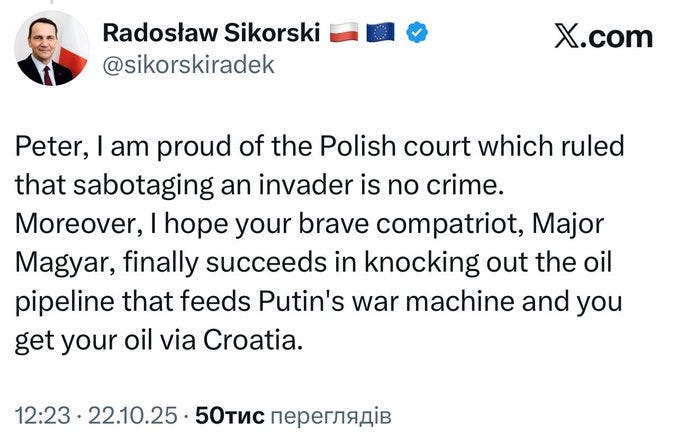
Yesterday, two near-simultaneous acts of sabotage saw explosions ripping through oil refineries in both Hungary and Romania. In Hungary it was the MOL in Százhalombatta, which reportedly receives Russian oil, while in Romania the Petrotel-Lukoil, a subsidiary of the Russian parent company.

As one commentator writes, these attacks came literally hours after the European Council had just approved to ban Russian gas starting in 2026:

The timing here is exceptionally curious because this attack came just hours after the European Council essentially locked in its position to almost completely ban Russian gas imports, with new contracts being outlawed at the beginning of 2026, and all long term contracts forcibly expiring in 2028. A similar ban on oil imports is expected in the near future. Hungary and Slovakia have pledged to issue legal challenges to the ban.

As of this writing, there were reports that a new explosion lit up a refinery in Bratislava, Slovakia—which allegedly processes Russian oil from the Druzhba pipeline. But subsequent follow-ups appear to show these were fake—though it’s as of yet uncertain.

The real attacks on Romania and Hungary came just days after Europe essentially gave carte blanche for terror attacks across the EU by way of several top European officials openly condoning not only the Nord Stream attacks, but even attacks against Hungarian oil pipelines. Here Polish Foreign Minister Sikorski addresses Hungary’s Peter Szijjarto:


Read more

Thursday, 23 October 2025

Trump’s Sanctions Put Him on “Warpath” with Russia, Says Medvedev

Will Jones | The Daily Sceptic

Donald Trump has put the US on the “warpath” with Moscow with his decision to impose sanctions and cancel a peace summit, former Russian president Dmitry Medvedev has said. The Telegraph has more.

On Wednesday night, the US President announced sanctions against Russia’s two largest oil companies, Rosneft and Lukoil. The measures followed the collapse of a proposed meeting with Vladimir Putin.

The Kremlin had signalled it was unwilling to meet America’s terms for a ceasefire.

“The US is our enemy, and its talkative ‘peacemaker’ has now fully embarked on the warpath with Russia,” Mr Medvedev wrote on Telegram. 

“The decisions taken are an act of war against Russia. And now Trump has fully aligned himself with loony Europe,” said the Deputy Chair of Russia’s National Security Council, reigniting his war of words with the US President.

The European Union also announced new sanctions on Russia, including a ban on the import of liquefied natural gas. The natural gas ban will phase out imports rather than halt them immediately. 

Read more

Monday, 20 October 2025

EU could ban filtered cigarettes

Comment: what a surprise. The Euro-Fascist bloc has been wanting to restrict smoking for years. Could it be that there are health benefits to smoking?

Warning: Nicotine Seriously Improves Health

Researchers Light Up for Nicotine, the Wonder Drug 

Secret health benefits of Nicotine 

_________________________

RT/Sott.net

Outlawing vapes is also being considered as an additional measure, the German tabloid has reported.

The EU is considering a ban on filtered cigarettes and e-cigarettes as part of its push to reduce tobacco consumption within the bloc, German tabloid Bild has reported.

Earlier this month, the World Health Organization said that Europe had surpassed Southeast Asia as the region with the highest number of smokers in the world. Some 173 million people on the continent used tobacco in 2024, according to the UN body's data.

The EU is planning to follow the recommendations by the WHO on "banning filters to reduce the palatability and attractiveness of cigarettes," the paper said in an article on Wednesday.

A bill by the European Council, which had been reviewed by the paper, suggested that outlawing the manufacture, import and distribution of filtered cigarettes "would make an important contribution to reducing tobacco consumption."

Read more

Tuesday, 14 October 2025

Straussians take control of the United Nations and NATO

Thierry Meyssan | Voltairenet.org

It had not been planned, but the proponents of the generalized war, the Straussians, expelled from the governing bodies of the United States, have regrouped in intergovernmental organizations. To everyone’s surprise, they are certainly present in the European Union, but especially in the United Nations and in the Contact Group on the Defence of Ukraine. Institutions dedicated to peace have been recovered by the warmongers.

For almost a year, President Donald Trump has been handing order to the United States. It has restored the principles of equality before the law and promotion to merit to the detriment of those of diversity, equity and inclusion (IED). He slashed in federal budgets everything that corresponded to imperial expenses and tried to restore the primary function of the armies, the defense of the homeland. 

At the same time, we all see how he fails to conclude the peace he hoped for in Ukraine and Palestine. He lets the Europeans fight not for Ukraine, but against Russia and the coalition of Benjamin Netanyahu persist in his program of a “Greater Israel”, that is to say annexation of his neighbors.

However, we do not see the most serious: the Straussians, who held the dragee high under the mandates of George Bush Jr., Barack Obama and Joe Biden are still not defeated. They have withdrawn to two intergovernmental organizations: NATO and the UN.

On the sidelines of NATO, they have taken control of the Contact Group on the Defence of Ukraine (formerly the Ramstein Group) which, since 9 September, no longer meets alternately at the US military base in Ramstein and at NATO headquarters in Mons-Brussels, but now also in London.

They were the ones who organized, with the Ukrainian secret services, drone flights over the Western and North European airports. Then, they pushed for the delivery of German Patriot missile batteries to Ukraine, after secretly organizing the transfer of the first batteries from Israel.

They are still the ones who falsified the reports of the United Nations General Secretariat on the meetings of 19 and 26 September of the Security Council. Unlike these – which we have been wrong to believe in – the Security Council has not validated the return of sanctions against Iran. He did not have the power.  

Read more

Sunday, 5 October 2025

Danish PM Alleges Russian 'Hybrid' Drone War 'Only The Beginning'

Zero Hedge 

Some of the more tiny NATO countries are pretending to carry the biggest stick, at least judging by their outspoken jingoistic rhetoric of late. Small 'Eastern flank' countries like Estonia and Lithuania have long exhibited this loud anti-Moscow rhetoric, but Denmark is increasingly joining in.

Danish prime minister Mette Frederiksen in a fresh interview given to Financial Times has declared NATO must step up its response to Russia, warning that recent drone incursions are "only the beginning" of an alleged 'hybrid war' and sabotage campaign aimed at dividing Europe.

"We need to be very open about [the fact] that it probably is only the beginning," she told FT. "We need all Europeans to understand what is at stake and what's going on. When there are drones or cyber attacks, the idea is to divide us."

Over the last couple weeks Danish authorities have claimed that hundreds of mystery drones have at various times over that span sought to disrupt commercial and military aviation over the small northern European country. Top officials have linked these to Russian operations, though without presenting any evidence.

Read more

Saturday, 4 October 2025

Putin compares ideology of modern West to USSR

RT

Russian President Vladimir Putin has drawn a parallel between the Soviet Union and the present-day US and EU, accusing them of imposing their own political systems on other countries.

Speaking at a plenary session of the Valdai Discussion Club in Sochi on Thursday, the president suggested that political systems which force their own values on others don't last.

"The Soviet Union once erred by imposing its system. Then, the United States has taken up that baton. The EU has also distinguished itself," Putin said.

"A nation that respects its own tradition, as a rule, does not encroach on the traditions of others," the Russian president concluded.
 

Sunday, 18 August 2019

The EU’s latest assault on internet freedom

Andrew Tettenborn
spiked.com

Soon online speech will be regulated by Brussels.

As things stand, what you can and cannot say on the internet is largely a matter for national law, decided by national parliaments. This means that every nation in Europe currently has different laws and practices. 

But the EU has quietly been moving to change this. Take last year’s Copyright Directive, which more or less demands the introduction of automated content filters on social-media platforms. And last month, it became clear that an impatient Brussels wants to turbocharge this process by bringing internet regulation to the EU level, where it can pull the necessary strings.

The EU Digital Services Act sounds innocent on the surface. It is ostensibly aimed (in Euro-speak) at enhancing the so-called Digital Single Market by harmonising national laws and removing competitive barriers. Member states have not yet been consulted or made aware of any specific proposals in the Act. But thanks to the leak of an internal briefing to the Digital Single Market steering group, obtained German digital freedom activists Netzpolitik, we can see what Brussels has planned.

One of the EU’s key concerns, as the briefing makes clear, is the lack of EU-wide rules and regulations covering what people can see and say online. The fight against online hate speech, for example, is said to be ‘expensive and inefficient across the Single Market’. There are also no EU-wide rules on online advertising, nor does the EU have oversight of online services as a whole.

The prescription? EU regulation of the internet. 
 

Tuesday, 23 July 2019

What is the real ‘Orwellian nightmare’ now?

"In its near universal display of contempt for the masses, the liberal intelligentsia is exhibiting a particularly ‘Orwellian’ trait: uncritical political conformism"


Mick Hume
Spiked.com 

In the 70 years since George Orwell wrote Nineteen Eighty-Four, the word ‘Orwellian’ has become a form of lazy political shorthand. It is used to condemn anything deemed to smack of the sort of Big Brother system of authoritarian control Orwell described in his last and greatest novel. The irony is that many of those who use it today might also have a touch of the ‘Orwellian’ about their views.

As the Guardian’s Dorian Lynskey outlines in his widely acclaimed new book, The Ministry of Truth: A Biography of George Orwell’s 1984, published to mark the 70th anniversary, the meaning of Orwell’s masterwork has often been reinterpreted over the years to suit the prevailing fears of the age.

Thus in the 1950s and 1960s, at the height of the Cold War between the West and the Soviet Union, the focus was on the threat of Stalinist totalitarianism. In the 1980s, concerns were more likely to be expressed about the ‘Orwellian’ potential of hi-tech surveillance systems and CCTV cameras. When the actual year 1984 came around, many of us young radicals imagined plenty that was ‘Orwellian’ about the British state’s year-long war to defeat the striking miners.

When Lynskey comes to now, however, he does the same thing and reinterprets Nineteen Eighty-Four to fit the prejudices of the present. Almost predictably, he begins his book by linking the dystopian world described by Orwell with Donald Trump’s America. He quotes Trump’s adviser, Kellyanne Conway, who claimed – in the row over the true size of the crowd at his presidential inauguration – that she was using ‘alternative facts’. This is why, Lynskey tells BBC News, people are now turning to Orwell’s novel again, ‘for what it says about truth. And flagrant lies. And the nature of exerting power by distorting reality.’

Thus a discussion of the importance of a 70-year-old classic can become yet another exercise in blaming lies – and, implicitly, the stupidity/gullibility of voters – for Trump’s victory over the liberal establishment. Many try to claim that similar propaganda lies were behind the mass vote to leave the EU – effectively blaming Big Brother tactics for the Brexit revolt.

Sunday, 21 July 2019

A Bank With $49 Trillion In Derivatives Exposure Is Melting Down Before Our Eyes

Michael Snyder
The Economic Collapse blog

Could it be possible that we are on the verge of the next “Lehman Brothers moment”?  

Deutsche Bank is the most important bank in all of Europe, it has 49 trillion dollars in exposure to derivatives, and most of the largest “too big to fail banks” in the United States have very deep financial connections to the bank.  In other words, the global financial system simply cannot afford for Deutsche Bank to fail, and right now it is literally melting down right in front of our eyes.  For years I have been warning that this day would come, and even though it has been hit by scandal after scandal, somehow Deutsche Bank was able to survive until now.  But after what we have witnessed in recent days, many now believe that the end is near for Deutsche Bank.  On July 7th, they really shook up investors all over the globe when they laid off 18,000 employees and announced that they would be completely exiting their global equities trading business

It takes a lot to rattle Wall Street.
But Deutsche Bank managed to. The beleaguered German giant announced on July 7 that it is laying off 18,000 employees—roughly one-fifth of its global workforce—and pursuing a vast restructuring plan that most notably includes shutting down its global equities trading business.
Though Deutsche’s Bloody Sunday seemed to come out of the blue, it’s actually the culmination of a years-long—some would say decades-long—descent into unprofitability and scandal for the bank, which in the early 1990s set out to make itself into a universal banking powerhouse to rival the behemoths of Wall Street.
These moves may delay Deutsche Bank’s inexorable march into oblivion, but not by much. 

Read more

Thursday, 18 July 2019

EU Looking To Regulate Everything Online, And To Make Sites Proactively Remove Material

Tech Dirt

One of the reasons that Techdirt and many others fought so hard against the worst ideas of the EU Copyright Directive is that it was clearly the thin end of the wedge. If things like upload filters and the imposition of intermediary liability become widely implemented as the result of legal requirements in the field of copyright, it would only be a matter of time before they were extended to other domains. Netzpolitik has obtained a seven-page European Commission paper sketching ideas for a new EU Digital Services Act (pdf) that suggests doing exactly that. The Act's reach is extremely wide:
The scope would cover all digital services, and in particular online platforms. This means the clarification would address all services across the internet stack from mere conduits such as ISPs to cloud hosting services; while a special emphasis in the assessment would be dedicated to updated rules for online platforms such as social media, search engines, or collaborative economy services, as well as for online advertising services.
A core aim is to replace the e-Commerce Directive, passed in 2000. This is presented as "outdated", but the suggestions in the paper are clearly a continuation of attacks on the fundamental principles underlying the open Internet that began with the Copyright Directive.

One of the problems for the EU when pushing through the upload filters of Article 13/17 in the Copyright Directive is that Article 15 of the e-Commerce Directive explicitly states that there is "No general obligation to monitor". Constant surveillance is the only way that upload filters can work -- if you don't monitor all the time, you can't be sure you block everything that the law requires. Furthermore, Article 14 of the e-Commerce Directive emphasizes that "the service provider is not liable for the information stored at the request of a recipient of the service". That's subject to certain conditions, such as being required to remove material that infringes on copyright, but only after being informed of its presence on their servers.

Read more

Tuesday, 9 July 2019

Money Laundering Scandals Bring Court Charges and Record Job Cuts to Euro Banks

Lubomir Tassev
Activist Post
 
The international financial establishment is known to express concern about the risks of money laundering when the crypto space is mentioned. A string of scandals indicates, however, that traditional banks are not only susceptible to the phenomenon but sometimes complicit, whether knowingly or inadvertently. New chapters have been added to the saga over the last few months that are hurting banks, bankers and their clients.

Deutsche Bank Prepares to Lay Off 20,000 Employees


Deutsche Bank, one of the biggest names associated with money laundering accusations, has been dogged by many problems during the past year. The leading German financial institution is now preparing for a major reorganization that may include the sacking of up to 20,000 employees, if the plan is approved at the end of this week.

The changes come after a failed merger with Germany’s Commerzbank a couple of months ago, which was eventually deemed too risky by the teams of both banks. It did not materialize, despite the support of the federal government in Berlin.

Many of the layoffs are expected to affect Deutsche Bank’s investment banking offices in London and New York. According to a BBC report, the German bank has 8,000 employees in the British capital. And the 20,000 jobs that are likely to be cut represent a fifth of the institution’s global staff.

Besides persistent problems with its investment business and unsatisfactory financial results, the banking giant has been suffering from its involvement in money laundering scandals. In November, 2018 its headquarters and other offices in Frankfurt were raided by law enforcement officers and representatives of the German tax authority.

During the operation, government agents, including prosecutors, were trying to establish whether Deutsche Bank employees assisted clients in setting up offshore accounts used to transfer illicit funds. The bank was connected to the big money laundering scandal at Danske Bank last year, which revealed that around €200 billion (around $230 billion) has flowed through its Estonian branch from suspicious accounts from the former Soviet space. 

Read more

Monday, 10 June 2019

Something Huge Just Happened In Europe

John Rubino
Dollar Collapse

Critics of modern monetary policy have been predicting that the day would come when a central bank would cut interest rates (or at least promise to), and the financial markets, instead of throwing a party, would fall. Then it would be game over for easy money. 

This has yet to happen in the US. Both when the Fed stopped tightening in January and when it promised to resume easing more recently, stock prices soared, which implies that the addict is still responsive to new injections.

But in Europe, where monetary policy is further down the road to universally-negative interest rates, the story is different. On Thursday, European Central Bank chair Mario Draghi went back to his tried-and-true “whatever it takes” script, promising to restart QE and cut interest rates even further if the weak EU economy doesn’t pick up steam. 

The markets, instead of reacting with their typical euphoria, seemed to recoil. Most EU member bond yields went up rather than down, bank stocks fell and the euro — which would normally be expected to fall on the prospect of easier money — rose. 

This is both huge and, like I said, expected. Once a central bank has pushed interest rates below zero and bought up most of the available high-grade bonds, lower interest rates and more bond purchases ought to lose some of their punch. And it appears that they have.

Read more

Friday, 7 June 2019

Election? What Election? EU Elite Will Censor Their Way Out of This Mess (or Die Trying)


Helen Buyniski
Aletho News

The neoliberal establishment is wringing its hands in the wake of European elections that proved a resounding victory for populist parties across the continent, casting around for someone to blame but utterly incapable of realizing their own interference has doomed them. Doubling down on the censorship, they are determined to provoke the catastrophe they need to make free speech history.

The NGO-industrial complex was operating at maximum capacity in the weeks leading up to the election, shutting down hundreds of Facebook pages deemed “fake” or “hate speech” in the hope of controlling the messages reaching voters before they made the terrible mistake of voting for a candidate who represents their interests.

Led by Avaaz, which claims to be a “global citizens’ movement monitoring election freedom and disinformation,” this well-heeled fifth column whipped the press into paranoid frenzies with reports like “Fakewatch,” which breathlessly documented 500 “suspicious” pages and groups it claims are “spreading massive disinformation.” The groups have little in common other than their alleged “link[s] to right-wing and anti-EU organizations,” a capital offense for the promoters of “democracy,” which can only be permitted where it doesn’t stray from the center-left path of most #Resistance.

“Far-right and anti-EU groups are weaponizing social media at scale to spread false and hateful content,” the study warns, gloating that after sharing its findings with Facebook, the platform shut down an “unprecedented” number of pages on the eve of the election (77 out of the 500, according to VentureBeat, which has credulously signal-boosted every utterance of Avaaz as if it is divine truth from the Oracle of Delphi). Avaaz’s reports frame the problem as an affliction of the right wing only, even though disinformation is second nature to political operatives at both ends of the spectrum (and, more importantly, in the sanctified center).

Read more

Thursday, 6 June 2019

What Lauren Southern's Borderless Didn't Say


In Lauren Southern's film Borderless, she investigates what is happening with Europe's borders. The film claims to blow the European border crisis wide open, but there's some major aspects that weren't covered.
Related Posts Plugin for WordPress, Blogger...