Search This Blog

Showing posts with label US Dollar. Show all posts

Wednesday, 5 November 2025

Taming the sound and fury of the Empire of Chaos

 
Close the door, put out the light
You know they won't be home tonight
The snow falls hard and don't you know
The winds of Thor are blowing cold

Led Zeppelin, No Quarter

In a matter of less than a year, Russian scientific know-how came up with four bangers:

1. Oreshnik: hypersonic missile, already tested in the Ukraine battleground.

2. Burevestnik: Or "Stormbringer", with that nice Deep Purple ring. Nuclear cruise missile with unlimited range.

3. Poseidon: nuclear-powered torpedo, capable of loitering underwater, undetected, for unlimited time; then, at a command, strikes enemy coasts with a nuclear payload, provoking a radioactive tsunami. Largely exceeds the destructive power of the Sarmat, Russia's largest ICBM.

4. Khabarovsk: nuclear sub. Call him The Messenger of Doom: capable of delivering at least 6 Doomsday-enabling Poseidons.

President Putin was crystal clear when detailing some key facts. The "compact nuclear systems" used in the Burevestnik and the Poseidon "can also be adapted to create new energy sources, including for the Arctic."

Putin also stressed how both Burevestnik and Poseidon "use only Russian-made parts". Praise the Lord for those chips from upgraded Soviet washing machines.

And there's a lot more to come following the tracks of Burevestnik and Poseidon: "I'm talking about...the Avangard system, or the serial production of the Oreshnik missile system...soon the heavy intercontinental Sarmat missile." 
 

Tuesday, 23 July 2019

The World Is Dedollarizing

Peter Koenig
Global Research

What if tomorrow nobody but the United States would use the US-dollar? Every country, or society would use their own currency for internal and international trade, their own economy-based, non-fiat currency. It could be traditional currencies or new government controlled crypto-currencies, but a country’s own sovereign money. No longer the US-dollar. No longer the dollar’s foster child, the Euro. No longer international monetary transactions controlled by US banks and – by the US-dollar controlled international transfer system, SWIFT, the system that allows and facilitates US financial and economic sanctions of all kinds – confiscation of foreign funds, stopping trades between countries, blackmailing ‘unwilling’ nations into submission. What would happen? – Well, the short answer is that we would certainly be a step close to world peace, away from US (financial) hegemony, towards nation states’ sovereignty, towards a world geopolitical structure of more equality.

We are not there yet. But graffities are all over the walls signaling that we are moving quite rapidly in that direction. And Trump knows it and his handlers know it – which is why the onslaught of financial crime – sanctions – trade wars – foreign assets and reserves confiscations, or outright theft – all in the name of “Make America Great Again”, is accelerating exponentially and with impunity. What is surprising is that the Anglo-Saxon hegemons do not seem to understand that all the threats, sanctions, trade barriers, are provoking the contrary to what should contribute to American Greatness. Economic sanctions, in whatever form, are effective only as long as the world uses the US dollar for trading and as reserve currency.

Once the world gets sick and tired of the grotesque dictate of Washington and the sanction schemes for those who do no longer want to go along with the oppressive rules of the US, they will be eager to jump on another boat, or boats – abandoning the dollar and valuing their own currencies. Meaning trading with each other in their own currencies – and that outside of the US banking system which so far even controls trading in local currencies, as long as funds have to be transferred from one nation to another via SWIFT.

Many countries have also realized that the dollar is increasingly  serving to manipulate the value of their economy. The US-dollar, a fiat currency, by its sheer money mass, may bend national economies up or down, depending in which direction the country is favored by the hegemon. Let’s put the absurdity of this phenomenon in perspective.

Read more

Thursday, 13 June 2019

Putin Sets The Table To Leave The Dollar Behind

Rory Hall
The Daily Coin

This is twice that Russian President Putin has said on the global stage the Federal Reserve Note no longer deserves the status and privilege of “world reserve currency” that allows unlimited printing of the currency. The first time he made mention he actually said that it was a threat to Russia’s national security.

In a speech at the International Economic Forum, in St. Petersburg, Russia, “Russian Davos”, President Putin reaffirmed his position regarding the Federal Reserve Note and it’s international role. For the record, we see the abuse of the Federal Reserve and the Federal Reserve Note, U.S. dollar, in similar light as President Putin. The current status of “world reserve currency” should not be allowed in this day and time. The absolute abuse of power, excessive power granted and the ability to shackle entire nations through the use of a currency that is not even their own should have never been allowed but it is way past time for this system to be dissolved.
In a speech at a plenary session, Mr Putin accused Washington of seeking to “extend its jurisdiction to the whole world.” “But this model not only contradicts the logic of normal international communication. The main thing is, it does not serve the interests of the future.” Source
As recently we pointed out Russia has been and is, apparently readying, a gold backed cryptocurrency to use as global trade settlement. When a man steps up to the microphone and says to the world – “The main thing is, it (U.S. dollar) does not serve the interests of the future.” while at the same time announcing that Russia, along with China, are working on a global trade settlement mechanism outside the dollar, well, you would have to be some kind serious stupid to ignore those words. 

Read more

Monday, 18 June 2018

Russia Sells Off Record Amount of US Treasury Bonds

Arkady Stravitsky

The US Treasury Department report for April published on June 15 revealed that Russia sold $47.4 billion out of the $96.1 it had held in Treasury bonds (T-bonds). In March, Moscow cut its Treasury holdings by $1.6 billion. In February, Russia reduced its bond portfolio by $9.3 billion. Other holders did it too. Japan sold off about $12 billion, China liquidated roughly $7 billion. Ireland ditched over $17 billion.

The tariff wars unleashed by Washington stirred fears that financial markets may be in for a rough ride with American treasuries dumped by some partners, including such major holders as China and Japan, each holding over $1 trillion in bonds.

Russia has cut its holdings in American securities following numerous rounds of sanctions imposed by Washington against Moscow and amid the ongoing trade wars between the US and its allies and partners.

This is bad news and ominous warning for Washington. The foreign demand is critical to offset an expected surge in federal borrowing needs. The Treasury Department needs to finance the huge spending bill along with tax cuts that were passed by Congress in December 2017. It plans to auction off around $1.4 trillion in treasuries this year with a glut of sellers and a shortage of buyers in the bond market the government plans to add $600 billion to.

Saturday, 9 June 2018

America is In a Debt Trap Death Spiral

F. William Engdahl
Global Research

The US economy and its financial structures have never recovered from the great financial meltdown of 2008 despite the passage of ten years. Little discussion has been given to the fact that the Republican Congress last year abandoned the process of mandatory budget cuts or automatic sequestration that had been voted in a feeble attempt to rein in the dramatic rise in US government debt. That was merely an added factor in what soon will be recognized as a classic debt trap. What is now looming over not just the US economy but also the global financial system is a crisis that could spell the end of the post-1944 dollar system.
 
First some basic background. When President Nixon, on advice of Paul Volcker, then at US Treasury, announced on August 15, 1971 the unilateral end of the Bretton Woods gold-dollar system, to replace it with a floating dollar, Washington economists and Wall Street bankers realized that the unique role of the US dollar as leading reserve currency held by all central banks and the currency for world commodity and other trade, especially oil, gave them something that appeared to be a gift from monetary heaven.

So long as the world needed US dollars, Washington could run government deficits without end. Foreign central banks, especially the Bank of Japan in the 1980’s and since the turn of the century, the Peoples’ Bank of China, would have little choice but to reinvest their surplus trade dollar earnings in interest-bearing AAA-rated US Treasury securities. This perverse dollar system allowed Washington to finance its wars in faraway places like Afghanistan or Iraq with other peoples’ money. During the Administration of George W. Bush, when Washington’s annual budget deficit exceeded annually one trillion dollars, Vice President Dick Cheney cynically quipped, “debt doesn’t matter; Reagan proved that.” Up to a point that appeared so. Now we are getting dangerously near to that “point” where debt does matter.

Read more

Tuesday, 1 May 2018

If you want to preserve your wealth for times of turmoil, buy physical gold

RT

Gold, which is traditionally seen as a safe haven, is usually subject to the whims of supply and demand. Its value changes quickly, pushing the bullion price to extremely high levels at times.

The yellow metal also makes a habit of performing poorly when the stock market is doing well. But gold is the ultimate store of value, according to precious metals expert Ronan Manly of Singapore's BullionStar.


"What this means is that gold retains its purchasing power over long periods. Gold's purchasing power is not eroded by inflation as it is an inflation hedge," the analyst told RT. "In contrast, fiat currencies such as the US dollar are not stores of value. Fiat currency purchasing power is consistently eroded by inflation, and over time fiat currencies, such as the US dollar, lose nearly all of their purchasing power relative to gold."  

Read more


Tuesday, 24 April 2018

Iran Officially Switches From Dollar To Euro

Zero Hedge

Just two weeks after "panic" hit the streets of Tehran as the Iranian government attempted to 'fix' the freefall of the Rial against the US Dollar...

 Middle East Monitor reports that Iran’s feud with the US is set to get worse after Tehran announced this week that it will start reporting foreign currency amounts in euros rather than US dollars, as part of the country’s effort to reduce its reliance on the American currency due to political tension with Washington. [...]

Read more

Saturday, 21 April 2018

The Dollar’s 70-Year Dominance Slowly Coming To An End

Alex Deluce
Gold Telegraph 

The US dollar hasn’t been backed by gold since 1971, but that might change soon. 

Republican Congressman Alex Mooney is proposing that the US once again place value on the dollar by backing it with physical gold. The problem is, the Federal Reserve has been printing money with the abandon of a drunken copy machine, and the 147.3 million ounces of gold being held in Ft. Knox may not be enough to cover the out-of-control fiat currency currently in circulation.

According to Alex Mooney’s bill, the dollar has decreased 30 percent in purchasing power since 2000. It has lost 96 percent of its value since 1913. On an average, the US is devalued by 50 percent every generation. 


If the gold standard were to be reinstated, control of the dollar would revert to free market forces instead of the whim of the Federal Reserve. It would mean that each dollar would have its equivalent in gold, as it did prior to 1913. At that time, the US economy grew at a robust annual rate of 4 percent compared to an average annual growth of 2 percent since 2000. 

Read more

Tuesday, 7 March 2017

Visualizing The US Debt Ceiling (In $100 Bills)

Zero Hedge

The United States owes a lot of money. For now, there is no debt ceiling - it has been suspended - but in 10 days that changes, and who knows what happens then.

For some context as to just how much money the US owes - and what the debt ceiling looks like - 

Demonocracy is back...

Read more


Tuesday, 14 June 2016

False flag, blow-back, or incompetence? A FOREX look at Orlando Shooting

Global Intel Hub 


This tragic event in Orlando is an opportunity to connect the dots in an ever simple global world; as explained in Splitting Pennies - key to understanding Forex markets and how our global financial system includes understanding international politics, and specifically US foreign policy, and how it is connected to the US Dollar as a world reserve currency.  Forex is information brokerage, both as a facilitator and as primary emission of that information.  It is by itself, information - as well, those who play 'the great game' use it to execute their strategem. 


This event, is a domestic event with no implications on the markets (although maybe a short term boom for Smith & Wesson (SWHC).  It's not going to affect Forex, directly.  But it will affect foreign policy - not by itself, but as one woven yarn in a policy sweater.  There will be in the days and months ahead, political aggressiveness to 'fight terrorism.'  This event alone, would not be sufficient to go to war with Syria for example, but in the area of domestic support of foreign actions, such events are key to seizing the hearts and minds of the average American, and in this case also the LGBT community - embroiled in domestic disputes of their own. 


The fact that the shooter was in contact with the FBI isn't necessarily suspicious.  The FBI is in contact with millions of people all around the world, connected to cases, and their daily operations.  The fact that shooter worked for this G4S, as reported first here on Zero Hedge - is highly suspicious.  Omar Mateen effectively worked for DHS, although through a subcontracted private company.  This is the "Department of Homeland Security" designed to protect us from such 'terrorists.'


Let's examine 3 motives: 


False Flag 


If you are one of these TV watchers that believe 'it doesn't happen in America' read the following report from PNAC (Project for a New American Century) in full here - note the DATE and note the SIGNERS of this 'research' that says, before 9/11:

Further, the process of transformation,
even if it brings revolutionary change, is
likely to be a long one, absent some
catastrophic and catalyzing event – like a
new Pearl Harbor. 
What an interesting coincidence, that a Washington based think tank that worries about a declining budget (because of declining real military threats) and declining power, should within a short year after publishing their report have the justification they need to increase their budgets and power by 10.  Or more recently, look at evidence of Sandy Hook false flag here and here.

So was this event a false flag - to escalate our involvement in Syria, Ukraine, or a number of other global hotspots?  Possible, but not probable.  

Read more


Thursday, 26 May 2016

A Crisis Unlike We Have Seen In Human History

Zero Hedge

Posted with permission and written by Rory Hall, The Daily Coin (CLICK FOR ORIGINAL)

I sat down with John Rubino of Dollar Collapse to discuss the current state of our economic world. In a very lively conversation, we hit some of the more pressing items of the day. John has done a fantastic job of documenting the demise of the dollar since he co-authored ”The Collapse of the Dollar” with James Turk back in 2004. John’s insights and analysis are top shelf and he should be on everyone’s list of people to follow.

How many “emergency” “secret” meetings do the central planners around the world need to have before the citizens of the respective countries begin to fully understand and take notice that something is very, very wrong? This year alone there have been several off-calendar meetings with, at least, one more now added to the docket.

The G-20 central planners have scheduled an “emergency” meeting for summer 2016. What will the topics be? Could it possibly be the fact the global economy is on the verge of total collapse? With the Baltic Dry Index, Shanghai Containerized Freight Index, not to mention commodities, all spiraling out of control to the downside, do you think there may be a reason for these people to be concerned? My guess is they could care less and are simply meeting in order to determine how the remaining wealth, in their respective countries, will be divided as the global economy continues grinding to a halt.

If one simply looks at the following line-items, it is clear for anyone to see something is about to hit the fan and it’s not anything anyone wants hitting the fan. 
  • 45 million people in the U.S. on food stamps
  • some estimates as high as 10 million refugees flooding into the European Union
  •  non-stop wars of aggression involving NATO, Russia, Syria and several other countries
  • financial crisis that began in 2008 has not been addressed and the problems that started that year have grown larger and far deeper
  •  banking system in the European Union, especially Italy, is under enormous stress due to faulting/fraudulent accounting
  •  Federal Reserve balance sheet at $4 TRILLION – U.S. debt at $20 TRILLION and counting
  •  United Kingdom/Britain and the Brexit movement that is taking root
  •  U.S. Presidential candidates, Donald Trump and Bernie Sanders, garnering global attention as the citizens of the U.S. seek alternatives to the current embedded criminal politicians.
  • Japan instituting a Negative Interest Rate Policy (NIRP) for their sovereign bonds – Japan has basically been in a recession for over 20 years
  •  China is manufacturer to the world and with economies slowing down or shutting down, there is no reason to manufacture products
These are just a few of the items that are currently hampering growth for individual citizens and individual Western nations. Currently, there are just too many holes that need to be filled and the central bankers are losing control and the people are losing faith in the narratives they are being fed. Once faith is lost, en masse, the show will become a lot more interesting and a lot more dangerous. 

Read more

Saturday, 27 December 2014

Oil Crash: Don’t Believe the Happy Clatter

Wall St. On Parade
Pam Martens and Russ Martens

There is a mushrooming false narrative taking over the business airwaves: lower oil prices lead to lower prices at the pump which put more cash in consumers’ pockets which will lead to a more robust economy in the United States in 2015.

Yes, there are certainly lower prices at the pump. Yes, that gives consumers more disposable income. But it will decidedly not lead to a more robust economy in the United States for very long.

This isn’t a little speed bump in oil prices. This is one of the most dramatic and rapid crashes in a key industrial commodity in history. Since June, the price of West Texas Intermediate (WTI), the domestic crude oil produced in the U.S., is down by 47 percent. The price of the internationally traded crude oil, Brent, is down by a similar figure.

If this price collapse were happening in just crude oil, it could be shrugged off as a supply glut problem attributable to growing shale production in the U.S. and over production among OPEC members. But other industrial commodities are in freefall as well. Iron ore prices are down 49 percent this year while copper has declined 15 percent. The price of natural gas is down 30 percent in just the past month, including a plunge of 9 percent just yesterday.

Read more
 

Wednesday, 17 December 2014

The Oil Coup

Mike Whitney
Global Research

“John Kerry, the US Secretary of State, allegedly struck a deal with King Abdullah in September under which the Saudis would sell crude at below the prevailing market price. That would help explain why the price has been falling at a time when, given the turmoil in Iraq and Syria caused by Islamic State, it would normally have been rising.” (Stakes are high as US plays the oil card against Iran and Russia, Larry Eliot, Guardian)

U.S. powerbrokers have put the country at risk of another financial crisis to intensify their economic war on Moscow and to move ahead with their plan to “pivot to Asia”.

Here’s what’s happening: Washington has persuaded the Saudis to flood the market with oil to push down prices, decimate Russia’s economy, and reduce Moscow’s resistance to further NATO encirclement and the spreading of US military bases across Central Asia. The US-Saudi scheme has slashed oil prices by nearly a half since they hit their peak in June. The sharp decline in prices has burst the bubble in high-yield debt which has increased the turbulence in the credit markets while pushing global equities into a tailspin. Even so, the roiled markets and spreading contagion have not deterred Washington from pursuing its reckless plan, a plan which uses Riyadh’s stooge-regime to prosecute Washington’s global resource war. Here’s a brief summary from an article by F. William Engdahl titled “The Secret Stupid Saudi-US Deal on Syria”:

Read more

Tuesday, 2 December 2014

New G20 Rules: Cyprus-style Bail-ins to Take Deposits AND Pensions

Ellen Brown

On the weekend of November 16th, the G20 leaders whisked into Brisbane, posed for their photo ops, approved some proposals, made a show of roundly disapproving of Russian President Vladimir Putin, and whisked out again. It was all so fast, they may not have known what they were endorsing when they rubber-stamped the Financial Stability Board’s “Adequacy of Loss-Absorbing Capacity of Global Systemically Important Banks in Resolution,” which completely changes the rules of banking.

Russell Napier, writing in ZeroHedge, called it “the day money died.” In any case, it may have been the day deposits died as money. Unlike coins and paper bills, which cannot be written down or given a “haircut,” says Napier, deposits are now “just part of commercial banks’ capital structure.” That means they can be “bailed in” or confiscated to save the megabanks from derivative bets gone wrong.

Rather than reining in the massive and risky derivatives casino, the new rules prioritize the payment of banks’ derivatives obligations to each other, ahead of everyone else. That includes not only depositors, public and private, but the pension funds that are the target market for the latest bail-in play, called “bail-inable” bonds.

“Bail in” has been sold as avoiding future government bailouts and eliminating too big to fail (TBTF). But it actually institutionalizes TBTF, since the big banks are kept in business by expropriating the funds of their creditors.

It is a neat solution for bankers and politicians, who don’t want to have to deal with another messy banking crisis and are happy to see it disposed of by statute. But a bail-in could have worse consequences than a bailout for the public. If your taxes go up, you will probably still be able to pay the bills. If your bank account or pension gets wiped out, you could wind up in the street or sharing food with your pets.

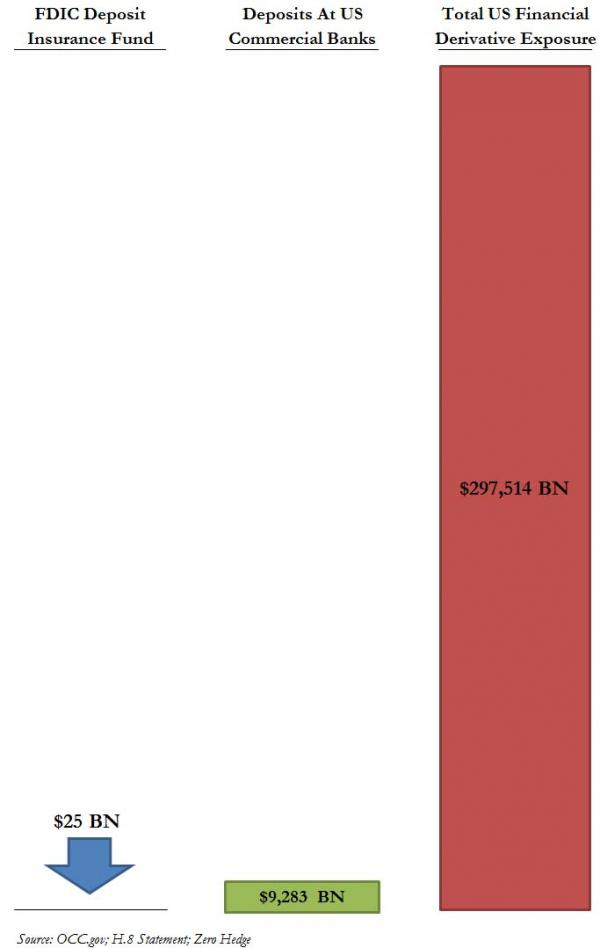
In theory, US deposits under $250,000 are protected by federal deposit insurance; but deposit insurance funds in both the US and Europe are woefully underfunded, particularly when derivative claims are factored in. The problem is graphically illustrated in this chart from a March 2013 ZeroHedge post:

Deposits vs Reserves vs Derivs_0 #2

More on that after a look at the new bail-in provisions and the powershift they represent.

Bail-in in Plain English

The Financial Stability Board (FSB) that now regulates banking globally began as a group of G7 finance ministers and central bank governors organized in a merely advisory capacity after the Asian crisis of the late 1990s. Although not official, its mandates effectively acquired the force of law after the 2008 crisis, when the G20 leaders were brought together to endorse its rules. This ritual now happens annually, with the G20 leaders rubberstamping rules aimed at maintaining the stability of the private banking system, usually at public expense.

According to an International Monetary Fund paper titled “From Bail-out to Bail-in: Mandatory Debt Restructuring of Systemic Financial Institutions”:
[B]ail-in . . . is a statutory power of a resolution authority (as opposed to contractual arrangements, such as contingent capital requirements) to restructure the liabilities of a distressed financial institution by writing down its unsecured debt and/or converting it to equity. The statutory bail-in power is intended to achieve a prompt recapitalization and restructuring of the distressed institution.
The language is a bit obscure, but here are some points to note:
  • What was formerly called a “bankruptcy” is now a “resolution proceeding.” The bank’s insolvency is “resolved” by the neat trick of turning its liabilities into capital. Insolvent TBTF banks are to be “promptly recapitalized” with their “unsecured debt” so that they can go on with business as usual.
  • “Unsecured debt” includes deposits, the largest class of unsecured debt of any bank. The insolvent bank is to be made solvent by turning our money into their equity – bank stock that could become worthless on the market or be tied up for years in resolution proceedings.
  • The power is statutory. Cyprus-style confiscations are to become the law.
  • Rather than having their assets sold off and closing their doors, as happens to lesser bankrupt businesses in a capitalist economy, “zombie” banks are to be kept alive and open for business at all costs – and the costs are again to be to borne by us.
The Latest Twist: Putting Pensions at Risk with “Bail-Inable” Bonds

First they came for our tax dollars. When governments declared “no more bailouts,” they came for our deposits. When there was a public outcry against that, the FSB came up with a “buffer” of securities to be sacrificed before deposits in a bankruptcy. In the latest rendition of its bail-in scheme, TBTF banks are required to keep a buffer equal to 16-20% of their risk-weighted assets in the form of equity or bonds convertible to equity in the event of insolvency.

Called “contingent capital bonds”, “bail-inable bonds” or “bail-in bonds,” these securities say in the fine print that the bondholders agree contractually (rather than being forced statutorily) that if certain conditions occur (notably the bank’s insolvency), the lender’s money will be turned into bank capital.
However, even 20% of risk-weighted assets may not be enough to prop up a megabank in a major derivatives collapse. And we the people are still the target market for these bonds, this time through our pension funds.

In a policy brief from the Peterson Institute for International Economics titled “Why Bail-In Securities Are Fool’s Gold”, Avinash Persaud warns, “A key danger is that taxpayers would be saved by pushing pensioners under the bus.”

It wouldn’t be the first time. As Matt Taibbi noted in a September 2013  article titled “Looting the Pension Funds,” “public pension funds were some of the most frequently targeted suckers upon whom Wall Street dumped its fraud-riddled mortgage-backed securities in the pre-crash years.”
Wall Street-based pension fund managers, although losing enormous sums in the last crisis, will not necessarily act more prudently going into the next one. All the pension funds are struggling with commitments made when returns were good, and getting those high returns now generally means taking on risk.

Other than the pension funds and insurance companies that are long-term bondholders, it is not clear what market there will be for bail-in bonds. Currently, most holders of contingent capital bonds are investors focused on short-term gains, who are liable to bolt at the first sign of a crisis. Investors who held similar bonds in 2008 took heavy losses. In a Reuters sampling of potential investors, many said they would not take that risk again. And banks and “shadow” banks are specifically excluded as buyers of bail-in bonds, due to the “fear of contagion”: if they hold each other’s bonds, they could all go down together.

Whether the pension funds go down is apparently not of concern.

Propping Up the Derivatives Casino: Don’t Count on the FDIC

Kept inviolate and untouched in all this are the banks’ liabilities on their derivative bets, which represent by far the largest exposure of TBTF banks. According to the New York Times:
American banks have nearly $280 trillion of derivatives on their books, and they earn some of their biggest profits from trading in them.
These biggest of profits could turn into their biggest losses when the derivatives bubble collapses.
Both the Bankruptcy Reform Act of 2005 and the Dodd Frank Act provide special protections for derivative counterparties, giving them the legal right to demand collateral to cover losses in the event of insolvency. They get first dibs, even before the secured deposits of state and local governments; and that first bite could consume the whole apple, as illustrated in the above chart.
The chart also illustrates the inadequacy of the FDIC insurance fund to protect depositors. In a May 2013 article in USA Today titled “Can FDIC Handle the Failure of a Megabank?”, Darrell Delamaide wrote:
[T]he biggest failure the FDIC has handled was Washington Mutual in 2008. And while that was plenty big with $307 billion in assets, it was a small fry compared with the $2.5 trillion in assets today at JPMorgan Chase, the $2.2 trillion at Bank of America or the $1.9 trillion at Citigroup.
. . . There was no possibility that the FDIC could take on the rescue of a Citigroup or Bank of America when the full-fledged financial crisis broke in the fall of that year and threatened the solvency of even the biggest banks.
That was, in fact, the reason the US Treasury and the Federal Reserve had to step in to bail out the banks: the FDIC wasn’t up to the task. The 2010 Dodd-Frank Act was supposed to ensure that this never happened again. But as Delamaide writes, there are “numerous skeptics that the FDIC or any regulator can actually manage this, especially in the heat of a crisis when many banks are threatened at once.”

All this fancy footwork is to prevent a run on the TBTF banks, in order to keep their derivatives casino going with our money. Warren Buffett called derivatives “weapons of financial mass destruction,” and many commentators warn that they are a time bomb waiting to explode. When that happens, our deposits, our pensions, and our public investment funds will all be subject to confiscation in a “bail in.” Perhaps it is time to pull our money out of Wall Street and set up our own banks – banks that will serve the people because they are owned by the people.
__________________

Ellen Brown is an attorney, founder of the Public Banking Institute, and author of twelve books including the best-selling Web of Debt. Her latest book, The Public Bank Solution, explores successful public banking models historically and globally. Her 200+ blog articles are at EllenBrown.com.

Friday, 21 November 2014

It's official: US stole Ukraine's gold

Dmitry Orlov
Club Orlov

This just in: it turns out that the rumors were right after all. At least part of the reason the US State Dept./CIA staged a coup in Ukraine that overthrew its democratically elected government and installed a neo-Nazi puppet regime was to steal Ukraine's gold. Rumor had it that shortly after the coup the gold was quietly loaded onto a plane that took it to the US. And now comes the official revelation: Ukraine has no gold reserves left. The gold was sold to pay for a failed military campaign in Eastern Ukraine, and to prop up the fake paper gold market for a little bit longer. One would expect that once the fix is off, the price of gold will skyrocket, the US dollar will drop like a rock, and Americans will need to add the word “hyperinflation” to their list of national woes.

Thursday, 28 August 2014

The Housing Echo-Bubble Is Popping

Washington's Blog


There is nothing remotely “normal” about the echo-bubble’s rise, and we can anticipate that its deflation will be equally abnormal.

Conventional wisdom on the resurgence of the housing markets takes one of two paths:

1. Housing is not in a bubble, it is merely returning to “normal”
2. Housing is bubbly in some markets, but prices will continue to rise

Here’s an alternative view: housing is in an echo-bubble that’s popping.Courtesy of the excellent Market Daily Briefing, here are some charts that make the case that the housing echo-bubble was just another Federal Reserve-induced speculative asset bubble that’s popping, like every other speculative bubble in recorded history.

First up: home prices, as measured by the Case-Shiller Price Index. Note the near-perfect symmetry of the echo-bubble: it has taken roughly the same time-span to inflate and reach a top as the first housing bubble from January 2004 to its peak 2+ years later.

The echo-bubble has topped out at about 50% of the decline from the primary bubble top to the trough in 2012.

Read more
 

Saturday, 23 August 2014

Is the $5 Bill the New $1 Bill?

Charles Hugh Smith

Events, food purchased away from home and live entertainment are increasingly unaffordable to the bottom 90%.

It's starting to feel like a $5 bill is the new $1 bill: everything that could be purchased with one or two dollars not that long ago is now $5 or even $10. A few days ago I was enjoying the Butte County Fair in California's farmbelt (the Central Valley), and it seemed like a rural county fair was a price baseline that was far enough away from the urban artifice of $100 meals at fancy bistros to reflect the statistically elusive real-world inflation.

Everything was $5, or close to it: the carnival rides for kids: $5. The games (ring toss, etc.): $5. Funnel cakes, cotton candy, etc.: $5.

Whatever wasn't $5 was $10: pulled pork sandwich, etc. There was almost no need for $1 bills, except at the admission booth: adults, $8/day, kids/seniors $4.

So let's add up the costs for a family of two adults and two kids. 

Read more
 

Thursday, 14 August 2014

Putin Says The Petrodollar Must Die, "The Dollar Monopoly In Energy Trade Is Damaging Russia's Economy"

Zero Hedge

On one hand, despite initial weakness following Europe's triple-dip red alert, futures declined only to surge higher after some headline or another out of Russia was again spun to suggest imminent Ukraine de-escalation (something which Russia whose only interest is to keep crude prices high, has absolutely zero interest in), perpetuating a rumor which was set off by a Russian media outlet tweet last week that has sent S&P futures over 50 higher in less than a week on... nothing.

On the other, Putin just said the following, which no matter how one spins it, shows precisely how Russia is inclined vis-a-vis future (un-de-counter) escalations.
PUTIN SAYS RUSSIA SHOULD AIM TO SELL OIL AND GAS FOR ROUBLES GLOBALLY, AS DOLLAR MONOPOLY IN ENERGY TRADE IS DAMAGING ECONOMY
Reuters adds:

President Vladimir Putin said on Thursday Russia should aim to sell its oil and gas for roubles globally because the dollar monopoly in energy trade was damaging Russia's economy.

"We should act carefully. At the moment we are trying to agree with some countries to trade in national currencies," Putin said during a visit to the Crimea region, which Moscow annexed from Ukraine earlier this year.
Countries such as China, India, Iran, Brazil, and virtually every other non-insolvent, that is to say "developed, Western" country.

And now, bring on the Russian "isolation" (which is about to push Europe, not Russia, into a triple-dip recession) and further de-escalation.

Saturday, 9 August 2014

De-Dollarization Accelerates - China/Russia Complete Currency Swap Agreement

Zero Hedge
 
The last 3 months have seen Russia's "de-dollarization" plans accelerate. First Gazprom clients shift to Euros and Renminbi, then the UK signs currency swap agreements with China, then NATO ally Turkey cuts ties and mulls de-dollarization, Switzerland jumps in the currency swap agreements, and BRICS create their own non-US-based funding vehicle, and then finally this week, Russia's oligarchs have shifted cash holdings to Hong Kong. But this week, as RT reports, Russian and Chinese central banks have agreed a draft currency swap agreement, which will allow them to increase trade in domestic currencies and cut the dependence on the US dollar in bilateral payments. “"The agreement will stimulate further development of direct trade in yuan and rubles on the domestic foreign exchange markets of Russia and China," the Russian regulator said.

Read more
Related Posts Plugin for WordPress, Blogger...