Search This Blog

Showing posts with label CRISPR. Show all posts

Wednesday, 7 August 2019

‘Increased mortality’: 1st generation CRISPR babies will likely die young, scientists warn

RT

It is now six months since the world’s first gene-edited babies were born in China, but researchers in the US warn that, though the twin girls may be more resistant to HIV, they also have “significantly increased mortality.”
 
Geneticist He Jiankui, dubbed the 'Chinese Frankenstein,' shocked the world in November 2018 when he announced that he had created the first gene-edited babies. He and his team edited the gene CCR5 from two twin babies (a third gene-edited child is due to be born this summer) in a bid to make them immune from HIV.

However, it turns out that people with the variant of that genome that He and his team gave the children are 21 percent more likely to die younger according to researchers from UC Berkeley.

Read more

Wednesday, 10 July 2019

What the ban on gene-edited babies means for family planning

Marie Menke
The Conversation

Technology surrounding the human embryo has moved out of the realm of science fiction and into the reality of difficult decisions. Clinical embryologists fertilize human eggs for the purpose of helping couples conceive. The genetic makeup of these embryos are tested on a routine basis. And today, we no longer ask “can we,” but rather, “should we” edit human embryos with the goal of implantation and delivery of a baby?

As a reproductive endocrinologist, I frequently encounter couples grappling with complicated reproductive issues. If one or both parents are affected by single gene disorders, these couples have the opportunity to first test their embryos and then decide whether to transfer an embryo carrying a mutation rather than finding out the genetic risk of their baby while pregnant. In some cases they may decide not to transfer an embryo that carries the mutation as part of the in vitro fertilization procedure. 

These issues seem simple, but carry large consequences for patients. “Should we transfer an embryo affected with our genetic disorder?” “What should we do with our affected embryos if we do not transfer them?” Some patients will opt to skip testing altogether. 

Clinical trials of GM embryos banned in the US


House Democrats this year considered, then backed away from, lifting a ban written into the budget of the U.S. Food and Drug Administration that bars the approval of any clinical trial or research “in which a human embryo is intentionally created or modified to include a heritable genetic modification.” The current gene-editing ban prohibits editing the genes inside the cell’s nucleus, as Chinese scientist He Jiankui did. He used the gene-editing tool CRISPR to modify the CCR5 gene in twin girls to give them immunity from HIV. 

The current ban also prohibits so-called mitochondrial replacement therapy, or three-parent babies

Read more

Monday, 29 April 2019

Genetically Modified Babies. The Genetic Editing of Human Life is “Big Business”

Prof Michel Chossudovsky
Global Research

Last November, He Jiankui, a Chinese biology professor at Southern University of Science and Technology (SUST) in Shenzhen (Guangdong Province) announced that he and his team had created the World’s first “genetically edited babies”: twin babies Lula and Nana. 

Dr. He Jiankui, used the CRISPR technology “to alter the embryos of seven couples [allegedly] to make them resistant to HIV”.  He Jiankui made his announcement at the Second International Summit on Human Genome Editing held at the University of Hong Kong.  

Dr. He claims to have used CRISP “to tweak the DNA of human embryos during in vitro fertilization”.

The broad implications of this experiment are far-reaching. The genetic editing of human life forms including embryos has a bearing on the future of humanity.

It opens up the pandora’s box of genetic engineering applied to human beings.
It undermines the “reproduction of real life”. Potentially, it destroys humanity.


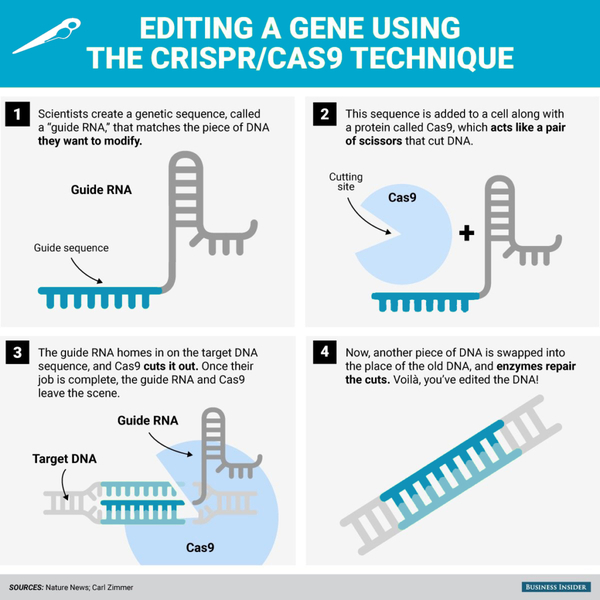
 Screenshot Source Nature News Carl Zimmer, Click image to enlarge


The experiment raises important scientific and ethical issues. Human embryos are not commodities.

The Chinese government immediately opened an investigation, Dr He Jiankui was fired by his University in January 2019.

Corporate Interests: Genetic Editing is “Big Business”

Despite government regulations and ethical issues, there are powerful corporate interests involved in the development and patenting of genetic editing of life forms including Dr. He’s findings on “genetically modified babies”.

Read more

Sunday, 20 January 2019

Monsanto/Bayer Moving to Genome Edit Fruits and More

F. William Engdahl 
 
Not surprising, Monsanto, today hidden behind the Bayer logo, as the world leader in patented GMO seeds and the probable carcinogenic Roundup herbicide with glyphosate, is attempting to quietly patent genetically modified or GMO varieties of fruits using controversial gene-editing. The “beauty” of this for Monsanto/Bayer is that in the USA, according to a recent ruling by the US Department of Agriculture, gene-edited agriculture needs no special independent testing. The developments are not good for human health or safety, nor will it do anything to give the world better nutrition.

The agrichemical and GMO giant Monsanto, which today tries to keep a lower profile inside the German agrichemical and GMO giant Bayer, is moving into the highly controversial domain of gene-editing of new crop varieties. In 2018 as the company was being deluged with lawsuits over its use of the probable carcinogen, Roundup, Monsanto invested $125 million in a gene-editing startup called Pairwise. The link is anything but casual.

Former Monsanto Vice President for Global Biotechnology, Tom Adams, has taken the post of CEO of Pairwise. In short, this is a Monsanto gene-editing project. In a press release, Pairwise says it is using the controversial CRISPR gene-editing technology to create genetically edited produce. Among their goals apparently is a super-sweet variety of strawberry or apples, just what our sugar-saturated population doesn’t need.

CRISPR gene-editing, a stealth attempt by the global agribusiness industry to promote artificial mutations of crops and, as the world was shocked recently to hear, even humans, as in China, is being advanced, much like GMO crops falsely were, as solution to world hunger. Pairwise founder, Keith Joung, told media that their CRISPR gene-edited fruits, “will speed innovation that is badly needed to feed a growing population amid challenging conditions created by a changing climate.” How sweeter genetically-edited strawberries will solve world hunger he leaves to the imagination. Pairwise also says that gene-edited fruits would somehow also cut down on food wasteOne has to be also skeptical there as well, even if it makes nice promotion copy. In addition to super-sweet strawberries, Monsanto plans to use its work with Pairwise to develop new varieties of gene-edited corn, soybeans, wheat, cotton and canola crops. And because the USDA unfortunately has given the green light, the new genetically modified foods will undergo no independent testing for health and safety.

Read more

Friday, 22 June 2018

US military wants to know what synthetic-biology weapons could look like

Comment: US military telegraphing what they already know and what they are already experimenting with. Their "concerns" and curiosity are merely a way to suggest Russia is at fault or a legion of terrorists (most of which have been created and funded by the same minds). It's an interesting article when seen as a snapshot of their objectives. 

-------------------------

Antonio Regalado
MIT Tech Review

A study ordered by the US Department of Defense has concluded that new genetic-engineering tools are expanding the range of malicious uses of biology and decreasing the amount of time needed to carry them out.
The new tools aren’t in themselves a danger and are widely employed to create disease-resistant plants and new types of medicine. However, rapid progress by companies and university labs raises the specter of “synthetic-biology-enabled weapons,” according to the 221-page report.

The report, issued by the National Academies of Sciences, is among the first to try to rank national security threats made possible by recent advances in gene engineering such as the gene-editing technology CRISPR.

“Synthetic biology does expand the risk. That is not a good-news story,” says Gigi Gronvall, a public health researcher at Johns Hopkins and one of the report’s 13 authors. “This report provides a framework to systematically evaluate the threat of misuse.”

Experts are divided on the perils posed by synthetic biology, a term used to describe a wide set of techniques for speeding genetic engineering. In 2016, the US intelligence community placed gene editing on its list of potential weapons of mass destruction.

“Many different groups have written and spoken about the topic, with a wide spread of opinion,” says D. Christian Hassell, deputy assistant secretary of defense for chemical and biological defense, who commissioned the report in order to obtain a “consensus opinion from among the top leaders and thinkers” in the field.

Hassell says the military’s current view is that “synbio is not a major threat issue at the moment” but bears preparing for, in part because defenses like vaccines can take years to develop.

The current report attempted to weigh potential threats by considering factors such as the technical barriers to implementation, the scope of casualties, and the chance of detecting an attack. It found that while “some malicious applications of synthetic biology may not seem plausible right now, they could become achievable with future advances.”

Among the risks the authors termed of “high concern” is the possibility that terrorists or a nation-state could re-create a virus such as smallpox. That is a present danger because a technology for synthesizing a virus from its DNA instructions has previously been demonstrated.

Read more
Related Posts Plugin for WordPress, Blogger...