Search This Blog

Showing posts with label designer babies. Show all posts

Wednesday, 10 July 2019

What the ban on gene-edited babies means for family planning

Marie Menke
The Conversation

Technology surrounding the human embryo has moved out of the realm of science fiction and into the reality of difficult decisions. Clinical embryologists fertilize human eggs for the purpose of helping couples conceive. The genetic makeup of these embryos are tested on a routine basis. And today, we no longer ask “can we,” but rather, “should we” edit human embryos with the goal of implantation and delivery of a baby?

As a reproductive endocrinologist, I frequently encounter couples grappling with complicated reproductive issues. If one or both parents are affected by single gene disorders, these couples have the opportunity to first test their embryos and then decide whether to transfer an embryo carrying a mutation rather than finding out the genetic risk of their baby while pregnant. In some cases they may decide not to transfer an embryo that carries the mutation as part of the in vitro fertilization procedure. 

These issues seem simple, but carry large consequences for patients. “Should we transfer an embryo affected with our genetic disorder?” “What should we do with our affected embryos if we do not transfer them?” Some patients will opt to skip testing altogether. 

Clinical trials of GM embryos banned in the US


House Democrats this year considered, then backed away from, lifting a ban written into the budget of the U.S. Food and Drug Administration that bars the approval of any clinical trial or research “in which a human embryo is intentionally created or modified to include a heritable genetic modification.” The current gene-editing ban prohibits editing the genes inside the cell’s nucleus, as Chinese scientist He Jiankui did. He used the gene-editing tool CRISPR to modify the CCR5 gene in twin girls to give them immunity from HIV. 

The current ban also prohibits so-called mitochondrial replacement therapy, or three-parent babies. 

Read more

Monday, 29 April 2019

Genetically Modified Babies. The Genetic Editing of Human Life is “Big Business”

Prof Michel Chossudovsky
Global Research

Last November, He Jiankui, a Chinese biology professor at Southern University of Science and Technology (SUST) in Shenzhen (Guangdong Province) announced that he and his team had created the World’s first “genetically edited babies”: twin babies Lula and Nana. 

Dr. He Jiankui, used the CRISPR technology “to alter the embryos of seven couples [allegedly] to make them resistant to HIV”.  He Jiankui made his announcement at the Second International Summit on Human Genome Editing held at the University of Hong Kong.  

Dr. He claims to have used CRISP “to tweak the DNA of human embryos during in vitro fertilization”.

The broad implications of this experiment are far-reaching. The genetic editing of human life forms including embryos has a bearing on the future of humanity.

It opens up the pandora’s box of genetic engineering applied to human beings.
It undermines the “reproduction of real life”. Potentially, it destroys humanity.


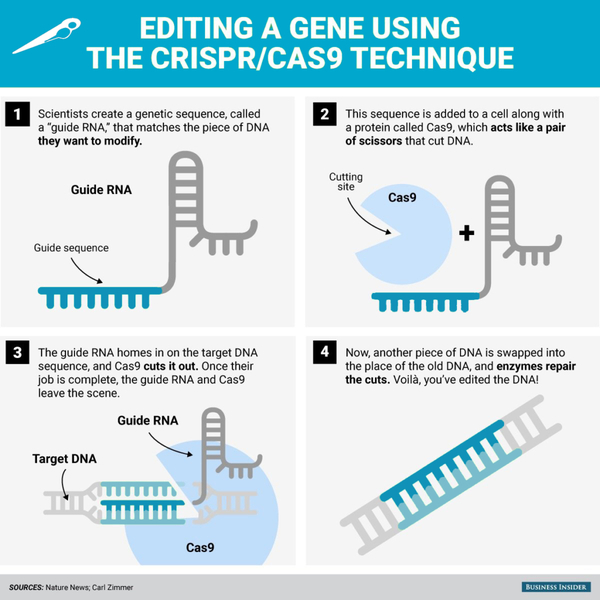
 Screenshot Source Nature News Carl Zimmer, Click image to enlarge


The experiment raises important scientific and ethical issues. Human embryos are not commodities.

The Chinese government immediately opened an investigation, Dr He Jiankui was fired by his University in January 2019.

Corporate Interests: Genetic Editing is “Big Business”

Despite government regulations and ethical issues, there are powerful corporate interests involved in the development and patenting of genetic editing of life forms including Dr. He’s findings on “genetically modified babies”.

Read more

Saturday, 23 March 2019

Scientists From Around the World Call for Immediate Halt to ‘Genetically Altered Children’

Derrick Broze
The Mind Unleashed 

Scientists and ethicists from around the world are warning of the consequences of failing to implement a temporary global halt on gene editing of human eggs, embryos, and sperm. 

In a letter to the journal Nature, 18 scientists and ethicists from seven countries called for a global moratorium on the type of gene editing that can result in genetically altered babies. The letter was prompted by a 2018 announcement by a Chinese scientist declaring the birth of the world’s first gene-edited twin babies.

“The 18 signatories of this call include scientists and ethicists who are citizens of 7 countries. Many of us have been involved in the gene-editing field by developing and applying the technology, organizing and speaking at international summits, serving on national advisory committees and studying the ethical issues raised.”
Fears of “designer babies” have been on the rise in the last decade as scientists move closer to producing embryos which have been genetically modified to produce children with specific, desirable characteristics. This vision was once the exclusive domain of Hollywood movies like Gattaca, but now, a future where parents are able to pick and choose exactly how their child’s genes express themselves is eerily close.

Specifically, the group is calling for a moratorium on germline cells—in this case egg or sperm cells—that can then be inherited and “could have permanent and possibly harmful effects on the species.”

“To begin with, there should be a fixed period during which no clinical uses of germline editing whatsoever are allowed,” the scientists write. “As well as allowing for discussions about the technical, scientific, medical, societal, ethical and moral issues that must be considered before germline editing is permitted, this period would provide time to establish an international framework.”

From that point on, individual nations will choose their own paths. The scientists predict that some nations may choose to continue a moratorium indefinitely or a permanent ban. They also call on any nation that chooses to allow specific applications of germline editing to first give public notice and engage in an “international consideration about the wisdom of doing so.” The group also calls for a “transparent evaluation” to determine if germline editing is justified and for a nation to gain a “broad societal consensus” over the appropriateness of the editing.

Read more

Wednesday, 1 June 2016

British Scientist Plans to Genetically Modify Human Embryos After Ethics Committee’s Approval

Joseph Jankowski
Activist Post

Genetically modified humans might seem like a far-out idea that has a place only in science fiction but is actually what some scientists have in store for humanity in the very near future.

After receiving the go-ahead from the Human Fertilisation and Embryology Authority (HFEA) earlier this year, British scientist Dr. Kathy Niakan, of the Francis Crick Institute, will now be able to genetically modify human embryos.

Dr. Niakan will use a gene editing technique on embryos that have been donated by consenting patients undergoing fertility treatment.
The Telegraph reports:
Despite the approval, the start of research may still be months away due to the difficulties of obtaining sufficient embryos.
The controversial project is thought to mark the second time the procedure will be undertaken. Scientists in China, who carried out the first experiment but are not believed to have been approved by a regulator, were met with widespread criticism.
Dr Niakan, speaking at a briefing in central London in January, said she hoped the research would give hope to prospective patients.
“We would really like to understand the genes that are needed for an embryo to develop into a healthy baby,” she said.
“Miscarriage and infertility are extremely common but they are not very well understood. We believe that this research could improve our understanding of the very earliest stages of human life.”
According to Dr. Niakan, 50 percent of human embryos fail to reach the early developmental blastocyst stage.

“If we were to understand the genes, it could really help us improve infertility treatment and provide crucial insights into the causes of miscarriage,” Niakan said.

Some believe that this type of genetic engineering will pave the path for “designer babies” which would be an act of god by humans.

Others, such as Dr. Kiakan, are looking at this as a way to advance the good health of humanity.

Either way you look at this, it is safe to that some very interesting results could come from the genetic tampering of humans.

Related Posts Plugin for WordPress, Blogger...