Search This Blog

Showing posts with label Establishment. Show all posts

Sunday, 24 July 2016

Wishful thinking (Saker rant)

The Saker

Caveat one: Wishful thinking is considered bad, pollyannish, naïve, deluded, etc. Fine. I will plead “guilty” to all of these and boldly proceeded to express some terminal wishful thinking. I will do that because I do believe that it is sometimes important to set aside such otherwise precious things as realism and the so-called “real world” and to unabashedly proclaim that the world we live in is not the world we wished to be living in and that while we might break under the weight of reality, we sill are capable of remembering the ideals we hold dear. And then maybe, our wishes, at least some of them, will come true.
Caveat two: I won’t bother explaining the facts. Those who by now failed to understand what is happening will not be convinced otherwise anyway, as for those who understand, they don’t need me to rehash it all.

Let me begin by a confession. I support the western sanctions against Russia. I love the Magnitsky Act. The day the Eurovision was won by a Ukronazi manipulated Tatar in clear violation of the Eurovision rules, I was delighted. Likewise, I whole-heartedly support the campaign to denounce homophobia in Russia. I think that the NATO summit in Warsaw was a stunning success and I applaud the deployment of NATO battalions in Poland, the Baltics and, frankly, all around the Russian border. I think that Victoria Nuland and Mc Caine should be the next recipients of the Nobel Peace Prize and, of course, I totally support the complete expulsion of all Russian athletes from the Olympic Games.

I support all of the above because they all serve to show the true face of the AngloZionist Empire, something which the Russian people greatly need.

The latest decision by the three judges of the Court of Arbitration for Sport (CAS) – one Italian, one Brit and one American – is a perfect example of the truly cosmic level of hypocrisy and double-standards which is not only customary, but the hallmark of the Empire’s application of so-called “western values” towards Russia. It is also a casebook example of the use of “soft power” which goes even beyond strategic psychological operations.

Read more

Saturday, 15 August 2015

Death squads, pedophiles and psychopaths: Inside the British establishment

Joe Quinn
Sott.net
 

On August 2nd, the UK's Express reported that British special forces were dressing up as ISIS jihadis and conducting operations in Iraq and Syria. Idiotically describing the tactic as "unorthodox", the Express journalists said that "more than 120 members of the elite regiment are currently in the war-torn country". Such a strategy can seem justified to those with only an official understanding of the Middle East conflict - where ISIS are the 'baddies' and Western operatives are the 'goodies' - and a hopelessly naive belief in the benevolence of the British military. But when viewed in the context of actual British military history in 'conflict zones' over the course of the 20th century, this story takes on a much more sinister form.

Staying with the present for a moment, the claim that British special forces are in Iraq and Syria to "fight ISIS" is not credible. More than four years ago the anglo-American warmongers made it abundantly clear that they, in league with their head-chopping royal friends in Saudi Arabia, were determined to unseat Assad, even going as far as to fabricate WMD evidence (a la Saddam Hussein) to justify a NATO attack. When Russian diplomacy thwarted that effort, the US and British 'elite' fell back on the tried and tested 'civil war' of attrition by proxy forces, in an effort to oust Assad.

But Assad, democratically elected by the Syrian people, is reluctant to leave just because Washington, Riyadh, Whitehall and Tel Aviv want him too. And while Russian, Iranian and Lebanese help is still available, it seems that the West's proxy army, aka the 'Syria rebels', are doomed to fight and die forever, or until the West's supply of hired guns (or money) runs out.

Genetically averse to accepting the hard facts of any situation, the US and British 'elites' have recently declared their right to "attack ISIS positions" directly through manned US airstrikes from Turkish bases. The real point of these airstrikes however is revealed in the fact that the US claims the right to attack anyone who threatens the Pentagon-trained 'Syrian rebels', who are primarily fighting against Assad on behalf of the US, British and Saudi regimes. That, of course, is the main point of these airstrikes; a back-door attempt to justify US military attacks on the Syrian government and its military rather than "fighting ISIS". It's reasonable to conclude, therefore, that those British special forces dressed up as ISIS form part of the same strategy and are providing "boots on the ground" to support US airstrikes on Syria positions.

But a gang of UK special forces dressed up as jihadis presents other opportunities too. They could, for example, carry out attacks against anyone, including civilians if it was considered expedient, and blame it on ISIS.

Just yesterday, a truck bomb exploded in the Shiite Sadr city area of Baghdad, killing 54 people. "ISIS" claimed responsibility by way of an unverifiable online message, but the attack bolstered Western governments' long-term plans to divide Iraq up into three separate states. The Pentagon recently 'resigned' itself to this policy it has been pushing for years, and former chief of US armed forces in Iraq, Gen. Raymond Odierno, also said as much in recent comments that were denounced by the Iraqi government.

But whatever these real-life 'jihadi johns' get up to, the British military's extensive experience in dressing up its recruits as the enemy and sending them into a conflict to 'stir things up', will ensure they perform admirably, no doubt. 


Read more

Tuesday, 6 January 2015

Billionaire Sex Offender's Phone Book Contained E-Mail Addresses, 21 Phone Numbers For Bill Clinton

The Smoking Gun

Now that Prince Andrew has found himself ensnaredin the sleazy sex slave story of wealthy degenerate Jeffrey Epstein, Bill Clinton can’t be too far behind. 

Epstein, who paid teenage girls for naked massages at his Palm Beach, Florida mansion, is a convicted sex offender whose circle of powerful friends has included financiers, celebrities, politicians, and scientists.

In fact, Epstein, 61, has maintained many of these relationships even after pleading guilty in 2008 to a felony charge stemming from a lengthy probe of his lewd interaction with scores of underage girls, many of whom were recruited while they were students at a Palm Beach high school.

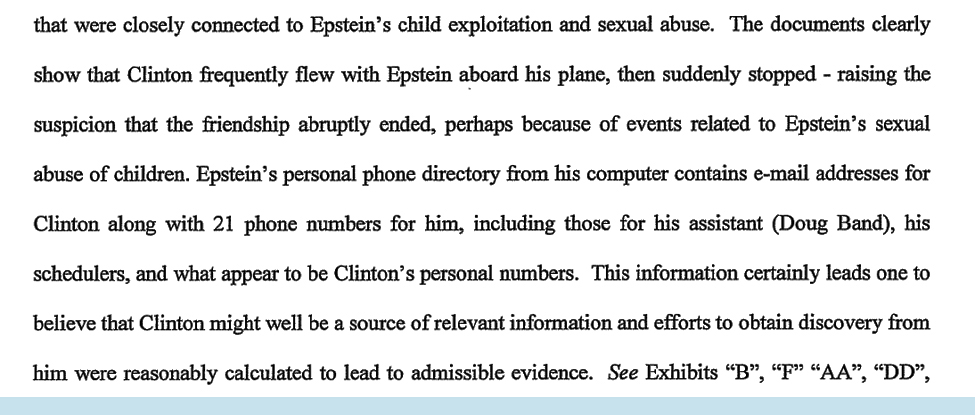
As part of a civil suit filed against Epstein by several of his victims, lawyers for the women floated the possibility of subpoenaing Clinton since he “might well be a source of relevant information” about Epstein’s activities.

While Clinton was never deposed, lawyers obtained Epstein’s computerized phone directory, which included “e-mail addresses for Clinton along with 21 phone numbers for him, including those for his assistant (Doug Band),” according to a court filing.

Read more 


See: Jeffrey Epstein: The billionaire paedophile, his rich and famous contacts, and a very dark secret


Wednesday, 24 December 2014

UK 'Establishment': Unmasking psychopathic faces - Pedophilia and murder in VERY high places


Gary Boyle
Sott.net


8 year old Vishal Mehrotra, who disappeared near the Elm Guest House in West London - alleged haunt of 'pedophiles in power'.In an article published on RT last month, the father of an eight-year-old boy who died in the UK in the 1980s alleged that his son may have been abducted and murdered by members of a Westminster pedophile ring, and further claims that Scotland Yard were complicit in "covering up" the crime.
Vishambar Mehrotra, a retired magistrate, said he recorded a male prostitute saying in a telephone call that Mehrotra's son Vishal may have been abducted in the notorious Elm Guest House in southwest London in 1981. Mehrotra also said despite playing the recording for police officers, they refused to investigate allegations that high-profile judges and politicians were involved in the kidnapping of his son.
After watching the wedding procession of Prince Charles and Princess Diana in July 1981, Vishal Mehrotra was abducted as he walked home in the Putney area of London. Newspaper reports at the time claim Mehrotra's home was less than a mile from the Elm Guest House, where witnesses said a "kings and queens" party was being hosted. Part of Vishal's skeleton was found in 1982 in woodlands in West Sussex. According to coroners' reports, there was no trace of his legs, spine or clothing.

Elm House was raided in June 1982 and dozens of men with high public profiles were questioned. Although none were implicated, it is believed the raids were connected to the disappearance of Vishal, as well as another boy, 15-year-old Martin Allen.

Mehrotra told theTelegraph:
"I was contacted by a young man who seemed to be in his 20s. He told me he believed Vishal may have been taken by pedophiles in the Elm Guest House near Barnes Common."

"He said there were very highly placed people there. He talked about judges and politicians who were abusing little boys."

"At that time I trusted the police. But when nothing happened, I became confused and concerned. Now it is clear to me that there has been a huge cover-up. There is no doubt in my mind."
Martin Allen's disappearance has also been linked to the notorious Elm Guest House in Barnes, south-west London, and the alleged VIP pedophile brothel. But when the Sunday People reported that when the boy's older brother pushed for more to be done on the case, saying he believed a top level cover-up was hiding the circumstance of the teenager's disappearance, he was told to "stop talking like that, you might get hurt."

Mr Allen, 51, now believes the files relating to Martin have been destroyed or lost to avoid solving the mystery that has haunted his family for 35 years. As reported in the Daily Mail last month, he said:

Martin Allen was abducted thirty years ago in London and his disappearance has also been linked to the notorious Elm Guest House in Barnes, south west London, and the alleged VIP pedophile brothel.
"I've no faith in the police. They failed us.

Within a couple of months of Martin disappearing, my father said: 'There's something not right here.'
Police weren't doing enough. They went through the motions.

So it didn't surprise me when a senior officer warned me I could get hurt."
Mr Allen said he always believed there was 'Establishment involvement' in his brother's disappearance.
Read more

See also: Westminister Paedophile Ring

Thursday, 8 May 2014

The Six Principles of the New Populism (and the Establishment’s Nightmare)

Robert Reich

More Americans than ever believe the economy is rigged in favor of Wall Street and big business and their enablers in Washington. We’re five years into a so-called recovery that’s been a bonanza for the rich but a bust for the middle class. “The game is rigged and the American people know that. They get it right down to their toes,” says Senator Elizabeth Warren.

Which is fueling a new populism on both the left and the right. While still far apart, neo-populists on both sides are bending toward one another and against the establishment.

Who made the following comments? (Hint: Not Warren, and not Bernie Sanders.)

A. We “cannot be the party of fat cats, rich people, and Wall Street.”

B. “The rich and powerful, those who walk the corridors of power, are getting fat and happy…”

C. “If you come to Washington and serve in Congress, there should be a lifetime ban on lobbying.”

D. “Washington promoted moral hazard by protecting Fannie Mae and Freddie Mac, which privatized profits and socialized losses.”

E. “When you had the chance to stand up for Americans’ privacy, did you?”

F. “The people who wake up at night thinking of which new country they want to bomb, which new country they want to be involved in, they don’t like restraint. They don’t like reluctance to go to war.”

(Answers: A. Rand Paul, B. Ted Cruz, C. Ted Cruz, D. House Republican Joe Hensarling, E. House Republican Justin Amash, F. Rand Paul )

You might doubt the sincerity behind some of these statements, but they wouldn’t have been uttered if the crowds didn’t respond enthusiastically – and that’s the point. Republican populism is growing, as is the Democratic version, because the public wants it.

And it’s not only the rhetoric that’s converging. Populists on the right and left are also coming together around six principles:

Read more
 

Tuesday, 8 April 2014

The Richest Rich Are in a Class by Themselves


Bloomberg

The rallying cry of the Occupy Movement was that the richest 1 percent of Americans is getting richer while the rest of us struggle to get by. That’s not quite right, though. The bottom nine-tenths of the 1 Percent club have about the same slice of the national wealth pie that they had a generation ago. The gains have accrued almost exclusively to the top tenth of 1 Percenters. The richest 0.1 percent of the American population has rebuilt its share of wealth back to where it was in the Roaring Twenties. And the richest 0.01 percent’s share has grown even more rapidly, quadrupling since the eve of the Reagan Revolution. 

These figures come out of a clever analysis by economists Emmanuel Saez of the University of California at Berkeley and Gabriel Zucman of the London School of Economics, who is a visiting professor at Berkeley. The Internal Revenue Service asks about income, not wealth, which is the market value of real estate, stocks, bonds, and other assets. Saez and Zucman were able to deduce wealth by exploiting IRS data going back to when the federal income tax was instituted in 1913. They figured out how much property different strata of society owned by looking at the income that was generated by that property, such as dividends and capital gains. To simplify, if a family reported $1 million in rental income one year and the market rate of return on rental properties was 10 percent, then Saez and Zucman concluded that the family must have owned property worth $10 million.

The message for strivers is that if you want to be very, very rich, start out very rich. The threshold for being in the top 0.1 percent of tax filers in 2012 was wealth of about $20 million. To be in the top 0.01 percent—that’s the 1 Percent club’s 1 Percent club—required net worth of $100 million. Of course, even $100 million is a pittance to Bill Gates, whose net worth, according to the Bloomberg Billionaires Index, is nearly 800 times that.

Previous research to measure wealth used the Federal Reserve’s Survey of Consumer Finances, which collects a very small sample of the richest Americans, and records on the federal estate tax, which covers only the dead. Saez and Zucman argue that their methodology is the best yet because the IRS data—tax evasion notwithstanding—is of high quality. It’s also annual and broken down by types of income, and it covers every family, not just a sample.


For the two economists, picking the correct rates of return for different types of assets was among the trickiest procedures. The assumed rate of return is the bridge from income, which they could observe, to assets, which they couldn’t. A strong indication that they got the rates right is that their method works for charitable foundations, for which they had publicly disclosed data on both income and assets.

Saez said by e-mail that “wealth-specific taxes become important tools to think about.” You don’t have to agree to find his and Zucman’s data useful. Writing about the findings on their blog, House of Debt, economists Atif Mian of Princeton University and Amir Sufi of the University of Chicago Booth School of Business say, “Simple measurement is often a bit boring, but it is also absolutely crucial for thinking about the overall economy.”

Tuesday, 1 April 2014

Billionaires With Big Ideas Are Privatizing American Science

New York Times 

Funding the Future


As government financing of basic science research has plunged, private donors have filled the void, raising questions about the future of research for the public good.

Last April, President Obama assembled some of the nation’s most august scientific dignitaries in the East Room of the White House. Joking that his grades in physics made him a dubious candidate for “scientist in chief,” he spoke of using technological innovation “to grow our economy” and unveiled “the next great American project”: a $100 million initiative to probe the mysteries of the human brain.

Along the way, he invoked the government’s leading role in a history of scientific glories, from putting a man on the moon to creating the Internet. The Brain initiative, as he described it, would be a continuation of that grand tradition, an ambitious rebuttal to deep cuts in federal financing for scientific research.
“We can’t afford to miss these opportunities while the rest of the world races ahead,” Mr. Obama said. “We have to seize them. I don’t want the next job-creating discoveries to happen in China or India or Germany. I want them to happen right here.”

Absent from his narrative, though, was the back story, one that underscores a profound change taking place in the way science is paid for and practiced in America. In fact, the government initiative grew out of richly financed private research: A decade before, Paul G. Allen, a co-founder of Microsoft, had set up a brain science institute in Seattle, to which he donated $500 million, and Fred Kavli, a technology and real estate billionaire, had then established brain institutes at Yale, Columbia and the University of California. Scientists from those philanthropies, in turn, had helped devise the Obama administration’s plan.


Wendy Schmidt and her husband are advancing ocean studies. Credit Béatrice de Géa for The New York Times


American science, long a source of national power and pride, is increasingly becoming a private enterprise.

In Washington, budget cuts have left the nation’s research complex reeling. Labs are closing. Scientists are being laid off. Projects are being put on the shelf, especially in the risky, freewheeling realm of basic research. Yet from Silicon Valley to Wall Street, science philanthropy is hot, as many of the richest Americans seek to reinvent themselves as patrons of social progress through science research.
The result is a new calculus of influence and priorities that the scientific community views with a mix of gratitude and trepidation.

“For better or worse,” said Steven A. Edwards, a policy analyst at the American Association for the Advancement of Science, “the practice of science in the 21st century is becoming shaped less by national priorities or by peer-review groups and more by the particular preferences of individuals with huge amounts of money.”

They have mounted a private war on disease, with new protocols that break down walls between academia and industry to turn basic discoveries into effective treatments. They have rekindled traditions of scientific exploration by financing hunts for dinosaur bones and giant sea creatures. They are even beginning to challenge Washington in the costly game of big science, with innovative ships, undersea craft and giant telescopes — as well as the first private mission to deep space.

The new philanthropists represent the breadth of American business, people like Michael R. Bloomberg, the former New York mayor (and founder of the media company that bears his name), James Simons (hedge funds) and David H. Koch (oil and chemicals), among hundreds of wealthy donors. Especially prominent, though, are some of the boldest-face names of the tech world, among them Bill Gates (Microsoft), Eric E. Schmidt (Google) and Lawrence J. Ellison (Oracle).

This is philanthropy in the age of the new economy — financed with its outsize riches, practiced according to its individualistic, entrepreneurial creed. The donors are impatient with the deliberate, and often politicized, pace of public science, they say, and willing to take risks that government cannot or simply will not consider.

Yet that personal setting of priorities is precisely what troubles some in the science establishment. Many of the patrons, they say, are ignoring basic research — the kind that investigates the riddles of nature and has produced centuries of breakthroughs, even whole industries — for a jumble of popular, feel-good fields like environmental studies and space exploration.

As the power of philanthropic science has grown, so has the pitch, and the edge, of the debate. Nature, a family of leading science journals, has published a number of wary editorials, one warning that while “we applaud and fully support the injection of more private money into science,” the financing could also “skew research” toward fields more trendy than central.

“Physics isn’t sexy,” William H. Press, a White House science adviser, said in an interview. “But everybody looks at the sky.”

Fundamentally at stake, the critics say, is the social contract that cultivates science for the common good. They worry that the philanthropic billions tend to enrich elite universities at the expense of poor ones, while undermining political support for federally sponsored research and its efforts to foster a greater diversity of opportunity — geographic, economic, racial — among the nation’s scientific investigators.

Historically, disease research has been particularly prone to unequal attention along racial and economic lines. A look at major initiatives suggests that the philanthropists’ war on disease risks widening that gap, as a number of the campaigns, driven by personal adversity, target illnesses that predominantly afflict white people — like cystic fibrosis, melanoma and ovarian cancer.

Public money still accounts for most of America’s best research, as well as its remarkable depth and diversity. What is unclear is how far or fast that balance is shifting, since no one, either in or out of government, has been comprehensively tracking the magnitude and impact of private science. In recognition of its rising profile, though, the National Science Foundation recently announced plans to begin surveying the philanthropic landscape.

There are the skeptics. Then there are the former skeptics, people like Martin A. Apple, a biochemist and former head of the Council of Scientific Society Presidents.

Read more


Du Pont heir dodged prison for raping 3-year-old daughter after judge ruled he 'would not fare well' behind bars

Comment: Clearly, the judge was paid off or threatened. Child rape is a daily leisure activity for many members of the Establishment. While it is true that there is treatment for paedophilia (not necessarily a cure) it is seldom given to the majority of perpetrators so why is it automatically afforded to this man? It's obvious why.

----------------------------------

NY Daily  News 

Robert H. Richards IV, 47 — whose great-grandfather was du Pont family patriarch Irenee du Pont — was given just eight years probation after pleading guilty to raping his 3-year-old daughter. But now his ex-wife, Tracy Richards, is suing him for sexually abusing the girl and their young son.

A du Pont family heir who pleaded guilty nearly six years ago to raping his 3-year-old daughter was never put behind bars because a Delaware judge ruled he “would not fare well” in prison, court records show.

Robert H. Richards IV — scion of the family who built the chemical empire and kin to the co-founders of a prestigious law firm, Richards Layton & Finger — was given eight years probation and was ordered to seek treatment after being convicted of fourth-degree rape in 2008, the records show.

Officials managed to keep the case away from the public spotlight until this month — when his ex-wife, Tracy Richards, filed a lawsuit seeking compensatory and punitive damages for abusing their daughter and son, the News Journal reported.

Richards, 47 — whose great-grandfather is du Pont family patriarch Irenee du Pont — has never been criminally charged for crimes against his son.

The recently filed litigation claims that the father — who lives in a $1.8 million mansion near Winterthur Museum — raped his daughter, now 11, several times beginning in 2005, according to the newspaper.
Two years later, when the girl was 5 years old, she told her grandmother, Donna Burg, that she was being sexually abused by Richards, court documents show.

The little girl said her father told her it was “our little secret,” but said she didn’t want the man touching her anymore, according to the court docs.

Tracy Richards, after Burg told her of the sickening abuse, confronted her then-husband and had him arrested for raping the child.

Richards used “his family’s wealth and position in the community” to hire an expensive defense team and denied the charges, according to the lawsuit obtained by the News Journal.

But after failing a polygraph test, he admitted to abusing the little girl. Richards allegedly told investigators “he was ill and that he needed medical treatment,” the lawsuit said.

Richards pleaded guilty in 2008 to fourth-degree rape — a deal that helped him dodge any jail time.

Superior Judge Jan Jurden sentenced Richards to eight years in prison, but suspended the time for probation that requires monthly visits with a case officer.

“Defendant will not fare well in Level 5 setting,” Jurden wrote in her sentencing order. In Delaware’s correctional system, Level 5 is prison.

Brendan J. O’Neill, a Delaware public defender, told the Detroit Free Press that the ruling may prompt the public to be skeptical of “how a person with great wealth may be treated by the system.”

But he defended the judge’s decision, saying sometimes people need help more than they deserve to be punished.

“It’s an extremely rare circumstance that prison serves the inmate well,” he told the paper. “Prison is to punish, to segregate the offender from society, and the notion that prison serves people well hasn’t proven to be true in most circumstances.”

But now Richard’s ex-wife is seeking justice by suing him for assault, negligence and negligent infliction of emotional distress on his two children, the News Journal reported.

The lawsuit claims that while taking another lie detector test in 2010, Richards allegedly told the examiner he began to sexually abuse his son in 2005 — when the boy was 19 months old.

The father allegedly confessed that he “was very concerned something happened with his son, but that he has repressed the memories,” according to the lawsuit.

Saying the abuse was “similar to what happened with his daughter,” Richards allegedly “promised that whatever I did to my son, I will never do it again,” the lawsuit said.

An attorney for the convicted pedophile’s ex-wife said the lawsuit is the first step in seeking justice.
“This self-confessed, admitted rapist and child abuser didn’t go to jail and, in fact, he stays in luxury where he’s always been,” said the lawyer, Thomas C. Crumplar.

jkemp@nydailynews.com


Wednesday, 19 February 2014

1% Jokes and Plutocrats In Drag: What I Saw When I Crashed a Wall Street Secret Society

The 2012 Kappa Beta Phi neophyte class.

New York Magazine

Recently, our nation’s financial chieftains have been feeling a little unloved. Venture capitalists are comparing the persecution of the rich to the plight of Jews at Kristallnacht, Wall Street titans are saying that they’re sick of being beaten up, and this week, a billionaire investor, Wilbur Ross, proclaimed that “the 1 percent is being picked on for political reasons.”

Ross's statement seemed particularly odd, because two years ago, I met Ross at an event that might single-handedly explain why the rest of the country still hates financial tycoons – the annual black-tie induction ceremony of a secret Wall Street fraternity called Kappa Beta Phi.

“Good evening, Exalted High Council, former Grand Swipes, Grand Swipes-in-waiting, fellow Wall Street Kappas, Kappas from the Spring Street and Montgomery Street chapters, and worthless neophytes!”

It was January 2012, and Ross, wearing a tuxedo and purple velvet moccasins embroidered with the fraternity’s Greek letters, was standing at the dais of the St. Regis Hotel ballroom, welcoming a crowd of two hundred wealthy and famous Wall Street figures to the Kappa Beta Phi dinner. Ross, the leader (or “Grand Swipe”) of the fraternity, was preparing to invite 21 new members — “neophytes,” as the group called them — to join its exclusive ranks.

Looking up at him from an elegant dinner of rack of lamb and foie gras were many of the most famous investors in the world, including executives from nearly every too-big-to-fail bank, private equity megafirm, and major hedge fund. AIG CEO Bob Benmosche was there, as were Wall Street superlawyer Marty Lipton and Alan “Ace” Greenberg, the former chairman of Bear Stearns. And those were just the returning members. Among the neophytes were hedge fund billionaire and major Obama donor Marc Lasry and Joe Reece, a high-ranking dealmaker at Credit Suisse. [To see the full Kappa Beta Phi member list, click here.]  All told, enough wealth and power was concentrated in the St. Regis that night that if you had dropped a bomb on the roof, global finance as we know it might have ceased to exist.

During his introductory remarks, Ross spoke for several minutes about the legend of Kappa Beta Phi – how it had been started in 1929 by “four C+ William and Mary students”; how its crest, depicting a “macho right hand in a proper Savile Row suit and a Turnbull and Asser shirtsleeve,” was superior to that of its namesake Phi Beta Kappa (Ross called Phi Beta Kappa’s ruffled-sleeve logo a “tacit confession of homosexuality”); and how the fraternity’s motto, “Dum vivamus edimus et biberimus,” was Latin for “While we live, we eat and drink.”

On cue, the financiers shouted out in a thundering bellow: “DUM VIVAMUS EDIMUS ET BIBERIMUS.”

Read more


Thursday, 6 February 2014

Sun Sea & Satan

One World Chronicle

A hard-hitting emotionally charged 60 min documentary by Bill Maloney (Award winning independent film director) who’s family were all brought up in the UK care system.

It covers Maloney’s visit and interpretation of Jersey, Channel Islands, following the ongoing child abuse investigations of the children’s care home ‘Haut de la Garenne’. It highlights connections with the Sea Cadets and children being brought from London care homes for ‘sailing holidays’ on the Island. The documentary contains strong language and strong opinions.

Due to his and his family’s experiences of Establishment care homes Maloney felt compelled to see first hand the response of Islanders to the alleged abuse claims and their general feeling for the Governing States. A mixed response of silence, anger and insensitivity is catalogued from this island of geographical beauty with an ugly underbelly. The film includes mainstream news reports with Jeremy Paxman, Stuart Syvret, Lenny Harper, Esther Rantzen and Frank Walker.

It is the opinion of Bill Maloney that if a child was required – Haut de la Garenne was the venue; if an adult was required – St Saviours Mental Hospital was the venue.

JERSEY IS NOT PART OF THE UK, IT IS OWNED BY THE CROWN.

DONATIONS – In order to remain independent Pie and Mash Films rely on donations from generous individuals to carry out investigations into all forms of abuse and the erosion of our civil liberties.
With your help we can raise the awareness of the consequences of abuse by individuals, corporates, and the ‘Establishment’ and confront those in power who deny justice. http://www.pienmashfilms.com/page18.htm


Wednesday, 8 January 2014

British Jury Rules Killing of (Unarmed) Mark Ruggan Lawful

Comment: Could we have really expected anything else?  

----------------


Common Dreams

In what furious critics and his family blasted as "a perverse judgment," a London inquest jury has ruled that the 2011 police shooting of Mark Duggan, a young father who may or may not have had gang connections, was legal - even though they also found he was unarmed despite police claims to the contrary at the time and ongoing police references to "armed criminals." Local MP David Lammy said the killing of Duggan, which sparked the worst riots in modern English history, shows Britain "does not currently have the strong, efficient and independent regulatory body that is necessary for the public to have full confidence in the police."

Carole Duggan, Mark's aunt, said he had been "executed...The jury found that he had no gun in his hand and yet he was gunned down. For us that's an unlawful killing."
Related Posts Plugin for WordPress, Blogger...