Search This Blog

Showing posts with label Malaysia. Show all posts

Friday, 16 August 2019

Missing European Teenager Found Dead in Malaysian Jungle Under Mysterious Circumstances - Another Missing 411 Case?

Niall Bradley
Sott.net


 Details concerning the discovery of the body of missing Irish-French teenager in the Malaysian jungle on August 13th point to it being another 'Missing 411' case.

15-year-old Nora Quoirin was on holiday in Malaysia with her two younger siblings and their parents, staying at the Dusun eco-resort in Negeri Sembilan state.

Situated at a trailhead on the west side of the Berembun Forest Reserve, the resort is a mere 35kms as the crow flies from Kuala Lumpur International Airport, but is nonetheless surrounded by dense rainforest. 


The Quoirin family had arrived there on August 4th, checked-in to their villa at the resort, then Nora was noticed missing by her father at 8am the next morning when he discovered she was not in her room and that the window was open.

As search-and-rescue (SAR) teams began looking for her, Malaysian officials' working theory was that she had left the bedroom at some point in the early hours, wandered off and become lost. But Nora was born with the brain defect holoprosencephaly, an unusual condition in which the forebrain is not fully divided into left and right hemispheres.

Nora's medical condition meant that she was highly dependent on full-time care and, as her mother insists, "would not have wandered off on her own." Her siblings, who were sleeping in the same room as her, did not notice her leave, and CCTV cameras at the resort did not capture her leaving. Even if she had been motivated to do so, it's unlikely Nora could physically negotiate the rigors of leaving the resort and trekking through steep, dense jungle. For these reasons, her parents insisted that local investigating authorities consider that she had been abducted.

Police are keeping an open mind about a criminal angle, but they have reported that

there was no sign of any intruder entering the property. They did not find any footprints inside the villa or forensic evidence to suggest an unknown person was inside. The entire area around the villa where the family were staying is covered with soggy vegetation and the single-track road leading to the resort is covered with mud.

Had someone entered through the window and climbed a flight of stairs to an upstairs bedroom where Nora was sleeping, it is assumed there would have been traces of mud on the floor. It is because of the lack of evidence of any crime that police treated the case as primarily that of a missing person.
In any event, multiple SAR teams searched the area, as far as 4kms away from the resort, for 9 days until she was found on the 13th. By then over 350 people had been involved in intensive searches of the surrounding jungle and the nearby river, using helicopters with thermal detectors, drones, sniffer dogs, and even local shamans. The spot where she was found is described as "particularly inaccessible" by the local police chief. 

Read more

Monday, 29 May 2017

Indonesian Borneo is finished: Pollution reaching epic proportions

RT

How destructive can man get, how ruthless, in his quest to secure maximum profit, even as he endangers the very survival of our planet? 

The tropical forests of Kalimantan (known as Borneo in Malaysia), the third largest island in the world, have almost totally disappeared. Coalmines are savagely scarring the hills; the rivers are polluted, and countless species are endangered or extinct.

It is all a terrible sight, whether you see it from the air or when driving (or walking) through the devastation that is taking place on the ground. The soil is black; it is often saturated with chemicals. Dead stubs of trees are accusatively pointing towards the sky. Many wonderful creatures, big and small, who used to proudly inhabit this tropical paradise, are now hiding in the depth of what remains of one of the largest tropical jungles on earth.

Engines are instantly roaring everywhere; huge equipment is continually cutting through something pure, or digging and finally transporting what has already been extracted, killed, or taken down mercilessly.

Ms. Mira Lubis, Senior Lecturer at Tanjungpura University, Pontianak in Western Kalimantan, summarizes the situation honestly but brutally:

“I think we, the people of Borneo, have lost our sovereignty over our own space and resources, under the pressure of global capitalism... Apparently, we just became poor despite all the wealth that we have.”

Read more

Monday, 23 December 2013

China’s String of Pearls Strategy: Extending their economic and military reach


Modernising the military is one of China’s four pillars in its modernisation drive which includes education, industry and infrastructure, military and agriculture.

China’s largest strategic concern – regime survival and domestic stability - directly links to its economy. To sustain its economic growth China has to be depending increasingly on its external supply of energy, raw materials and food. So the development of Sea Line of Communication or (SLOCs) is vitally important as more than 80% of China’s trade go through the sea. The majority of the energy comes from the country’s coal about 65 %, 30% by oil and remaining by gas, nuclear and hydroelectric power.

China used to be the largest oil exporter in East Asia but in 1993 it became a net importer and in 2004, overtook Japan to become the world’s second largest importer. By 2020 an estimated 60% of the country’s oil has to be imported compared to 8% in 1995. Also to be noted is that over 65% of China’s oil import came from the Middle East and Africa.

The choke-point of Straits of Malacca is considered too risky for China because if there will be a collision near its narrowest point in Singapore it will disrupt the traffic flow by up to 2 weeks to China. So if there is a disruption of deliveries then China’s economy will be in a total standstill. So China knows the importance of protecting its SLOCs so that the oil supply from the Middle East remains uninterrupted.


Free Rider 

Currently such protection is provided by the United States Navy in the form of permanent deployment of an aircraft carrier in the Gulf region. China currently enjoys being a ‘free rider’ meaning China gets free protection from the U.S Navy without having to pay for it.

However, for the past few years the U.S has already been cutting back its defence budget plus more oil has since been discovered recently, hence making the U.S less dependent on Middle Eastern oil in the future. Sooner or later the U.S will have to scale back its commitment to provide security to the shipping lanes in the Middle East.

Hence, by then China will then need to commit more resources towards maintaining security of the shipping lanes in the Middle East. Below is the map of China’s SLOC and the oil shipping lanes from Hainan Island China till the Middle East.

 
Source : Stratfor
Picture courtesy of FAS (Federation Of American Scientist)
Shows the Hainan Island Naval base with Jin Class SSBN and Cave Entrance
Click to enlarge
 
String of Pearls Strategy

This gave rise to the String of Pearls strategy. It is like pearls tied to a string and each pearl represents a country normally a port where China can get access to it. The string that attach to the pearls represents the Sea Lines of Communication (SLOCs). The String of Pearls will provide China with forward presence and military bases along the SLOCs from China to the Persian Gulf in the Middle East. A pearl normally comes with facilities like airstrips and naval bases.

The First Pearl is located at the Hainan Island in South China. The Chinese have already upgraded the naval base and military facilities. This massive underground submarine and warship base is built because of its strategic location in the South China Sea. The entrance is so huge that it can allow the fleet of 50 plus conventional and nuclear submarines to go in and out without Western spy satellites detecting.


The Second Pearl is the port of Hambantota in Sri Lanka despite much objection from India. However the project is already under way and China is underwriting a US$1.2 billion package for the facility. China investment in this area will increase significantly as it has some interest in oil drilling in Northeast Sri Lanka. Hambantota port will also include aviation fuel storage facility, LNG refinery and a bunkering facility to refuel ships.

The Third Pearl is located at the Chittagong port in Bangladesh. Fourth is the Woody Island located 300 miles east of the Paracel Archipelago. An airstrip has been upgraded for this purpose. And so does Port of Sittwe in Myanmar, Marao in the Maldives and Port of Gwadar in Pakistan. The Gwadar port comes with a naval base and it is is chosen because of its strategic value in the 240 km distance from the Straits of Hormuz.

In its Grand Strategy that encompassed the ‘Peace Development’, China has identified 3 stages in development spanning 50 years. This involves both the economic and military. In the first stage of development from 2000-2010 China hopes to double its GDP and upgrade its Navy from ‘Green Water’ to ‘Blue Water’ and operate within the First Island Chain that stretch from Japan to Philippines , has been achieved.

The second stage from 2010-2020 with total GDP to be double and the development of the ‘Aircraft Carrier’ fleet of up to six carriers groups, to operate beyond the First Island Chain to reach the Second Island Chain which stretch from Guam to Indonesia and Australia is already on target with the recent commissioning of its first Aircraft Carrier, The Liaoning.

And finally, from 2020-2050 to catapult the nation to the middle rung of the Advanced Nations and with its Navy upgraded to a truly ‘World class Blue Water’ which can project power forward in all Oceans of the World. With a doctrine change from a inward looking to a outlook one, China’s Foreign policy has to be a more outward looking with global influence.

India complained to the US that China’s String of Pearls strategy is more of a strategic than commercial and the String of Pearls is encircling it from north to south. And also it feel very uneasy because a few of the pearls are India‘s old foe like Pakistan and Sri Lanka. Thus all these developments represent China’s rising geopolitical influence through ports and airstrips and also building diplomatic relations from Hainan Island to Persian Gulf. This also acts as a strategy to cut off US influence in this part of the world and also to contain India’s influence in this area. The following map shows how China’s String of Pearls encircle India and the rest of South Asia.


The Second String of Pearls is taking shape in the Pacific Ocean. China already had a strong presence in the Pacific Islands ever since there is a power vacuum left by the French and the Americans. China’s CHECKBOOK diplomacy did a marvellous job and it helped most of the Pacific Island nations to pay off their debts with no strings attached. Unlike Western aid which comes with a whole list of conditions like human rights, transparency, opening up of market and etc.

The following are the reasons why China putting so much importance in this area,
> One China policy
> To counter U.S forces from Guam & Hawaii in case of future confrontation
> Strategic positioning of the Pacific
Taiwan has been lobbying the Pacific Nations to recognize it as a country and for a vote in the UN. It was doing this quite successfully for a while with nations like Kiribati, Nauru, Palau, Tuvalu , Marshall Islands, and the Solomon Islands. In return Taiwan will provide aid to them. China came into the scene and counter offered them and eventually of the 24 nations only 6 left that is still loyal to Taiwan. China not only provides aids to them but also build infrastructure like roads, schools and government buildings for them.

China already import significant amount of timber and fishes from Papua New Guinea and Solomon islands. China also has an interest in Papua New Guinea’s vast energy and mineral resources through interest in the Ramu Nickel and Cobalt mine. It is reported there are more than 1000 SOEs doing more than $10 billion in business there last year besides providing a market for Chinese goods.

The Pacific Islands lie between the equator and International Date Line makes it an ideal location for satellite tracking. Kiribati is the only country falls into this category and China in 1997 built a satellite tracking station on the Tarawa atoll. The Tarawa station is also important as it can be used to launch and track rockets (either nuclear warheads or satellites) and also for monitoring US Navy and military installations in the Pacific. This station also played a big role in China’s first-manned space mission and also its future lunar mission. However after suffered some bad diplomatic relations the installation had to be removed.

The third String of Pearls is likely be the African Continent since more than 20% of China’s oil imports come from that region. According to sources, Swakopmund in Namibia currently accommodate China’s third overseas satellite and space telemetry tracking station after the closure of the Tarawa base, is likely be the first pearl. Next will be the other African Nations on the east coast of Africa. The Port of Hambantota in Sri Lanka which has bunkering facilities for ship refuel and supplies provide a perfect docking point for Chinese ships on the way to Africa.

In Conclusion

The development of the Strings of Pearl can be seen as part of China’s ambitious plan to consolidate and tighten its grip on Global power projection.

This whole game plan can be seen as part of a strategy that derives from the centuries old Chinese board game called Wei Qi also known as GO in the West.

The objective of this game is to move as many pieces of his stone (either black or white) towards the opponent side. In a way it surrounded the opponent with many scattered pieces and then consolidates his position in one or two areas where it will be used for the final push to finish off his opponent.

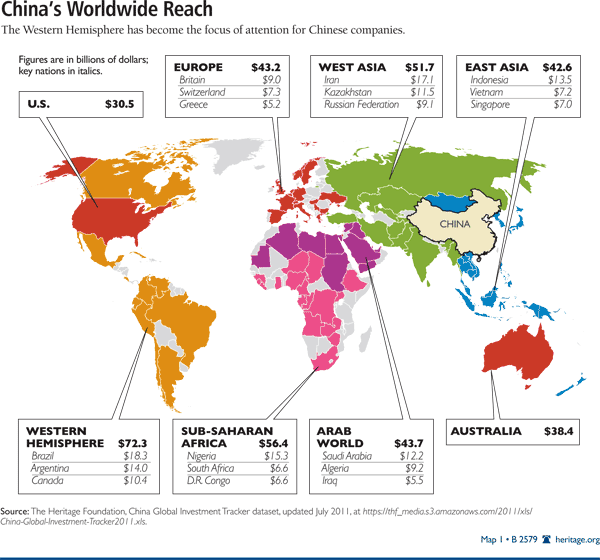
Thus if observed from another angle, China today can be seen as a giant Wei Qi board, where the pieces represents the Chinese SOEs (State Owned Enterprises) and private Chinese investors be it local or Overseas Chinese or rather known as the Bamboo Network that has spread their wings in all four corners of the Earth.

They are starting to move their pieces (investments) and scattering all over the world. 

Although their move might be sporadic at the moment but in time they will be able to achieve economies of scale and move into areas that shows signs of economic boom quickly. Their strategic locations will give them a head start over any would be competitors in terms of presence and integration into the local economy.

The following map best illustrates China’s strategic move by scattering its SOEs around the world where it can be used to capitalize on any positive economic development arising from the different parts of the world.


As seen above China has already made its maiden move to scatter its SOEs around the world and in time it will move into specific areas that offer the best opportunity to further strengthen its influence.


In a way the development of the String of Pearls complements China’s future Global economic expansion. - Malaysia Chronicle

Related Posts Plugin for WordPress, Blogger...