Search This Blog

Showing posts with label meat. Show all posts

Tuesday, 7 May 2019

Lab grown meat backed by Bill Gates to hit shelves in first US state this summer

Nick Meyer
Alt Health Works


Contrary to Biotech talking points, true genetically engineered food has only been on store shelves since the 1990s.

The first commercially available GMO crop was the "FlavrSavr" tomato, which was scrapped due to consumer and corporate rejection.

Since then, many other GMO crops, foods and similar experiments have made their way to store shelves, unlabeled and not tested for long-term safety.

These crops and foods were rushed to market even in spite of warnings from the FDA's own scientists, as detailed in the popular book 'Altered Genes, Twisted Truth' by public interest attorney Steven M. Druker.

The latest lab grown food development is a far different type of experiment, however, with sights on rocking the foundation of one of the most profitable industries in the United States: the meat industry.

And now, one Bill Gates-backed project is ready for its close-up, and will be sold on store shelves for the first time this summer.
 

Read more

Monday, 4 February 2019

What's Really Behind The Plant-based Diet Agenda?

Edward Talbot
Sustainable Agriculture Systems


I have previously covered the anti-animal agriculture narrative here and the plant-based and/or alternative protein agenda here.

But as the plant-based diet agenda is currently enjoying an uninterrupted public relations campaign facilitated by the obliging media; and given last week's launch of the EAT-Lancet Commission's report on healthy diets for sustainable food systems, I feel compelled to delve a little deeper into the matter.

Although I loathe mixing business and politics, livestock agriculture is becoming increasingly politicised. Regrettably, this forces one's hand.

Why something so innocuous as personal dietary choice needs to be voiced so loudly is a strange phenomenon. However, there are some interesting facets of information that can be gleaned by analysing the EAT-Lancet Commission's posturing and the alternative protein movement.
The anti-animal agriculture narrative and plant-based diet agenda combines political ideology and commercial interests. This "movement" is insidious, unsavoury, and cannot be ignored by those who value liberty and consumer choice.

Although most people cannot deprive themselves of high-quality nutrition for long-periods of time, the fact that some people are going to such great lengths to avoid the consumption of meat and dairy products is rather telling.
The nutritional argument against consuming animal source foods is non-existent. It is quite simply illogical that red meat or dairy products cause modern diseases (I have previously covered this subject here). Dietary recommendations have been moulded by religious and other personal beliefs (such as the temperance movement), animal rights activists, and food companies since their inception. None of this is anything new. What is new, is the concept of promoting a "planetary health diet."

Nutrition science is ambiguous enough without adding extra layers of complexity. What's good for the planet and what's good for human health are understandable concerns to have. But conjoining the two is imprudent, especially when innumerable falsehoods are bandied about regarding both.

By far and away, the biggest contemporary driver of the anti-animal agriculture narrative is the supposed environmental impact of livestock - and that is a good place to start a critique of the plant-based diet agenda. 


Read more

Thursday, 14 June 2018

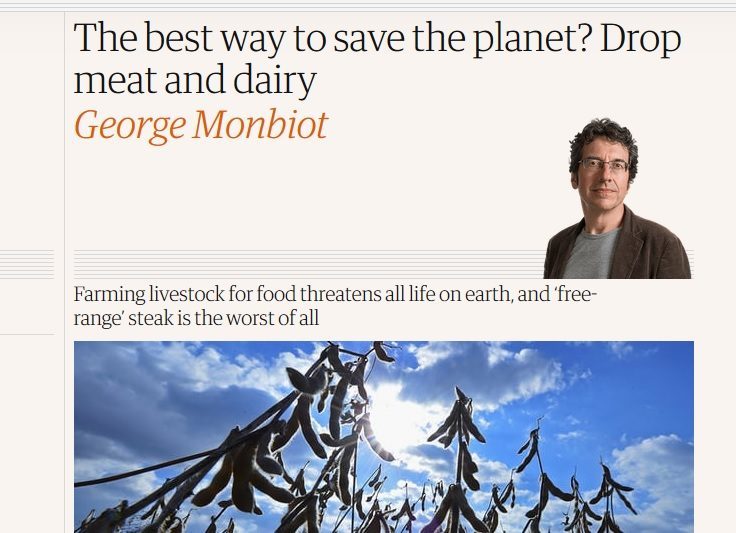
No, George Monbiot, Dropping Meat and Dairy Will Not Reduce Your Impact on the Earth

Doug DiPasquale
Sott.net


Guardian George Monbiot
© The Guardian Feel the awesome power of meat guilt

If you were to believe the headlines (something not generally recommended) gracing newspapers and interwebs this week, you'd be assured that if you don't go vegan, you're going to kill the planet. Peer-reviewed research published in the prestigious journal Science late last month is based on a database of a bunch of different food products, which the study's authors analyzed from production to retailing to determine their environmental impact. From Science Daily:
Researchers at Oxford University and the Swiss agricultural research institute, Agroscope, have created the most comprehensive database yet on the environmental impacts of nearly 40,000 farms, and 1,600 processors, packaging types, and retailers. This allows them to assess how different production practices and geographies lead to different environmental impacts for 40 major foods.
So how did they assess the environmental impact of our daily foodstuffs? Pollutants like heavy metals or toxic chemicals being released? Destruction of fragile ecosystems? The number of endangered species affected? Invasive genetically modified technologies and their consequences? Nope. Those things don't matter in the grand scheme of things, apparently. All that matters now is carbon dioxide, the innocuous gas that feeds plants. In the current media landscape, all the horrific things we do to the environment get a pass. The only thing that gets attention is CO2.

So it's no surprise that the studies that bolster this propaganda get the most traction in the media, dutifully tweeted out by the PC brigade, who are secure in their belief that they're 'doing something' to 'help save the planet'.

One article about this that stood out was George Monbiot's column at the Guardian, which ran with the headline: 'The best way to save the planet? Drop meat and dairy'... Right away, we know we're in for a wild ride. This is actually the second Guardian article in the last week about this study, and it attempts to guilt their readers into going vegan. It would appear their readers' diets is a particularly important issue for them.

The Monbiot piece opens:

Whether human beings survive this century and the next, whether other lifeforms can live alongside us: more than anything, this depends on the way we eat. We can cut our consumption of everything else almost to zero and still we will drive living systems to collapse, unless we change our diets.
The "more than anything" part is debatable, but as long as we're talking in generalizations, this is likely true. Monocrop farming, confined animal feeding operations (CAFOs), genetic modification, glyphosate, toxic chemical agriculture - these things are all absolutely brutal on a planetary scale and it's probably true that we're going to reach a tipping point, if we haven't already, and start seeing absolutely devastating consequences and loss of life (human and otherwise). But that's not what Monbiot is talking about, as we see in the next paragraph. 

Read more
Related Posts Plugin for WordPress, Blogger...