Search This Blog

Showing posts with label neuroscience. Show all posts

Wednesday, 4 September 2019

"Scariest Thing You'll Read All Day": Report Sounds Alarm Over Brain-Reading Technology and Neurocapitalism

Common Dreams

A Vox report that swiftly sparked alarm across the internet Friday outlined how, "in the era of neurocapitalism, your brain needs new rights," following recent revelations that Facebook and Elon Musk's Neuralink are developing technologies to read people's minds.

As Vox's Sigal Samuel reported:
Mark Zuckerberg's company is funding research on brain-computer interfaces (BCIs) that can pick up thoughts directly from your neurons and translate them into words. The researchers say they've already built an algorithm that can decode words from brain activity in real time.
And Musk's company has created flexible "threads" that can be implanted into a brain and could one day allow you to control your smartphone or computer with just your thoughts. Musk wants to start testing in humans by the end of next year.
Considering those and other companies' advances and ambitions, Samuel warned that "your brain, the final privacy frontier, may not be private much longer" and laid out how existing laws are not equipped to handle how these emerging technologies could "interfere with rights that are so basic that we may not even think of them as rights, like our ability to determine where our selves end and machines begin."

Read more

Thursday, 25 April 2019

Scientists have found a way to decode brain signals into speech


It’s a step towards a system that would let people send texts straight from their brains.

You don’t have to think about it: when you speak, your brain sends signals to your lips, tongue, jaw, and larynx, which work together to produce the intended sounds.

Now scientists in San Francisco say they’ve tapped these brain signals to create a device capable of spitting out complete phrases, like “Don’t do Charlie’s dirty dishes” and “Critical equipment needs proper maintenance.”

The research is a step toward a system that would be able to help severely paralyzed people speak—and, maybe one day, consumer gadgets that let anyone send a text straight from the brain. 

A team led by neurosurgeon Edward Chang at the University of California, San Francisco, recorded from the brains of five people with epilepsy, who were already undergoing brain surgery, as they spoke from a list of 100 phrases.

When Chang’s team subsequently fed the signals to a computer model of the human vocal system, it generated synthesized speech that was about half intelligible.

The effort doesn’t pick up on abstract thought, but instead listens for nerves firing as they tell your vocal organs to move. Previously, researchers have used such motor signals from other parts of the brain to control robotic arms. 

Sunday, 21 April 2019

Zombie Science: Researchers Kept the Brains of Decapitated Pigs Alive For 36 Hours

Dagny Taggart
The Organic Prepper

Scientists seem to be crossing a lot of boundaries as of late, which begs the question: Just because they can do something, does it mean they should?

Advances in brain-related technology are reaching dystopian levels. Scientists recently developed the ability to predict our choices before we are consciously aware of them, and can now translate people’s thoughts into speech. Smart chips that will create super-intelligent humans are in development, and China is mining data from the brains of citizens.

While there are legitimate uses for some of this technology, it doesn’t take much stretch of the imagination to realize that much of it could also be used for nefarious purposes. 

Are scientists taking some research too far?


Developments in artificial intelligence are both fascinating and terrifying, but they pale in comparison to a recent discovery in neuroscience.

This headline caught my attention a few days ago:


That article goes on to explain the study:
In March 2018, Yale neuroscientist Nenad Sestan shared a remarkable bit of news with his peers at a National Institutes of Health (NIH) meeting: he was able to keep pigs’ brains “alive” outside their bodies for up to 36 hours.
The news quickly made its way from that meeting to the media. And now, more than a year later, the details of the radical study have finally been published in the highly respected journal Nature, confirming that what sounded initially like science-fiction was actually sound science — and raising startling questions about what it really means to be “dead.” (source)
Read more

Tuesday, 2 April 2019

Could Multiple Personality Disorder Explain Life, the Universe and Everything?

Scientific American

In 2015, doctors in Germany reported the extraordinary case of a woman who suffered from what has traditionally been called “multiple personality disorder” and today is known as “dissociative identity disorder” (DID). The woman exhibited a variety of dissociated personalities (“alters”), some of which claimed to be blind. Using EEGs, the doctors were able to ascertain that the brain activity normally associated with sight wasn’t present while a blind alter was in control of the woman’s body, even though her eyes were open. Remarkably, when a sighted alter assumed control, the usual brain activity returned.

This was a compelling demonstration of the literally blinding power of extreme forms of dissociation, a condition in which the psyche gives rise to multiple, operationally separate centers of consciousness, each with its own private inner life.

Modern neuroimaging techniques have demonstrated that DID is real: in a 2014 study, doctors performed functional brain scans on both DID patients and actors simulating DID. The scans of the actual patients displayed clear differences when compared to those of the actors, showing that dissociation has an identifiable neural activity fingerprint. In other words, there is something rather particular that dissociative processes look like in the brain.

There is also compelling clinical data showing that different alters can be concurrently conscious and see themselves as distinct identities. One of us has written an extensive treatment of evidence for this distinctness of identity and the complex forms of interactive memory that accompany it, particularly in those extreme cases of DID that are usually referred to as multiple personality disorder.

The history of this condition dates back to the early 19th century, with a flurry of cases in the 1880s through the 1920s, and again from the 1960s to the late 1990s. The massive literature on the subject confirms the consistent and uncompromising sense of separateness experienced by the alter personalities. It also displays compelling evidence that the human psyche is constantly active in producing personal units of perception and action that might be needed to deal with the challenges of life.

Although we may be at a loss to explain precisely how this creative process occurs (because it unfolds almost totally beyond the reach of self-reflective introspection) the clinical evidence nevertheless forces us to acknowledge something is happening that has important implications for our views about what is and is not possible in nature.

Now, a newly published paper by one of us posits that dissociation can offer a solution to a critical problem in our current understanding of the nature of reality. This requires some background, so bear with us.

Read more

Wednesday, 20 February 2019

5G Is The “Stupidest Idea In The History of The World”- Washington State Biochemistry/Medical Science Prof

"Putting in tens of millions of 5G antennae without a single biological test of safety has got to be about the stupidest idea anyone has had in the history of the world."

Arjun Walia
Collective Evolution


We are in the midst of a 5G wireless technology rollout, and politicians have yet to address safety concerns. I recently used Canadian Prime Minister Justin Trudeau as an example, but it's happening worldwide. It's one of many examples that illustrates how large corporations completely control politics. I also recently wrote about Robert F. Kennedy explaining how this came to be, and how they've been able to completely compromise government, big media, and our federal regulatory agencies that are supposed to be protecting and informing us.

In the video, he uses Big Pharma as an example, as they provide the most money to congress; even more so than big oil and gas. In that article I also outline multiple examples of fraud so readers can get a clearer picture of what's going on and see some actual evidence of it.

It's clear that we are not being protected, and politicians are simply abiding to the the will of their masters, the big corporations, who in turn act as slaves to their 'financial overlords,' the big banks. We continue to see products and services being approved and implemented without ever going through any safety testing. This is a big problem, and one of the main reasons why we could be seeing a drastic rise in multiple diseases and ailments, especially when it comes to neuropsychiatric disorders. A study titled "Microwave frequency electromagnetic fields (EMFs) produce widespread neuropsychiatric effects including depression" published in the Journal of Chemical Neuroanatomy outlines this quite clearly, and it's only one of thousands of peer-reviewed studies raising multiple concerns in regards to this type of technology.

Is there really any concern for the well being of humanity within these institutions? If not, why do we continue to support them? Is it because we're under the illusion that there is actual concern? And why do we continue to take power away from ourselves by electing corrupt politicians?


Read more

Monday, 18 February 2019

‘Jaw-dropping moment’: Scientists discover mysterious new communication mechanism in the brain

RT

Researchers studying the brain have stumbled upon a mysterious, previously unknown form of neural communication that has stunned the scientific community. 
 
Despite major scientific breakthroughs, the brain largely remains a mystery, and the team from Case Western Reserve University have added to it with their latest paper on a self-propagating ‘wireless’ communication they encountered that can jump across different sections of the brain.

While we’re asleep, the cortex and hippocampus in the brain send out mysterious neural ‘waves’. Scientists have previously observed a low-level, slow periodic activity in the brains of decapitated mice by studying slices of their hippocampuses.

“We’ve known about these waves for a long time, but no one knows their exact function and no one believed they could spontaneously propagate,”says neural and biomedical engineer Dominique Durand from Case Western Reserve University in Cleveland, Ohio.

Read more

Thursday, 21 June 2018

The Baton Rouge Gunman and “Targeted Individuals”: US Naval Academy Graduate Educates Americans on Non-Consensual Neuro-Experimentation

Comment: This article is a couple of years old but worth digging out for its relevance to the rising awareness of targeted individuals and its relationship to false flag events.

-----------------

Ramola D
The Everyday Concerned Citizen

Whistleblower David Voigts, former Naval Officer and systems engineer with a background in Surface Warfare, Electronic Warfare, and Nuclear Engineering, who has been walking cross-country for “Targeted Individuals” since mid-spring this year, spoke out recently, both in a Wheel of Freedom interview, and on Facebook (covered here)  to condemn the hidden Military/Intelligence programs of non-consensual neuro-experimentation currently underway in the United States of America and worldwide, which he suspects has been operative in the case of the Baton Rouge shooter, Gavin Long.

In a Facebook post on July 18, David Voigts, who is currently in Seymour, Indiana, wrote: 

“This is why I’m walking across the country with a huge sign on my back. The US has developed a human-machine interface weapon that spoofs the nervous system. It is being misused to torture American citizens. This shooting in Baton Rouge is one of the outcomes.”

Gavin Long, who adopted the name Cosmo Setepenra, and wrote books on self-improvement, was the young 29-year-old ex-Marine and Iraq war veteran reportedly killed by police in Baton Rouge after he reportedly shot at six police officers, killing three and wounding the others, following the recent reported deaths of Alton Sterling and Philandro Castile at the hands of police.

News reports on investigations into his background as well as recordings of talk show interviews reveal that he had mentioned being targeted and was a member of Freedom from Covert Harassment and Surveillance, a group advocating for those being covertly targeted, assaulted, non-consensually experimented on, and hyper-surveilled in a variety of ways in their communities, including with experimental military directed-energy weapons, biometric and physical surveillance devices, synthetic telepathy, and remote bio-hacking neuroweapons. 

Read more

Sunday, 20 May 2018

The Dark Secret at the Heart of AI

Comment: This is an interesting article from last year that touches on the known, official nature of Artificial Intelligence and its dangers. It's very much the tip of a very large iceberg and although a welcome cautionary tale, it doesn't even touch on the deeper dangers away from commerical and consumer applications.

When we factor in the inevitable black projects combined with energy directed weaponry and mass mind control then it opens up a Pandora's Box that is highly secretive and well away from any kind of public oversight, including the normal parameters of State control. This is indeed an area that is up and running. 

We have no idea how far this technology has come in corralling the mass mind but given the probability that such a box of tricks is deeply seductive to the psychopathic mind presently dominating the corridors of power, it is more than probable that experimentation has been undertaken in concert with, and as an outgrowth of MK ULTRA and other programs which were never dismantled but merely outsourced, DARPA being the public hub of these "creative" endeavours.

Much more research is needed, not least some whistleblowers. However, for obvious reasons, such people are extremely aware that to come forward about these black ops means  they effectively paint a target on their backs and become the next line in experimentation. This has likely happened many times.

Who would want to willingly place themselves in that particular line of fire?  Hence the in-built protection that such projects are afforded.  

And when engineeers still don't really understand how some aspects of AI works then we really have a recipe for a technology that can grow it's own consciousness and thus be out of the control of human rules.  

Please read my Technocracy series for further information.

-----------------------

Will Knight
MIT Tech Review

Last year, a strange self-driving car was released onto the quiet roads of Monmouth County, New Jersey. The experimental vehicle, developed by researchers at the chip maker Nvidia, didn’t look different from other autonomous cars, but it was unlike anything demonstrated by Google, Tesla, or General Motors, and it showed the rising power of artificial intelligence. The car didn’t follow a single instruction provided by an engineer or programmer. Instead, it relied entirely on an algorithm that had taught itself to drive by watching a human do it.
 
Getting a car to drive this way was an impressive feat. But it’s also a bit unsettling, since it isn’t completely clear how the car makes its decisions. Information from the vehicle’s sensors goes straight into a huge network of artificial neurons that process the data and then deliver the commands required to operate the steering wheel, the brakes, and other systems. The result seems to match the responses you’d expect from a human driver. But what if one day it did something unexpected—crashed into a tree, or sat at a green light? As things stand now, it might be difficult to find out why. The system is so complicated that even the engineers who designed it may struggle to isolate the reason for any single action. And you can’t ask it: there is no obvious way to design such a system so that it could always explain why it did what it did.

The mysterious mind of this vehicle points to a looming issue with artificial intelligence. The car’s underlying AI technology, known as deep learning, has proved very powerful at solving problems in recent years, and it has been widely deployed for tasks like image captioning, voice recognition, and language translation. There is now hope that the same techniques will be able to diagnose deadly diseases, make million-dollar trading decisions, and do countless other things to transform whole industries.

But this won’t happen—or shouldn’t happen—unless we find ways of making techniques like deep learning more understandable to their creators and accountable to their users. Otherwise it will be hard to predict when failures might occur—and it’s inevitable they will. That’s one reason Nvidia’s car is still experimental.

Already, mathematical models are being used to help determine who makes parole, who’s approved for a loan, and who gets hired for a job. If you could get access to these mathematical models, it would be possible to understand their reasoning. But banks, the military, employers, and others are now turning their attention to more complex machine-learning approaches that could make automated decision-making altogether inscrutable. Deep learning, the most common of these approaches, represents a fundamentally different way to program computers. “It is a problem that is already relevant, and it’s going to be much more relevant in the future,” says Tommi Jaakkola, a professor at MIT who works on applications of machine learning. “Whether it’s an investment decision, a medical decision, or maybe a military decision, you don’t want to just rely on a ‘black box’ method.”

There’s already an argument that being able to interrogate an AI system about how it reached its conclusions is a fundamental legal right. Starting in the summer of 2018, the European Union may require that companies be able to give users an explanation for decisions that automated systems reach. This might be impossible, even for systems that seem relatively simple on the surface, such as the apps and websites that use deep learning to serve ads or recommend songs. The computers that run those services have programmed themselves, and they have done it in ways we cannot understand. Even the engineers who build these apps cannot fully explain their behavior.

Read more

Wednesday, 16 May 2018

This DeepMind AI Spontaneously Developed Digital Navigation ‘Neurons’ Like Ours

Comment: Ahh, Google DeepMind - serving our interests by mining our minds for a more efficient society. What could go wrong?

---------------------- 

Singularity Hub

"The research on grid-cells is still very much basic science, but being able to mimic the powerful navigational capabilities of animals could be extremely useful for everything from robots to drones to self-driving cars."


When Google DeepMind researchers trained a neural network to tackle a virtual maze, it spontaneously developed digital equivalents to the specialized neurons called grid cells that mammals use to navigate. Not only did the resulting AI system have superhuman navigation capabilities, the research could provide insight into how our brains work.

Grid cells were the subject of the 2014 Nobel Prize in Physiology or Medicine, alongside other navigation-related neurons. These cells are arranged in a lattice of hexagons, and the brain effectively overlays this pattern onto its environment. Whenever the animal crosses a point in space represented by one of the corners these hexagons, a neuron fires, allowing the animal to track its movement.

Mammalian brains actually have multiple arrays of these cells. These arrays create overlapping grids of different sizes and orientations that together act like an in-built GPS. The system even works in the dark and independently of the animal’s speed or direction.

Exactly how these cell work and the full range of their functions is still somewhat of a mystery though. One recently proposed hypothesis suggests they could be used for vector-based navigation—working out the distance and direction to a target “as the crow flies.”

That’s a useful capability because it makes it possible for animals or artificial agents to quickly work out and choose the best route to a particular destination and even find shortcuts.

So, the researchers at DeepMind decided to see if they could test the idea in silico using neural networks, as they roughly mimic the architecture of the brain.

Read more

Saturday, 18 February 2017

Mindless data consumption leads to web-based brain damage

Brendan D. Murphy
Global Freedom Movement

"Even though we think we're getting a lot done, ironically, multitasking makes us demonstrably less efficient." ~Daniel J. Levitin, Neuroscientist
Web-Based Brain Damage

Evidence is mounting that our haphazard info-consuming ways on the web are adversely affecting our neurological and cognitive functioning - as well as wasting time by making us far less efficient - and far more distracted - than we think we are. The internet is a wonderful (read: essential) thing for humanity, but the way we use it seems to need some tweaking.

According to a study in the Journal of Digital Information, people who read documents online containing hypertext didn't retain as much information as people reading without hypertext. The temptation to click on hyperlinks caused breaks in focus and attention, interrupting the flow of the material, thus compromising memory retention.[i]

Long-term memory is essential for building models, maps, or schemas - a.k.a. context. When we are poor in context, our ability to make informed assessments of incoming information is crippled. New information may be rejected simply because no groundwork (context) has been laid within which to assimilate it. Learning is stifled.
There is also the issue of "multi-tasking." MIT neuroscientist Earl Miller states that our brains are "not wired to multitask well...When people think they're multitasking, they're actually just switching from one task to another very rapidly. And every time they do, there's a cognitive cost in doing so."[ii]

We pay for our broken attention span in mitigated comprehension and recall. Scattered attention on the internet does not conduce to contemplation and the formation of deeper meaning, or broader understanding through dot connecting, a.k.a. context building. The ultimate example, of course, is aimless scrolling through social media feeds, "witnessing" lots of information while learning virtually nothing from it.

Daniel J. Levitin, neuroscientist, warns us that "Multitasking creates a dopamine-addiction feedback loop, effectively rewarding the brain for losing focus and for constantly searching for stimulation," adding that this rapid switching from one task to another "tweaks the novelty-seeking, reward-seeking centres of the brain, causing a burst of endogenous opioids (no wonder it feels so good!), all to the detriment of our staying on task. It is the ultimate empty-caloried brain candy. Instead of reaping the big rewards that come from sustained, focused effort, we instead reap empty rewards from completing a thousand little sugar-coated tasks."[iii] 


Read more

Wednesday, 8 February 2017

Mark Zuckerberg funds research firm in bid to develop mind-reading brain implants

Jasper Hamill
The Sun


Billionaire pays for research into 'neural recording', a creepy-sounding technique which could change the lives of people suffering serious illnesses

Facebook founder Mark Zuckerberg is funding the development of technology with the potential to read humans' minds.

The billionaire has just pledged to hand over £40 million to researchers working to combat deadly diseases.

This cash will be distributed by the Chan Zuckerberg Biohub, an organisation which aims to "enable doctors to cure, prevent or manage all diseases during our children's lifetime".

Some of the projects are likely to ring alarm bells among paranoid people who fear technological progress will come at the expense of human freedom.

One of the researchers who will receive funding is Dr. Rikky Muller, CEO and founder of a firm called Cortera.

She is working to develop "clinically viable and minimally invasive neural interfaces" designed to be used by people suffering severe disabilities.  


[...]

One project funded by Zuck's research group involve the "monitoring and manipulation of neural circuits".

Read more

Sunday, 15 January 2017

Mice are transformed into aggressive 'zombie' hunters after scientists flick a killer switch in their brains

Daily Mail 


They're known for their timidity and love of cheese, but scientists have tapped into the 'killer instinct' of mice, to turn them into aggressive 'zombies'. 


Researchers isolated the brain circuitry in mice that coordinates predatory hunting, including one set of neurons in the amygdala - the brain's centre of emotion and motivation, making the animal pursue prey. 


They also 'switched on' another set in the brain region signalling the animal to use its jaw and neck muscles to bite anything in its path – a little like a fictional zombie. 


Read More

Friday, 6 January 2017

Is psychosis an ‘immune disorder’?

Mind Hacks

A fascinating new study has just been published which found evidence for the immune system attacking a neuroreceptor in the brain in a small proportion of people with psychosis. It’s an interesting study that probably reflects what’s going to be a cultural tipping point for the idea of ‘immune system mental health problems’ or ‘madness as inflammation disorder’ but it’s worth being a little wary of the coming hype.

This new study, published in The Lancet Psychiatry, did blood tests on people who presented with their first episode of psychosis and looked for antibodies that attack specific receptors in the brain. Receptors are what receive neurotransmitters – the brain’s chemical signals – and allow information to be transferred around the nervous system, so disruption to these can cause brain disturbances.

Read more

Friday, 29 July 2016

One-third of American adults say they'd be 'enthusiastic' about having a microchip implanted in their brain to 'enhance their thinking power'

Claire Bernish
The Free Thought Project


Over one-third of Americans would not only accept a microchip implant in their brain, but would be "enthusiastic" about the receiving the device to 'enhance their thinking power.'

Once the subject of dystopian science fiction novels, three emerging technologies served as a focal point for a new survey to glean the public's willingness to accept what many would call exceedingly invasive biomedical 'enhancements.'

Pew Research Center surveyed 4,726 adults — 47 of whom additionally agreed to participate in focus groups — to discern not only how well putative biomedical advancements might be received, but where the public stands on inherent ethical and moral questions arising from their use.

Given previous trepidations and warnings from government whistleblowers such technology could easily be employed for less than benevolent purposes, results proved a startling level of both acceptance and eagerness.

Keep in mind, every one of these technologies, while not yet widely available for elective use, are actively being developed — and though the majority of those surveyed expressed reservations for their use in otherwise healthy people, a significant number essentially said, 'sign me up.'

Though 69 percent of respondents claimed they would be "worried" about an implant — known as a neuroprosthesis — to improve cognitive abilities, fully 34 percent said they were "enthusiastic" about the idea. Largely divided along religious lines, many felt such invasive technology to improve the ability to think and process information would cross the line of "meddling" too much with nature.

But of the three biomedical 'improvements' in question, a microchip brain implant was perhaps the least Orwellian — as well as the least accepted.  


Read more

Thursday, 13 August 2015

New system of lymphatic vessels discovered in the brain


Jeremy Dean, PhD
Psy Blog

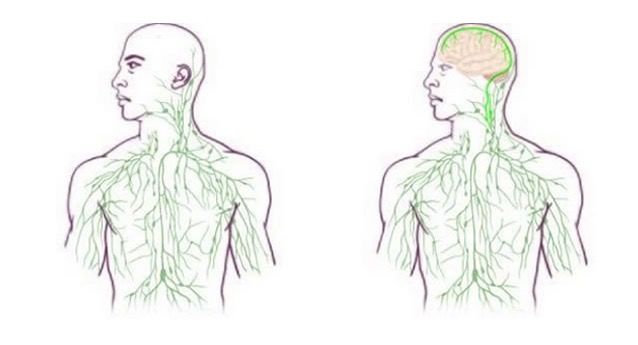
Vessels discovered in the brain that were thought not to exist — could revolutionise study of neurological diseases like Alzheimer's.

The brain is directly connected to the immune system by vessels previously thought not to exist, new research reports.The finding means the textbooks will have to be rewritten.Discovery of the vessels may also revolutionise the study of neurological diseases like Alzheimer's and autism.

Professor Jonathan Kipnis, who led the research, was initially sceptical about the results:

"I really did not believe there are structures in the body that we are not aware of.I thought the body was mapped.I thought that these discoveries ended somewhere around the middle of the last century.But apparently they have not."
The vessels are located in the meninges — the membrane that surrounds the brain and spinal cord. The vessels run near major blood vessels, which partly explains why they have been so difficult to find.

The left-hand image below shows the old map of the lymphatic system and the updated version is on the right. 

Image
© University of Virginia Health System

The discovery will likely have profound implications for how scientists study the neuro-immune system, Professor Kipnis said:
"Instead of asking, 'How do we study the immune response of the brain?' 'Why do multiple sclerosis patients have the immune attacks?' now we can approach this mechanistically.
Because the brain is like every other tissue connected to the peripheral immune system through meningeal lymphatic vessels.
It changes entirely the way we perceive the neuro-immune interaction.We always perceived it before as something esoteric that can't be studied. But now we can ask mechanistic questions.

We believe that for every neurological disease that has an immune component to it, these vessels may play a major role. Hard to imagine that these vessels would not be involved in a [neurological] disease with an immune component. In Alzheimer's, there are accumulations of big protein chunks in the brain.We think they may be accumulating in the brain because they're not being efficiently removed by these vessels."
The study was published in the journal Nature (Louveau et al., 2015). 


Tuesday, 12 May 2015

One step closer to artificial intelligence: Scientists create cells replicating human brain processes

RT
 
Australian scientists have for the first time developed an electronic long-term memory cell that mimics the work of a human brain. Researchers say the discovery is a step towards creating a bionic brain.

Researchers from the Royal Melbourne Institute of Technology (RMIT) have created the world’s first electronic multi-state memory cell which mirrors the brain’s ability to simultaneously process and store multiple strands of information, according to the university’s press-release. 

The groundbreaking discovery was recently published in the materials science journal Advanced Functional Materials. 

The device which is 10,000 times thinner than a human hair is a “vital step towards creating a bionic brain,” the scientists said. 

Read more

Thursday, 20 November 2014

Brain decoder can eavesdrop on your inner voice

New Scientist 

TALKING to yourself used to be a strictly private pastime. That’s no longer the case – researchers have eavesdropped on our internal monologue for the first time. The achievement is a step towards helping people who cannot physically speak communicate with the outside world.

“If you’re reading text in a newspaper or a book, you hear a voice in your own head,” says Brian Pasley at the University of California, Berkeley. “We’re trying to decode the brain activity related to that voice to create a medical prosthesis that can allow someone who is paralysed or locked in to speak.”

When you hear someone speak, sound waves activate sensory neurons in your inner ear. These neurons pass information to areas of the brain where different aspects of the sound are extracted and interpreted as words.

In a previous study, Pasley and his colleagues recorded brain activity in people who already had electrodes implanted in their brain to treat epilepsy, while they listened to speech. The team found that certain neurons in the brain’s temporal lobe were only active in response to certain aspects of sound, such as a specific frequency. One set of neurons might only react to sound waves that had a frequency of 1000 hertz, for example, while another set only cares about those at 2000 hertz. Armed with this knowledge, the team built an algorithm that could decode the words heard based on neural activity alone.

Read more


Sunday, 9 November 2014

X-Men mind control becomes a reality

Comment: And since we are ruled by benevolent beings with our best interests at heart we have nothing to worry about right? And combine it with other technologies and the emerging SMART societies that should all make us sleep soundly at night...

-----------------------------------

The Telegraph

Taking control of another person’s body with your mind is something that has been long dreamed of in comic books and films like X Men, but now scientists have achieved it in real life. 

Researchers used electromagnets and computers to transmit a person’s brainwaves allowing them to control the hand of another sitting in a different building one mile away.

The technology recorded the brain signals from a computer gamer and then fired them into the brain of another volunteer, triggering the nerves that controlled their hand muscles.

This allowed the gamer, who had no physical computer controls themselves, to use the other person to play a computer game.

Read more

Saturday, 9 August 2014

IBM Develops a New Chip That Functions Like a Brain

New York Times

Inspired by the architecture of the brain, scientists have developed a new kind of computer chip that uses no more power than a hearing aid and may eventually excel at calculations that stump today’s supercomputers.

The chip, or processor, is named TrueNorth and was developed by researchers at IBM and detailed in an article published on Thursday in the journal Science. It tries to mimic the way brains recognize patterns, relying on densely interconnected webs of transistors similar to the brain’s neural networks.

The chip’s electronic “neurons” are able to signal others when a type of data — light, for example — passes a certain threshold. Working in parallel, the neurons begin to organize the data into patterns suggesting the light is growing brighter, or changing color or shape.

The processor may thus be able to recognize that a woman in a video is picking up a purse, or control a robot that is reaching into a pocket and pulling out a quarter. Humans are able to recognize these acts without conscious thought, yet today’s computers and robots struggle to interpret them.

Read more
 
Related Posts Plugin for WordPress, Blogger...