Search This Blog

Showing posts with label Coloured Revolution. Show all posts

Friday, 4 May 2018

What’s Washington Really Doing in Armenia?

F. William Engdahl
New Eastern Outlook


There has been considerable speculation in recent days as to whether the recent and ongoing protests across former Soviet Armenia constitute another Washington Color Revolution destabilization or whether it represents simply the angry revolt of citizens fed up with the deep corruption and lack of economic development under the regime of Prime Minister Serzh Sargysan. Following days of large protests, the former President was forced to resign on April 23, declaring, “Nikol Pashinyan was right. I was wrong.” Armenia is an integral member of Russia’s Eurasian Economic Union and were it to come under control of a pro-NATO opposition could bring a strategic problem for Moscow to put it mildly. The issue is significant. 

Ironically, what nominally sparked the protests was the action of Sargysan to in effect do what Turkey’s Erdogan has done, only in reverse. He and his parliamentary majority party managed to strip the office of President of almost all but ceremonial roles, while giving actual decision powers to the office of Prime Minister. That he managed just before he himself became Prime Minister. Reaction from Moscow to the ongoing protests until now has evidently been muted following a statement that it won’t get involved in Armenian internal affairs.

At this point, despite the fact that Sargysan resigned as Prime Minister and did not submit himself as candidate to oppose Pashinyan in the May 1 parliament vote, Pashinyan fell short of the majority needed to be named Prime Minister. As of this writing he has called for a total blockage of traffic and government buildings by “peaceful acts of civil disobedience.” He told a crowd outside Parliament after the failed vote was announced, “Tomorrow total strike is declared. We block all the streets, communications, subway and the airports starting from 08:15. Our struggle cannot end in a failure.” 

Color Revolution? 

What evidence points to a directed Washington intervention into a country strategic for Moscow? First we have the established presence of an office in Yerevan of the Open Society Foundations-Armenia of George Soros. As the anti-government protests built in size on April 17, several NGOs signed an open letter to the government warning that they had identified probable government-backed protest disruptors and warned against their deployment against the peaceful protestors.

The call was signed among others by Helsinki Committee of Armenia, part of Helsinki Committees which in part is funded by George Soros’ Open Society Foundations. The call was also signed by Soros’ Open Society Foundations – Armenia.

Thursday, 31 August 2017

Violent "Color Revolution" in America? Attempted overthrow of Trump threatens to shred fabric of American society

Larry Chin
Global Research


What is now unfolding in America is a process of engineered dissent which is controlled by the corporate elites. This process precludes the formation of a real mass movement against racism, social injustice and US led wars.

This article by Larry Chin analyzes how the elite opponents of Donald Trump are manipulating public opinion with the support of the mainstream corporate media. Through staged protest events funded by corporate foundations, the unspoken objective is to create profound divisions within American society. These divisions preclude the formation of a meaningful and united protest movement.

The objective of these staged protest movements against Trump is not to support democracy. Quite the opposite. It is to ensure complete control over the US State apparatus by a competing faction of the corporate establishment. Where is the US antiwar movement? Rarely are these engineered protests against US led wars.

A grassroots and united movement against the Trump presidency and the Neocons, against war and social injustice is what has to be achieved. But this will not occur when several of the organizations which are leading the protest against Trump are supported and funded by Wall Street.


Michel Chossudovsky, Global Research 2017
***
A race war and a civil war are being incited by the US political establishment and Deep State opponents of Donald Trump, in order to foment violence towards Trump's removal from the White House. The events in Charlottesville, together with "Russia-Gate" are being used as a "defining moment of crisis" and a pretext to justify Trump's overthrow.

Turning American streets into war zones

America has never faced chaos of this nature in modern times: manufactured domestic political terrorism disguised as civil unrest, masking a coup. The stated goal of the agitators is "mass insurrection"and "all forms of violence" to make the country "ungovernable"

Just as the global "war on terrorism" is a criminality and treason disguised as "freedom fighting" and "the defense of liberty", this war against Trump, labelled as the "new Hitler", is part of an unfolding domestic terror operation, which ironically utilizes the propaganda techniques of Hitler and the Third Reich (Goebbels), not to mention the anarchist playbook of Saul Alinsky (and, by extension, Hillary Clinton and Barack Obama, both of whom are Alinsky disciples). (See also Ben Carson quoted in the Washington Post, "Hillary Clinton, Saul Alinsky and Lucifer, explained", July 20, 2015)

From the violence and propaganda brainwashing to the manipulation and destruction of culture and history (statues and monuments, etc.). what is unfolding is a repeat of familiar institutional terror.

Goals are achieved through the weaponization and mobilization of indoctrinated and deceived masses as well as grassroots activists, coupled with mind-controlled authoritarian thugs.

The larger "resistance" features a toxic combination of professional paid anarchists, brainwashed "social justice warriors", and deluded protestors who are misinformed and invariably ignorant as to who is supporting and funding the "protest movements". There is no rational conversation to be had, no reasoning, in such an atmosphere of ginned-up hysteria.

This large-scale extortion aims to devastate the United States from within, forcing Trump out of office. An already deeply divided and confused nation with an already shredded social fabric will be torn apart.

The mainstream corporate media, the engineers of delusion and mob-manipulating propaganda, is ginning it up, creating mass hysteria and mental affliction.

What is taking place is not simple protests from supporters of a losing political faction, but a domestic terrorism operation planned and executed by the establishment majority-supported by neoliberals as well as neoconservative Republicans-in defense of their system against perceived existential threat from anti-establishment movements. Mob violence has always been a weapon of the oligarchy. It was inaccurate and tactically stupid for Trump to call this insurrection "Alt-Left". It is in fact a mainstream establishment operation, which uses "left", "progressive" and antifa symbols to pursue its political objectives.

The ultimate objective is to create social divisions which prevent the development of a real and independent mass protest movement against the seats of corporate power.

This "chaos agenda"is a "color revolution". The elites and Deep State figures behind today's American anarchy are the same ones that funded and orchestrated "color revolutions" around the world, the toppling of Ukraine and the installation of the Ukrainian neo-Nazi Svoboda regime, unrest in Turkey, the destabilization of Syria, the European refugee crisis, and the Arab Spring. What worked overseas is now being applied within US borders.

The Purple Revolution began the night Trump won the presidential election that foiled the installation of Hillary Clinton. This warfare has escalated and intensified in the months ever since, culminating with Charlottesville.

The increasingly failing Trump/Russian hack narrative is being replaced by a variation on an old theme: Nazis. "Trump is a Nazi". Nazis must die.

Trump's repeated denials and long history of standing against Nazis, the KKK and white supremacists, and having nothing to do with them, are to no avail. 


Read more

Friday, 17 February 2017

The Swamp Strikes Back

Pepe Escobar
Sputnik


The tawdry Michael Flynn soap opera boils down to the CIA hemorrhaging leaks to the company town newspaper, leading to the desired endgame: a resounding victory for hardcore neocon/neoliberalcon US Deep State factions in one particular battle. But the war is not over; in fact it's just beginning.

Even before Flynn's fall, Russian analysts had been avidly discussing whether President Trump is the new Viktor Yanukovych — who failed to stop a color revolution at his doorstep. The Made in USA color revolution by the axis of Deep State neocons, Democratic neoliberalcons and corporate media will be pursued, relentlessly, 24/7. But more than Yanukovych, Trump might actually be remixing Little Helmsman Deng Xiaoping: "crossing the river while feeling the stones". Rather, crossing the swamp while feeling the crocs.
Flynn out may be interpreted as a Trump tactical retreat. After all Flynn may be back — in the shade, much as Roger Stone. If current deputy national security advisor K T McFarland gets the top job - which is what powerful Trump backers are aiming at - the shadowplay Kissinger balance of power, in its 21st century remix, is even strengthened; after all McFarland is a Kissinger asset.

This call won't self-destruct in five seconds


Flynn worked with Special Forces; was head of the Defense Intelligence Agency (DIA); handled highly classified top secret information 24/7. He obviously knew all his conversations on an open, unsecure line were monitored. So he had to have morphed into a compound incarnation of the Three Stooges had he positioned himself to be blackmailed by Moscow.
What Flynn and Russian ambassador Sergey Kislyak certainly discussed was cooperation in the fight against ISIS/ISIL/Daesh, and what Moscow might expect in return: the lifting of sanctions. US corporate media didn't even flinch when US intel admitted they have a transcript of the multiple phone calls between Flynn and Kislyak. So why not release them? Imagine the inter-galactic scandal if these calls were about Russian intel monitoring the US ambassador in Moscow. 

Read more

Thursday, 10 September 2015

The rise of the neocon strategy of regime change and the destabilization of Europe

Robert Parry
Consortium News

The refugee chaos that is now pushing deep into Europe - dramatized by gut-wrenching photos of Syrian toddler Aylan Kurdi whose body washed up on a beach in Turkey - started with the cavalier ambitions of American neocons and their liberal-interventionist sidekicks who planned to remake the Middle East and other parts of the world through "regime change."

Instead of the promised wonders of "democracy promotion" and "human rights," what these "anti-realists" have accomplished is to spread death, destruction and destabilization across the Middle East and parts of Africa and now into Ukraine and the heart of Europe. Yet, since these neocon forces still control the Official Narrative, their explanations get top billing - such as that there hasn't been enough "regime change."

For instance, The Washington Post's neocon editorial page editor Fred Hiatt on Monday blamed "realists" for the cascading catastrophes. Hiatt castigated them and President Barack Obama for not intervening more aggressively in Syria to depose President Bashar al-Assad, a longtime neocon target for "regime change."

But the truth is that this accelerating spread of human suffering can be traced back directly to the unchecked influence of the neocons and their liberal fellow-travelers who have resisted political compromise and, in the case of Syria, blocked any realistic efforts to work out a power-sharing agreement between Assad and his political opponents, those who are not terrorists.

In early 2014, the neocons and liberal hawks sabotaged Syrian peace talks in Geneva by blocking Iran's participation and turning the peace conference into a one-sided shouting match where U.S.-funded opposition leaders yelled at Assad's representatives who then went home. All the while, the Post's editors and their friends kept egging Obama to start bombing Assad's forces.

The madness of this neocon approach grew more obvious in the summer of 2014 when the Islamic State, an Al Qaeda spinoff which had been slaughtering suspected pro-government people in Syria, expanded its bloody campaign of beheadings back into Iraq where this hyper-brutal movement first emerged as "Al Qaeda in Iraq" in response to the 2003 U.S. invasion.

It should have been clear by mid-2014 that if the neocons had gotten their way and Obama had conducted a massive U.S. bombing campaign to devastate Assad's military, the black flag of Sunni terrorism might well be flying above the Syrian capital of Damascus while its streets would run red with blood.

But now a year later, the likes of Hiatt still have not absorbed that lesson — and the spreading chaos from neocon strategies is destabilizing Europe. As shocking and disturbing as that is, none of it should have come as much of a surprise, since the neocons have always brought chaos and dislocations in their wake.

When I first encountered the neocons in the 1980s, they had been given Central America to play with. President Ronald Reagan had credentialed many of them, bringing into the U.S. government neocon luminaries such as Elliott Abrams and Robert Kagan. But Reagan mostly kept them out of the big-power realms: the Mideast and Europe.

Those strategic areas went to the "adults," people like James Baker, George Shultz, Philip Habib and Brent Scowcroft. The poor Central Americans, as they tried to shed generations of repression and backwardness imposed by brutal right-wing oligarchies, faced U.S. neocon ideologues who unleashed death squads and even genocide against peasants, students and workers.

The result - not surprisingly - was a flood of refugees, especially from El Salvador and Guatemala, northward to the United States. The neocon "success" in the 1980s, crushing progressive social movements and reinforcing the oligarchic controls, left most countries of Central America in the grip of corrupt regimes and crime syndicates, periodically driving more waves of what Reagan called "feet people" through Mexico to the southern U.S. border. 

Read more
 

Friday, 28 August 2015

Color Revolution In Lebanon Designed To Weaken Hezbollah, Syria, Iran

Brandon Turbeville

During the past week, demonstrations in Lebanon over uncollected garbage have descended into violent clashes between protesters and police. Masses of demonstrators have swelled in the streets of Beirut in a movement now being deemed the “You Stink!” movement.
With these developments suddenly taking place in Lebanon and, with taking the Syrian crisis into context and the Iranian nuclear deal in the background, it is reasonable to question whether or not these protests are a legitimate expression of discontent with an inefficient government or whether it is the product of a Western-backed color revolution aimed at destabilizing Lebanon – particularly Hezbollah – and further weakening the “Shiite Arch of Influence.”

When attempting to analyze events in Lebanon, like much of the Middle East, very little could be considered simple. Lebanon has been racked with economic depression, cultural tensions, color revolutions, civil war and civil war brinkmanship, and terrorism for decades. It has also been the target of outside forces for many years.

The Background

The issue of trash pickup – the issue around which the protests began – was entirely a legitimate issue. Squabbling within the Lebanese government has resulted in gridlock on issues such as the disposal of garbage and the economic crisis has brought funding of garbage disposal into question. Likewise, when the government brought up the idea of the privatization of trash disposal services, Lebanese erupted in anger understanding that privatization would mean higher prices, poorer service, and even less accountability. 


Already suffering from the effects of the world economic depression, Lebanon’s main source of national income – tourism and banking – have seen drastic reductions due to the crisis in Syria and the spillover of fighting across the border. An increase of Syrian refugees alongside Palestinian refugees already inside the country’s borders have also taxed the social fabric and the social safety net system in Lebanon. As Andrew Korybko points out in his article “Lebanon’s Future Is On The Line, And It Directly Affects Syria,” Lebanon’s high debt-to-GDP ratio is one of the world’s highest standing at 143% and the unemployment rate among young people in Lebanon stands officially at 34%.

The economic crisis has become so strained that Prime Minister Tammam Salam recently announced that the government might not be able to pay salaries to workers as early as next month.

Lebanon is also in the middle of an acute political crisis, having been without a President since May 2014, after the previous Presidential term ended. In addition, Prime Minister Salam has hinted that he will resign if political gridlock continues. This resignation would only add to the tensions in Lebanon since the Prime Minister appoints the President. Salam’s resignation would throw Lebanon into a Constitutional crisis on top of the protests, terrorism, and economic hardship.

As Korybko writes, the political situation as it currently stands in Lebanon suggests that one of two men – Michael Aoun and Samir Geagea – have the potential to be president. Both men seem to represent the main “trans-religious political coalitions.”

Aoun is allied with Hezbollah while Geagea is tied to a former Prime Minister Saad Hariri, a Lebanese-Saudi billionaire. Wikileaks cables released coming from the Saudi Foreign Ministry suggests that Hariri still maintains connections and contacts with Saudi intelligence and the Saudi royal family. The connections are deep enough that Hariri once thought it a reasonable proposition to ask the Saudis to fund his political party. 


Read more
 

Saturday, 31 January 2015

Ten reasons why Victoria Nuland should be seen as Stalin of today

Vladimir Golstein
Russia Insider


10. Both use made up names. Stalin's family name was Jugashvilli, Nuland's ancestor's name was Nudelman. The ancestors of both Nuland and Stalin came from the Russian empire, which probably gave them both the idea that they have a special knowledge of how to handle Russia.

9. Nuland's right hand man happens to be her husband, Robert Kagan. Stalin's right hand man was a fellow communist, named Lazar Kagan(ovich). Kagan co-authored "Project for a New American Century" and he obviously wants to realized his vision for Ukraine by implementing what might be called, "amerikanizatsiia," that is, the process of bringing in the officials from US and other countries to run Ukraine along the American lines. In his turn, Kaganovich was the First Secretary of the Communist Party of the Ukrainian SSR from 1925-1928 and was expected to usher in "New Soviet Century" through the politics of "ukrainizatsiya": creating a new ruling Soviet elite for Ukraine, the elite brought in primarily from other places.

8. Both are clear ideologues: Nuland of "neocon movement", Stalin of bolshevism. Both went to schooling with the masters and chief ideologues. Nuland worked closely with Rumsfeld and Cheney, starting as Vice President's senior aide, and eventually serving as his deputy national security adviser. In his essay for Financial Times, Geoff Dyer quotes an former colleague in the Obama administration State Department , who observed that "I have no doubt that when she sits down for a family dinner, she is the biggest neocon at the table." While Lenin's widower, Krupskaia, joked that had Lenin re-appeared when Stalin was already in charge, he would have had Lenin put to jail for deviating from the party course.

7. Both are willing to see through numerous deaths in Ukraine to get the territory under their influence. Stalin together with Kaganovich unleashed forced collectivization upon Ukraine, resulting in mass death of peasants, known as Holodomor. Nuland's and her fellow neocons' forced "americanization" resulted in the civil war between Donbass and Kiev, that so far has claimed thousands of lives, destroyed infrastructure, and produced hundreds of thousands of refugees.

6. They both tend to be aggressive and demanding and refuse to take no for an answer. Consequently, they prefer to squeeze their opponents till they break. Geoff Dyer's quotes Dimitri Simes, president of the Center for the National Interest in Washington DC who observed: "It is clear that her whole approach is to push Russia so hard that it has no choice but to accommodate the US." Stalin's ability to squeeze his opponents is, of course, proverbial.

5. According to Stalin's critic, Abdurakhman Aftorkhanov, Stalin made two mistakes during the WWII. He showed Europe to Russians (soldiers who saw how prosperous it was and realized that they were duped). And he showed Russians to Europe - which got scared, and started NATO, and other programs. The fate of Russia and the rest of the world has changed as the result of these mistakes. Someday, Nuland's critics will charge her with accomplishing a similar feat. She has fully exposed to the Western world Ukraine's lawlessness, corruption, and neofascism. And she has amply demonstrated Western World to both Ukrainians and Russians, who will never trust it again: seeing its unscrupulous meddling into their affairs.

4. Both are too arrogant and impatient to waste their time of diplomacy, and prefer to cut to the chase. They dismiss the possible opposition or obstacles with the similar terms. "F..k EU," famously observed Nuland, in response to the questions about EU attitude toward the regime change in Ukraine. Stalin never hesitated to resort to the foul language, calling Lenin's wife, "syphilitic whore," or bragging that in the course of WWII he managed to outsmart Great Britain: "Stalin could always raise a laugh from his courtiers by saying, as he often did: 'We f***ed England!'"

3. Both prefer to rule by decree and appoint the people to the offices. While Nuland boldly proclaimed from the comfort of her office that Yatseniuk will be the future leader of Ukraine: "Yats is the man," Stalin, of course, went even further, not only assigning Kaganovich, Khrushchev, and others to run Ukraine, but threating Lenin's widow, Krupskaia, that if she continues to challenge him, he'll appoint another woman as Lenin's widow.

2. Similarly to Stalin, who for the sake of strategic purposes made the deal with Nazis (Ribbentrop), Nuland held various meetings with Ukraine's Right Sector and other ultra-nationalist, neo-fascist organizations; and seems to be very cozy with Svoboda leader, Oleh Tyahnybok.

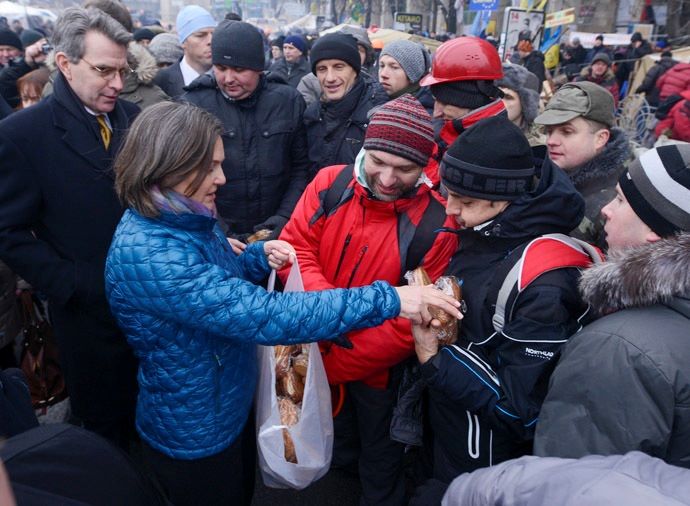
1. And finally, both Stalin and Nuland tend to present themselves in stunning visual imagery as the good caring parents of the new nation, easily duping the gullible locals. Here is Stalin surrounded by admiring Soviet children who are forever grateful to him for their happy childhood, and here is Nuland, surrounded by happy Ukrainians, whom she feeds with pastry as they are ready to embark on the path toward the new statehood.


Saturday, 20 December 2014

Head of Stratfor, ‘Private CIA,’ Says Overthrow of Yanukovych Was ‘The Most Blatant Coup in History’

Blacklisted News

In a December 19th interview in the Russian magazine Kommersant, George Friedman, who is the Founder and CEO of Stratfor, the ‘Shadow CIA’ firm, says of the overthrow of Ukraine’s President Viktor Yanukovych that occurred on February 22nd of 2014: “It really was the most blatant coup in history.” Perhaps he is saying this because of the videos that were uploaded to the Web which showed it to be so, but this statement by him contradicts the description that is asserted by the U.S. White House and the European Union, and the Western press, which description is that Yanukovych’s overthrow was instead just the result of the U.S. Government’s $5+ billion expense since 1991 to establish ‘democracy’ in Ukraine

Friedman further says that “The Russian authorities can not tolerate a situation in which western armed forces will be [in Ukraine] a hundred kilometers from Kursk or Voronezh [in Russia]”, and that the goal of the U.S. is to “maintain the balance of power in Europe, helping the weaker party,” which he says is Europe. He furthermore says, “The United States considers the most dangerous potential alliance to be between Russia and Germany. This would be an alliance of German technology and capital with Russian natural and human resources.” So: the U.S. is trying to antagonize Germans against Russia. This will weaken both of them. However, that would be not a “balance of power” but an increasing imbalance of power in favor of the United States. The Russian interviewer failed to catch his inconsistency on that.

Friedman was consistent with the U.S. Government’s line that Russia is a threat to the U.S.; he said: “No American president can afford to sit idly by if Russia becomes more and more influential.” He said that this is especially the case in the Middle East, and regarding Syria. But he then clarified himself, “I’m not saying that Russia’s intervention in the Syrian conflict was the cause of the Ukrainian crisis, it would be a stretch.” Regarding Ukraine, he said: “The bottom line is that the strategic interests of the United States are to prevent Russia from becoming a hegemon. And the strategic interests of Russia are not to allow the US close to its borders.” He avoided even to mention the United States as possibly being a “hegemon” itself, one which is trying, along with its NATO allies, to crush Russia for its resisting America’s hegemony — that is, global dominance by America’s aristocracy.

Read more
 

Friday, 19 December 2014

Lavrov: US is organizing a coup d'etat in Russia

Ukrainia

Russia’s foreign minister said that the US is stoking regime change in Russia with its sanctions.

There are serious reasons to believe that the US is using its sanctions in an attempt to destabilize Russia and change its current political system, Foreign Minister Sergei Lavrov said in an interview to France 24. 

"I have serious reasons to believe that it is so. Some politicians don't even hide the fact," Lavrov said answering a question. 

He said Russia would not only survive the sanctions but would come out even stronger afterward. 

"As Vice President Biden said publicly, it was the US that ordered Europe to join sanctions against Russia," Lavrov said. "Unfortunately, for several years we overestimated the independence of the EU and several major European countries. This is geopolitics."

Lavrov recalled that several times in its history Russia had been in much worse situations but had always emerged stronger.  


Monday, 15 December 2014

USAID Exposed in Cuba - What it Tells Us About US Subversion Worldwide

Anthony Cartalucci
Land Destroyer

Revealed in an Associated Press (AP) investigation, the United States Agency for International Development (USAID) had for two years attempted to create and exploit a social network within Cuba for the purpose of sparking unrest and overthrowing the Cuban government. The program was an abject failure, primarily because the Cuban government took the necessary measures to investigate, interrogate, and otherwise disrupt what was foreign-backed sedition.
AP would reveal in its report titled, "US co-opted Cuba's hip-hop scene to spark change," that:

The program is laid out in documents involving Creative Associates International, a Washington, D.C., contractor paid millions of dollars to undermine Cuba's communist government. The thousands of pages include contracts, emails, preserved chats, budgets, expense reports, power points, photographs and passports. 
The work included the creation of a "Cuban Twitter" social network and the dispatch of inexperienced Latin American youth to recruit activists, operations that were the focus of previous AP stories.
Far from the first time USAID and other US organizations claiming to be aiding in development but in fact engaged in political subversion, the Cuban program itself was based on another US-backed program used to topple the government of Serbia in 2000, AP would reveal.
The USAID operation involved money covertly funneled into Cuba through front companies and offshore banks. USAID, despite the evidence, has wholly denied the operation, as has other US organizations caught in blatant political subversion.
 

Read more


Friday, 29 August 2014

Sunday, 29 June 2014

“Color Revolutions”: US State Department Document Confirms Regime Change Agenda in the Middle East

Global Research
via Middle East Briefing

The Obama Administration has been pursuing a policy of covert support for the Muslim Brotherhood and other insurgent movements in the Middle East since 2010.  MEB has obtained a just-released U.S. State Department document through a Freedom of Information Act lawsuit that confirms the Obama Administration’s pro-active campaign for regime change throughout the Middle East and North Africa region. 

The October 22, 2010 document, titled “Middle East Partnership Initiative: Overview,” spells out an elaborate structure of State Department programs aimed at directly building “civil society” organizations, particularly non-governmental organizations (NGOs), to alter the internal politics of the targeted countries in favor of U.S. foreign policy and national security objectives.

The five-page document, while using diplomatic language, makes clear that the goal is promoting and steering political change in the targeted countries:

“The Middle East Partnership Initiative (MEPI) is a regional program that empowers citizens in the Middle East and North Africa to develop more pluralistic, participatory, and prosperous societies.  As the figures in this overview illustrate, MEPI has evolved from its origins in 2002 into a flexible, region-wide tool for direct support to indigenous civil society that mainstreams that support into the daily business of USG diplomacy in the region.  MEPI engages all the countries of the NEA region except Iran.  In the seven of NEA’s eighteen countries and territories with USAID missions, country-level discussions and communication between MEPI and USAID in Washington ensure that programming efforts are integrated and complementary.”

In a section of the document titled “How MEPI Works,” three core elements of the program were spelled out:  region-wide and multi-country programming, local grants, and country-specific projects.  The objectives of the region-wide and multi-country programming were described as:

“builds networks of reformers to learn from and support one another, and to catalyze progressive change in the region.”  The local grants “provide direct support to indigenous civic groups, and now represent more than half of MEPI’s projects.”

Under the country-specific aspect of the program, designated officers of the U.S. embassies manage the funding and work as direct liaisons to the various funded local NGOs and other civil society groups.   The “country-specific projects” are tasked “to respond to local developments and local needs, as identified by our embassies, local reformers, and our own field analysis.  Political developments in a country may produce new opportunities or challenges for USG policy goals, and MEPI will shift funds to respond to these needs.”

According to the October 2010 document, the Deputy Chief of Mission (DCM) at every U.S. embassy in the MENA (Middle East/North Africa) is in charge of the MEPI program, giving it a clear high priority.  The document makes clear that the Middle East Partnership Initiative is not coordinated with host governments:

“MEPI works primarily with civil society, through NGO implementers based in the United States and in the region.  MEPI does not provide funds to foreign governments, and does not negotiate bilateral assistance agreements.  As a regional program, MEPI can shift funds across countries and to new issue-areas as needed.”

The document makes clear that special priority, as early as 2010, was given to Yemen, Saudi Arabia, Tunisia, Egypt and Bahrain, and that project headquarters in Abu Dhabi and Tunis were overall coordinating centers for the entire regional program.  Within a year of its inception, Libya and Syria were added to the list of countries on the priority list for civil society intervention.

The State Department document was released as part of an FOIA suit focused on Presidential Study Directive 11, which remains classified “secret” and has not yet been released to the public.  According to MEB sources, PSD-11 spelled out the Obama Administration’s plans to support the Muslim Brotherhood and other allied “political Islam” movements believed at the time to be compatible with U.S. foreign policy objectives in the region.

The MEPI is currently directed by Paul Sutphin, who was previously U.S. consul general in Erbil, Iraq and more recently, Director of the Office of Israel and Palestinian Affairs at the State Department’s Bureau of Near Eastern Affairs.  His deputy is Catherin Bourgeois, who was first assigned to MEPI in February 2009 as Division Chief of Policy and Programming.  Her past State Department assignments have involved the development of Information Technology uses in advancing U.S. foreign policy goals.

Two other senior State Department officials have overseen the development and expansion of the program since the drafting of the October 2010 MEPI document, spelling out its transformation into a regime-change force.  Tomicah S. Tillemann is the Senior Advisor for Civil Society and Emerging Democracies, appointed to that post by then-Secretary of State Hillary Clinton in October 2010.  He remains in that post under Secretary John Kerry.  He was the founder of the Lantos Foundation for Human Rights and Justice, itself an NGO named after Tilleman’s grandfather, the former U.S. Congressman, Tom Lantos.

In September 2011, Ambassador William B. Taylor was appointed to head the then-newly established Office of the Special Coordinator for Middle East Transitions, after having served as the U.S. Ambassador to Ukraine during the “Orange Revolution” of 2006-2009.  According to a State Department paper:

“The Office of the Special Coordinator for Middle East Transitions (D/MET), established in September 2011, coordinates United States Government assistance to incipient democracies arising from popular revolts across the Middle East and North Africa (MENA) region.  The Special Coordinator for Middle East Transitions implements a coordinated interagency strategy to support designated MENA countries undergoing transitions to democracy—currently, Egypt, Tunisia, and Libya.”
The complete State Department documents released under the FOIA will soon be available as part of a comprehensive MEB Special Report now in production on the regime-change program and its consequences for the region.   For upcoming details on this report, check the MEB website.

Wednesday, 11 June 2014

Ukraine President Once Agent for U.S. State Department

ICH

Is he still working for his former masters in Washington, DC?

Two diplomatic messages from the WikiLeaks Public Library on U.S. Diplomacy indicate that newly elected President of Ukraine, Petro Poroshenko was an agent for United States State Department. A confidential message from the U.S. Embassy in Kiev on April 29, 2006 mentions the newly elected Ukraine president twice.


"During an April 28 meeting with Ambassador, Our Ukraine (OU) insider Petro Poroshenko emphatically denied he was using his influence with the Prosecutor General to put pressure on Tymoshenko lieutenant Oleksandr."

"During an April 28 meeting with Ambassador, Our Ukraine (OU) insider Petro Poroshenko denied that he was behind Prosecutor General Oleksandr Medvedko's recent decision to issue an arrest warrant for Tymoshenko lieutenant Oleksandr Turchynov. … [to] question him about the alleged destruction of SBU [Ukraine intel] files on organized crime figure Seymon Mogilievich." [Russian Mafia Boss of Bosses] WikiLeaks Public Library of U.S. Diplomacy

The motivation for alleged destruction of files appeared in an embassy message from April 14, 2006.

"-- The files contained information about Tymoshenko's cooperation with Mogilievich when she ran United Energy Systems in the mid-late 1990s." WikiLeaks

Yulia Tymoshenko, an aspiring oligarch, is the darling of the both the Bush and Obama administrations for her role in the 2004 Orange Revolution that brought the first modern anti-Russian Ukraine government to power. She helped negotiate the natural gas deals between Ukraine and Russia.

Read more


Friday, 9 May 2014

Putin offers Obama a gambit the latter cannot refuse

The Saker
The Vineyard of the Saker


 I have to admit that today's move by Putin caught me completely off-guard. My first impression was that by asking the folks in the Donbass to postpone the referendum, Putin was basically tossing aside a valuable bargaining chip. Even more disturbing was his apparent backing for the upcoming May 25th presidential election.

Let me also say, however, that the notion of Putin "caving in" never even crossed my mind if only because categories such as "caving in" are simply not applicable in the real world of international politics - they are only good for the talking heads on the Idiot Tube and their zombified audience.

But if Putin was not "caving in" - what in the world was he doing? I submit that what Putin did is give us his reply to yesterday's quiz. Remember what I wrote?

Let us assume that Russia does not intervene and that, with time and effort, the nationalists regain control of most of the eastern and southern Ukraine. Let is further assume that the referendum wanted by the Russian-speakers is either not held or ignored, while the Presidential election goes ahead and that Poroshenko or Tymoshenko get's "kind of elected" in a farcical election which, however, the USA and its EU protectorate will immediately recognize as "legitimate".
This is *exactly* the option chosen by Putin today. To see why, we have to look at this not from Moscow's perspective, but from Kiev's perspective. From the point of view of the junta this outcome looks something like this:
"So we have managed to get most of the East and South more or less under control. We have stopped the 'terrorists'' referendum and we got our leader Oligarchenko elected President in an election fully backed the US and Europe. What do we do next?"
This is when things get really interesting for a number of reasons. For one thing, the economy is completely dead and nobody, really nobody, has any idea as to what to do about it. Second, the degree of hatred between the western Banderastan and the eastern Donbass is at an all-time high and nobody has any idea as to how to make all these people coexist together. Third, and there are a lot of signs in Kiev and elsewhere that this is already beginning to happen, social unrest triggered by the economic collapse is going to go from bad to worse with each passing week. Fourth, now that the neo-Nazi thugs do not have a "patriotic" job to do anymore - what kind of "activities" will keep them busy next?

There is a well-known experiment in psychology: you put two rats into a cage and you start giving them electrical shocks (though a grid in the cage floor). You know what they do? They immediately attack each other. Pain makes them do that - they strike out at the only enemy they see.

So just imagine the utter chaos which will take place this summer all over the Ukraine.

Now add to that the fact that the Ukraine will desperately need Russian energy for which it is both unable and unwilling to pay.

To me, this picture does not look only bleak, it looks apocalyptic.

Now consider the very same picture from the US and EU's point of view.

First, it is pretty darn obvious that they, the US & EU, "own" the Ukraine (not Russia). They overthrew Yanukovich, they backed the neo-Nazis, they promised wealth and freedom to the Ukrainians if they sign the agreement with the EU and they put their full political weight behind President Oligarchenko and his government. Frankly, their best hope was to blame any and all problems on Russia, its "agents" in the Donbass and Moscow's support for the "terrorists". But now that this pretext is gone - whom shall they blame next?

Maybe each other?

I can already hear the outraged comments about how all this is just a cynical rationalization for the fact that "Russia has betrayed the Russian-speakers in the southeast". So let's talk about them.

I don't know about you - but I am personally unimpressed to say the least about the numbers of men who turned up to fight against the junta. Yes, some did and they are fighting hard but, again, this is not South Ossetia by a long shot. I did see small groups of determined men fighting back, but I did not see large hordes of infuriated miners organizing a mass demonstration or, even less so, attacking the junta's forces. Did you?

So where the hell is everybody? Sitting at home and waiting for the outcome?

Furthermore, and several commentators have pointed this out, it is rather dubious that the resistance leaders have the organizational skills to simultaneously fight the junta and organize a referendum.

Add to this a very real possibility that a non-trivial part of the population is rather lukewarm, undecided or otherwise wishy washy about staying in the Ukraine or not - and you have all the ingredients of an embarrassing PR disaster.

My personal (and highly subjective) feeling is that most folks in the Donbass would prefer to live without a neo-Nazi regime and get their pay in Rubles. But they also want some "Polite Armed Men in Green" to make that happen for them. And that is something Putin has no reason at all to agree to.

When I thought about submitting a quiz to you yesterday I had already firmly decided for myself that non-intervention was a much better option for both Russia and the Donbass. But when this evening I heard Putin I was totally caught off-guard and disturbed. It appeared to me that he was giving up important things for nothing and my instinctive knee-jerk reaction was, as always, to suspect the worst. But now that I had time to really think it over, what Putin is doing makes sense. Not only is he choosing the "no intervention" option (which I had expected him to do) - he is pro-actively contributing to that outcome (which I did not expect him to do at all). I had expected Russia to look "firm and stern" and not to yield on anything in order to maximize the uncertainty and anxiety of the US, EU and the freaks in power in Kiev. Also, I had not expected Putin to give the western propaganda machine such an fantastic opportunity to gloat, declare Russia a "paper tiger" and declare victory for Obama. But now that I think about that I find that a very sneaky move: let them gloat today - it will just make their inevitable fall tomorrow even much more painful to cope with.

In chess, this is called a "gambit". You accept the loss of a piece to win a positional advantage. Except that in chess your opponent has the option to decline the gambit whereas in this case the Empire has to accept it.

I should have known better since Putin had already done exactly that when the USA was about to attack Syria: he "gave up" the entire Syrian chemical weapons arsenal in exchange for a disruption in the AngloZionist Empire's momentum towards an attack on Syria. At the time his gambit was also greeted by a chorus of "the Russians caved in! they betrayed Assad!" and yet eight months later nobody can deny that Syria is winning the war.

I will tell you honestly that I hate gambits. In chess and in life. And when offered a gambit in chess I usually decline it. To me this is a profoundly counter-intuitive move.

I suspect that Putin must be a much better chess player then I am.

The Saker 

A deal between devils: The neo-Nazi element and the U.S.'s proxy war in Ukraine

sott.net
Joe Quinn

The US military hasn't actually been involved in an overt "war", in the traditional sense of a conflict between two mostly equally matched adversaries, since the end of the Korean war in 1953. As Col. Fletcher Prouty points out in his book JFK:The CIA, Vietnam, and the Plot to Assassinate John F. Kennedy, US soldiers in Vietnam were mainly fighting against 1 million North Vietnamese villagers who were 'deported' to the South (by the US Navy) where, like any dispossessed people, they resorted to theft to survive. These were the bulk of the 'Viet Cong' that the US military raped, tortured, napalmed and shot en masse. Every other US military and/or CIA 'adventure' from the 1960s until today (and there have been many) has involved one of the following three approaches:

A) a short-lived 'turkey shoot' against an impotent 'enemy' (see Iraq "war" 1, Libya 2011).

B) a protracted direct "war" of colonial expansion waged against an indigenous, largely civilian, population who resist occupation and plunder of their land (see Iraq "war" 2).

C) a 'proxy war', where paramilitary groups (either local or imported) are funded, trained and armed by CIA and US military 'advisers' (too many to list, but see here for a list) and fight local resistance groups on behalf of the USA.


Read More

Monday, 5 May 2014

Dozens Of CIA, FBI Agents "Advising Ukraine Government", German Press Reports

Zero Hedge

Now that the situation in Ukraine has officially been upgraded to “war”, what really happens on the ground will remain largely wrapped by the fog of war on either side, with just one thing assured: a war it may be but more than anything it is a proxy war – one in which both western and Russian interests are manifest in the fighting, and killing, of mostly innocent civilians in Ukraine – a carbon copy replica of what happened last year in Syria.   

What is very surprising is that Germany’s press is finally stepping away from the western media propaganda umbrella and starting to report the side of the narrative that is in direct opposition to US interests in either Ukraine, or Germany.

So just who, and why, is pulling the strings on Germany’s media outlets in a way that goes against the official Merkel fiction, if in agreement with Germany’s commercial and industrial interests (as well as those of Europe’s commission himself)?

And how soon before Germany’s position, one clearly against the imposition of further sanctions on Russia and the additional alienation of the Kremlin, puts Germany on direct collision course with Obama and the US state department? And what then: will Germany, shunned by the US, have no choice but to reallign with the ascendent Eurasian axis of China and Russia. Stay tuned.

Read more

Friday, 2 May 2014

Tuesday, 29 April 2014

The History and Science of Color Revolutions Part 4

Brandon Turbeville 
Activist Post

Eastern European, Slovac, and Middle Eastern nations are not the only targets of Anglo-American destabilization campaigns and color revolutions, particularly in recent years. South America, Asia, and even Russia have been and continue to be subject to Western meddling in their own internal affairs, with some of these mass mobilizations being more successful than others.


It is well-established that the entire “Arab Spring” uprising was nothing more than a Western-backed color revolution bolstered by many legitimate complaints of the subject populations yet instigated and guided by Anglo-Americans who have no interest in bringing these people real democracy or freedom. Instead, the teeming masses are nothing more than battering rams for an agenda they do not understand or even know exists.

As in the color revolutions of Eastern Europe and the Slovac world, the “Arab Spring” was engineered and controlled from the very beginning, with “freedom-spreading” organizations working on the ground to recruit, organize, train, and assist participants for the upcoming protests and destabilization. As Tony Cartalucci and Nile Bowie write in their e-book War on Syria: Gateway to WWIII,
One of the organizations involved in recruiting, training, and supporting youth activists ahead of the “Arab Spring” was described in an April 2011 New York Times article. The organization, Movements.org, or Alliance of Youth Movements, would later be described admitting to US funding and involvement in the “Arab Spring” uprisings. The article implicates Freedom House, the National Endowment for Democracy, and two of its satellite organizations, the International Republican Institute, and the National Democratic Institute, in recruiting, training, and supporting the unrest starting as early as 2008. While the New York Times article doesn’t mention the organization by name, it links to an official US State Department announcement titled, “Announcement on Alliance of Youth Movements Summit,” that most certainly does.[1] The Alliance of Youth Movements is a corporate-sponsored “coup college” of sorts, training activists to subvert and topple governments on the US State Department’s behalf.
Indeed, while the aforementioned New York Times article still attempts to obfuscate and cover for the NGOs in their role in the Arab Spring, and therefore does not reveal the extent to which they were responsible, it is surprisingly open regarding the role played by Western NGOs in the movement. The author of the article, Ron Nixon, writes,

But as American officials and others look back at the uprisings of the Arab Spring, they are seeing that the United States’ democracy-building campaigns played a bigger role in fomenting protests than was previously known, with key leaders of the movements having been trained by the Americans in campaigning, organizing through new media tools and monitoring elections.
A number of the groups and individuals directly involved in the revolts and reforms sweeping the region, including the April 6 Youth Movement in Egypt, the Bahrain Center for Human Rights and grass-roots activists like Entsar Qadhi, a youth leader in Yemen, received training and financing from groups like the International Republican Institute, the National Democratic Institute and Freedom House, a nonprofit human rights organization based in Washington, according to interviews in recent weeks and American diplomatic cables obtained by WikiLeaks.
The work of these groups often provoked tensions between the United States and many Middle Eastern leaders, who frequently complained that their leadership was being undermined, according to the cables.
The Republican and Democratic institutes are loosely affiliated with the Republican and Democratic Parties. They were created by Congress and are financed through the National Endowment for Democracy, which was set up in 1983 to channel grants for promoting democracy in developing nations. The National Endowment receives about $100 million annually from Congress. Freedom House also gets the bulk of its money from the American government, mainly from the State Department.
Readers of my “The History and Science Of Color Revolutions” series of articles should recognize at least three hallmarks of a destabilization campaign or color revolution – i.e. the presence of well-funded NGOs and Foundations, foreign training of activists and movement leaders, and election monitoring.

That being said, Nixon further explains the methods used by these organizations to instigate and promote the “Arab Spring” color revolution. He states,

Some Egyptian youth leaders attended a 2008 technology meeting in New York, where they were taught to use social networking and mobile technologies to promote democracy. Among those sponsoring the meeting were Facebook, Google, MTV, Columbia Law School and the State Department.
“We learned how to organize and build coalitions,” said Bashem Fathy, a founder of the youth movement that ultimately drove the Egyptian uprisings. Mr. Fathy, who attended training with Freedom House, said, “This certainly helped during the revolution.”
Ms. Qadhi, the Yemeni youth activist, attended American training sessions in Yemen.
“It helped me very much because I used to think that change only takes place by force and by weapons,” she said.
But now, she said, it is clear that results can be achieved with peaceful protests and other nonviolent means.
Although, in the end, many of the countries suffering under the “Arab Spring” did indeed dissolve into chaos and violence, it is important to remember the work of Gene Sharp and “nonviolence as a form of warfare.”

Nixon continues his explanation by writing,

Diplomatic cables report how American officials frequently assured skeptical governments that the training was aimed at reform, not promoting revolutions.
Last year, for example, a few months before national elections in Bahrain, officials there barred a representative of the National Democratic Institute from entering the country.
In Bahrain, officials worried that the group’s political training “disproportionately benefited the opposition,” according to a January 2010 cable.
In Yemen, where the United States has been spending millions on an anti-terrorism program, officials complained that American efforts to promote democracy amounted to “interference in internal Yemeni affairs.”
But nowhere was the opposition to the American groups stronger than in Egypt.
Egypt, whose government receives $1.5 billion annually in military and economic aid from the United States, viewed efforts to promote political change with deep suspicion, even outrage.
Hosni Mubarak, then Egypt’s president, was “deeply skeptical of the U.S. role in democracy promotion,” said a diplomatic cable from the United States Embassy in Cairo dated Oct. 9, 2007.
At one time the United States financed political reform groups by channeling money through the Egyptian government.
But in 2005, under a Bush administration initiative, local groups were given direct grants, much to the chagrin of Egyptian officials.
According to a September 2006 cable, Mahmoud Nayel, an official with the Egyptian Ministry of Foreign Affairs, complained to American Embassy officials about the United States government’s “arrogant tactics in promoting reform in Egypt.”
The main targets of the Egyptian complaints were the Republican and Democratic institutes. Diplomatic cables show that Egyptian officials complained that the United States was providing support for “illegal organizations.”
Gamal Mubarak, the former president’s son, is described in an Oct. 20, 2008, cable as “irritable about direct U.S. democracy and governance funding of Egyptian NGOs.”
The Egyptian government even appealed to groups like Freedom House to stop working with local political activists and human rights groups.
Clearly, the color revolution machine is not unique to Eastern Europe. Not only the theory, but the practical application of the color revolution and destabilization methodology extends across the world with the necessary networks already set in place with willing staff and plentiful funding.

Thus, the Anglo-European color revolution apparatus, relying heavily on the United States for coordination and funding, are traditionally the most successful players in the geopolitical game, at least in recent years.

Unfortunately, it is Americans that have typically fallen for every color revolution enacted overseas (and domestically) just as much as Eastern Europeans, Middle Easterners, and Africans have done.

The American people must quickly learn the formula behind color revolutions, destabilizations, and the agendas of the world oligarchy before it becomes too late for us all.

Notes:

 
[1] “Announcement on Alliance of Youth Movements Summit.” America.gov Archive, November 20, 2008.


The History and Science of Color Revolutions Part 3

Brandon Turbeville 
Activist Post

In my last article regarding the history and science of color revolutions, I attempted to demonstrate how the science of using mass movements of “swarming adolescents” to destabilize national governments and implement regime change is actually a well-established instrument of imperialist desires. In addition, the previous article also demonstrated the methodology of this type of attack in terms of the means of deployment and necessary components of the color revolution.


Yet, if one were to desire a case study in the art of color revolution and destabilization, then the case of Milosevic’s Serbia could easily be provided.


Indeed, Michael Dobbs of the Washington Post wrote an article in 2000 entitled, “U.S. Advice Guided Milosevic Opposition: Political Consultants Helped Yugoslav Opposition Topple Authoritarian Leader,” where he peripherally outlined the tactics used by the United States and NGOs in order to accomplish the desired regime change and the weakening of yet another target nation. This successful destabilization resulted in what Mowat deems in his excellent article “A New Gladio In Action,” “The Serbian Virus,” a domino effect of color revolutions in the Eastern European and Slavic countries.[1] Dobbs wrote,
U.S.-funded consultants played a crucial role behind the scenes in virtually every facet of the anti-Milosevic drive, running tracking polls, training thousands of opposition activists and helping to organize a vitally important parallel vote count. U.S. taxpayers paid for 5,000 cans of spray paint used by student activists to scrawl anti-Milosevic graffiti on walls across Serbia, and 2.5 million stickers with the slogan "He's Finished," which became the revolution's catchphrase.

Some Americans involved in the anti-Milosevic effort said they were aware of CIA activity at the fringes of the campaign, but had trouble finding out what the agency was up to. Whatever it was, they concluded it was not particularly effective. The lead role was taken by the State Department and the U.S. Agency for International Development, the government's foreign assistance agency, which channeled the funds through commercial contractors and nonprofit groups such as NDI and its Republican counterpart, the International Republican Institute (IRI).
While NDI worked closely with Serbian opposition parties, IRI focused its attention on Otpor, which served as the revolution's ideological and organizational backbone. In March, IRI paid for two dozen Otpor leaders to attend a seminar on nonviolent resistance at the Hilton Hotel in Budapest a few hundreds yards along the Danube from the NDI-favored Marriott.
During the seminar, the Serbian students received training in such matters as how to organize a strike, how to communicate with symbols, how to overcome fear and how to undermine the authority of a dictatorial regime. The principal lecturer was retired U.S. Army Col. Robert Helvey, who has made a study of nonviolent resistance methods around the world, including those used in modern-day Burma and the civil rights struggle in the American South.[2]
Those readers familiar with the methods used to deploy a successful color revolution will immediately recognize three aspects of Dobbs’ statement. First, the fact that U.S. organizations funded many of the activists directly and/or paid for supplies needed for guerrilla and overt activism on the ground. Second, that there was the clear existence of a parallel vote counting and reporting apparatus and, third, the involvement of individuals like Col. Robert Helvey.

Jonathan Mowat picks up the topic, particularly that of Helvey’s involvement and summarily documents the rest of the Serbian story in his own article by writing,

Helvey, who served two tours in Vietnam, introduced the Otpor activists to the ideas of American theoretician Gene Sharp, whom he describes as "the Clausewitz of the nonviolence movement," referring to the renowned Prussian military strategist.
Peter Ackerman, the above-mentioned [in his own article] coup expert, analyzed and popularized the methods involved in a 2001 PBS documentary-series and book, "A Force More Powerful: A Century of Nonviolent Conflict," together with retired US Airforce officer Jack DuVall. Focusing on youth organizing, they report:
After the NATO bombing, which had helped the regime suppress opposition, Otpor's organizing took hold with a quiet vengeance. It was built in some places around clubhouses where young people could go and hang out, exercise, and party on the weekends, or more often it was run out of dining rooms and bedrooms in activists' homes. These were "boys and girls 18 and 19 years old" who had lived "in absolute poverty compared to other teenagers around the world," according to Stanko Lazendic, an Otpor activist in Novi Sad. "Otpor offered these kids a place to gather, a place where they could express their creative ideas." In a word, it showed them how to empower themselves.
In addition, Otpor offered food, shelter, and entertainment to a portion of the population that was suffering from a tragic lack of those things. Otpor, as a heavily-funded organization, was thus able to gain the trust and allegiance - conditional as it may have been - of a substantial number of young Serbians.

Jonathan Mowat continues by writing,

Otpor's leaders knew that they "couldn't use force on someone who . . . had three times more force and weapons than we did," in the words of Lazendic. "We knew what had happened in. Tiananmen, where the army plowed over students with tanks." So violence wouldn't work—and besides, it was the trademark of Milosevic, and Otpor had to stand for something different. Serbia "was a country in which violence was used too many times in daily politics," noted Srdja Popovic, a 27 year-old who called himself Otpor's "ideological commissar." The young activists had to use nonviolent methods "to show how superior, how advanced, how civilized" they were.
This relatively sophisticated knowledge of how to develop nonviolent power was not intuitive. Miljenko Dereta, the director of a private group in Belgrade called Civic Initiatives, got funding from Freedom House in the U.S. to print and distribute 5,000 copies of Gene Sharp's book, "From Dictatorship to Democracy: A Conceptual Framework for Liberation." Otpor got hold of Sharp's main three-volume work, "The Politics of Nonviolent Action," freely adapting sections of it into a Serbian-language notebook they dubbed the "Otpor User Manual." Consciously using this "ideology of nonviolent, individual resistance," in Popovic's words, activists also received direct training from Col. Robert Helvey, a colleague of Sharp, at the Budapest Hilton in March 2000.

Helvey emphasized how to break the people's habits of subservience to authority, and also how to subvert: the regime's "pillars of support," including the police and armed forces. Crucially, he warned them against "contaminants to a nonviolent struggle," especially violent action, which would deter ordinary people from joining the movement: and alienate the international community, from which material and financial assistance could be drawn. As Popovic put it: "Stay nonviolent and you will get the support of the third party."
That support, largely denied to the Serbian opposition before, now began to flow. Otpor and other dissident groups received funding from the National Endowment for Democracy, affiliated with the U.S. government, and Otpor leaders sat down with Daniel Server, the program director for the Balkans at the U.S. Institute for Peace, whose story of having been tear-gassed during an anti-Vietnam War demonstration gave him special credibility in their eyes. The International Republican Institute, also financed by the U.S. government, channeled funding to the opposition and met with Otpor leaders several times. The U.S. Agency for International Development, the wellspring for most of this financing, was also the source of money that went for materials like t-shirts and stickers.
Yet the color revolution did not end with Serbia. With the small nation now under control and a successful destabilization having taken place, a large portion of the Slavic world and Eastern European bloc was now in the crosshairs of the Anglo-Americans.[3] This spread of the color revolution, organized and directed by the West from the word “go,” was the reason behind Mowat’s designation of the chain of events as the “Serbian Virus.” Very soon after Serbia was successfully overthrown, the color revolution motive move on to at least three more countries in Eastern Europe.

Mowat describes this situation as follows:

In the aftermath of the Serbian revolution, the National Endowment for Democracy, Albert Einstein Institution, and related outfits helped establish several Otpor-modeled youth groups in Eastern Europe, notably Zubr in Belarus in January 2001; Kmara in Georgia, in April 2003; and Pora in Ukraine in June 2004. Efforts to overthrow Belarus President Alexsander Luschenko failed in 2001, while the US overthrow of Georgian President Eduard Schevardnadze was successfully accomplished in 2003, using Kmara as part of its operation.
Commenting on that expansion, Albert Einstein staffer Chris Miller, in his report on a 2001 trip to Serbia found on the group's website, reports:
Since the ousting of Milosevic, several members of Otpor have met with members of the Belarusian group Zubr (Bison). In following developments in Belarus since early this year, It is clear that Zubr was developed or at least conceptualized, using Otpor as a model. Also, [Albert Einstein's report] From Dictatorship to Democracy is available in English on the Zubr website at www.zubr-belarus.com. Of course, success will not be achieved in Belarus or anywhere else, simply by mimicking the actions taken in Serbia. However the successful Serbian nonviolent struggle was highly influenced and aided by the availability of knowledge and information on strategic nonviolent struggle and both successful and unsuccessful past cases, which is transferable. 
Otpor focused on building their human resources, especially among youth. An Otpor training manual to "train future trainers" was developed, which contained excerpts from The Politics of Nonviolent Action, provided to Otpor by Robert Helvey during his workshop in Budapest for Serbs in early 2000. It may be applicable for other countries. 
And with funding provided by Freedom House and the US government, Otpor established the Center for Nonviolent Resistance, in Budapest, to train these groups.
This harkens back to an article written in 2004 for The Guardian by Ian Traynor, entitled “US Campaign Behind The Turmoil In Kiev,” also cited by Mowat. Indeed, Traynor discussed this very movement in his article when he wrote,

In the centre of Belgrade, there is a dingy office staffed by computer-literate youngsters who call themselves the Centre for Non-violent Resistance. If you want to know how to beat a regime that controls the mass media, the judges, the courts, the security apparatus and the voting stations, the young Belgrade activists are for hire.
They emerged from the anti-Milosevic student movement, Otpor, meaning resistance. The catchy, single-word branding is important. In Georgia last year, the parallel student movement was Kmara. In Belarus, it was Zubr. In Ukraine, it is Pora, meaning high time.

Stickers, spray paint and websites are the young activists' weapons. Irony and street comedy mocking the regime have been hugely successful in puncturing public fear and enraging the powerful.
Going back to “A New Gladio In Action,” Mowat adds to the description of how color revolutions are orchestrated on the ground inside the target nation as well as across national borders. Indeed, the color revolution in Georgia was just such an operation, involving the coordination of organizations and training sessions that spanned from Georgia itself into Serbia. In Serbia’s own color revolution, the people power putsch was organized from Hungary. Similarly, we saw the shipping in of high numbers of death squad fighters who posed as “protesters” early on during the destabilization of Syria (although their true nature became clear very soon after) through a complex network of countries such as Saudi Arabia, Turkey, Qatar, Libya, and Jordan.

Jonathan Mowat describes the cross border operations as follows:

Last year, before becoming president in Georgia, the US-educated Mr Saakashvili traveled from Tbilisi to Belgrade to be coached in the techniques of mass defiance. In Belarus, the US embassy organized the dispatch of young opposition leaders to the Baltic, where they met up with Serbs traveling from Belgrade. In Serbia's case, given the hostile environment in Belgrade, the Americans organized the overthrow from neighboring Hungary—Budapest and Szeged.
[Quoting Traynor] In recent weeks, several Serbs traveled to the Ukraine. Indeed, one of the leaders from Belgrade, Aleksandar Maric, was turned away at the border.The Democratic party's National Democratic Institute, the Republican party's International Republican Institute, the US State Department and USAID are the main agencies involved in these grassroots campaigns as well as the Freedom House NGO and billionaire George Soros' Open Society Institute.
Mowat also quotes an article published in the Associated Press by Dusan Stojanovic, on November 2, 2004, entitled "Serbia's export: Peaceful Revolution." The article elaborates on the “for hire” nature of the revolutionary organizations created with the help of Western intelligence and the U.S. State Department. The article states,

"We knew there would be work for us after Milosevic," said Danijela Nenadic, a program coordinator of the Belgrade-based Center for Nonviolent Resistance. The nongovernmental group emerged from Otpor, the pro-democracy movement that helped sweep Milosevic from power by organizing massive and colorful protests that drew crowds who never previously had the courage to oppose the former Yugoslav president. In Ukraine and Belarus, tens of thousands of people have been staging daily protests—carbon copies of the anti-Milosevic rallies—with "training" provided by the Serbian group.
The group says it has "well-trained" followers in Ukraine and Belarus. In Georgia, Ukraine and Belarus, anti-government activists "saw what we did in Serbia and they contacted us for professional training," group member Sinisa Sikman said. Last year, Otpor's clenched fist was flying high on white flags again—this time in Georgia , when protesters stormed the parliament in an action that led to the toppling of Shevardnadze.
Last month, Ukrainian border authorities denied entry to Alexandar Maric, a member of Otpor and an adviser with the U.S.-based democracy watchdog Freedom House. A Ukrainian student group called Pora was following the strategies of Otpor.
Mowat also adds that:

James Woolsey's Freedom House "expressed concern" over Maric's deportation, in an October 14, 2004, press release which reported that he was traveling to Ukraine as part of "an initiative run by Freedom House, the National Democratic Institute, and the International Republican Institute to promote civic participation and oversight during the 2004 presidential and 2006 parliamentary elections in Ukraine." In a related statement, it added that it hoped the deportation was not a sign of the Ukrainian government's "unwillingness to allow the free flow of information and learning across borders that is an integral and accepted part of programs to encourage democratic progress in diverse societies around the world."[4]
In the doublespeak world of destabilization organizations such as USAID, NDI, IRI, and Freedom House, “free flow of information and learning” amounts to nothing more than the free flow of agents of unrest and the learning of propaganda well-funded and specifically designed to bring about the change in domestic national society that is desired by the world Oligarchy.

Notes:

[1] See also: Tarpley, Webster G. Obama: The Postmodern Coup. Mowat, Jonathan. “A New Gladio In Action: ‘Swarming Adolescents.’” Progressive Press. 2008. Pp. 243-270.
[2] Dobbs, Michael. “U.S. Advice Guided Milosevic Opposition; Political Consultants Helped Yugoslav Opposition Topple Authoritarian Leader.” The Washington Post. December 11, 2000. http://www.highbeam.com/doc/1P2-565855.html Accessed on July 4, 2013.
[3] See also: Tarpley, Webster G. Obama: The Postmodern Coup. Mowat, Jonathan. “A New Gladio In Action: ‘Swarming Adolescents.’” Progressive Press. 2008. Pp. 243-270.
[4] See also: Tarpley, Webster G. Obama: The Postmodern Coup. Mowat, Jonathan. “A New Gladio In Action: ‘Swarming Adolescents.’” Progressive Press. 2008. Pp. 254-256.


Related Posts Plugin for WordPress, Blogger...