Search This Blog

Friday, 21 August 2015

Why after a decade of education are our kids so uneducated?

Phillip J. Watt
The Mind Unleashed


It's clear that we need to redesign our education model. An example that we can all relate to is simply asking ourselves what information do we need to live an honourable, healthy and happy life, and of that, what is provided through the school system? The answer is almost none of it.

It is up to the parents, mentors, peers and other societal influences to fill these gaps, but we all know this doesn't regularly occur. If the guides and teachers in a child's life don't have the knowledge and skills to properly inform and take care of themselves, then how can they be expected to share it with others? They literally can't, which is why we need an effective safety net to provide all the information that our children need to develop into awakened, functional and wholesome adults.

The education system in western society is not geared towards providing what's best for each child. Primarily it is designed to produce citizens who contribute to, and consume from, the interdependent global economy. It's like a factory assembly line; what mundane 9-5 job are we best suited to live a stressed out adult existence?

It is in this sense that we are indoctrinated through our schooling to uncritically accept the system that we are born into, regardless if it means ill health and discontentment for the individual and our society as a whole. The model is simply designing the new generations into robotic slaves of the old ways when we are undertaking multiple paradigm shifts into a new era of human civilisation.

However, it's not just the systemic box that we're squashed into; our kids are being lied to in many ways. There is also little focus on real education, such as equipping them with the creative, personal, emotional, social and other life skills to properly survive and thrive in today's challenging society. For example, emotional and social skills are a "different way of being smart" and are extremely important for kids to learn at a young age, so why aren't they a primary focus?  


Read more

Thursday, 20 August 2015

Updated NASA Data: Global Warming Not Causing Any Polar Ice Retreat

Comment: Just a little reminder from earlier this year....

-----------------------

James Taylor
forbes.com

Updated data from NASA satellite instruments reveal the Earth’s polar ice caps have not receded at all since the satellite instruments began measuring the ice caps in 1979. Since the end of 2012, moreover, total polar ice extent has largely remained above the post-1979 average. The updated data contradict one of the most frequently asserted global warming claims – that global warming is causing the polar ice caps to recede.

The timing of the 1979 NASA satellite instrument launch could not have been better for global warming alarmists. The late 1970s marked the end of a 30-year cooling trend. As a result, the polar ice caps were quite likely more extensive than they had been since at least the 1920s. Nevertheless, this abnormally extensive 1979 polar ice extent would appear to be the “normal” baseline when comparing post-1979 polar ice extent.

Updated NASA satellite data show the polar ice caps remained at approximately their 1979 extent until the middle of the last decade. Beginning in 2005, however, polar ice modestly receded for several years. By 2012, polar sea ice had receded by approximately 10 percent from 1979 measurements. 

(Total polar ice area – factoring in both sea and land ice – had receded by much less than 10 percent, but alarmists focused on the sea ice loss as “proof” of a global warming crisis.)
NASA satellite measurements show the polar ice caps have not retreated at all.

A 10-percent decline in polar sea ice is not very remarkable, especially considering the 1979 baseline was abnormally high anyway. Regardless, global warming activists and a compliant news media frequently and vociferously claimed the modest polar ice cap retreat was a sign of impending catastrophe. Al Gore even predicted the Arctic ice cap could completely disappear by 2014.

In late 2012, however, polar ice dramatically rebounded and quickly surpassed the post-1979 average. Ever since, the polar ice caps have been at a greater average extent than the post-1979 mean.

Now, in May 2015, the updated NASA data show polar sea ice is approximately 5 percent above the post-1979 average.

During the modest decline in 2005 through 2012, the media presented a daily barrage of melting ice cap stories. Since the ice caps rebounded – and then some – how have the media reported the issue?

The frequency of polar ice cap stories may have abated, but the tone and content has not changed at all. Here are some of the titles of news items I pulled yesterday from the front two pages of a Google News search for “polar ice caps”:

Climate change is melting more than just the polar ice caps
2020: Antarctic ice shelf could collapse
An Arctic ice cap’s shockingly rapid slide into the sea
New satellite maps show polar ice caps melting at ‘unprecedented rate’

The only Google News items even hinting that the polar ice caps may not have melted so much (indeed not at all) came from overtly conservative websites. The “mainstream” media is alternating between maintaining radio silence on the extended run of above-average polar ice and falsely asserting the polar ice caps are receding at an alarming rate.

To be sure, receding polar ice caps are an expected result of the modest global warming we can expect in the years ahead. In and of themselves, receding polar ice caps have little if any negative impact on human health and welfare, and likely a positive benefit by opening up previously ice-entombed land to human, animal, and plant life. Nevertheless, polar ice cap extent will likely be a measuring stick for how much the planet is or is not warming.

Wednesday, 19 August 2015

Half Of Young Adults In Great Britain Don't Identify As Straight

Vocative


Over half of adults aged 18-to-24 in Great Britain identify as something other than exclusively heterosexual, according to a new survey.

Market research firm YouGov polled 1,632 adults, asking respondents to report their sexual identity using the Kinsey scale—a measuring system created by noted sexologist Alfred Kinsey, where 0 is “exclusively heterosexual” and 6 is “exclusively homosexual.” It found that 28% of all participants identify as something other than straight. This jumps to 54% for those aged 18-to-24.

Overall, 72 percent identified as exclusively heterosexual and four percent said they were exclusively homosexual, compared to 46 percent and six percent, respectively, for 18-to-24 year olds. The others were scattered along the spectrum, though in all age groups bisexuals were mostly clumped around 1 on the Kinsey scale, meaning they are closer to exclusive heterosexuality. 

The figures show that sexual fluidity is more likely the younger someone is. Of respondents aged 18-to-24, 52 percent saw their sexuality as fixed (either straight or gay), with this number growing with age: 67 percent of 25-to-39 year olds, 81 percent of 40-to-59 year olds, and 89 percent of those aged 60+ 

Read More

Cui bono: Who benefits from the Bangkok bombing?


Pepe Escobar
Asia Times


The Guy in the Yellow T-shirt — long shorts, unruly black hair, thick dark glasses — arrived at the Erawan shrine in a tuk-tuk. No one may have noticed him; just another nondescript backpacker in one of the busiest crossroads in Asia. He may have come to pay his respects to the golden statue of Brahma at the center of the shrine - and gaze on the Thai dancers and musicians in the background.

He sits on a bench. Then, slowly, he gets rid of a black backpack. He stands up, checks his mobile. Then he walks away. Stops. Actually seems to be calling someone on his mobile. Then he finally leaves Erawan, hitting the crowded intersection, clutching a white plastic bag, but always checking his phone.

He may - or may not - have known all his movements were being tracked by multiple CCTV cameras. A few minutes after he disappears from their sights, and allegedly takes a motorbike taxi, he enters, with a lethal bang, the wilderness of mirrors that is contemporary Thailand.

Who is he? Thai police is convinced he is none other than the Bangkok Bomber. And there seem to be no other prime CCTV-captured candidates.

The first leak described him as an "Arab-like man". That's quite vague - as there is a huge, bustling mini-Middle East only two Skytrain stations away from the Erawan shrine. But that was enough to ring all al Qaeda/ISIS bells across the planet.

Then a quote was wrongly attributed to General Prime Minister Prayuth Chan-ocha, the head of the - quaintly Orwellian - National Council for Peace and Order which rules over Thailand after a coup in May 2014. Prayuth was actually referring to someone else when he stated that the suspect was believed to be a northeast-based Red Shirt member - as in a faithful follower of self-exiled, corruption-tainted, billionaire tycoon/former prime minister Thaksin Shinawatra.

And that's Thai wilderness of mirrors in full regalia. The Guy in the Yellow T-shirt may be an Arab terrorist; he may be an indigenous anti-military Red Shirt operative; he might even be something in between - a Thai Muslim separatist. 


Read more
 

Monday, 17 August 2015

8 Reasons Why The Telegraph Thinks The Market Doomsday Clock Is One Minute To Midnight

Zero Hedge

"Time is now rapidly running out," warns The Telegraph's John Ficenec as the British paper takes a deep dive into the dark realities behind the mainstream media headlines continued faith in central planning. Sounding very "Zero Hedge", Ficenec warns that from China to Brazil, the central banks have lost control and at the same time the global economy is grinding to a halt. It is only a matter of time before stock markets collapse under the weight of their lofty expectations and record valuations.

There are signs things could get a whole lot worse.. (via The Telegraph)

1 - China slowdown

China was the great saviour of the world economy in 2008. The launching of an unprecedented stimulus package sparked an infrastructure investment boom. The voracious demand for commodities to fuel its construction boom dragged along oil- and resource-rich emerging markets.

Ambrose Evans-Pritchard: China cannot risk the global chaos of currency devaluation
Why China has devalued the renminbi

The Chinese economy has now hit a brick wall. Economic growth has dipped below 7pc for the first time in a quarter of a century, according to official data. That probably means the real economy is far weaker.

Read more


Sunday, 16 August 2015

Terrorism is “Made in the USA”. The “Global War on Terrorism” is a Fabrication, A Big Lie

US-NATO Military Deployments, Economic Warfare, Goldman Sachs and the Next Financial Meltdown

Michel Chossoudovsky
Black Listed News

What is the relationship between war in a military theater and “economic warfare”? An act of war is invariably an economic undertaking which supports dominant corporate interests. The conduct of US-NATO military operations is carried out on behalf of powerful financial institutions. 

US led wars in the Middle East under the humanitarian mantle of the “global war on terrorism” largely serve the interests of Wall Street, the Anglo-American oil conglomerates, the so-called ‘defense contractors”, the biotech conglomerates (Monsanto et al), Big Pharma and the corporate media.

But modern warfare is by no means limited to the sphere of military and intelligence operations.

Washington not only imposes economic sanctions on countries which do not support its imperial agenda, it also fosters the outright destabilization of national economies. While the Pentagon and NATO coordinate military operations against sovereign countries, Wall Street carries out concurrent destabilizing actions on financial markets including the rigging of the oil, gold and foreign exchange markets directed against Russia and China.

It’s called “financial warfare”, it’s part of the same global agenda, it’s implemented alongside and in coordination with the Worldwide deployment of the US-NATO’s military machine.

In this regard, Obama’s “Pivot to Asia” directed against China involving the deployment of US naval forces in the South China Sea, is reinforced through concurrent destabilizing actions on the Shanghai stock exchange. The ultimate intent is to undermine –through non-military means– the national economy of the People’s Republic of China.

War and Financial Warfare

Is financial warfare coordinated with political decision-making pertaining to major military and intelligence operations?

Acts of financial warfare require intelligence;  they often require consultation and coordination at the highest levels of government. While the decision making process between the military-intelligence apparatus and the corporate financial system is by no means integrated, it nonetheless overlaps through a system of cross appointments and consultations.

Overlapping appointments

Amply documented, the mega-banking institutions on Wall Street and their related hedge funds exert their influence at the highest levels of the US government including the State Department, the Pentagon and the White House.


The system of cross-appointments together with corporate lobbying is part of this process.  National security advisers and former Pentagon officials are appointed to the World Bank,  etc.  Former prime ministers, senior government officials take on consulting positions with major banking institutions,  CIA officials are involved as advisers in key trade negotiations, etc. Conversely, Wall Street bankers are appointed to key positions in government.

In early August, Goldman Sachs appointed NATO’s former Secretary General Anders Fogh Rasmussen as a financial consultant.

Over the last five years (2009-2014), Rasmussen was actively involved in coordinating NATO’s humanitarian bombing raids in the Middle East not to mention NATO military deployments on Russia’s doorstep in Eastern Europe, the Baltic States and the Black Sea.

During his stint as Prime Minister of Denmark (2001-2009), Rasmussen was involved (under a neoliberal policy agenda) in dismantling Denmark’s welfare state alongside the privatization of state assets.
Rasmussen’s consulting advice will be used as part of Goldman’s political lobbying in the EU, namely the process of influencing political and strategic decision making.

Moreover, Goldman’s multibillion dollar investment decisions, its inside trading operations, its various speculative actions on the commodities, forex, precious metals markets, etc, require detailed inside information/ political coordination pertaining to geopolitical and military affairs.

Rasmussen joins a long list of  prominent officials and political personalities who are acting as consultants for Goldman Sachs.

Mayor of Chicago Rahm Emanuel who was Obama’s Chief of Staff, was also consultant to Goldman. His role “was to “introduce us to people”, in the words of one Goldman Sachs partner at the time.”

Peter Sutherland who was EU commissioner, trade negotiator and subsequently Director General of the World Trade Organization (WTO) was appointed in 2005 to Goldman Sachs as a non-executive Chairman. He ended his 20 year stint with Goldman in 2015.

Robert Zoellick, former president of the World Bank joined Goldman Sachs in 2013 as chairman of the bank’s board of international advisers. Zoellick had previously held several high ranking positions in the US administration. He was Deputy Secretary of State (2005–2006) under the Bush administration.


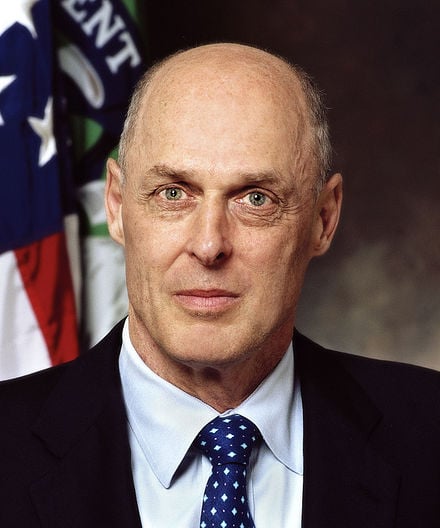
It works both ways: government officials are appointed to Goldman; in turn Goldman Sachs officials are appointed to key positions in government.  George W. Bush’s Secretary of the Treasury Henry Paulson (2006-2009) (image left) was a former Goldman Sachs chairman and CEO. He was appointed to the Treasury two years before the 2008 financial crash.

These appointments enable Goldman Sachs among other Wall Street mega banks to manipulate government policy.

It also provides them with an inroad into the corridors of the Treasury, not to mention the central banks: e.g, the notorious appointment of  a former Goldman Sachs official (and Canadian citizen) Mark Carney to the position of governor of the Bank of England. Carney previously held  the position of Governor of the Bank of Canada. He also heads the G20′s Financial Stability Board.

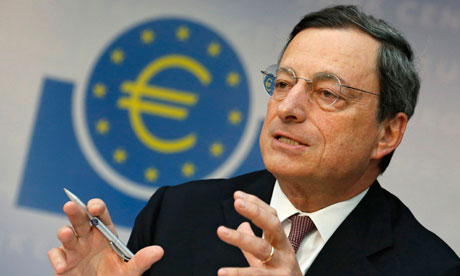
Mario Draghi, was vice chairman and managing director of Goldman Sachs International (2002–2005), before his appointment as Governor of the Bank of Italy (2005-2009). In 2011, he was appointed Governor of the European Central Bank (ECB).


Goldman Sachs is a Trojan Horse with its former banking officials deployed in key governmental positions.  These appointments provide Goldman Sachs with the ability to influence and oversee the conduct of macro-economic policy.
Moreover, their former officials will provide them with inside information emanating from within the governmental structure. –i.e market rigging by major financial institutions will invariably require advanced knowledge regarding actions or decisions taken  within the government and military-intelligence apparatus.

Regulating The Next Wall Street Financial Crash 


Barely acknowledged by the financial media, another notorious appointment of a Goldman official pertains to the Security and Exchanges Commission (SEC)  In May 2015, Goldman official Andrew J. “Buddy” Donohue  was appointed SEC chief of staff for Mary Jo White which enables him to “regulate Wall Street” so to speak on behalf of Wall Street.
This is a timely appointment. Financial markets including the multi-trillion trade in derivatives are in a state of disarray. They are exceedingly unstable, largely as a result of market rigging and speculative activity by powerful actors, not to mention the lack of regulatory procedures.

Goldman Sachs Inc. played a central role in the 2008 financial meltdown, with their former chairman and CEO Henry Paulson in charge of the US Treasury.

In a bitter irony, Institutional speculators  are in charge of regulating financial markets. The next financial crash, were it to occur, will be be “regulated” by the SEC with former Goldman Sachs official Andrew J. “Buddy” Donohue in the driver’s seat, acting on behalf of a handful of “too big to fail, too big to jail” financial institutions.

Let us not despair: Goldman Sachs does not control the US Treasury.  It’s in the hands of a former Citigroup official Jacob Lew -who according to expert opinion is slated to act “responsibly” in the case of a stock market crisis.


During his stint at Citigroup which preceded the 2008 financial crisis, Lew was in charge of a speculative hedge fund investment unit which consisted according to a 2010 Huffington Post Report in shorting or betting “on the housing market to collapse.”:
[Concern was expressed when he was appointed Budget Director regarding] his unit’s investments in a hedge fund that bet on the housing market to collapse — a reality suffered by millions of American homeowners.  … But in an age in which the housing collapse led to a financial upheaval that cost 8 million American jobs and plunged the nation into its deepest recession since the Great Depression, bets [coordinated by Jack Lew] that profited off the collapse may not be perceived in the best light.
It is worth noting that Treasury Secretary Jack Lew was also involved in what is best described as “legal tax evasion” through the transfer of Citigroup funds to the Cayman islands. According to the Weekly Standard (February 2013), Jack Lew:
oversaw as many as a hundred Cayman Island investments when he worked at Citi Bank as chief operating officer of the alternative investment services unit, SEC disclosures reveal. It has previously been reported that Lew himself had been invested in a fund that was based in the Cayman Islands.  …
SEC documents ending in the year 2007 reveal that at least 90 subsidiaries of Citi were based in the Cayman Islands. A couple weeks later, in January 2008, Jack Lew took the high-ranking executive job at Citi.
Names of the Citi subsidiaries include: Asia Mortgage Finance, Azabu Credit Management Company Ltd., Alternative Investments MGR, Ltd., Asia Enterprise III Offshore L.P., Baltic Pharma Limited, BISYS Hedge Fund Director Services Limited, Brennan Limited, and many, many more.
By the end of 2008 that number of Citi subsidiaries in the Cayman Islands, which fell under the jurisdiction Lew was in charge of, jumped to 113.
In the 2012 presidential campaign, the Obama campaign called Mitt Romney’s own Cayman Island investments “bets against America.”
But only months after the election ended, Obama nominated his former chief of staff Jack Lew, who himself had similar investments and even oversaw investment funds there, to be the next treasury secretary.
When asked this morning [February 13, 2013]  at a Capitol Hill hearing about his investment in the Cayman Islands-based fund, Lew plead ignorance. He claimed today that he “actually didn’t know” the fund he invested in was housed in the Cayman Islands. Besides, he said, my “benefit was really very small.”
Financial Meltdown. Could it happen Again?

Who are the main actors?

We are dealing with a complex process of rigging and manipulation. This article has skimmed the surface focussing on selected key appointments on behalf of Wall Street’s mega banks.

Let us address the issue of so-called “fiscal responsibility”:

A speculator and tax evader (Jack Lew) is in charge of fiscal and monetary policy at the US Treasury and the regulation of major US stock markets at the Security and Exchange Commission (SEC) is in the hands of Goldman Sachs, which also means that the SEC cannot be used to indict Goldman Sachs, CitiGroup et al. on charges of inside trading and financial fraud.

Saturday, 15 August 2015

Death squads, pedophiles and psychopaths: Inside the British establishment

Joe Quinn
Sott.net
 

On August 2nd, the UK's Express reported that British special forces were dressing up as ISIS jihadis and conducting operations in Iraq and Syria. Idiotically describing the tactic as "unorthodox", the Express journalists said that "more than 120 members of the elite regiment are currently in the war-torn country". Such a strategy can seem justified to those with only an official understanding of the Middle East conflict - where ISIS are the 'baddies' and Western operatives are the 'goodies' - and a hopelessly naive belief in the benevolence of the British military. But when viewed in the context of actual British military history in 'conflict zones' over the course of the 20th century, this story takes on a much more sinister form.

Staying with the present for a moment, the claim that British special forces are in Iraq and Syria to "fight ISIS" is not credible. More than four years ago the anglo-American warmongers made it abundantly clear that they, in league with their head-chopping royal friends in Saudi Arabia, were determined to unseat Assad, even going as far as to fabricate WMD evidence (a la Saddam Hussein) to justify a NATO attack. When Russian diplomacy thwarted that effort, the US and British 'elite' fell back on the tried and tested 'civil war' of attrition by proxy forces, in an effort to oust Assad.

But Assad, democratically elected by the Syrian people, is reluctant to leave just because Washington, Riyadh, Whitehall and Tel Aviv want him too. And while Russian, Iranian and Lebanese help is still available, it seems that the West's proxy army, aka the 'Syria rebels', are doomed to fight and die forever, or until the West's supply of hired guns (or money) runs out.

Genetically averse to accepting the hard facts of any situation, the US and British 'elites' have recently declared their right to "attack ISIS positions" directly through manned US airstrikes from Turkish bases. The real point of these airstrikes however is revealed in the fact that the US claims the right to attack anyone who threatens the Pentagon-trained 'Syrian rebels', who are primarily fighting against Assad on behalf of the US, British and Saudi regimes. That, of course, is the main point of these airstrikes; a back-door attempt to justify US military attacks on the Syrian government and its military rather than "fighting ISIS". It's reasonable to conclude, therefore, that those British special forces dressed up as ISIS form part of the same strategy and are providing "boots on the ground" to support US airstrikes on Syria positions.

But a gang of UK special forces dressed up as jihadis presents other opportunities too. They could, for example, carry out attacks against anyone, including civilians if it was considered expedient, and blame it on ISIS.

Just yesterday, a truck bomb exploded in the Shiite Sadr city area of Baghdad, killing 54 people. "ISIS" claimed responsibility by way of an unverifiable online message, but the attack bolstered Western governments' long-term plans to divide Iraq up into three separate states. The Pentagon recently 'resigned' itself to this policy it has been pushing for years, and former chief of US armed forces in Iraq, Gen. Raymond Odierno, also said as much in recent comments that were denounced by the Iraqi government.

But whatever these real-life 'jihadi johns' get up to, the British military's extensive experience in dressing up its recruits as the enemy and sending them into a conflict to 'stir things up', will ensure they perform admirably, no doubt. 


Read more

Jeb Bush Linked to Cartel Money Laundering While Serving CIA

Wayne Madsen
Black Listed News

While Jeb’s brother, George W. Bush, glossed over his AWOL status with the Texas Air National Guard, Jeb does not have a military record to defend but he does have a CIA employment record to fess up to.

Jeb’s early work in Venezuela and south Florida is much more troubling than Dubya pretending to be on active duty in Texas while he was actually off in Alabama helping a GOP U.S. Senate campaign and getting sloppy drunk in redneck bars. Jeb should fully explain his relationship with Alberto Duque, a Colombian national who laundered drug money for the Medellin and Cali narco-cartels and Nicaraguan contras while serving as owner of City National Bank of Miami and president of the General Coffee Company of Colombia.

Apparently, there was more than coffee arriving in sacks of coffee coming into Miami from Colombia. Duque financed a $30 million real estate development project run by Jeb Bush.
In 1983, Duque was convicted for fraud and sent to federal prison. Duque hired a Bush family CIA crony to serve as City National Bank’s president.

He was Don Beazley, who previously worked for the CIA’s Nugan Hand Bank in Australia. Before it collapsed, Nugan Hand was responsible for laundering money from the CIA’s Golden Triangle opium and heroin smuggling operations from Southeast Asia’s Golden Triangle and paying off U.S. surrogates in Asia, including Ferdinand Marcos in the Philippines, Suharto in Indonesia, Park Chung Hee in South Korea, and various Thai generals.

In return for CIA money gifts, Marcos ordered his Energy Minister, Geronimo Velasco, to have the Philippines National Oil Corporation enter into business relationships with three Bush family-owned businesses: Zapata Petroleum Corporation, Zapata Offshore Company, and Overbey Oil Development Corporation. The three Bush firms were also linked to various CIA activities, including the abortive 1961 Bay of Pigs invasion of Cuba.

Jeb Bush’s Texas Commerce Bank was also the bank used by the Zapata companies. Velasco died of a sudden heart attack in San Francisco in 2007. Velasco’s Republic Glass Corporation became a holding company that owned a number of British Virgin Islands-based subsidiaries.

Beazley had also been president of Great American Bank of Miami. The bank was indicted for drug money laundering in 1982. Beazley also negotiated the sale of Second National Bank of Homestead, a subsidiary of Great American, to Nugan Hand. It was in this environment of interconnected CIA money laundering banks that Jeb Bush found himself and his real estate business immersed in the 1980s.

Read more

Friday, 14 August 2015

Freedom And Central Planning Can Never Coexist

Alt-Market.com
Brandon Smith 

The average person is a statist, whether he realizes it or not. It is important that liberty activists recognize and accept this fact because the truth of our limitations as a movement determines the kinds of solutions into which we should ultimately put our time and energy. The fantasy of a final grand march of an awake and aware majority on the doorsteps of power is just that: a fantasy. Some people might argue that given more time, such an event could be organized or could happen spontaneously. But these people seem to forget that the immediacy of any crisis inspires awareness and cuts the bindings of complacency for only a certain percentage of any given population. With “more time” often comes more complacency, not less.

So, history becomes a kind of balancing act, with crisis generating the necessity of intelligent and moral action in some people but rarely, if ever, in most people (even during the American Revolution, in which patriots represented a stark minority). The reason that the culture of freedom consistently plateaus and remains stuck at underdog status is because human beings are, first, often acclimated to the idea that crises are things that only happen to other people, and, second, they are obsessed with the idea that governments should retain prohibitory and administrative power over the public as a means to "prevent" crisis from occurring (the sheepdog and sheep mentality).

Not all people necessarily “love” their current government, but many citizens tend to see the idea of government as an inevitability of a stable society. They assume pre-eminence of the state because they have never known anything else. Not only that, but as people separate into political and ideological factions, often based on false paradigms (such as the false left/right paradigm), they covet government as a kind of tool or weapon that can be used for “the greater good” if only their side had total control of it. Very few people in this world want to shrink government down to a manageable size comparable to that which existed just after the American Revolution, and even fewer would entertain the idea of erasing central governments entirely. The allure of the federalized state as a means to impose ideological control over others is intoxicating.

Read more
 

Thursday, 13 August 2015

What crisis? Germany made 100 BILLION euros from Greek suffering


© Associated Press
Sputnik
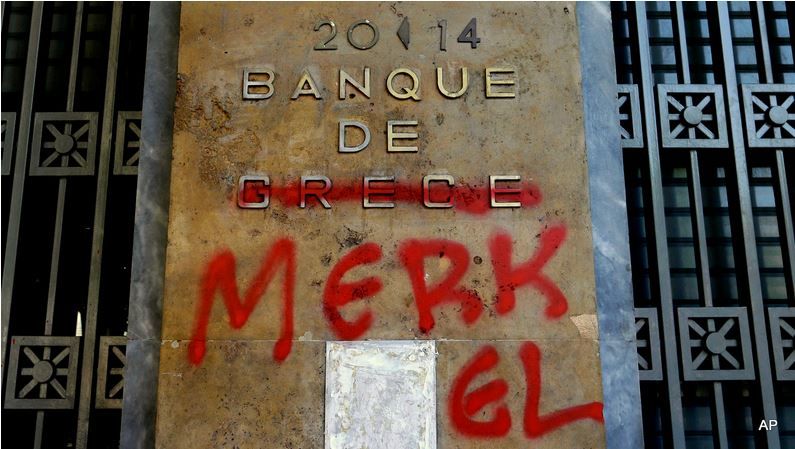
Red spray paint covers a French-language Bank of Greece sign to read ‘Bank of Merkel’ in reference to German Chancellor Angela Merkel in Athens, Monday, July 6, 2015.
The German government, which has taken a hard line on Greece, has saved some 100 billion euros ($109 billion) in the country's financial crisis thanks to lower borrowing costs, a study has found.

Germany saved through lower interest payments on funds the government borrowed amid investor "flights to safety," the German-based non-profit Halle Institute for Economic Research (IWH) said in its paper published Monday. 


"These savings exceed the costs of the crisis - even if Greece were to default on its entire debt," the study said. "Germany has clearly benefited from the Greek crisis."

In the face of turmoil, investors seeking a safe haven for their money within the euro zone turned to export champion Germany, which "disproportionately benefited" from that during the debt crisis, the IWH said.

"Every time financial markets faced negative news on Greece in recent years, interest rates on German government bonds fell, and every time there was good news, they rose."

Germany, the euro zone's effective paymaster, has demanded fiscal discipline and tough economic reforms in Greece in return for consenting to new aid from international creditors, Agence France-Presse reported.

Finance Minister Wolfgang Schaeuble has opposed a Greek debt write-down while pointing to his own government's balanced budget.

The balanced budget, however, was facilitated largely by Germany's interest savings amid the Greek debt crisis, according to the study. The estimated 100 billion euros Germany saved since 2010 accounted for more than 3% of GDP, according to the IHW.

"Even if Greece doesn't pay back a single cent, the German public purse has benefited financially from the crisis," said the paper.

At the same time, the bonds of other countries - including the United States, France and the Netherlands - also benefited, but "to a much smaller extent."

Greece and its creditors are working on the draft of a new bailout of up to 86 billion euros ($94 billion) in exchange for further reforms, AFP reported. They are aiming for a deal before Greece must repay 3.4 billion euros to the European Central Bank on August 20. 

New system of lymphatic vessels discovered in the brain


Jeremy Dean, PhD
Psy Blog

Vessels discovered in the brain that were thought not to exist — could revolutionise study of neurological diseases like Alzheimer's.

The brain is directly connected to the immune system by vessels previously thought not to exist, new research reports.The finding means the textbooks will have to be rewritten.Discovery of the vessels may also revolutionise the study of neurological diseases like Alzheimer's and autism.

Professor Jonathan Kipnis, who led the research, was initially sceptical about the results:

"I really did not believe there are structures in the body that we are not aware of.I thought the body was mapped.I thought that these discoveries ended somewhere around the middle of the last century.But apparently they have not."
The vessels are located in the meninges — the membrane that surrounds the brain and spinal cord. The vessels run near major blood vessels, which partly explains why they have been so difficult to find.

The left-hand image below shows the old map of the lymphatic system and the updated version is on the right. 

Image
© University of Virginia Health System

The discovery will likely have profound implications for how scientists study the neuro-immune system, Professor Kipnis said:
"Instead of asking, 'How do we study the immune response of the brain?' 'Why do multiple sclerosis patients have the immune attacks?' now we can approach this mechanistically.
Because the brain is like every other tissue connected to the peripheral immune system through meningeal lymphatic vessels.
It changes entirely the way we perceive the neuro-immune interaction.We always perceived it before as something esoteric that can't be studied. But now we can ask mechanistic questions.

We believe that for every neurological disease that has an immune component to it, these vessels may play a major role. Hard to imagine that these vessels would not be involved in a [neurological] disease with an immune component. In Alzheimer's, there are accumulations of big protein chunks in the brain.We think they may be accumulating in the brain because they're not being efficiently removed by these vessels."
The study was published in the journal Nature (Louveau et al., 2015). 


Easy steps and resources to help you prepare for a different kind of future

Daisy Luther
Natural Blaze


One day, you're just moving through life with everyone else in your office or at your church, and then, for whatever reason, the reality of how tenuous our current lifestyle is, hits you squarely between the eyes. You realize that electricity and grocery stores and transportation are all things that you've been taking for granted and that these things could actually disappear. Maybe you're concerned about a natural disaster. Perhaps you saw something on the evening news. It could even be a job loss that puts these things out of reach.

But whatever the reason, suddenly, you know in your heart that you need to prepare for a different type of future, just in case.

Where on earth do you even start with something like that? 


Start with information

Before you start making enormous purchases or moving your family to a bunker, take some time to learn.

Information.

That is the key that unlocks the door to preparedness.

When you begin reading websites about prepping, sometimes it can be overwhelming. You see people talking about their one-year food supplies, their bug-out lodges, their ammo collection, and their homestead that is so far out in the wilderness that they have to climb a big pine tree on top of the mountain to get an internet connection (where they then boast online about their seclusion on a prepper forum).

Most preppers are just regular folks with a self-reliant mindset.

Getting started does not require a $20,000 investment or your children feverishly packing beans and rice into Ziplock bags late into the night. It requires enough information to properly assess your situation. It requires some guidance to help you develop a plan to keep your family safe, housed, and fed, regardless of what comes in the future.

So I want you to do three things. First, bookmark some websites. Second, begin building your preparedness library with books. Finally, create your own reference book from the information you're collecting. 


Read more

'The world is failing Yemen': Saudi Arabia desperate to escalate war as Yemeni rebels refuse to buckle

Bruce Riedel
Al-Monitor


Saudi Arabia and its Gulf allies are escalating the war in Yemen. The Houthi rebels and their allies show no sign of bending to the will of Saudi Arabia's King Salman bin Abdul-Aziz Al Saud after more than four months of war. The grim struggle in Yemen goes on with a frightful toll for the Yemeni people. The Saudis and the United Arab Emirates (UAE) are pouring arms into Aden, Yemen's second-largest city, and expanding their foothold there to the north. They seized a large Soviet-built air base north of Aden at Al-Anad. The air base is on the main road to Taiz, the next Saudi military objective. In Taiz, forces loyal to President Abed Rabbo Mansour Hadi claim to control much of the city, Yemen's third-largest and the historic second capital of North Yemen. The UAE has deployed over 1,500 of its own troops to the Aden front, the first time the coalition has placed its own ground forces into the battle. 

The Saudis have trained Hadi loyalists and equipped them with tanks and other armored vehicles to open another front in Marib governorate in the northwest of the country.

The Saudi gains so far have been outside the Zaydi Shiite heartland of the Houthi rebels.


Sanaa remains firmly in the rebels' control. The leader of the Zaydi Houthi rebels, Abdul-Malik al-Houthi, gave a speech this week to his followers, promising, "We are in a great battle in which we must use all our efforts." He acknowledged the Saudis and their allies had retaken the southern port of Aden but said, "The enemy threw all their weight to gain a limited achievement." Houthi accused the Saudis and their ally, Hadi, of working with both Israel and the Islamic State (IS) to take Aden. He called for an internal Yemeni political solution to the war.


Saturated fats in meat and dairy not as bad for health as previously thought, study finds

The saturated fats found in meat and dairy produce are not as bad for health as previously believed, a study has found. However, the scientists who conducted the research have warned against reaching for the butter dish.

A major study into the health implications of dietary fats has failed to find a link between food containing saturated fats, such as eggs, chocolate and cream, and an increased risk of dying from heart disease, stroke or type-2 diabetes.

The study nevertheless did find that industrially-produced “trans-fats” made from hydrogenated oils, and once used in margarine, snack foods and packaged baked foods such as some cakes and crisps, are linked with a greater risk of death from coronary heart disease.

The latest findings, published in the British Medical Journal, appear to confirm the growing realisation that the prevailing health advice for the past half century to cut down on foods that are rich in saturated fats such as butter and cheese may have been misguided.

The study, carried out in Canada by Russell de Souza of McMaster University in Hamilton, Ontario, and colleagues found no association between saturated fats and ill health, but did find a link with the consumption of foods containing trans-fats, such as margarine.

The scientists found that the consumption of industrial trans-fats was associated with a 34 per cent increase in all causes of mortality, a 28 per cent increase in death from coronary heart disease and a 21 per cent increase in the risk of being diagnosed with heart disease.

Read more

Wednesday, 12 August 2015

The Worth of Gold Growing by the Day

F.William Engdahl
Land Destroyer 


NEOThe worth of gold in the world is growing by the day. That might seem like a paradox but it isn’t. The worth of gold is not fixed on the Comex futures exchange, or the trade in London or Zurich. True, most of the gold-trading public takes its cue today from the CME’s COMEX gold futures price where it does not at all look like the worth of a bar of gold is growing. Why can we then speak of gold’s worth rising?

On Comex the price of gold futures has gone from a high of $1896 in August 2011 to current lows of $1099, lows last seen six years ago, tendency downward. Here we come to the fallacy of composition where we extrapolate from one particular to the universal, when we assume that something is true of the whole just because it is true of some part of the whole.

The COMEX gold futures market in New York and the Over-the-Counter (OTC) trades cleared through the London Bullion Market Association do set prices which are followed most widely in the world. They are also markets dominated by a handful of huge players, the six London Bullion Market Association gold clearing banks–the corrupt JP MorganChase bank; the scandal-ridden UBS bank of Zurich; The Bank of Nova Scotia – ScotiaMocatta, the world’s oldest bullion bank which began as banker to the British East India Company, the group that ran the China Opium Wars; the scandal-ridden Deutsche Bank; the scandal-ridden Barclays Bank of London; HSBC of London, the house bank of the Mexican drug cartels; and the scandal and fraud-ridden Societe Generale of Paris.


Key central banks, notably the Federal Reserve and Bank of England, have been accused of colluding with the major clearing banks to artifically smash gold prices when, as they did in August 2011, gold threatened to get out of control and endanger the dollar’s role as world reserve currency primus. Organizations representing gold investors such as GATA have documented in detail for years how the manipulations of the gold price was carried out.


All Heck Breaks Loose After Freaked-Out People’s Bank of China Devalues Yuan Again

Wolf Street

ow freaked out can the People’s Bank of China be about the Chinese economy that has been growing admirably at 7% this year, according to the government?

OK, there are some quibblers who might point out that car sales in July have plunged 6.6% to a 17-month low, after having already shrunk in June, and after having trended down all year, in the largest auto market in the world with the largest auto manufacturing capacity in the world that had been growing in leaps and bounds and had pushed job creation, investment, and GDP to new heights.

US automakers have bet the farm on China. This is where growth would come from. But in July, Ford sales through its joint ventures dropped 6% year-over-year, the third monthly decline in a row, and GM’s sales through its joint ventures dropped 4%. A vicious price war has broken out. In a market that has gotten used to seeing double-digit growth!

And granted, exports and imports plunged too, and producer prices plunged, and the totally crucial property sector is wobbly, and manufacturing plants get shut down as overcapacity is running rampant, and all kinds of other things plunged or stagnated or wobbled, and now the PBOC is truly freaking out.

Tuesday morning it had devalued the yuan by lowering the daily reference rate by a record 1.9% against the dollar. The spokesman called it a “one-time correction.”

The yuan – after moving no more than 0.01% against the dollar in the prior weeks and trading in Shanghai between 6.2096 and 6.2097 against the dollar for days – instantly plunged, and ended the day at 6.3248.

It shook up the markets, pushed down metals, oil, other commodities, and emerging market currencies. The Nikkei plunged until the Bank of Japan’s muscled intervention put a floor under it. As part of its well-communicated QQE policies, the BOJ buys equity ETFs when stocks start dropping. Hedge funds expect it and start buying with the BOJ. It works like a charm. And then in the US, stocks swooned too.

Read more
 

Tuesday, 11 August 2015

Clinton, Juppé, Erdoğan, Daesh and the PKK

Thierry Messyan
VoltaireNet.org

When they took power in Ankara in 2003, the Islamist party AKP modified Turkey’s strategic priorities. Rather than using reports on the post-« Desert Storm » balance of power, Recep Tayyip ErdoÄŸan harboured the ambition of freeing his country from the isolation it has known since the end of the Ottoman Empire. Based on analyses provided by his advisor, Professor Ahmet DavutoÄŸlu, he advocated solving century-old problems with Turkey’s neighbours, and becoming progressively the inevitable regional mediator. In order to do so, Turkey had to become a political model and build relations with his Arab partners, without losing its alliance with Israël.

This policy, known as « zero problem », began sucessfully at first.Ankara no longer feared Damascus and its support for the PKK, and also asked Syria for help in negotiating an exit. In October 2006, the Kurdish party declared a unilateral truce and began negotiations with the ErdoÄŸan government. In May 2008, Ankara organised indirect negotiations between Damascus and Tel-Aviv, the first talks since Ehud Barack’s rejection of the Bill Clinton / Hafez el-Assad plan. But President Bachar el-Assad withdrew from the discussions after Israël attacked Gaza in December 2009.

Realising that because of the Palestinian conflict, it was impossible to maintain good relations with all the states in the region, Ankara chose to support the Palestinians against Israël. This was the period of the Davos and Freedom Flotilla episodes. Backed by vast popular support in the Muslim world, Ankara approached Teheran and accepted, in November 2010, to participate in a Turkey-Iran-Iraq-Syria common market. Visas were repealed ; the rights of the Customs were considerably reduced ; a consortium was created to manage the oil and gas pipe-lines ; an authority was created to enable the management of water ressources. The overall structure looked so inviting that Lebanon and Jordan presented their candidacy. Sustainable peace seemed possible for the Levant.

When, in 2011, the United Kingdom and France launched a double war against Libya and Syria, at the request and under the control of the United States, Turkey quite logically opposed it. These wars, launched on the pretext of protecting the populations, were far too evidently neo-colonial strategies. Besides, they damaged Turkish interests, since Libya was one of its main economic partners and Syria had become one by way of the new regional common market.

That’s when everything collapsed…

Read more


Monday, 10 August 2015

Training Officers to Shoot First, and He Will Answer Questions Later

New York Times

When police officers shoot people under questionable circumstances, Dr. Lewinski is often there to defend their actions. He has testified in or consulted in nearly 200 cases over the last decade. 

His conclusions are consistent: The officer acted appropriately, even when shooting an unarmed person. Even when shooting someone in the back. Even when witness testimony, forensic evidence or video footage contradicts the officer’s story. He has appeared as an expert witness in criminal trials, civil cases and disciplinary hearings, and before grand juries. In addition, his company, the Force Science Institute, has trained tens of thousands of police officers. His research has been roundly criticized by experts

An editor for The American Journal of Psychology called his work “pseudoscience.” The Justice Department denounced his findings as “lacking in both foundation and reliability.” Civil rights lawyers say he is selling dangerous ideas. In the protests that have followed police shootings, demonstrators have often asked why officers are so rarely punished for shootings that seem unwarranted. Dr. Lewinski is part of the answer. In testimony on the stand, for which he charges nearly $1,000 an hour, he ... sprinkles scientific explanations with sports analogies.

Dr. Lewinski and his company have provided training for dozens of departments. His messages often conflict, in both substance and tone, with the training now recommended by the Justice Department and police organizations. 

Read more 
 

Social media use linked to depression

The New Daily


Heavy cyber networking might be an alarm bell for parents.

Children who often spend time browsing social media could be in need of extra emotional support from their guardians, new research has warned.

Teenagers who use social media for more than two hours each day were found to be more likely to have symptoms of depression.

The study published in the journal Cyberpsychology, Behaviour, and Social Networking discovered the link between heavy social media use and increased probability of mental health problems, including psychological distress and suicidal thoughts.

“Youth with mental health problems may be frequently using [social networking sites] to seek interaction or support,” the study found.

“The present results showed that more than a quarter of students reported an unmet need for mental health support. Of these, the majority reported frequent use of [social networking sites].”


Expanding your friendship group online might not be the best idea for the young. Photo: Getty
The researchers examined data taken from 750 students in the 2013 Ontario (Canada) Drug use and Health Survey.

Health professionals should factor in social media usage when treating youth with potential mental health complications, the authors recommended.

“Youth with poor mental health are spending significant time on social networking sites.

Read More

Sunday, 9 August 2015

The 70th Anniversary of the Bombing of Nagasaki

Gary G. Kohls, MD
lewrockwell.com

Unwelcome Truths for Church and State


 “An irradiated crucifix lies in the ruins of the Urakami Cathedral Following the Atomic Bombing of Nagasaki”

70 years ago (August 9, 1945) an all-Christian bomber crew dropped a plutonium bomb over Nagasaki City, Japan, instantly vaporizing, incinerating or otherwise annihilating tens of thousands of innocent civilians, a disproportionately large number of them Japanese Christians. The explosion mortally wounded uncountable thousands of other victims who succumbed to the blast, the intense heat and/or the radiation.

In 1945, the US was regarded as the most Christian nation in the world (that is, if you can label as truly Christian a nation whose churches are proponents of eye-for-an-eye retaliation, are supportive of America’s military and economic exploitation of other nations or otherwise fail to sincerely teach or adhere to the ethics of Jesus as taught in the Sermon on the Mount).

Ironically, prior to the bomb exploding nearly directly over the Urakami Cathedral at 11:02 AM, Nagasaki was the most Christian city in Japan, and the massive cathedral was the largest Christian church in the Orient.

Those baptized and confirmed Christian airmen, following their wartime orders to the letter, did their job efficiently, and they accomplished the mission with military pride, albeit with an astonishing number of near-fatal glitches in the mission. Most of us Americans would have done what the crew did if we had been in the shoes of the Bock’s Car crew. And, if we had never seen, heard or smelled the suffering humanity that the bomb caused on the ground, and if we had been treated as heroes in the aftermath, most of us would have experienced no remorse for our participation in what was retrospectively universally regarded as a war crime.

Indeed, the use of the most monstrous weapons of mass destruction in the history of warfare, was later defined by the Nuremberg Tribunal as an international war crime and a crime against humanity.

Of course, there was no way that the crew members knew that at the time of the mission. Some of the crew did admit that they had had some doubts about what they had participated in after the bomb actually detonated. But none of them actually witnessed the horrific suffering of the victims up close and personal. “Orders are orders” and disobedience in wartime is severely punishable, even by summary execution, so the crew obeyed the orders.


Read more

Related Posts Plugin for WordPress, Blogger...